
First published in 2005
Most people who say they want to change the world mean it in the broadest possible sense. Stuart Beattie’s work at Rosslyn Chapel has been more precise. His task has been to keep one of Scotland’s most scrutinised historic buildings from changing too much, too quickly, or in the wrong way.
Born and raised on a farm in Norfolk and educated at Cambridge, Beattie became the project manager entrusted with one of Scotland’s most delicate conservation challenges: the preservation of Rosslyn Chapel, the 15th century building in Midlothian that became internationally famous after The Da Vinci Code placed it at the centre of a modern literary storm.
The chapel was founded in 1446 by Sir William St Clair, later generations spelling the family name as Sinclair. Set above Roslin Glen, south of Edinburgh, it stands on a plateau above the North Esk, surrounded by woodland and layers of history. Its carved stone has earned it many descriptions, among them the Bible in Stone and the Chapel of the Grail. Those names suggest mystery, but they can also distract from the more demanding truth. Rosslyn is not only a legend. It is a building, made of sandstone, exposed to weather, damaged by time, and dependent on human judgement for its survival.
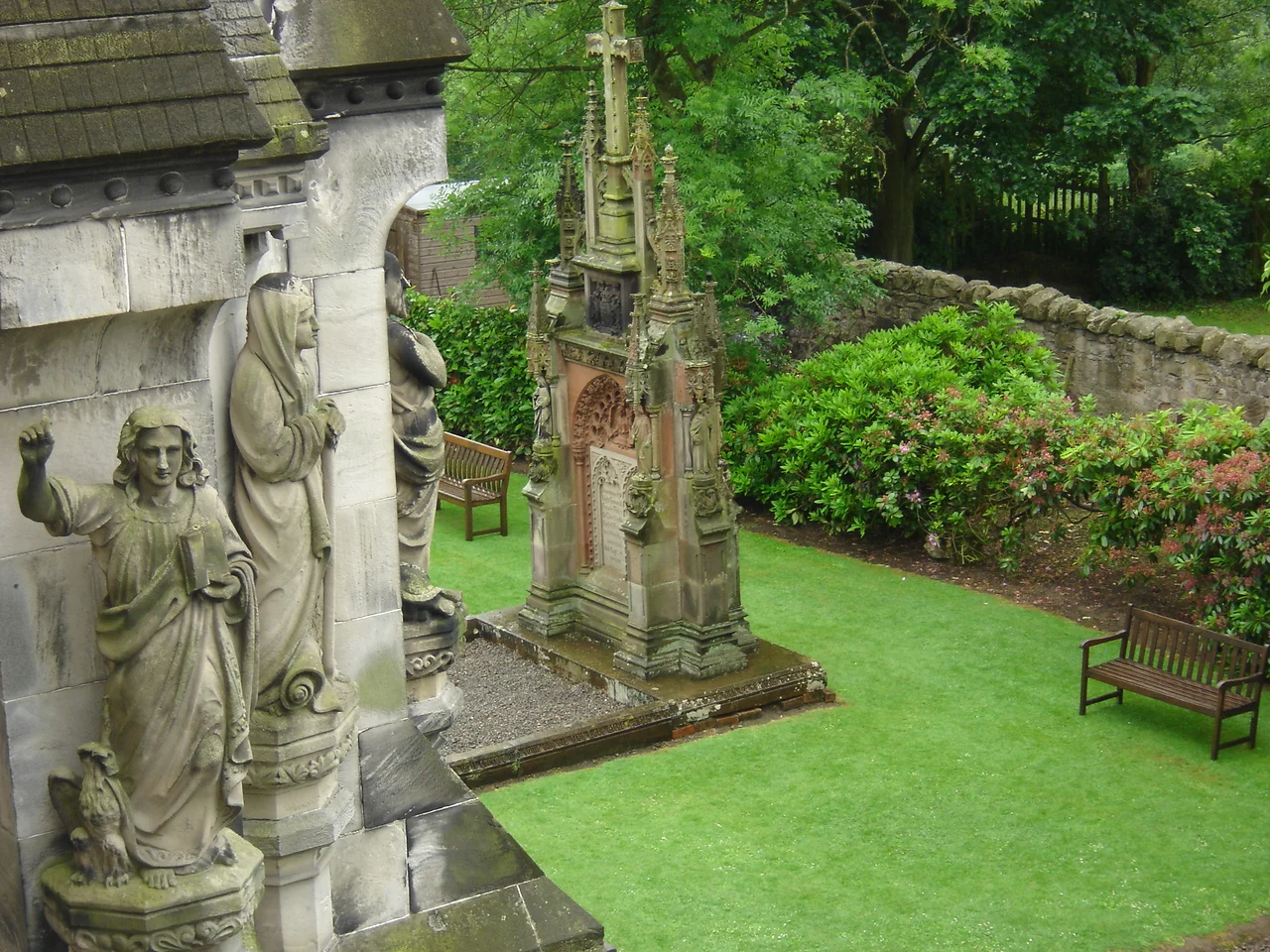
On a warm day in Roslin, Beattie and I sit on a bench in the chapel garden. Above us, scaffolding wraps the structure, making visible the scale of the work. The setting is calm, but Rosslyn’s history has rarely been so.
The chapel survived the religious upheavals of the Reformation. In 1650, during Oliver Cromwell’s campaign in Scotland, it was used as a stable by troops while nearby Rosslyn Castle was under pressure. By the late 17th century, it had suffered neglect and damage. In 1689, a Protestant mob from Edinburgh attacked the chapel and castle. The building later stood abandoned, overgrown and half hidden, until restoration work began in the 18th century under the St Clair family.
Today Rosslyn Chapel remains privately owned by the Sinclair family and is used as a Scottish Episcopal place of worship. It is also a visitor destination of international reputation, a listed historic building, and a conservation problem of unusual complexity.
“Rosslyn is magical, mysterious and world renowned,” Beattie says. “It needs to be preserved for the future.”
The problem is that earlier attempts to preserve it created difficulties of their own. In the 1950s, parts of the stone were treated with a magnesium based coating intended to protect the fabric. Instead, the treatment trapped moisture, salts and pollutants within the stone. The building had been sealed when it needed to breathe.
“Soluble pollutants and condensation were locked inside the stone,” Beattie explains.
In 1997, a protective steel canopy was erected over the chapel to allow the stonework to dry. It was not a romantic intervention, but a practical one. Rosslyn’s survival depended not on theories about hidden relics, but on moisture, ventilation, masonry and patience.
Beattie did not grow up expecting to take on such work. His early life on a Norfolk farm gave him a taste for independence and practical labour.
“I enjoyed growing up on a farm with its freedom and independence,” he says. “I must have had an assumption I would go into farming. I couldn’t see myself working in an office environment.”
After Cambridge, he married in 1973 and moved to Aberdeen, where he worked in agricultural research. In 1985 he moved to the Roslin Institute, where he managed research funds at the Roslin BioCentre. The institute would later become famous across the world for Dolly the sheep, born in 1996 and publicly announced in 1997 as the first mammal cloned from an adult cell.
“Business skills translate all over,” Beattie says.
By then, Beattie and his family had become part of the village of Roslin and of the chapel community. When the Rosslyn Chapel Trust was created in 1995, he was asked to take on the role of project manager.
“I jumped at the idea,” he says.
It was not an abstract appointment. He already had a decade long relationship with the chapel as a place of worship. That matters, because Rosslyn is not merely a heritage attraction. It is a working church, a historic monument, a family legacy and a building under constant physical pressure.
Because of its architectural and historic importance, the chapel is protected through the listed building system. Any significant alteration has to be considered in relation to its character. Beattie’s work has required him to move between conservation specialists, trustees, architects, engineers, historians, visitors, staff and public expectations.
“For every problem, we’ll come up with ten solutions,” he says. “Of those, maybe four are viable. After that, it’s a matter of selecting the most appropriate solution.”
The glamour attached to Rosslyn does not remove the ordinary demands of the job.
“Without a doubt, the chapel is world renowned, but its problems are everyday problems,” he says. “One minute I’m buying teabags and toilet rolls for the staff and the next I’m scheduled to meet with a design team.”
That mixture of the practical and the historic is part of the discipline of conservation. Buildings do not survive because people admire them in theory. They survive because someone checks the roof, pays attention to damp, listens to specialists, and orders the supplies no visitor ever sees.
Beattie is careful to credit the staff around him.
“They don’t just work for the money we pay them,” he says. “They’re part of Rosslyn. From one end to the other, there is a sense of ownership. We all do our work with love and devotion, which ensures our decisions are correct. It’s an attitude. We want to ensure every visitor experience is complete.”
Rosslyn’s fame rests partly on its stonework and partly on what people have imagined into it. Its carvings have been interpreted in many ways. The Apprentice Pillar, the green men, the angels, the plants, the stars and the intricate vaulting have encouraged religious, architectural, esoteric and speculative readings. The chapel has been linked in popular imagination with the Knights Templar, the Holy Grail, lost manuscripts, the Ark of the Covenant and the bloodline theories made famous by Dan Brown’s novel.
There is a vault beneath the chapel, though it has not served the purposes that modern legend often assigns to it. The last known burial there took place in the 17th century. Some have speculated that the vault may contain old records or manuscripts. Others have imagined much more. In recent years, especially after the publication of The Da Vinci Code, there have been calls for excavation or non invasive exploration.
The question is not simply what lies below. It is who has the right to disturb it, and for what purpose.
Does the public have a right to know what is inside a privately owned vault? Does curiosity justify intervention? Should modern technology be used to examine what earlier generations left closed? At Rosslyn, the appetite for mystery is itself part of the modern history of the place.
“Most visitors are content to say, I believe there is something under the floor,” Beattie says.
The arrival of The Da Vinci Code changed the scale of attention. Dan Brown’s novel sold in vast numbers and brought Rosslyn Chapel to the notice of readers who might never otherwise have heard of it. When Ron Howard’s film adaptation arrived to use Rosslyn as a backdrop, the chapel found itself at the intersection of tourism, fiction, faith, conspiracy and conservation.
Brown’s novel suggested that the Catholic Church had concealed the truth about Jesus and Mary Magdalene, and that Rosslyn held part of that secret. Historians and theologians challenged the claims. Visitors arrived anyway. Fiction, once released into the world, does not always remain politely inside its covers.
Beattie’s response is neither defensive nor dismissive.
“Rosslyn is different things to different people and we are sensitive to that,” he says. “People come here for a whole raft of reasons. I wish I had the time to devote to research like some of our visitors.”
That generosity is important. Rosslyn’s custodians cannot control every interpretation placed on the building. They can, however, protect the building itself. Beattie’s work has therefore remained focused less on proving or disproving the legends than on preserving the stone, the space and the structure through which those legends continue to pass.
“Rosslyn hasn’t been sitting here all these years, waiting for us to come along to restore her,” he says. “Over the years, everyone has done their part to help. It’s just this time we are arrogant enough to believe we’re getting it right. After seeing what others have done and learning from it, after doing our research, we believe we’re getting it right.”
It is a striking admission. Conservation is always, in part, an act of humility. Each generation intervenes with the knowledge it has, and each risks being judged later by knowledge it did not possess. The best custodians understand that they are not owners of the past. They are temporary hands placed upon it.
As our conversation ends, we stand near the chapel entrance while visitors begin arriving at the gate. Beattie looks up at the building he has spent years helping to protect.
“Rosslyn is like a lovely old woman who can no longer get around so well,” he says. “She needs someone to wash her face, and so we do it gently and lovingly. In time, it will be others who will do the job.”
Asked how he would like to be remembered for his time at Rosslyn, he does not reach for grandeur.
“Having not got it wrong,” he says. “I’m paranoid of failure.”
Then he pauses, smiles, and adds the sort of modest line that says more than ceremony could.
“The nicest thing would be for someone to come back 15 years from now and ask what happened to that short, stubby man that used to work here?”
For all the fame that surrounds Rosslyn Chapel, that may be the right measure of the work. Not spectacle. Not ownership. Not discovery. Simply to pass the building on without having made the wrong mark upon it.