
The Architectural Heritage Society of Scotland’s Strathclyde Group will visit the House of the Binns and Hopetoun House on 6 June 2026. The study day offers a concentrated view of West Lothian’s architectural inheritance, from a seventeenth century family house to one of Scotland’s most important classical country seats.
Two of West Lothian’s most significant historic houses will be visited during a summer study day organised by the Architectural Heritage Society of Scotland’s Strathclyde Group.
The event, titled Great Houses of West Lothian, takes place on Saturday 6 June 2026 from 10am to 2.30pm. Participants will begin at the House of the Binns near Linlithgow before travelling by car to Hopetoun House near South Queensferry. Tickets are available through Eventbrite at £30 per person.
The day matters because it places two very different houses in conversation with one another. The House of the Binns tells a story of family continuity, political memory and domestic survival across four centuries. Hopetoun House speaks to ambition, architectural patronage and the formal grandeur of Scotland’s late seventeenth and eighteenth century country house tradition.
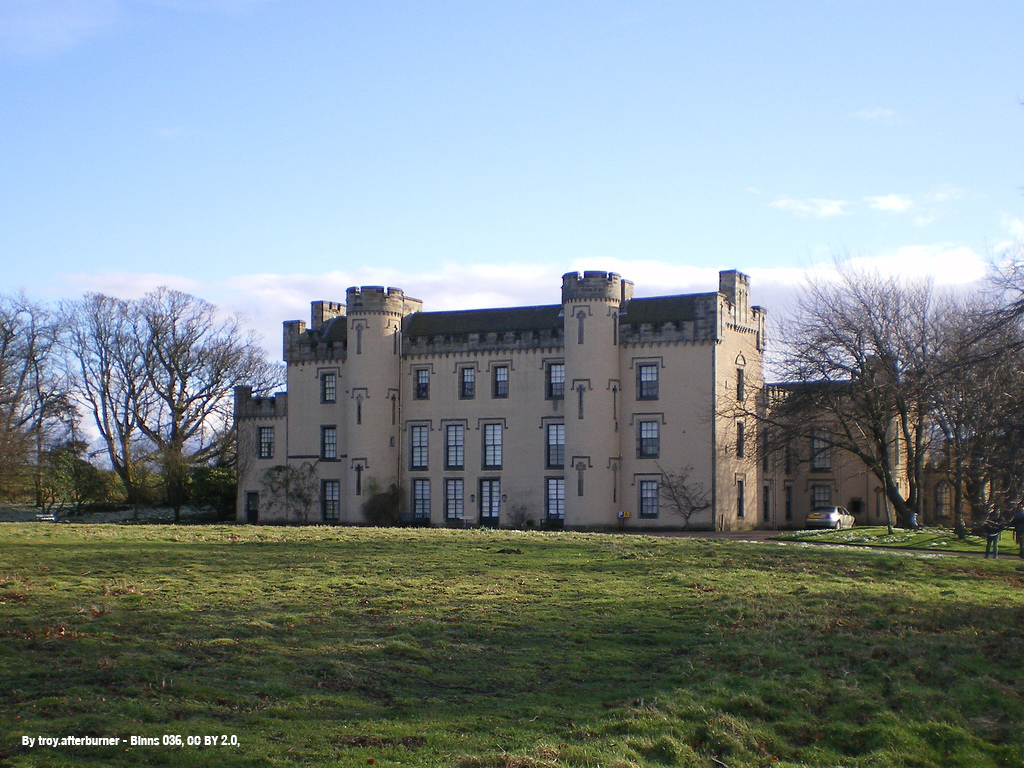
The House of the Binns has been home to the Dalyell family for more than 400 years. The National Trust for Scotland says the present house was built in 1612 by Thomas Dalyell, an Edinburgh merchant who made his fortune at the court of King James VI and I in London. Set in landscaped parkland overlooking the River Forth, it remains closely associated with the family that built it.
That continuity gives the Binns its particular character. It is not simply a preserved architectural object. It is a house shaped by occupation, inheritance, collecting and family memory. The National Trust for Scotland describes it as the only Trust property still home to the family who originally built it, noting that Thomas Dalyell bought the lands of the Binns in 1612 to create his family home.
The property also has a modern political resonance. The House of the Binns was the home of the late Tam Dalyell, the former Labour MP for West Lothian and Linlithgow, remembered for his independence of mind and for the constitutional question that came to bear his name. That later history sits within a much longer household story, carried through furniture, portraits, archives and the accumulated evidence of family life.
The morning visit will begin at 10am with tea, coffee and shortbread, followed by a guided tour lasting about an hour. After lunch, visitors will travel to Hopetoun House, where the afternoon tour is due to begin at 1pm.
Hopetoun House presents a very different architectural statement. It stands on the south shore of the Firth of Forth and is among Scotland’s grandest country houses. The building is closely associated with Sir William Bruce, William Adam and the Adam family, making it one of the important places through which Scotland’s classical and Georgian architectural development can be understood.
Architectural historian Alistair Rowan described Hopetoun as effectively two buildings: an elegant work by Sir William Bruce, built between 1699 and 1702, later transformed by the Baroque front created by William Adam and the first Earl of Hopetoun from about 1721. That layered history is what gives the house much of its importance. It is not a single design frozen at one moment, but a building altered by changing taste, wealth and architectural ambition.
The interiors are also central to Hopetoun’s reputation. The official history of the house notes that after William Adam’s death in 1748, the interior decoration was carried out by his sons John, James and Robert Adam, with the second Earl overseeing completion. The result is one of Scotland’s most complete surviving expressions of aristocratic Georgian interior culture.
Hopetoun is also formally protected. It is a Category A listed building, and its grounds are included in Scotland’s Inventory of Gardens and Designed Landscapes. Historic Environment Scotland records the designed landscape as part of the wider historic significance of the estate, including work associated with Bruce, William Adam and the Adam sons.
The study day is being organised by the Architectural Heritage Society of Scotland, a charity dedicated to the protection, preservation, study and appreciation of Scotland’s historic buildings. The society’s regional groups organise local activities and casework, with much of the work carried out by volunteers.
That voluntary structure is part of the importance of the event. Scotland’s built heritage is not protected only by legislation or ownership. It is also sustained by study, advocacy, public interest and the willingness of people to look carefully at buildings before they become invisible through familiarity.
In West Lothian, the two houses offer a particularly strong pairing. The Binns shows how a Scottish family house can retain the marks of long domestic occupation. Hopetoun shows how architecture could be used to project status, order and refinement on a national scale. One is intimate and cumulative; the other formal and commanding.
The study day will not exhaust either subject. It will, however, give visitors a direct encounter with two houses that help explain how land, family, architecture and memory shaped Scotland’s built environment.
For those interested in Scottish heritage, the value lies in seeing both properties in one day. Together, they show that West Lothian’s historic houses are not simply places to visit. They are records of how Scotland lived, built, inherited and chose to preserve.
(Note: Tickets can be booked via Eventbrite)