
Five collections held outside Scotland’s national museums and galleries have been awarded National Significance status. The decision recognises the national value of material held in Fife, St Andrews, Dundee, Loch Tay and Stirling, from linoleum and photography to art education, Iron Age archaeology and university collecting.
Five Scottish museum collections have been officially recognised as Nationally Significant through Scotland’s Recognition Scheme, bringing the total number of recognised collections to 56.
Museums Galleries Scotland announced the awards on International Museums Day, 18 May 2026. The newly recognised collections are the Linoleum Collection managed by OnFife, the Photographic Collection managed by the University of St Andrews, the Duncan of Jordanstone College of Art & Design Collection managed by University of Dundee Museums, the Oakbank Collection managed by the Scottish Crannog Centre, and the Art Collection managed by the University of Stirling.
The decision matters because it widens the map of Scotland’s national memory. It confirms that nationally important heritage is not held only by the country’s largest institutions, but also by local trusts, universities and specialist museums that preserve the evidence of Scotland’s industry, image-making, creative education, prehistoric life and public art.
Scotland’s Recognition Scheme exists to identify collections of national importance held outside the national museums and galleries. Museums Galleries Scotland says the scheme celebrates, promotes and supports collections whose significance extends beyond their immediate institution or area.
The five new awards show how varied that significance can be.
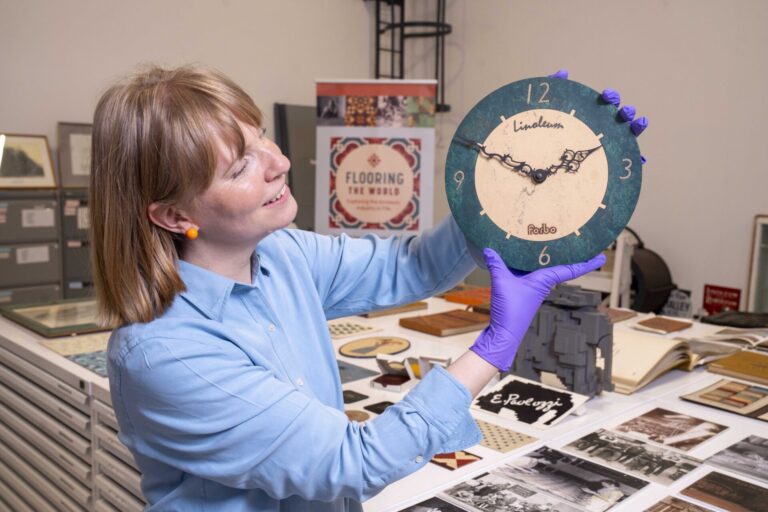
The Linoleum Collection managed by OnFife preserves the memory of an industry closely associated with Kirkcaldy. OnFife says the collection includes archives, photographs and material connected to the town’s linoleum factories and workers. The subject may seem ordinary because linoleum was made to be walked on, cleaned and used. Yet that is precisely why it matters. It records an industrial culture that shaped employment, design and civic identity in Fife.
Kirkcaldy’s connection with linoleum was not a marginal trade. The town became internationally associated with floorcovering manufacture, and local collections preserve pattern books, tools, photographs and other material that show how design, labour and manufacturing came together. Recognition gives that industrial inheritance a national status, placing factory work and commercial production within Scotland’s wider heritage.
The Photographic Collection at the University of St Andrews represents another kind of record. The university says the collection contains around 1.6 million photographs in formats including glass and film negatives, lantern slides, prints, postcards, transparencies and born digital images. It has also described St Andrews as thought to be the oldest photography collecting institution in the world.
That scale gives the collection obvious importance, but the value is not only numerical. Photography preserves evidence of streets, families, landscapes, buildings, scientific work, university life and social change. In Scotland, where place and memory are often tightly linked, such collections help show how the country has looked to itself and to others over time.
The Duncan of Jordanstone College of Art & Design Collection, managed by University of Dundee Museums, brings the recognition into the history of art education. University material describes the collection as including work by staff and students across drawing, painting, printmaking, sculpture, textiles, artists’ books, animation, video art, ceramics, graphic design, jewellery and metalwork. Recent reporting on the award notes that the collection contains more than 8,000 artworks and artefacts connected to Dundee’s creative history.
Dundee’s cultural position has increasingly been understood through design, art and creative production. A nationally recognised art school collection records not only finished objects, but the process by which artists and designers are trained. It shows the working life of a school as well as the wider influence of its graduates and teachers.
The Oakbank Collection, managed by the Scottish Crannog Centre, reaches much further back. The centre is concerned with crannogs, artificial or partly artificial loch dwellings associated with prehistoric and later Scottish life. Oakbank is especially important because waterlogged conditions preserved organic material that would normally decay.
Among the most important items is the Oakbank textile, found in 1979 and described by the Scottish Crannog Centre as a rare survival of Iron Age textile from Scotland. The Perth and Kinross Archaeological Research Framework notes that the textile has been radiocarbon dated to 480 to 390 cal BC.
That kind of survival changes how the Iron Age can be understood. It moves attention beyond defensive structures and metalwork into clothing, fibre, skill and domestic life. A fragment of textile can speak of daily practice as clearly as a monument, if it is preserved and interpreted with care.
The University of Stirling Art Collection offers a more modern form of public value. The university says its collection has been recognised as nationally significant and includes more than 800 prints, paintings, sculptures and other artworks. It describes the collection as part of a wider commitment to embedding art into everyday campus life.
University collections can be overlooked because they do not always sit inside conventional museum buildings. Yet they often support teaching, research, public engagement and daily access to art. Stirling’s recognition confirms that a campus collection can hold national importance when it is built, cared for and used as part of public cultural life.
Chanté St Clair Inglis, chair of the Recognition Committee, said the announcement showed that nationally significant collections are not “the preserve of a few”, and that Scotland’s history is held by institutions across the country in communities that have chosen to say that these stories matter.
That is the central point. These five collections are very different, but each preserves a part of Scotland that would be poorer if left unrecorded: the factory, the photograph, the art school, the loch dwelling and the campus collection.
The new recognition does not end the responsibility. Nationally significant collections still need conservation, cataloguing, storage, research, interpretation and public access. But it does make the responsibility clearer.
Scotland’s past is not kept in one building. It is held across the country, often in quieter places, by institutions that have done the long work of care.