
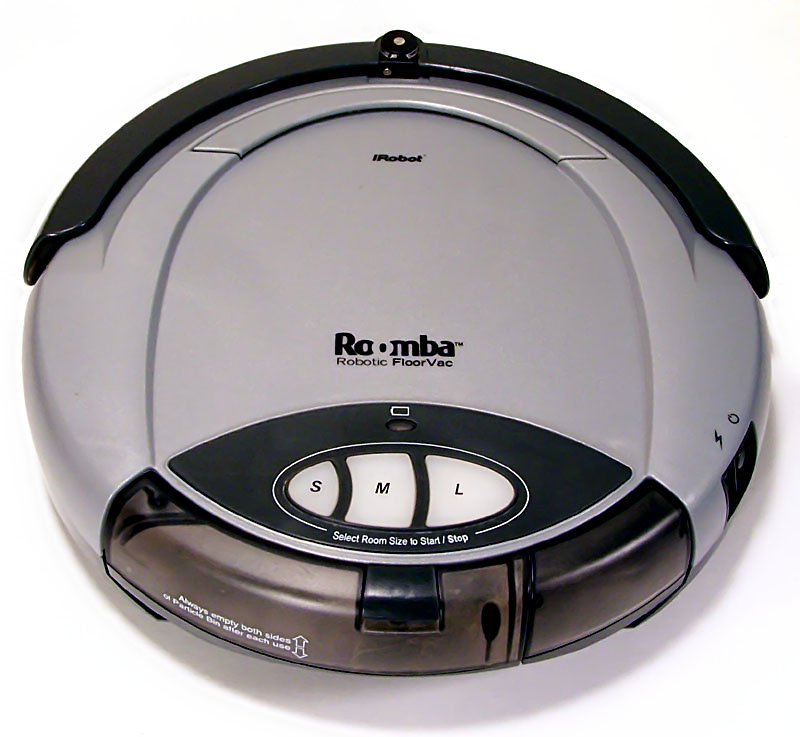
In 2002, a small machine began moving across floors without being pushed.
It did not follow a fixed path. It adjusted as it went, turning when it met a wall, circling when it found a concentration of dirt, returning to its starting point when its power ran low. It performed a task that had long been manual, and did so without instruction once it had been set in motion.
The device was Roomba, introduced by iRobot. It was presented as a vacuum cleaner, but it operated differently from those that had come before. It navigated a room on its own, detected obstacles and adjusted its movement in real time. For many users, it was the first encounter with a machine that could carry out a routine task without supervision.
The company behind it had not begun with domestic products. Founded by Colin Angle, Helen Greiner and Rodney Brooks, iRobot had worked on systems for military and space applications. During the late 1990s, it shifted part of its focus towards consumer robotics, identifying a possible demand for devices that could operate within the home. The development of Roomba followed from that shift, and its release in 2002 marked the point at which such a device became widely available.
What distinguished it was not its purpose, but how it carried it out. The system used a combination of infrared sensors and contact sensors to detect walls, furniture and other obstacles. It did not rely on a pre defined route. When it encountered an obstruction, it adjusted its path and continued, producing a pattern of movement that appeared irregular but allowed it to cover a space over time.
Early versions operated with this form of reactive navigation. Later models introduced more structured approaches, including methods such as simultaneous localisation and mapping, allowing the device to build a representation of its environment and move through it with greater efficiency. Over time, the system improved its ability to avoid repeated coverage of the same areas.
The device also incorporated sensors designed to identify areas with a higher concentration of dirt. Optical and acoustic signals were used to detect these regions, prompting the system to spend more time cleaning them. It was able to return to a charging station when its battery was low, allowing it to operate without direct oversight once it had been activated.
These features were modest when considered individually. Taken together, they allowed the device to function as an autonomous appliance. It did not require constant direction, and it did not depend on a fixed environment. It operated within the variability of a household setting.
The effect of this was not limited to cleaning. Before its introduction, robots had largely been associated with controlled environments such as factories, laboratories and specialised equipment. Roomba demonstrated that a machine could function within the less predictable conditions of a home at a price that made it accessible to a wider market. It suggested that autonomy could be applied to everyday tasks.
Its adoption reflected this. The device became one of the more widely sold consumer appliances of its kind, indicating that there was a viable market for domestic robotics. The presence of such a device in ordinary settings altered expectations about what machines might be used for.
The influence extended into other areas. The methods used for navigation, including obstacle detection and path adjustment, informed work on systems designed to operate in larger and more complex environments. Similar principles were applied in warehouse robotics, where machines move goods through dynamic spaces, and in the development of autonomous vehicles, where navigation depends on continuous interpretation of surroundings.
The success of the device also encouraged further work in domestic systems. Products such as robotic mops and automated security devices followed, along with systems that integrated voice control and network connectivity. Over time, Roomba itself incorporated these features, adding wireless connectivity in later models and enabling interaction through systems such as Amazon Alexa and Google Assistant. More recent versions have introduced real time mapping, lidar based sensing and the ability to recognise different rooms within a space.
The broader effect was to bring forms of automation into routine use. Tasks that had been performed manually became candidates for delegation to a system that could operate with limited supervision. This contributed to the development of what is now described as the smart home, in which devices are connected, responsive and able to act on information drawn from their environment.
The system itself remained relatively simple in comparison with later developments. It did not attempt to interpret language or to engage in complex reasoning. Its function was specific, and its behaviour was constrained. Yet its significance lies in where it operated. It placed a form of machine decision making within an ordinary setting and demonstrated that such a system could be accepted.
The change it represented was gradual rather than abrupt. It did not announce a new field. It entered an existing one and altered expectations from within. The extent to which domestic environments will continue to incorporate such systems remains to be seen. What is clear is that the presence of a machine moving across a floor without instruction was not treated as unusual for long.