
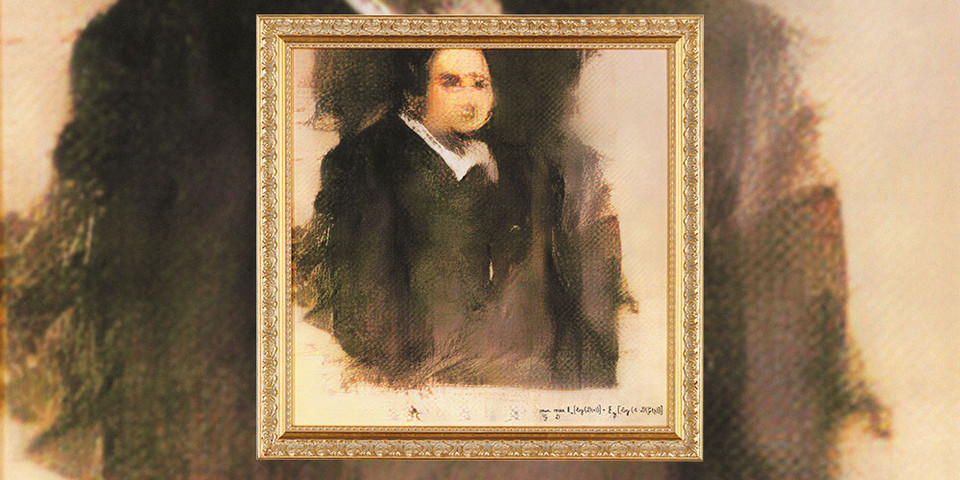

A portrait produced by a machine was sold in New York for $432,500.
The sale took place at Christie’s on 25 October 2018. The estimate had been set between $7,000 and $10,000. The difference between those figures drew attention, but it was not the price alone that made the moment notable. The work, Portrait of Edmond de Belamy, had no named painter.
It had been created by a model trained by the Paris based collective Obvious. The image presents a blurred and slightly distorted figure, resembling the portraiture of the eighteenth and nineteenth centuries. The composition is familiar, yet the surface resists clarity. The features appear incomplete, as though the process that formed them had been interrupted. There are no visible brushstrokes and no direct human mark beyond the selection of the final output. In place of a signature, a mathematical equation appears in the lower corner, referring to the algorithm used in its creation.
The work was generated using a Generative Adversarial Network. This form of deep learning allows a system to produce images, music and other material by learning from existing data. It operates through two neural networks that work in opposition. One generates new images based on patterns it has learned from real paintings. The other evaluates those images and determines whether they appear real or artificial. Through repeated interaction, the generating network improves, producing images that become increasingly lifelike and, at times, difficult to distinguish from human created work.
To produce this image, the model was trained on 15,000 portraits spanning from the fourteenth to the twentieth centuries, drawn from historical datasets. It studied styles, colour and composition, then generated new images that attempted to follow those conventions. From these outputs, the collective selected a final image and printed it on canvas. The result was a portrait that combined elements of historical practice with a process that did not rely on direct human execution.
The sale marked the first time an artificial intelligence generated artwork had been offered by Christie’s. That alone altered how such work might be regarded. It suggested that a major auction house was prepared to treat the output of a machine as something that could enter the established market for art.
The event also raised a set of questions that have not been resolved. If a system produces the image, but does so using data selected and structured by humans, then authorship becomes unclear. It is not obvious whether the work belongs to the system, the programmers who designed it, or the individuals who chose the final image. The question extends further. If a machine can generate an image that is recognised and valued, it becomes necessary to consider whether creativity depends on intention, or whether it can emerge from process alone.
Critics have argued that such work lacks the qualities associated with art, particularly emotion, narrative and deliberate intent. From this perspective, the system is not creating but repeating patterns learned from data. It has no awareness of its output and no capacity for inspiration. Others have taken a different view, suggesting that the value of an artwork may lie in its effect rather than its origin. If an image can be considered, interpreted and responded to, the absence of a human maker may not be decisive.
The sale also demonstrated that artificial intelligence was moving beyond its earlier roles in automation and data processing. Systems capable of generating images began to influence areas such as music, literature and film, where similar techniques were applied to produce text, sound and visual material. After the sale of Portrait of Edmond de Belamy, interest in such work expanded. Artists and technology companies began to experiment more openly with artificial intelligence as a tool for creation. Forms of digital art, including those later associated with non fungible tokens, became more visible within the market.
In the years that followed, further works generated by similar methods were sold at auction, in some cases for substantial sums. The presence of such work in the art market became less unusual, though not entirely settled. At the same time, the technology itself continued to develop. Systems became more capable of producing detailed and varied outputs, and their use spread across different forms of creative practice.
The direction of this development remains uncertain. Artificial intelligence is unlikely to replace human artists in a direct sense, but it is already being used as a tool that allows new forms of exploration. It can assist in generating ideas, styles and compositions that might not have been produced otherwise. At the same time, it raises practical and ethical questions. Ownership is not clearly defined when an image is generated by a system. It is not always clear whether such work should be distinguished from that produced by human means.
The sale in 2018 did not settle these questions. It marked a point at which they could no longer be avoided. A work produced through a computational process had entered a setting traditionally defined by authorship and tradition. The implications of that shift continue to unfold, and the position of artificial intelligence within art remains open.