
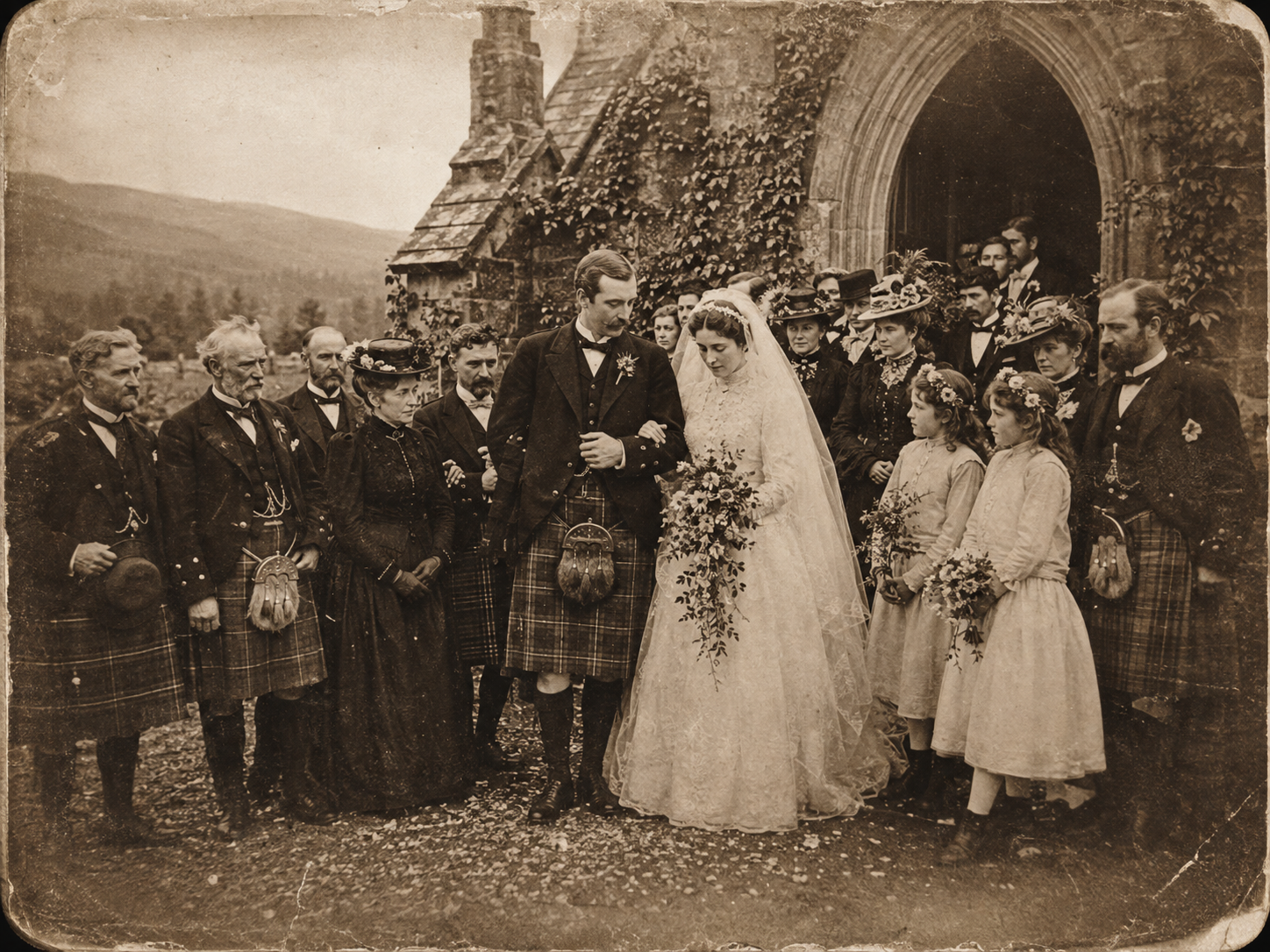
Long before Scottish weddings became affairs of hotel packages, photographers and carefully arranged seating plans, marriage could involve banns from the kirk, a loosened shoe against witchcraft, neighbours supplying the feast and, in some places, a piece of shortbread broken over the bride’s head.
The customs survive in an 1894 book that has largely slipped from ordinary reading: Bygone Scotland: Historical and Social, by David Maxwell. Rather than writing a conventional chronological history, Maxwell assembled a series of studies of Scottish life, including a chapter devoted entirely to marriage customs.
Some of what he recorded belongs firmly to folklore. Other parts reveal something more substantial: marriage in Scotland was once governed by a peculiar mixture of law, church discipline, local custom and popular superstition.
Maxwell wrote that January and May were considered unlucky months in some parts of Scotland, preserving the old warning that a May bride might never prosper. Particular days could acquire their own reputation for bad luck, while wedding parties took considerable care over what happened during the ceremony itself.
One belief held that a dog must not pass between the bride and groom while they were being married. Another required the best man to loosen or unbuckle the groom’s left shoe, supposedly to frustrate any witch attempting to cast a spell over the couple.
The measures sound picturesque now, but they belonged to a society in which supernatural interference was not always treated as harmless amusement. Scotland’s long history of witchcraft accusation gave ideas about charms, curses and protection a far darker context than the modern wedding superstition about something borrowed or something blue.
The wedding itself also differed according to place.
Maxwell described Highland marriages as generally taking place in churches, while Lowland ceremonies were often held at the bride’s father’s house and, later, sometimes at the minister’s manse. If two weddings were to take place at one church on the same day, efforts could be made to prevent the two parties meeting one another on the road.
Afterwards came the feast.
The bride and groom were expected to lead the first reel after supper. Maxwell gives its name as the “shemit”, or shame-faced reel, supposedly because of the newly married couple’s bashfulness.
Another late-Victorian collection of Scottish church history records the extraordinary scale on which some weddings could be held. Kirk sessions attempted to control festivities by regulating the number of guests and the hour at which celebrations should finish. Even then, gatherings of around 40 people could be regarded as an acceptable ceiling.
The community helped supply the table.
Landowners might contribute beef, mutton or venison; farmers supplied poultry or dairy produce; and ministers or schoolmasters could lend cooking utensils. Such arrangements belonged to the tradition of the “penny wedding”, in which the cost of celebration was spread more widely than it is in the modern model of one family paying a large commercial bill.
The bride’s arrival at her new home could bring another sequence of rituals.
One account describes bread and cheese being held above her as she crossed the threshold. Shortbread might then be broken over her head, with younger members of the gathering scrambling for the pieces. She could then be expected to sweep the hearth with a broom.
These were not uniform Scottish practices carried out identically from Shetland to the Borders. Maxwell himself was collecting traditions from different periods and places, and Victorian writers were sometimes too willing to turn local practices into national ones.
The legal history, however, is much firmer — and considerably stranger to modern eyes.
For centuries Scotland recognised forms of marriage that did not necessarily require either a church ceremony or a registrar.
National Records of Scotland explains that marriage by declaration before two witnesses could constitute a lawful marriage. These became known as “irregular marriages”. In its simplest form, Scottish law regarded the consent of the couple as the central element of the marriage rather than the presence of a clergyman.
That difference eventually made Scotland famous far beyond its borders.
England restricted clandestine and irregular marriage under Lord Hardwicke’s Marriage Act of 1753. Scottish law did not follow it. Couples who could not or would not marry under English requirements began travelling north, producing the border wedding trade associated most famously with Gretna Green, but also with Coldstream and Lamberton Toll.
The reality was less romantic than later legend sometimes made it appear.
Some irregular marriages were perfectly serious unions carried out without the formal machinery of the church. Others generated disputes over whether a marriage had actually taken place. Kirk sessions might summon couples, require them to acknowledge the union publicly, rebuke them and impose a fine.
Records from Dalton in Dumfriesshire, for example, show irregularly married couples being called before the kirk session in the late 18th century. In one 1773 case, a couple acknowledged their marriage publicly and paid a guinea to the poor. The frequency of such cases irritated the kirk session sufficiently for it to consider increasing the fine.
The church’s displeasure did not necessarily make the marriage invalid.
That is the curious feature of the Scottish system. The kirk might regard the manner of marriage as improper while the law could still recognise the relationship itself.
Old parish records show the more conventional route as well. Banns of marriage were normally proclaimed before the congregation on three successive Sundays so that objections or impediments could be raised. Where the bride and groom lived in different parishes, banns could be proclaimed in both.
Compulsory civil registration did not begin in Scotland until 1 January 1855. From then, statutory marriage registers recorded considerably more information about couples, including age, address, occupation and parents.
Even that did not immediately end irregular marriage.
National Records of Scotland has a 1903 Perth register containing both a conventional church marriage and an irregular marriage by declaration before witnesses. The latter required a sheriff’s warrant before it could be entered officially in the register.
The practice survived astonishingly late.
Irregular marriages were finally abolished under the Marriage (Scotland) Act 1939, with the change taking effect in 1940. The same legislation allowed Scottish registrars to conduct civil marriages.
One of the last generations to use the old system included couples whose lives would later become rather famous.
In January 1920, the Scottish woman Jessie Roberta “Rita” Cowan and Japanese chemistry student Masataka Taketsuru married secretly in Glasgow by declaration before witnesses. Taketsuru later helped establish Japan’s whisky industry, and their marriage became part of the story of Nikka whisky.
The ceremony required neither a grand church nor the machinery now associated with a wedding. Their declaration, witnesses and subsequent legal registration were enough.
That old Scottish principle is perhaps the most striking survival beneath all the shortbread, reels and supernatural precautions.
Marriage could certainly be surrounded by ritual. Communities cared about banns, respectability and the kirk’s approval. Families feasted. Brides crossed thresholds under bread and cheese. Shoes were loosened and dogs watched with suspicion.
Yet Scottish law retained, remarkably late, the much plainer proposition that two people themselves could create the marriage.
The elaborate wedding came and went around it.
Consent was the part that mattered.
Sources
David Maxwell — Bygone Scotland: Historical And Social, 1894, chapter “Scottish Marriage Customs”, Project Gutenberg
https://www.gutenberg.org/files/54245/54245-h/54245-h.htm
Project Gutenberg — Bygone Church Life In Scotland, chapter “Marriage Laws And Customs”
https://www.gutenberg.org/cache/epub/34941/pg34941-images.html
National Records of Scotland — Old Parish Registers: Marriages And Proclamation Of Banns
https://www.nrscotland.gov.uk/learning-and-events/research-guides/old-parish-registers-marriages-and-proclamation-of-banns/
National Records of Scotland — Irregular Border Marriage Registers
https://www.nrscotland.gov.uk/learning-and-events/research-guides/irregular-border-marriage-registers/
National Records of Scotland — Statutory Registers Of Births, Deaths And Marriages
https://www.nrscotland.gov.uk/learning-and-events/research-guides/statutory-registers-of-births-deaths-and-marriages/
Scotland’s People / National Records of Scotland — Irregular Marriage In Scotland
https://www.scotlandspeople.gov.uk/article/irregular-marriage-scotland
Scotland’s People / National Records of Scotland — Irregular Marriage And The Kirk Session In Scotland
https://www.scotlandspeople.gov.uk/article/irregular-marriage-and-kirk-session-scotland