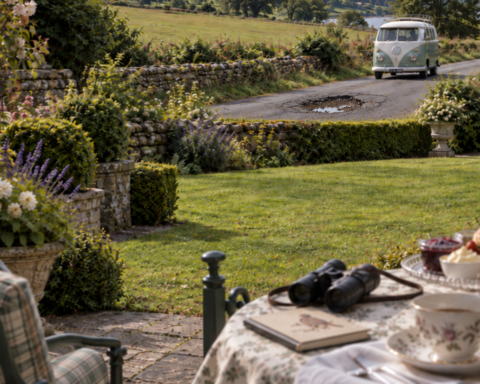

There is a particular sort of patience required on a Highland single-track road in August. Mr Gunn possesses it, although I should say there are limits.
We were on our way to the ironmonger, a perfectly ordinary journey which should have taken perhaps twenty minutes, when we came round a bend and found a motorhome directly in front of us, with what appeared to be most of western Europe parked behind it.
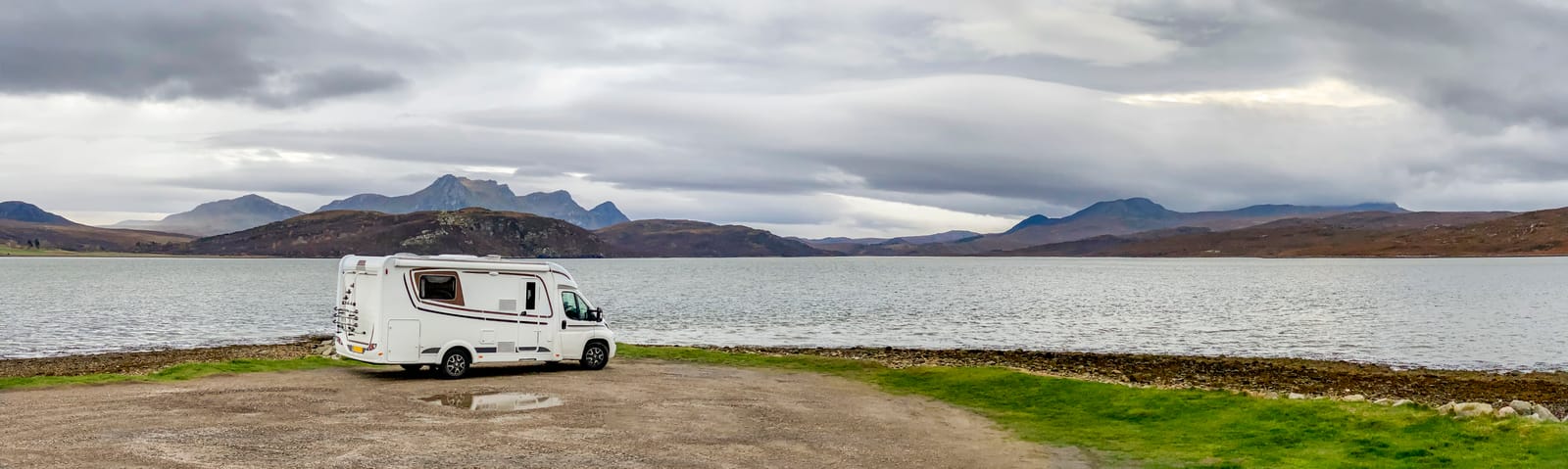
It was not one of the modest little campervans you occasionally see tucked neatly beside a loch, but a tremendous white vehicle with bicycles on the back, curtains at the windows and enough equipment attached to its roof to communicate with Norway.
Mr Gunn stopped.
The motorhome stopped.
There was a passing place perhaps fifteen yards behind it.
Unfortunately, there was also a car about six feet behind its bicycle rack.
And behind that car was another car.
And another.
And another.
The motorhome had apparently been travelling at such a stately pace that it had collected traffic for some considerable distance. Looking past it, through the gaps and around the bend, I could see perhaps thirty vehicles stretched along the road.
Mr Gunn turned off our engine.
I knew immediately this was going to take some time.
The gentleman driving the motorhome looked perfectly equipped for the Highlands. He had one of those expensive waterproof jackets with numerous technical zips and a collar apparently designed to withstand conditions on Everest. His wife had a matching one. Between them, I suspect they could have survived three nights on the Cairngorm plateau without assistance.
What neither of them appeared to have prepared for was the possibility that thirty other people might follow them down a single-track road.
Mr Gunn pointed towards the passing place.
The gentleman looked in his mirror.
Then he looked in the other mirror.
Then he adjusted the first mirror.
Then he turned around and looked through the motorhome itself, although given the curtains, cupboards, bicycles and what appeared to be half a fitted kitchen between him and the rear window, I cannot imagine this revealed very much.
He looked back at us.
Then he pointed behind himself.
Mr Gunn looked at me.
I looked at Mr Gunn.
The difficulty was now apparent.
It was not simply that the motorhome needed to reverse fifteen yards. Thirty vehicles needed to reverse sufficiently for the motorhome to reverse fifteen yards.
There is an etiquette to single-track roads which becomes second nature if you live with them. You use the passing places. You do not park in them. You let faster traffic by. If the passing place is immediately behind you and the other vehicle would otherwise have to reverse half a mile, you reverse.
Nobody needs to hold a conference about it.
Unfortunately, we now required something approaching traffic management.
Mr Gunn put the handbrake on.
This was not an act of aggression. It was simply recognition that we were no longer participating in road transport and had entered a different phase of the day.
Presently a tractor arrived behind us.
The tractor belonged to a farmer we know, who stopped, assessed the situation and appeared unsurprised by any of it.
He climbed down from his cab and came to Mr Gunn’s window.
“Passing place behind him?”
“Aye.”
“How far?”
“About fifteen yards.”
The farmer looked at the motorhome.
Then he looked beyond the motorhome at the procession disappearing around the bend.
“How many?”
“Thirty, maybe.”
The farmer looked back at Mr Gunn.
“Aye.”
That concluded the discussion.
A few minutes later, the post van arrived behind the tractor.
This transformed matters.
A motorhome facing a car and a tractor is an inconvenience. A motorhome facing a car, a tractor, thirty vehicles and His Majesty’s mail begins to resemble an infrastructure problem.
The postie got out.
And as the closest thing we had to an official representative of the state, he naturally took charge.
He surveyed the road.
“Does he not reverse?”
“He can’t,” I said. “There’s half of Europe behind him.”
The postie walked forward, spoke briefly to the motorhome driver and then disappeared past the side of the vehicle.
A few moments later we could see him progressing down the queue, explaining the situation one car at a time.
The solution was actually quite simple.
Everybody moved backwards.
Not very far. Twenty yards would probably do it. The last car would reverse first, then the next, then the next, until enough space reached the front of the queue for the motorhome to enter the passing place.
It was essentially an accordion.
On a road like this, two ordinary cars can often squeeze past one another if both drivers are willing to put a tyre into the ditch and proceed with a little faith. The motorhome, unfortunately, was considerably beyond the reach of that particular arrangement.
Unfortunately, one section of the accordion was broken.
Word travelled back up the line.
There was a problem.
The postie reappeared.
“One of them says his car won’t go into reverse.”
The farmer stared at him.
“What?”
“Won’t go into reverse.”
This was sufficiently interesting that the farmer walked down to investigate.
Mr Gunn remained in the driver’s seat.
I got out.
By the time I reached the scene, several other people had done the same.
The vehicle in question was a rented Volkswagen Golf driven by an American gentleman who was now looking deeply betrayed.
“It won’t go into reverse,” he explained.
The postie looked at the car.
The farmer looked at the car.
Several other men looked at the car.
The Golf, for its part, gave no outward indication that it had abandoned one-sixth of its gearbox somewhere north of Inverness.
The American demonstrated.
First gear.
Second gear.
Neutral.
No reverse.
“I’ve tried everything.”
Someone asked whether it was a rental.
“Yes. We rented it from Edinburgh.”
This apparently settled matters in his mind because he then produced his telephone and announced that he was going to call the rental company.
In Edinburgh.
From a Highland single-track road.
With approximately thirty vehicles waiting behind him, a motorhome waiting in front of him, and the Royal Mail now stationary.
Nobody quite knew what Edinburgh was expected to do.
Nevertheless, he telephoned.
We waited.
He pressed buttons.
We waited.
He put it on speaker. We all listened to recorded music.
At some point during this, the farmer looked back towards his tractor.
“I can tow it out the way.”
The telephone came down slightly.
“No, no. They’ll tell me what to do.”
The farmer considered this.
“I can tell you what to do.”
A few more drivers had now left their cars and wandered over.
By my count there were approximately twelve men standing around the Volkswagen, which is enough to field a shinty team and, judging by the discussion taking place, possibly manage one as well.
Everyone had a theory.
Clutch.
Gear linkage.
Electronic lock.
Handbrake.
Engine off.
Engine on.
Try first and then reverse.
Try second and then reverse.
One gentleman crouched beside the driver’s door for reasons known only to himself.
The American remained on hold.
Eventually, one of the men said the thing that perhaps should have been said fifteen minutes earlier.
“Can I have a look?”
The American surrendered the driver’s seat.
The man climbed in, pressed the clutch, put his hand on the gear lever and stopped.
“Ah.”
We all looked at him.
He pressed the gear lever down.
Then he moved it left and forward.
The reversing lights came on.
There was silence.
The American looked through the open door.
“What did you do?”
“You push the gearstick down first.”
The American stared at it.
“You push it down?”
“Aye.”
He tried it himself.
Down.
Left.
Forward.
Reverse.
The Golf moved backwards.
There are moments when a crowd disperses gradually and moments when twelve men realise simultaneously that their work here is done.
The shinty team dissolved.
The postie resumed command of the road.
And then, slowly, wonderfully, western Europe began to reverse.
A German estate moved back.
A small French hatchback followed it.
Then another car.
Then another.
The Volkswagen Golf, now in full possession of all its gears, retreated with particular enthusiasm.
The movement travelled along the queue like a message.
Twenty yards here.
Fifteen there.
Another ten.
Cars edged into gateways. People leaned from windows and waved one another backwards. The postie stood in the middle of it directing vehicles with an authority I suspect was never formally included in his job description.
Eventually the space reached the front.
The motorhome driver’s wife got out.
She was very pleasant.
“I am so sorry,” she said.
Nobody laughed.
This is one of the things I like about Highland people. There are moments when mockery would be very easy, but practicality generally arrives first.
The farmer walked down to the motorhome.
“I’ll guide you back,” he said.
The gentleman lowered his window.
There followed several minutes of careful instruction.
“Straight back.”
The motorhome moved approximately six inches.
“Keep coming.”
Another six inches.
“Plenty of room.”
The driver stopped.
“You’ve plenty.”
He moved again.
The postie leaned against the motorhome for a moment and took a deep breath.
I began wondering whether the ironmonger closed for lunch.
Eventually, through a combination of wing mirrors, hand signals and moral support from considerably more adults than had expected to spend their morning supervising road manoeuvres, the great white machine began its journey towards the passing place.
It went slowly.
Very slowly.
I have seen houses moved faster.
But it went. Mr. Gunn turned on the engine and adjusted his seat belt.
When at last all five tonnes of the motorhome were safely inside the passing place, the farmer raised one hand, the universal signal meaning that’s you.
We drove forward.
As we passed, the motorhome driver gave us an apologetic wave.
Mr Gunn returned it.
Then came the rest of Europe.
There were now thirty-nine cars behind him. I counted.
Every car had one entire side in the ditch, just two tyres down in the grass, while the other side remained on the road and hoped for the best.
Having moved to the back seat, I now rolled down my window to observe more closely.
At the generous points, we had perhaps twelve inches between us.
At the less generous points, two.
One gentleman had folded in his mirror in and was now leaning away from the window, which maybe he thought helped.
Another was staring straight ahead with the expression of a man who wished he were anywhere else.
A third gave Mr Gunn a solemn nod normally associated with military evacuations.
Nobody spoke. Nobody accelerated. Vehicles simply edged past one another at walking pace.
By car thirty-nine, I felt we had personally escorted most of western Europe through Sutherland.
The tractor followed us.
And the post van.
And after that, somewhere behind us, people resumed their travels.
I felt a little sorry for the motorhome driver. Driving something the size of a bungalow along roads largely designed when the principal traffic had four legs cannot be especially relaxing. There are stretches where the verge disappears, the ditch looks deep enough to lose a Labrador and the passing place you require always seems to be behind you rather than ahead.
Most visitors manage perfectly well.
Mr Gunn said very little for the rest of the journey. We reached the ironmonger considerably later than intended. We were almost there before I mentioned the American.
“Do you think the rental company might have done anything?”
Mr Gunn considered this.
“Didn’t need to.”
“No.”
He drove on for another few seconds.
“The farmer had a chain.”