
FIRST PUBLISHED IN 2015
For centuries, Bessie Bell and Mary Gray have been remembered as two young Perthshire women who tried to escape the plague by hiding in the countryside, only to die together. Their grave is still marked beside the River Almond and their names survive in one of Scotland’s best-known traditional ballads. But much of the familiar story was written down more than a century after the event, and modern research allows fact, tradition and later embellishment to be separated more carefully.
Bessie Bell and Mary Gray live more securely in Scottish memory than they do in the historical record.
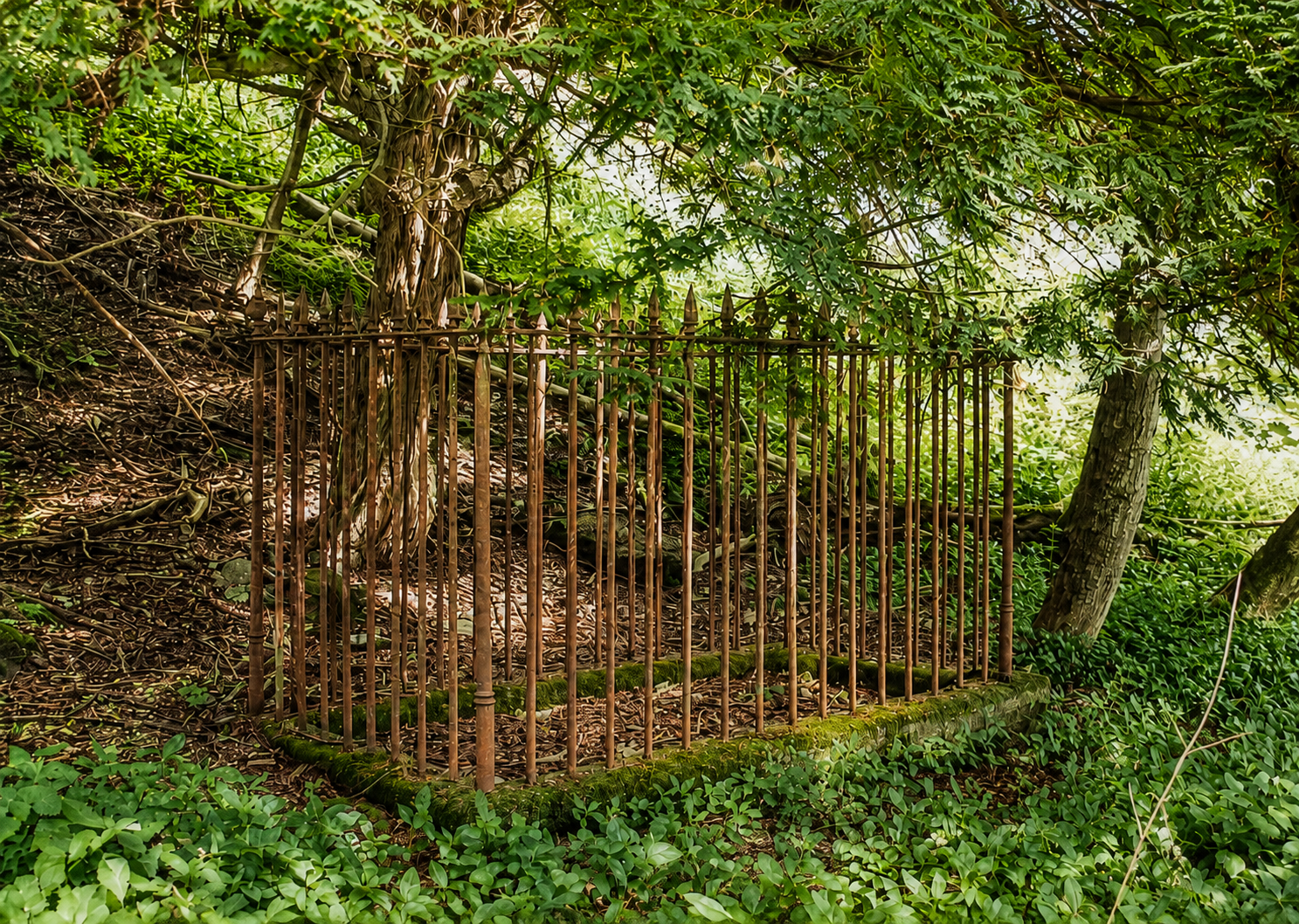
Near the River Almond, west of Perth, a small enclosed grave site is still recorded by Scotland’s National Record of the Historic Environment as “Grave of Bessie Bell and Mary Gray”. The Ordnance Survey marked it as their grave and dated it to 1645. When surveyed in 1975, it consisted of a level area of stones enclosed by metal railings, although no inscription or date stone was then visible.
The place is real. The plague was real. The ballad is real. But almost everything between those three facts is more complicated.
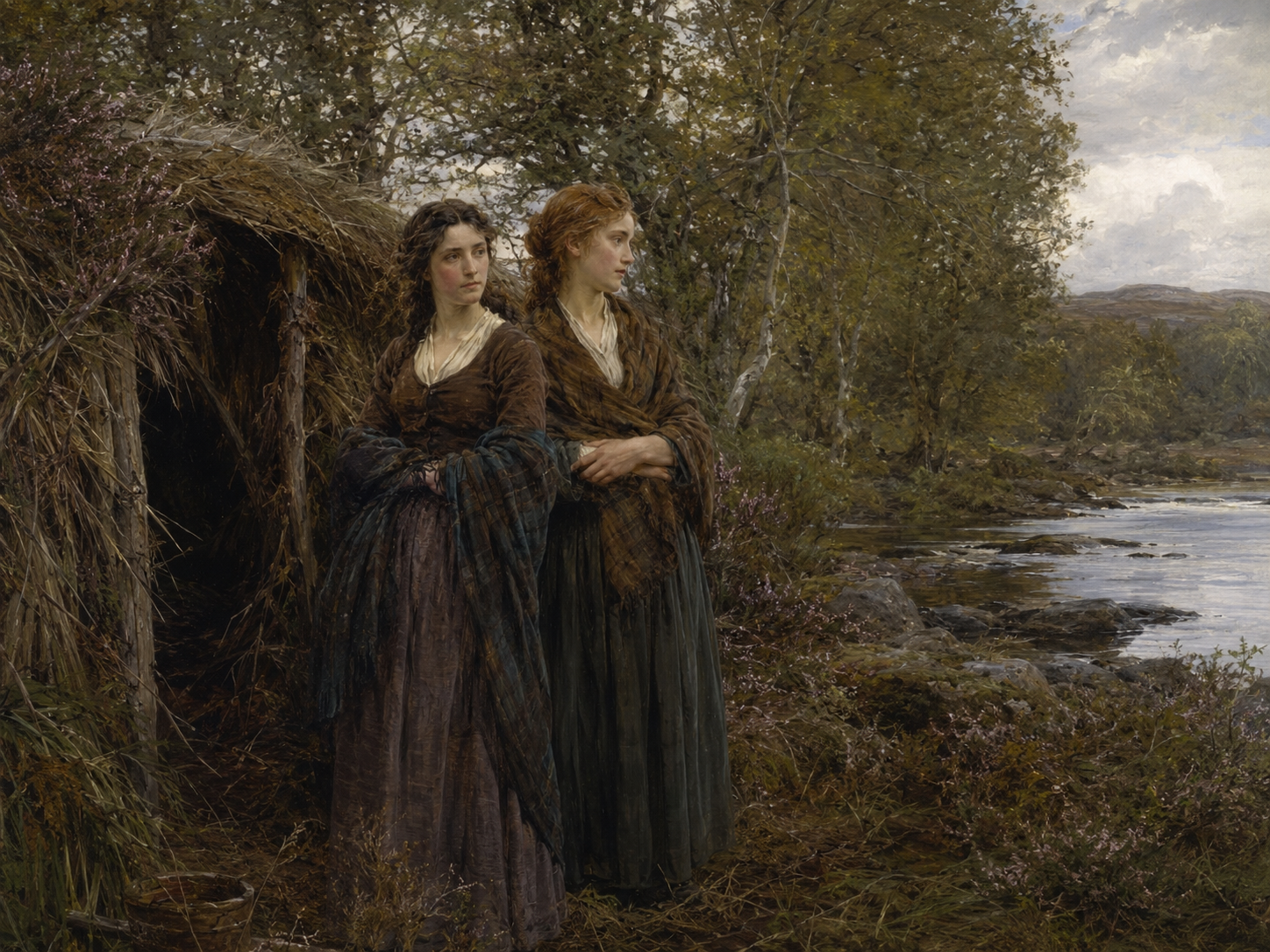
The familiar story says that Bessie and Mary were daughters of neighbouring Perthshire landowners. When plague threatened Perth, they withdrew from society and built themselves a temporary shelter, a bower covered with rushes and heather, at Burn Brae near Lednock. They lived there in isolation until infection somehow reached them. Both died and were buried away from the ordinary parish graveyard.
That bare story is substantially what survives in the traditional ballad later catalogued by the great nineteenth-century folklorist Francis James Child as Child Ballad No. 201, “Bessy Bell and Mary Gray”. The song is strikingly short. It gives the women, their bower, the arrival of the pest and their deaths. It says they had expected burial among their kin at Methven but instead lay elsewhere. It says nothing about a secret lover bringing provisions, contaminated jewellery, sexual relationships or any of the more elaborate explanations that later accumulated around the story.
The story told today is largely a combination of ballad and later oral tradition.
A note on the ballad: The line “to biek forenent the sin” has sometimes been misunderstood as referring to moral “sin”. In Scots, biek means to bask or warm oneself and forenent means facing or opposite; the final word is generally understood here as sun. The image is therefore of Bessie and Mary lying in the open at Stronach Haugh, facing the sun, rather than being punished for an unnamed offence.
 201A.1	 O BESSIE BELL and Mary Gray,
 	 They war twa bonnie lasses;
 	 They bigget a bower on yon burn-brae,
 	 And theekit it oer wi rashes.
 201A.2	 They theekit it oer wi rashes green,
 	 They theekit it oer wi heather;
 	 But the pest cam frae the burrows-town,
 	 And slew them baith thegither.
 201A.3	 They thought to lye in Methven kirk-yard,
 	 Amang their noble kin;
 	 But they maun lye in Stronach haugh,
 	 To biek forenent the sin.
 201A.4	 And Bessy Bell and Mary Gray,
 	 They war twa bonnie lasses;
 	 They biggit a bower on yon burn-brae,
 	 And theekit it oer wi rashes.
One of the most important accounts was written on 21 June 1781 by Major George Barry, then proprietor of Lednock — roughly 135 years after the probable events.
Barry said local tradition identified Mary Gray as the daughter of the laird of Lednock and Bessie Bell as the daughter of the laird of nearby Kinvaid. He was shown an old heap of stones in Dronach Haugh which local people told him was their burial place. The tradition described the women as beautiful and said that “an intimate friendship subsisted between them”. It also introduced the young man familiar from later retellings: an admirer said to have loved both women and to have brought them provisions while they were in hiding.
According to that tradition, it was through him that the infection reached them.
But that is tradition, not an eyewitness account.
There is no evidence establishing that a young man caused their deaths, and the traditional ballad itself does not mention him. Later stories grew still more elaborate, including one in which contaminated jewellery carried the infection. Those additions tell us a great deal about the way folklore develops, but very little that can safely be stated about what happened to two women in seventeenth-century Perthshire.
Even the year became confused
Barry’s account dated the plague to 1666.
That cannot be right.
The National Library of Scotland records that the Great Plague of 1665–67 never reached Scotland, largely because the Scottish authorities imposed restrictions on trade and quarantine measures against affected countries. Scotland’s devastating final major plague epidemic instead occurred in the mid-1640s.
The grave tradition consequently came to be associated with 1645, the date eventually placed on Ordnance Survey mapping and retained in the historic-environment record.
Modern research makes the chronology more interesting still.
A major peer-reviewed study published in PLOS ONE in 2024 reconstructed Scotland’s last great plague epidemic between 1644 and 1649, combining documentary, archaeological and genetic evidence. The researchers confirmed Yersinia pestis, the bacterium responsible for plague, in human remains associated with the Scottish epidemic. Their historical reconstruction records plague west of Perth by December 1645 but identifies an exceptionally severe outbreak in Perth itself during the summer of 1646, with mortality estimated at around 3,000 people.
The safest conclusion is therefore not that Bessie and Mary definitely died in one particular year.
It is that the legend fits the very real catastrophic plague epidemic which engulfed central Scotland in 1645–46. The traditional 1645 date is plausible, but the surviving evidence does not allow the deaths of two particular women to be dated with certainty.
The lairds present another problem
Modern digitisation of seventeenth-century tax records gives us something earlier generations of writers could not easily check.
The 1649 valuation roll for Perthshire, preserved by Scotland’s People, records a Patrick Gray as holding part of Lednock in Methven parish. That is only a few years after the traditional date of the story and gives genuine documentary support to the presence of the Gray family at Lednock. It does not prove Mary Gray’s identity or relationship to Patrick, but the family-and-place association is at least grounded in a contemporary record.
Bessie Bell is more difficult.
The same 1649 valuation records Sir William Stewart, not a Bell, as proprietor of Kinvade in Moneydie parish, valued at £440 Scots.
That does not prove there was no Bessie Bell connected with Kinvaid in 1645. Ownership might have changed, the family relationship remembered by tradition may have been different from formal ownership, or details may simply have become confused over the following century.
But it does mean that the frequently repeated statement that Bessie Bell was straightforwardly “the daughter of the Laird of Kinvaid” should be treated as tradition rather than established genealogy.
That is perhaps the most intriguing result of returning to the original records. The Gray side of the story leaves a faint documentary footprint. The Bell side, at least in the 1649 land record, does not fit quite so neatly.
And then Allan Ramsay changed the song
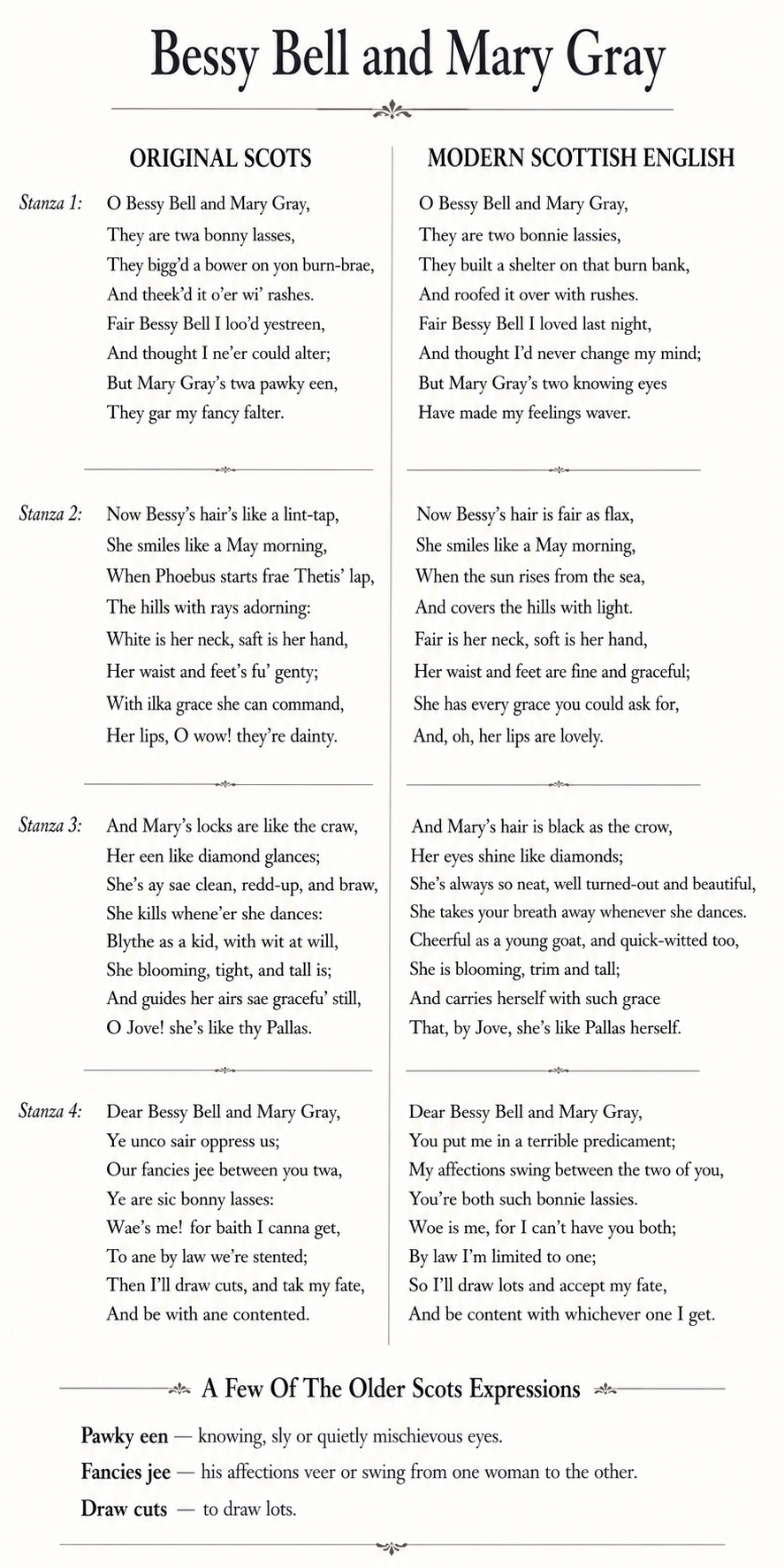
Another source of confusion is that there are effectively two Bessie Bell and Mary Gray songs.
The traditional Child ballad is the tragic one: two women build a bower, plague reaches them and they die.
The poet Allan Ramsay subsequently used their names and the familiar opening for a different song concerned largely with their beauty and a man’s difficulty choosing between them. The English Broadside Ballad Archive attributes a surviving broadside of that version to Ramsay, while ballad scholarship treats Ramsay’s composition separately from Child Ballad 201.
By 1792, “Bessy Bell and Mary Gray” was sufficiently established to appear in David Sime’s Edinburgh Musical Miscellany, a copy of which is now digitised by the National Library of Scotland.
Over time, the plague tragedy, Ramsay’s romantic verses, local oral tradition and later retellings became entangled.
The words above are Allan Ramsay’s expanded eighteenth-century version of Bessy Bell and Mary Gray. The traditional Scottish air associated with the song can also be heard online, giving a sense of how Ramsay’s verses would have sounded when sung rather than read on the page.
Listen: Bessie Bell and Mary Gray — traditional Scottish air
https://www.contemplator.com/scotland/bessie.html
That helps explain why modern accounts can sound extraordinarily certain about details which the earliest ballad never supplies.
Were Bessie and Mary lovers?
There is no reliable historical evidence that allows that question to be answered.
Their story has acquired a modern queer interpretation, partly because two young women withdrew from society and lived together and partly because Barry’s eighteenth-century account describes an “intimate friendship” between them.
But those facts are insufficient to establish a sexual relationship.
Nor does the later story of a male admirer establish that either woman was romantically involved with him.
The historical position is much simpler: we do not know.
The surviving traditional ballad does not describe a sexual relationship between the women. It does not describe a sexual relationship with the young man either. The young man is absent from the ballad altogether.
It is entirely legitimate for later generations to interpret folklore in new ways. What cannot responsibly be done is convert an interpretation into biography.
Nor do we know how the infection reached them
Modern medicine tells us that bubonic plague is caused by Yersinia pestis and is principally associated with infected rodent fleas. Pneumonic plague can also spread between people through respiratory droplets. Seventeenth-century Scots, of course, knew none of this; the cause of plague was not scientifically established until the end of the nineteenth century.
If Bessie and Mary were real women who isolated themselves during the epidemic, several routes of infection would have been possible.
Food, clothing, visitors, rodents or fleas could all have breached their isolation.
There is no surviving evidence which tells us which did.
The young man carrying the pest to their bower remains an exceptionally effective piece of storytelling because it transforms an invisible disease into a human tragedy. He may have existed. He may also have been folklore’s solution to the obvious question of how two isolated women became infected.
The grave remains
The strongest physical link between landscape and legend is still the quiet enclosure beside the Almond.
Historic Environment Scotland’s record does not authenticate the occupants through archaeological excavation. Rather, it documents a burial place which local tradition, nineteenth-century maps and historical accounts have associated with Bessie Bell and Mary Gray for generations.
Modern plague research also cautions against some of the darker stories once attached to their burial.
The 2024 study of Scotland’s final plague epidemic found that mass burial was often a practical response to overwhelming mortality, but also found examples of plague victims receiving normal and careful burial treatment. It found no simple basis for assuming that Scots universally regarded plague victims as people to be dishonoured after death.
There is therefore no historical basis for claiming that Bessie and Mary were excluded from consecrated ground because of homosexuality, sexual misconduct or some particular “sin”.
The ballad remembers that they did not lie where they expected to lie.
Why is another part of the silence.
And perhaps that is where the story should remain.
Bessie Bell and Mary Gray may have been two real young women whose deaths were remembered long enough to become song. A Gray family was genuinely established at Lednock within a few years of the great Perth plague. A place long identified as their grave still survives. Scotland really was devastated by plague when tradition says they lived, and modern genetic research has now confirmed the disease responsible for that final seventeenth-century epidemic.
Beyond that, certainty thins rapidly.
The lover, the contaminated necklace, the precise family histories and modern theories about their sexuality belong to the centuries of storytelling laid over the original tragedy.
What survives underneath is simpler and considerably more powerful.
Two young women tried to put distance between themselves and an epidemic.
They built a shelter in the countryside.
The plague reached them anyway.
And nearly four centuries later, Scotland still remembers their names.
Sources
Historic Environment Scotland / Trove — Burn Brae: Grave of Bessie Bell and Mary Gray
National Record of the Historic Environment entry for the traditional grave site, including Ordnance Survey records, location and historical references.
https://www.trove.scot/place/26852
Scotland’s People / National Records of Scotland — Perthshire Land Tax Roll, 1649: Methven Parish
Contemporary valuation recording Patrick Gray as proprietor of part of Lednock.
https://www.scotlandspeople.gov.uk/virtual-volumes/volume-images/volume_data-E106-26-4/REX01666?image_number=23
Scotland’s People / National Records of Scotland — Perthshire Land Tax Roll, 1649: Moneydie Parish
Contemporary valuation recording Sir William Stewart as proprietor of Kinvade.
https://www.scotlandspeople.gov.uk/virtual-volumes/volume-images/volume_data-E106-26-4/REX01666?image_number=51
Dittmar et al., PLOS ONE — “The Final Plague Outbreak in Scotland 1644–1649: Historical, Archaeological, and Genetic Evidence”, 2024
Peer-reviewed study reconstructing Scotland’s final major plague epidemic and confirming Yersinia pestis through genetic evidence.
https://pmc.ncbi.nlm.nih.gov/articles/PMC11559987/
University of Aberdeen — The Final Plague Outbreak in Scotland 1644–1649: Historical, Archaeological, and Genetic Evidence
University research record for the peer-reviewed study and its authors.
https://abdn.elsevierpure.com/en/publications/the-final-plague-outbreak-in-scotland-1644-1649-historical-archae/
National Library of Scotland — The Plague in Scotland
Historical overview of plague in Scotland, including the seventeenth-century epidemics and confirmation that the Great Plague of 1665–67 did not spread into Scotland.
https://www.nls.uk/collections/stories/scottish-history/the-plague-in-scotland/
Francis James Child / Cambridge University Press — Bessy Bell and Mary Gray, Child Ballad No. 201
Scholarly edition of the traditional ballad and an important source for separating the early ballad from later additions to the legend.
https://www.cambridge.org/core/services/aop-cambridge-core/content/view/A4D80C4E95257EDAB82EF318F7AF144B/9781107711129c13_p75-76_CBO.pdf/bessy_bell_and_mary_gray.pdf
Francis James Child — English and Scottish Ballads, digitised by Project Gutenberg
Historic scholarly collection containing material relating to Bessie Bell and Mary Gray and the traditional Scottish ballad tradition.
https://www.gutenberg.org/cache/epub/38037/pg38037-images.html
English Broadside Ballad Archive, University of California, Santa Barbara — An Excellent New Ballad Intituled Bessy Bell and Mary Gray
Catalogue record for the historical broadside associated with Allan Ramsay’s later treatment of Bessie Bell and Mary Gray.
https://ebba.english.ucsb.edu/ballad/34348/citation
National Library of Scotland — Edinburgh Musical Miscellany, Volume I, 1792
Digitised historical music collection containing “Bessy Bell and Mary Gray”.
https://digital.nls.uk/special-collections-of-printed-music/archive/94582540
Perth and Kinross Council — Bessy Bell and Mary Gray
Local historical account preserving the long-established Perthshire tradition concerning the women, the plague, their bower and burial place. This source is useful for documenting the tradition, rather than treating every detail as independently established historical fact.
https://www.pkc.gov.uk/article/10830/Bessy-Bell–Mary-Gray—early-17th-century