
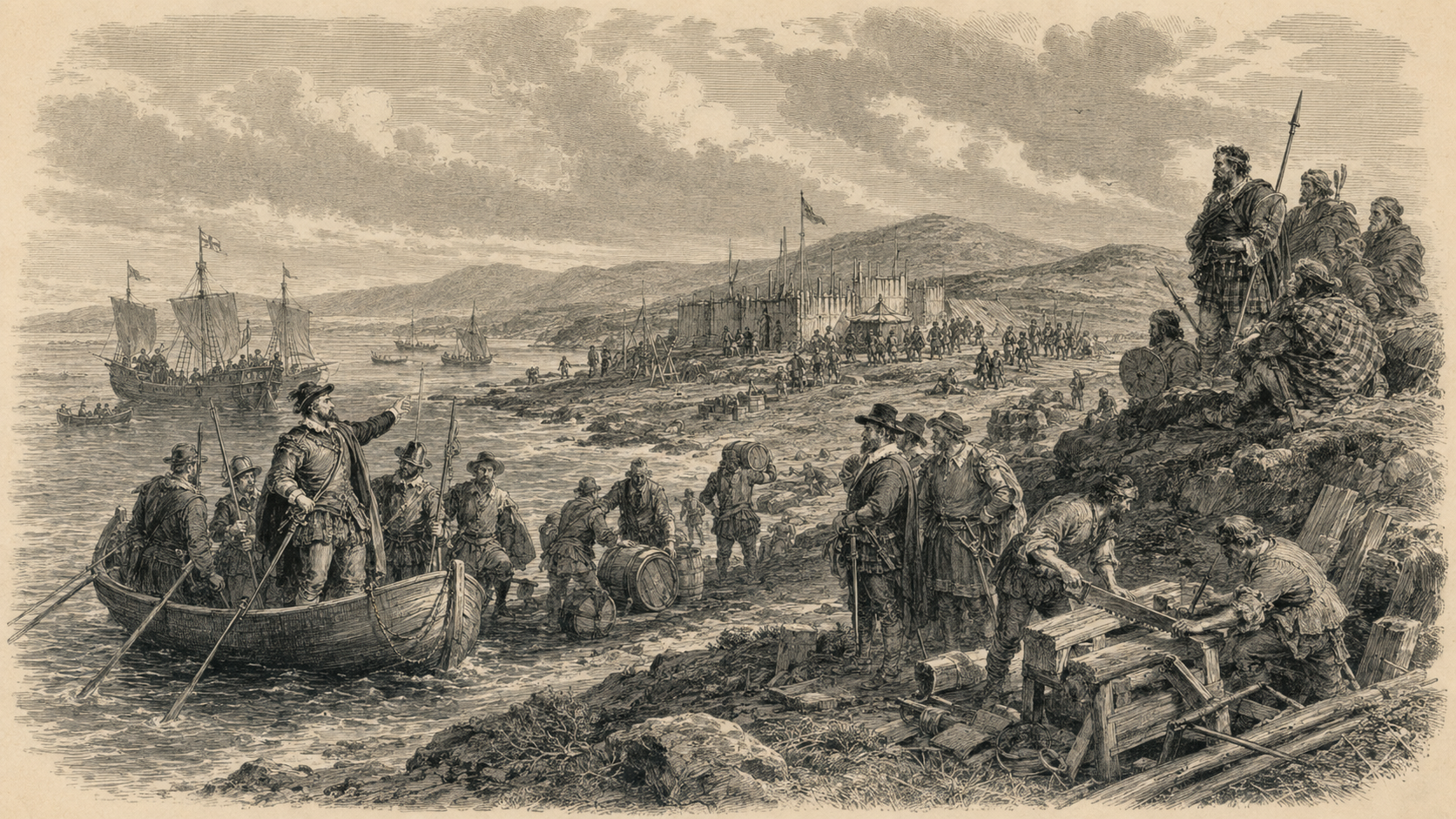
In 1598, James VI granted a group of Lowland landowners sweeping rights over Lewis. They came with soldiers, craftsmen and plans for a plantation. The island already had inhabitants, its own rulers and no intention of quietly changing hands.
In the summer of 1598, a group of Scottish gentlemen acquired an extraordinary document from the Crown. It gave them rights over Lewis, its lands, fisheries, harbours and resources, and authority to establish towns, markets and churches there.
The document existed on paper. Lewis existed in another world entirely.
For generations the island had been associated with the Macleods of Lewis, or Sìol Torcaill. Their lordship had been weakened by bitter internal disputes, competing claims of inheritance and violence within the family. Into that instability came men from the other side of Scotland who believed Lewis could be reorganised, settled and made profitable.
They became known as the Fife Adventurers.
James Browne, writing more than two centuries later in his History of the Highlands and of the Highland Clans, described their intentions with unusual directness. He wrote that reports of Lewis’s fertile soil encouraged barons and gentlemen of Fife to attempt to take possession of the island. Their declared aim, he said, was to “civilize” its inhabitants; Browne believed their underlying purpose was to establish a colony which would supplant the existing population.
The surviving government record shows that the language of “civility” was not Browne’s invention.
On 28 June 1598, James VI and the Scottish estates ratified a contract disposing of Lewis and neighbouring territories to the group of adventurers. The Crown’s document portrayed the islanders as resistant to royal authority and “civility”, while describing Lewis as exceptionally rich in grain, fisheries and other resources. The agreement explicitly anticipated increasing Crown rents and customs. It gave the new proprietors extensive rights over fisheries, minerals, ports, markets, burghs and local government.
The economic purpose sat alongside the political one. Lewis was to be made governable, taxable and commercially productive according to the priorities of the state.
The names attached to the contract included Patrick Leslie, commendator of Lindores; James Learmonth of Balcomie; Sir James Anstruther; James Spence of Wormiston; Sir James Sandilands of Slamannan; Captain William Murray; John Forret of Fingask and others, together with Ludovic Stewart, Duke of Lennox.
Browne dates the royal gift to 1599, while the surviving parliamentary contract establishes that the arrangement had been concluded the previous year. His account then describes what happened when the legal theory met the island itself.
The adventurers assembled soldiers and craftsmen and sent them west with what Browne called everything necessary for a “plantation”. On Lewis they began constructing houses and, according to his account, created a “small but handsome town”.
There is a tantalising archaeological echo of that story. The Stornoway Historical Society, drawing on work by the Western Isles Archaeological Service, records a tradition that the Fife Adventurers built a small town at Stornoway at the beginning of the 17th century. Little or nothing clearly attributable to it now survives. Later destruction, rebuilding and the construction of Cromwellian fortifications have obscured the early town beneath the Stornoway that followed.
The settlement did not proceed peacefully.
Lewis was already fractured by struggles within the Macleod family, and the adventurers entered those divisions rather than confronting a single united political authority. Modern research has stressed that the episode cannot be reduced neatly to Lowlanders against Highlanders. Gaelic families also manoeuvred for land, influence and commercial advantage, while the Macleod lordship itself had become politically vulnerable.
Neill Macleod became one of the settlers’ most determined opponents.
Browne records that, after relations between Macleod and Sir James Spence broke down, a party was sent to capture Neill during the night. Macleod was prepared. Browne says the attackers were met with such force that 60 were killed and the survivors driven back to their camp.
Tormaid Macleod then returned to Lewis. Browne says Neill and the islanders rallied around him. Their forces attacked the adventurers’ position, burned the fort, killed many of the settlers and captured their commanders. The prisoners were eventually released after promising that they would not return.
They returned.
The Fife settlers secured another royal commission and assembled support from surrounding territories. Browne records that the Earl of Sutherland sent men to assist them. Faced with the new force, Tormaid surrendered and was taken south to put his case directly before James VI.
His argument went to the heart of the affair.
According to Browne, Tormaid told the king that Lewis was his inheritance and that James had been wrongly persuaded that the island was his to dispose of. He blamed that decision for the bloodshed which had followed.
The settlers nevertheless found Lewis increasingly expensive to hold. Browne describes men who had exhausted their fortunes, others who had died, and a colony struggling to supply itself while facing continuing resistance. Eventually, he writes, they abandoned Lewis and returned to Fife.
Yet another attempt followed.
Sir George Hay and Sir James Spence became involved in what Browne explicitly calls the “colonization of the Lewis”. A fresh force arrived to plant a settlement and capture Neill Macleod. Meanwhile, Lord Kintail, whose Mackenzie family had its own designs on Lewis, publicly assisted the Crown-backed expedition while, Browne alleges, secretly helping Macleod intercept its supply vessel. Without provisions, the expedition collapsed. The remaining fort was subsequently burned.
The eventual winners were not the Fife Adventurers but the Mackenzies.
Modern scholarship places the Fife plantation between 1598 and 1609 and the subsequent Mackenzie acquisition within a much broader struggle over state authority, commerce and the western seaboard. Aonghas MacCoinnich’s research argues that the Mackenzies themselves became sophisticated planters and commercial operators, dealing with Scottish and European interests and complicating the old picture of commercially minded Lowlanders confronting supposedly backward Highland Gaels.
Browne’s story ends more violently. Neill Macleod withdrew with a small group to the offshore rock of Berrissay. Browne says he held out there for years before his opponents gathered the relatives of the defenders onto another rock threatened by the rising tide. Faced with the prospect of their families drowning, the men surrendered. Neill was later delivered to the Privy Council in Edinburgh and executed in 1613.
By then, the experiment begun by the Fife gentlemen had failed. The Macleods of Lewis had also lost their old position. The Mackenzies emerged with control of the island, and Stornoway entered another phase of its history. Local historical research dates Mackenzie acquisition to around 1610.
What survives most clearly from the Fife Adventurers is not their settlement.
It is the paperwork.
The royal contract still records the fisheries, revenue, ports, markets and “civility” that government expected Lewis to provide. Browne’s old volume preserves the story of the men who arrived to put those ambitions into effect and of the islanders who refused to make it easy.
Four centuries later, the little colonial town has largely disappeared beneath Stornoway. The document granting the island away has proved more durable than the settlement it was supposed to create.
Sources
James Browne, A History of the Highlands and of the Highland Clans, Volume I, A. Fullarton & Co., Glasgow, 1840. The title page of this copy confirms the 1840 edition.
Records of the Parliaments of Scotland to 1707 – Ratification of the Contract of the Lewis, 28 June 1598.
Aonghas MacCoinnich – Plantation and Civility in the North Atlantic World: The Case of the Northern Hebrides, 1570–1639, University of Glasgow.
University of Strathclyde – Living on the Edge? Plantation and Politics in the North Atlantic Archipelago 1493–1637.
Stornoway Historical Society / Western Isles Archaeological Service – The Archaeology of Stornoway.
Stornoway Historical Society – A Historical Overview.