
When artificial intelligence is discussed, the instinct is to look forward. To imagine machines yet to be built, systems yet to be understood. The assumption is that such thinking belongs to the modern age.
It does not.
The earliest traces of artificial intelligence, at least in spirit, appear not in laboratories, but in myth. In the world of ancient Greece, long before electricity or computation, there were already stories of constructed beings, mechanical servants, and systems governed by rules rather than instinct.
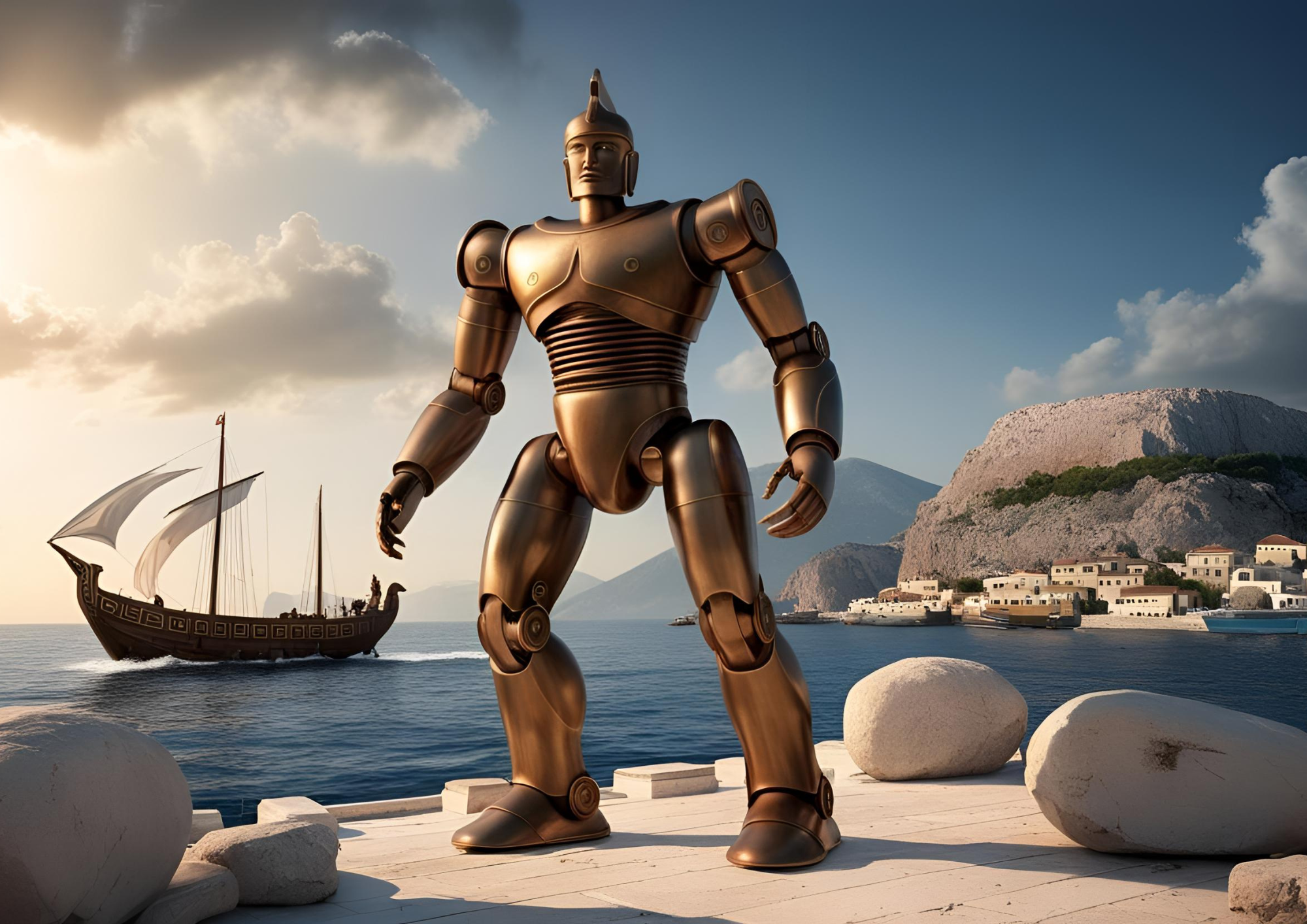
Among the most striking of these is Talos, the bronze guardian of Crete. Forged not born, he stands apart from the usual catalogue of mythological creatures. Talos was said to have been created by Hephaestus, the divine craftsman, and set to defend the island. His function was singular and unambiguous. He circled the coast, endlessly, hurling stones at approaching ships.
There is something distinctly modern in that description. A machine assigned a task, repeating it without deviation.
Talos was not described as thinking in any human sense. His behaviour was fixed, almost procedural. Yet he possessed structure. A single vein ran through his body, filled with ichor, sealed by a bronze nail. When that seal was removed, the system failed. It is difficult not to recognise the outline of a mechanism, complete with a critical point of vulnerability. His destruction at the hands of Medea was not a battle of strength, but of interference. The system was manipulated.
If Talos represents function, then Hephaestus represents design. In the ancient imagination, he was not merely a god, but an engineer of remarkable precision. Homer describes his creations in terms that are unexpectedly technical. Golden handmaidens that could walk and speak, assisting him in his forge. Tripods that moved of their own accord, transporting themselves across Olympus.
These are not idle fantasies. They suggest an early attempt to grapple with the idea of autonomous labour. Machines, or machine like beings, created to perform tasks without constant human control. The parallel with modern robotics is not exact, but it is close enough to be uncomfortable.
The Greeks did not build such devices. But they clearly understood the concept.
Alongside these myths runs a quieter, more rigorous line of thought. Not concerned with bronze giants or animated servants, but with reasoning itself. Here, the central figure is Aristotle.
Where myth imagined artificial beings, Aristotle examined the structure of thought. His work on syllogism established a method for drawing conclusions through formal logic. The structure is simple, almost austere. A general statement. A specific instance. A conclusion that follows.
All men are mortal.
Socrates is a man.
Therefore, Socrates is mortal.
It is a small step from this to the conditional logic that underpins modern computing. If this is true, then that must follow. Strip away the language, and what remains is a system. A method for processing information according to rules.
The resemblance to contemporary systems is not superficial. Decision trees, Boolean logic, rule based AI all rely on the same basic structure. Input, condition, output. Aristotle did not design machines, but he defined the logic they would later use.
What emerges from this period is not a technology, but a framework. On one side, myth explores the possibility of constructed beings. On the other, philosophy defines how reasoning itself might be formalised. Between them lies the outline of artificial intelligence, not yet realised, but already imagined.
The Greeks did not possess the means to build what they described. There were no circuits, no code, no engines capable of sustaining such systems. Yet the questions were already in place. Can a non human entity perform a task? Can behaviour be designed? Can reasoning be reduced to rules?
These are not modern questions. They are ancient ones.
The stories of Talos and the creations of Hephaestus suggest an awareness that machines could be made to serve. The work of Aristotle suggests that intelligence itself could be structured. Together, they form an early expression of ideas that would take millennia to develop.
The language has changed. The tools have changed. The ambition has not.
What is now called artificial intelligence is, in part, the continuation of a much older line of thought. One that began not with silicon, but with bronze, and with the quiet suspicion that thought itself might be built.