
When people speak of robotics and automation, they tend to picture modern factories, artificial intelligence, and highly advanced humanoid machines. It feels like a recent development, something born of silicon and code.
It is not.
The foundations reach much further back, into a period long before electricity, let alone computing. In the early thirteenth century, a polymath engineer was already building machines that moved, responded, and followed structured sequences of action. His name was Al-Jazari.
Al-Jazari, who lived between 1136 and 1206, worked as chief engineer at the court of the Artuqid dynasty in Diyarbakir, in a region that now spans parts of modern Turkey, Iraq, and Syria. His role required precision and reliability, but his work went far beyond utility. He approached engineering as a system of controlled behaviour.
In 1206, he completed his most important work, The Book of Knowledge of Ingenious Mechanical Devices. This was no simple catalogue. It documented more than one hundred mechanical inventions, each described in remarkable detail, complete with illustrations and instructions for construction. The book demonstrated not only technical mastery but a deep understanding of automation, robotics, and what would now be called programmable systems, centuries before the industrial age.
Among his most striking contributions were his automata. These were mechanical devices designed to mimic human and animal movement, operating through carefully engineered systems of water, gears, and timed release mechanisms. They were built both for function and for display, merging utility with spectacle.
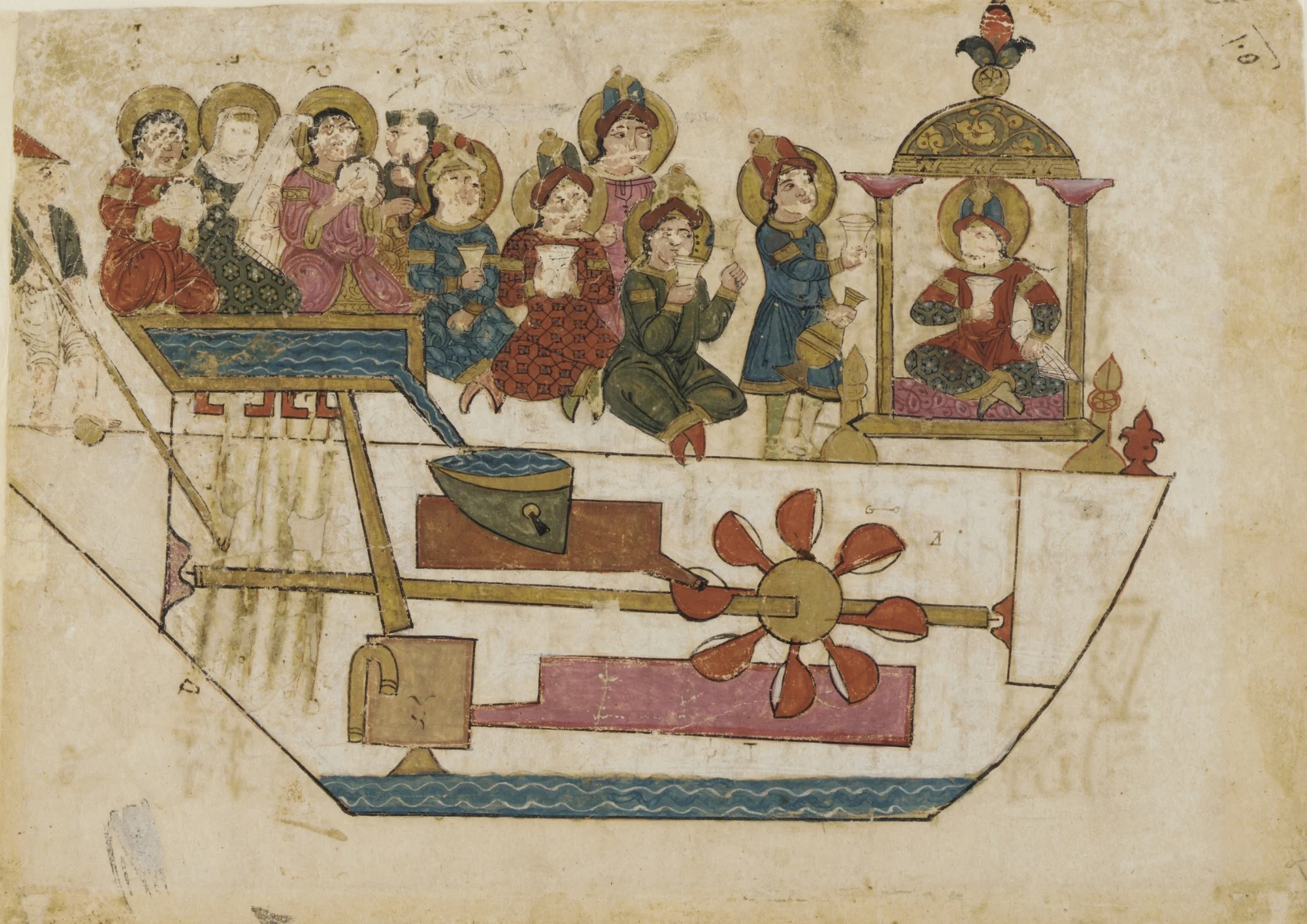
One of the most remarkable of these was a floating musical ensemble, often described as the first programmable automaton. The device consisted of a boat carrying four mechanical musicians, including drummers and harpists. It was powered by water driven cams, rotating mechanical components that triggered movement.
The significance lies in how it operated. The cams controlled the rhythm and sequence of the musicians’ actions, and by altering the arrangement of these cams, the performance itself could be changed. This ability to modify behaviour through mechanical configuration represents an early form of programmability, a clear conceptual ancestor to modern computer programming.
Al-Jazari also designed a humanoid hand washing automaton, a self operating servant intended for practical use. When activated, the device dispensed water, followed by soap, and then presented a towel. It achieved this through a sophisticated system of valves and hydraulics, carefully timed to deliver each stage in sequence. It stands as one of the earliest known machines designed to assist human activity in a structured and automated way.
Perhaps his most famous creation was the Elephant Clock, a complex water clock that combined engineering precision with symbolic design. The structure featured an elephant base, representing Indian and African traditions, supporting a system of moving elements that included a dragon, a phoenix, and a humanoid figure. Each component played a role in marking the passage of time through coordinated mechanical movement.
The clock was more than a timekeeping device. It represented a fusion of cultures and knowledge systems, while also demonstrating an advanced understanding of hydraulics, gears, and automated control. It translated the steady flow of water into repeated, predictable motion, a principle that sits at the heart of all mechanical automation.
Beyond these major works, Al-Jazari created mechanical peacocks, self operating doors, and numerous other hydraulic powered devices. Each demonstrated his mastery of fluid dynamics, mechanical engineering, and controlled motion. His designs reveal a consistent approach, using physical systems to produce repeatable, structured outcomes.
The influence of his work is visible across several domains that would only later be formally defined. His use of cams and valves to alter machine behaviour foreshadows modern programming and control systems. His hydraulic mechanisms influenced later developments in industrial engineering. His humanoid automata stand as early conceptual predecessors to modern robotic systems.
Centuries later, figures such as Leonardo da Vinci would explore similar ideas in mechanical design, including sketches of humanoid machines. Whether through direct transmission or parallel discovery, the underlying concept endured. Machines could be designed not only to act, but to act in sequence, with purpose.
Despite the sophistication of his work, Al-Jazari’s contributions were not widely recognised in Europe during the Middle Ages. His influence persisted more strongly in the Middle East and Asia, where his designs informed later engineering traditions. Only much later would his role in the history of automation be fully appreciated.
His work established several principles that remain central to modern technology. The idea that machines can be programmed. The use of control systems to regulate behaviour. The integration of engineering and function to solve practical problems. These are now foundational concepts in robotics, artificial intelligence, and industrial automation.
Today, his legacy is evident in systems that operate far beyond anything imaginable in the thirteenth century. Autonomous robots, AI driven machines, and networked devices all rely on the same essential idea that guided his work. A machine can be designed to perform tasks independently through a structured set of instructions.
Al-Jazari’s automata remind us that the desire to build intelligent, self operating systems is not a modern invention. It is an ancient ambition, expressed through the tools available at the time.
In an age defined by artificial intelligence and advanced robotics, his work stands not as a curiosity, but as a beginning.