
Long before modern computers, artificial intelligence, and digital processors, the idea that a machine might assist human thought began with a far more modest ambition.
To add numbers without error.
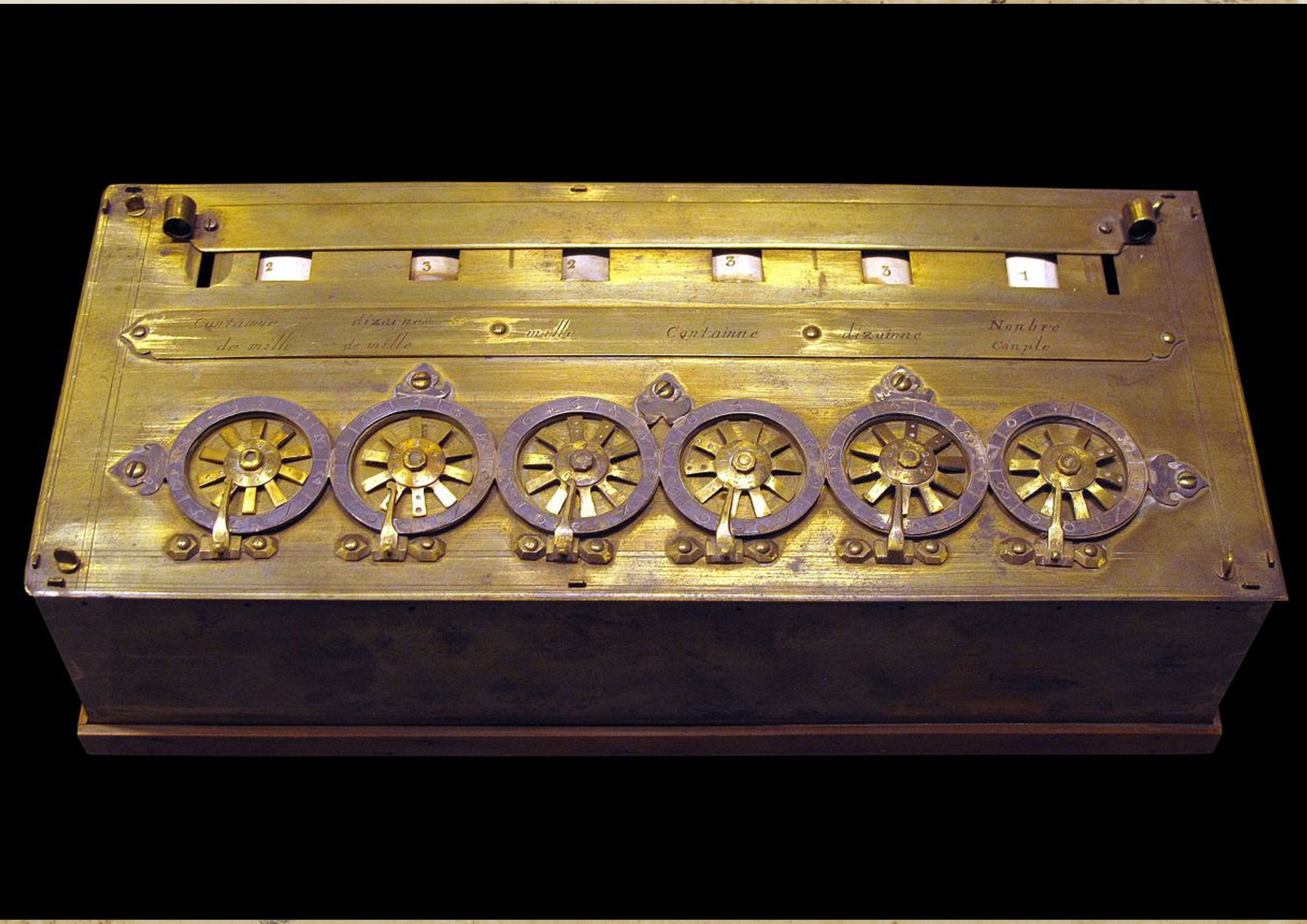
In 1642, a nineteen year old Blaise Pascal designed what is now regarded as the first functional mechanical calculator. It was called the Pascaline. It did not think, and it did not generalise, but it performed arithmetic reliably, and in doing so, introduced a principle that would endure.
That calculation could be mechanised.
The origins of the device were practical rather than philosophical. Pascal’s father, Étienne Pascal, worked as a tax collector in France, a role that demanded continuous, repetitive computation. The work was slow, prone to error, and dependent on careful manual record keeping. Pascal sought to reduce that burden, not by improving the method, but by replacing it.
The result was a machine constructed from metal gears and rotating dials, each marked with the digits zero through nine. Numbers were entered by turning the dials, and the result appeared through a small viewing window. The mechanism itself handled the arithmetic.
The essential innovation lay in what is now called the carry mechanism.
When a wheel completed a full rotation, moving from nine back to zero, it triggered the next wheel to advance by one. The machine, in effect, understood the structure of arithmetic well enough to handle the transition between units. What a human would perform mentally, the device performed physically.
It is a small detail, but it carries considerable weight. The ability to propagate change across a system, to move from one state to another according to defined rules, is fundamental to computation. In modern terms, it is not far removed from the logic that governs binary operations.
The Pascaline was limited in scope. It could add and subtract directly. Multiplication and division required repetition of those operations. The device was also expensive and mechanically intricate, making it impractical for widespread use. It remained, in most cases, a specialised instrument rather than a common tool.
And yet, its influence extended well beyond its immediate adoption.
The idea that calculation could be delegated to a machine did not disappear. It was taken up, refined, and extended by later figures. Gottfried Wilhelm Leibniz developed a more advanced device capable of multiplication. In the nineteenth century, Charles Babbage would propose machines that moved beyond arithmetic entirely, introducing programmability and general purpose computation.
Each of these developments rests, in part, on the same premise that Pascal established. That a process traditionally carried out by human thought can be embodied in mechanism.
The significance of the Pascaline, then, is not found in its immediate utility, but in its demonstration. It showed that numbers could be manipulated by a system of parts, operating according to fixed relationships. It reduced calculation to movement.
From there, the path becomes clearer.
Mechanical computation evolves into electromechanical systems. Those systems give way to electronic circuits. Circuits become programmable. Programmes become complex. And eventually, the question shifts from calculation to cognition.
The lineage is not direct, but it is continuous.
Modern systems, whether in data processing, artificial intelligence, or digital computation, still rely on the same underlying principle. Inputs are transformed into outputs through a series of defined operations. The scale has changed. The speed has increased. The abstraction has deepened. But the structure remains.
Pascal’s work also contributed to what might be called computational thinking. The recognition that problems can be broken into discrete steps, that operations can be standardised, and that results can be derived systematically rather than intuitively.
These ideas now underpin not only computing, but much of modern science and engineering.
His legacy is therefore not confined to the device itself. It persists in the frameworks that followed. In the development of programming languages such as Pascal. In the adoption of standardised units like the pascal in physics. And, more broadly, in the acceptance that machines can participate in processes once reserved for human reasoning.
The Pascaline did not transform the world in its own time. It was too specialised, too costly, and too early. But it established a direction.
A machine, properly constructed, could take on part of the intellectual labour of its operator.
That proposition, once demonstrated, has proved difficult to contain.