
Long before the age of silicon, before circuitry and code, there was an attempt to build a machine that could follow instructions.
Not merely calculate, but operate.
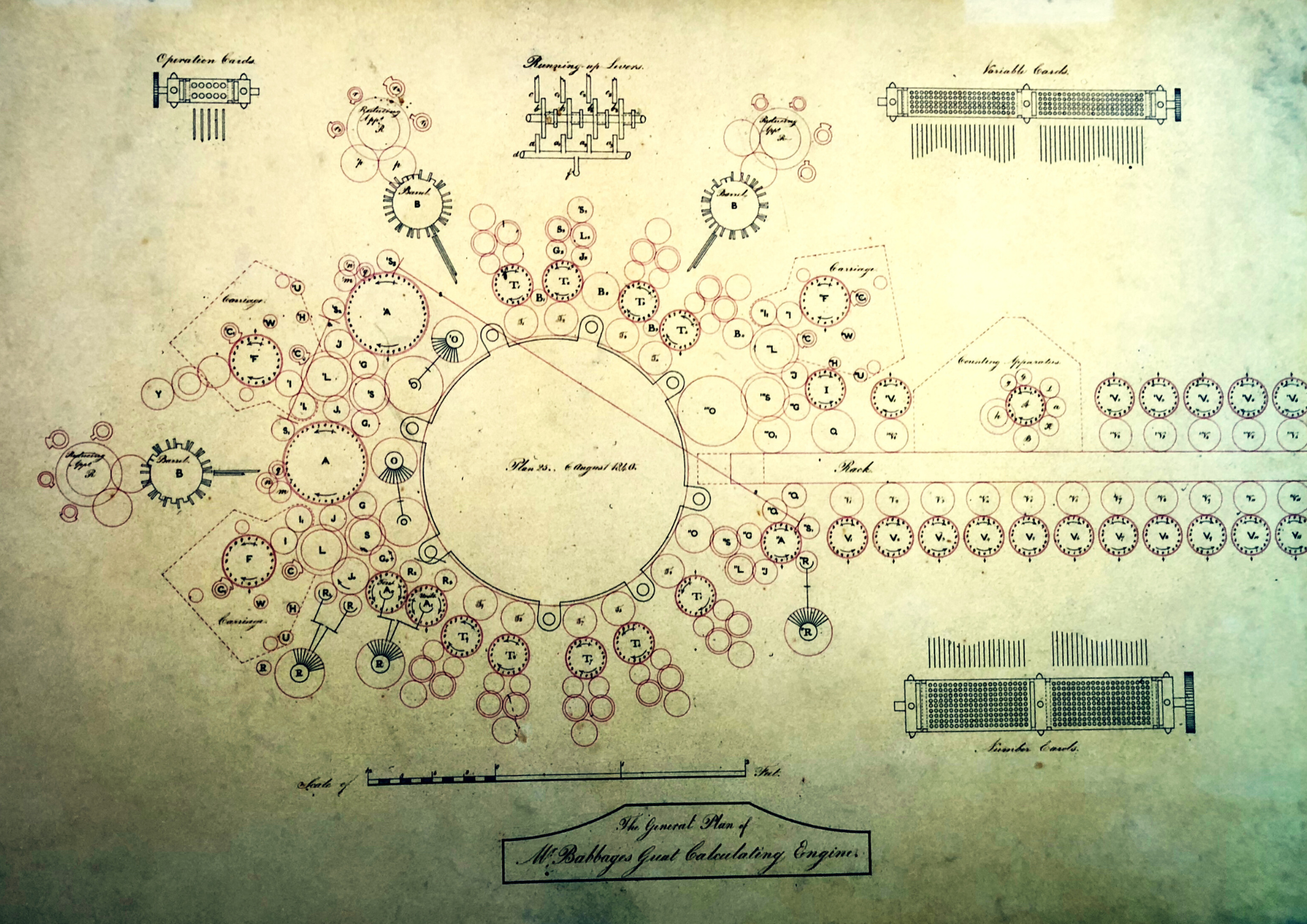
In 1837, Charles Babbage set out the design for what he called the Analytical Engine. It was not built. It could not be built, at least not with the tools available to him. Yet in outline, it contains almost everything that would later define modern computing.
The idea did not emerge in abstraction. Babbage had already spent years confronting the practical problem of error. Mathematical tables, used in navigation, engineering, and finance, were produced by hand and frequently wrong. His earlier design, the Difference Engine, was intended to remove that weakness. It was a machine of precision, but also of limitation. It could perform only a narrow class of calculations.
The Analytical Engine was something else entirely.
It was conceived as a general purpose machine. Not designed for a single task, but capable, in principle, of performing any calculation that could be expressed as a sequence of steps.
The architecture he proposed is now familiar, though at the time it had no precedent. The machine would contain a “store,” a place where numbers could be held. It would include a “mill,” where those numbers would be processed. Instructions would be fed into the system using punched cards, an idea borrowed from Jacquard loom, where patterns in fabric were controlled by similar means.
From these elements, something recognisable emerges.
Memory. Processing. Input. Output.
More than that, Babbage’s design allowed for conditional behaviour. The machine could, in effect, make decisions within the bounds of its instructions. It could repeat sequences of operations. It could alter its course based on intermediate results. What would later be called loops and conditional logic were already present, expressed in mechanical terms.
The scale of the design was considerable. The store was intended to hold up to a thousand numbers, each of forty digits. The mill would perform arithmetic operations using a complex system of gears and levers. The output could be printed, reducing the risk of transcription error.
It was, in every essential respect, a computer.
What it lacked was not conceptual clarity, but material feasibility. The precision engineering required to construct such a device exceeded the capabilities of the time. Funding was uncertain. Government support, once extended for the earlier machine, was withdrawn. The Analytical Engine remained, therefore, an architecture without a body.
It might have stayed that way, a curious design in the margins of Victorian engineering, had it not been for the intervention of Ada Lovelace.
In 1843, Lovelace translated a paper on the Engine by Luigi Menabrea. Her translation was accompanied by a series of notes that exceeded the original text in both length and ambition. Within those notes appears what is widely regarded as the first computer program, an algorithm for calculating Bernoulli numbers.
That fact alone would secure her place in the history of computing. But it is not the most significant aspect of her work.
Lovelace recognised that the Engine was not confined to numbers. If numbers could represent quantities, they could also represent symbols. And if symbols could be manipulated according to rules, then the machine might operate on more than arithmetic.
She suggested, cautiously but clearly, that such a device might one day compose music or produce other forms of structured output. In doing so, she separated the idea of computation from mere calculation. The machine was not simply a calculator. It was a processor of relationships.
That distinction would take more than a century to fully unfold.
The reasons the Engine was never built are, in themselves, instructive. Financial support proved inconsistent. The engineering tolerances required were extreme. Perhaps most significantly, the concept itself was not widely understood. It is difficult to fund what cannot be easily explained.
Had the machine been constructed, the history of computing might have advanced at a different pace. Instead, the design persisted in drawings and notes, waiting for the conditions required to realise it.
When those conditions arrived in the twentieth century, the parallels became difficult to ignore. The theoretical work of Alan Turing, particularly his conception of a universal machine, echoes the general purpose nature of Babbage’s design. Early electronic computers, including ENIAC, implemented architectures that, in principle, follow the same division between memory and processing.
Even the use of punched cards reappeared, notably in systems developed by IBM, where instructions and data were encoded physically and fed into machines.
There is, then, a continuity that runs through the history of computing, though it is not always acknowledged. The Analytical Engine did not directly produce modern computers, but it established the framework within which they would later be understood.
It also established something more subtle.
That a machine could be designed to follow a sequence of general instructions. That its behaviour could be determined not by its physical construction alone, but by the instructions it received.
That idea, once accepted, leads almost inevitably to the question of whether such instructions might become sufficiently complex to resemble thought.
Lovelace herself expressed caution on that point. She argued that the machine could only do what it was instructed to do, a position later revisited by Turing in his own work. The debate has not been resolved.
But the groundwork for it was laid in 1837.
The Analytical Engine, though never assembled, remains one of the clearest early statements of what a computer is. Not a device for a single task, but a system capable of executing instructions across a wide range of problems.
A general purpose machine.
It is a phrase that appears almost routine now. At the time, it was an idea without precedent.