


Editor’s Note: This investigation concerns more than the financial risk of an AI bubble. Data centres depend upon AI companies, while much of the commercial AI economy depends upon a continuing supply of human-created work, human behaviour, personal information, professional knowledge and everyday digital activity. If Scotland ties jobs, electricity infrastructure, public revenue and industrial policy to that economy, it may acquire a financial interest in keeping people permanently connected, measurable and available for data extraction. The country could become economically dependent upon systems it is supposed to regulate, systems that reward surveillance, weaken anonymity and turn ordinary human life into commercial input. The danger is that, once Scotland has built its economy around keeping it inflated, resistance to tracking, profiling and compulsory digital participation may be treated as a threat. In plain terms, Scotland risks tying part of its economy to its own digital enslavement.
_________
Scottish public bodies are helping data-centre investors address planning and electricity constraints before Scotland has completed a national assessment of the combined pipeline. CoreWeave, the American company at the centre of the Lanarkshire AI Growth Zone, warns its own investors that changing customer demand could leave it carrying excess capacity, leases, construction costs and financing obligations. The companies can change course. Scotland’s land and infrastructure cannot.
Scotland is being built into an economic wager it did not design and cannot control.
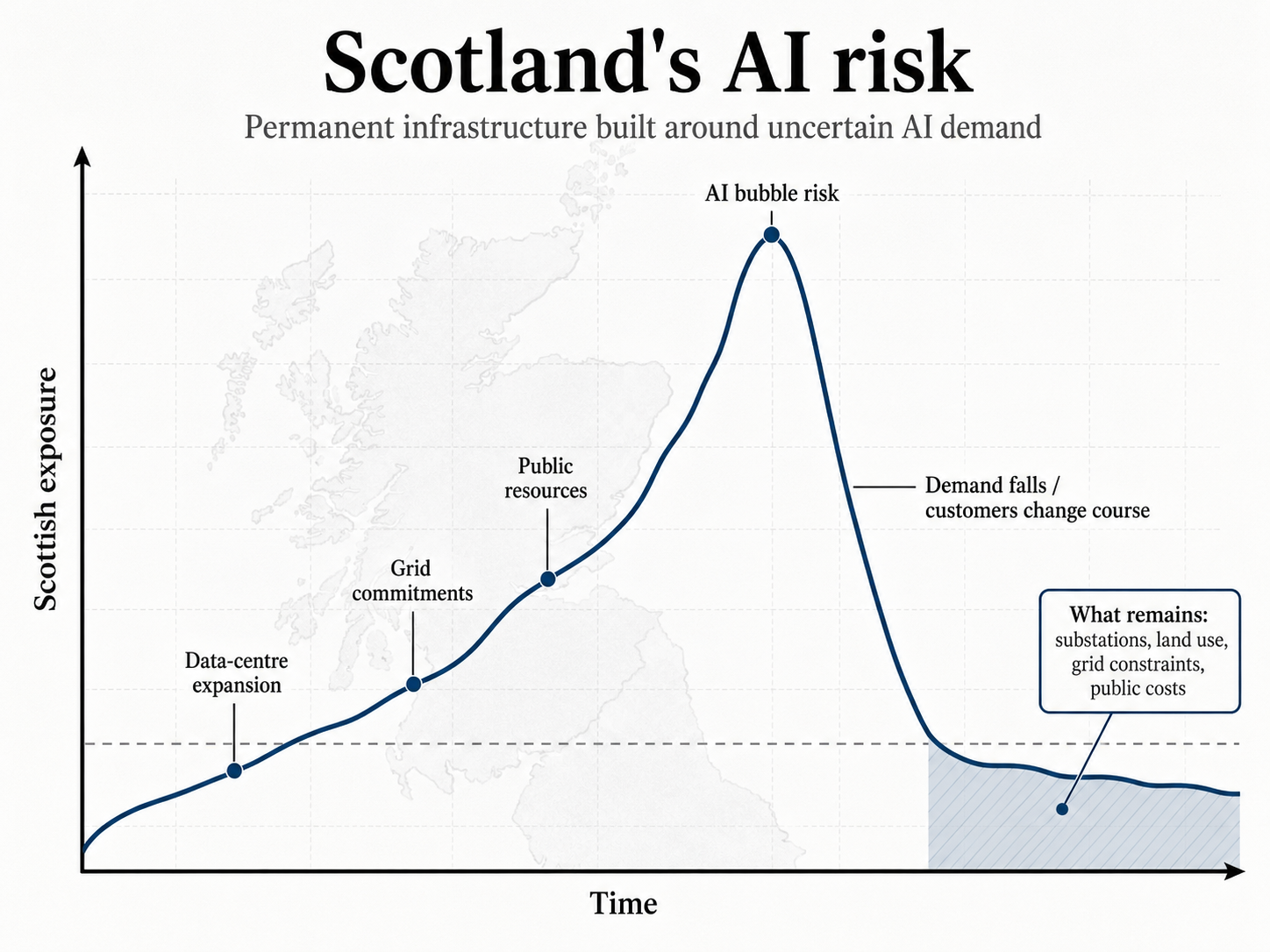 Across the country, developers are seeking land, substations, water, roads and grid connections for data centres intended to serve a global artificial-intelligence boom. Ministers, officials and public agencies are helping investors address planning and electricity barriers before Scotland has completed a national assessment of the combined demand.
The assumption beneath that work is that today’s extraordinary appetite for AI computing will continue long enough to justify the infrastructure built around it.
It may.
But financial markets have mistaken rapid expansion before. If AI investment proves to be a bubble, the companies involved can cancel projects, reduce orders, change suppliers, restructure debts or move their computing elsewhere.
Scotland cannot move a substation.
It cannot easily return an industrial site to its previous use, recover years of constrained grid capacity or undo public decisions made around jobs and investment forecasts that failed to endure.
That is the wager now being made: rapidly changing commercial demand, set against permanent Scottish consequences.
CoreWeave’s Scottish Entrance
The clearest example is CoreWeave, the American AI cloud company working with DataVita in the Lanarkshire AI Growth Zone.
The UK Government announced the zone in January with claims of £8.2 billion in private investment, more than 3,400 jobs and a community fund worth up to £543 million over 15 years. The published notes say the investment and employment estimates were provided by DataVita. North Lanarkshire Council has emphasised that the proposals remain subject to the full statutory planning process.
CoreWeave has separately announced £1.5 billion of investment in partnership with DataVita.
The company was founded in 2017. Before 2022, much of its limited revenue came from cryptocurrency-mining services that it subsequently discontinued. Its present cloud platform was launched in 2020.
CoreWeave is now growing at extraordinary speed. It reported revenue of approximately $5.1 billion for 2025, alongside a net loss of $1.17 billion. At the end of the year it had $60.7 billion in remaining contracted obligations, with committed contracts lasting about five years on average. It also carried $21.6 billion in debt and $8.2 billion in operating lease liabilities.
Scotland is dealing with a young, highly leveraged company expanding rapidly in a market whose future requirements remain uncertain.
A five-year customer contract is a serious commercial commitment. It is not a guarantee that the same customer, company, technology or quantity of computing demand will remain in place for the useful life of Scottish grid and industrial infrastructure.
Microsoft Supplied Two-thirds of CoreWeave’s Revenue
Microsoft accounted for approximately 67 per cent of CoreWeave’s revenue during 2025. In the first three months of 2026, the company’s two largest customers together accounted for 65 per cent of revenue: 45 per cent from the customer labelled A and 20 per cent from the customer labelled B. CoreWeave does not identify either company in that revenue table and says its alphabetical labels may refer to different customers in different reporting periods. Elsewhere in the filing, it names Microsoft and Meta as significant customers and describes its agreements with OpenAI.
OpenAI committed to pay CoreWeave up to approximately $11.9 billion through October 2030 under one agreement. A later arrangement involves up to approximately $6.5 billion through May 2031. Meta initially committed up to approximately $21 billion for computing capacity extending into 2032.
NVIDIA and Jane Street are also customers as well as shareholders. NVIDIA paid CoreWeave about $326.3 million for services during 2025. Jane Street paid approximately $100 million during 2025 and $220.6 million during the first quarter of 2026 under its service arrangements.
CoreWeave is therefore supported by real contracts with some of the largest companies in technology and finance.
It is also exposed to their decisions.
The Warning CoreWeave Gives its Investors
CoreWeave tells investors that its customers may develop services that compete with its own. They may redesign systems so that they require fewer CoreWeave services, decline to renew or expand purchases, build their own infrastructure or adopt a competitor’s platform.
It also describes what could happen after capacity has been commissioned.
If customers fail to perform, CoreWeave says it may be left with excess capacity while remaining responsible for equipment, infrastructure, data-centre leases, building work and associated financing for which it receives no corresponding revenue. The company says it does not currently maintain insurance against customer credit risk.
Those are not claims made by opponents of data centres. They are warnings issued by CoreWeave to the people buying its shares and lending it money.
Scottish communities deserve the same candour before permanent infrastructure is organised around the company’s expected demand.
Scotland would not automatically inherit CoreWeave’s debts if a customer left. Its corporate liabilities would remain with CoreWeave, its subsidiaries, landlords and financiers.
Scotland’s exposure is different.
It includes land-use decisions, council resources, grid capacity, substations, road and water infrastructure, skills programmes, the possible displacement or delay of other developments and the opportunity cost of organising public policy around commercial demand that may later change.
Who Owns and Finances CoreWeave
CoreWeave is listed on Nasdaq, but its founders retain control through Class B shares carrying ten votes each.
At 15 April 2026, chief executive Michael Intrator held 38.70 per cent of the company’s total voting power. Brian Venturo held 20.30 per cent and Brannin McBee held 14.59 per cent. Directors and executive officers together controlled 72.32 per cent of the vote.
The largest disclosed outside shareholder was a group of funds managed or advised by Magnetar Financial. Those funds held 17.07 per cent of the ordinary Class A shares but 5.34 per cent of total voting power.
NVIDIA held 10.66 per cent of the Class A shares and 3.27 per cent of total voting power. Jane Street held 6.53 per cent of the Class A shares and two per cent of voting power.
NVIDIA occupies an unusually broad position. It is a shareholder, supplier and customer. CoreWeave says all the graphics processors used in its infrastructure are NVIDIA units because of requirements in its customer contracts. NVIDIA accounted for 17 per cent of CoreWeave’s purchases from suppliers in 2025 and bought $2 billion of additional CoreWeave shares in January 2026.
Jane Street is similarly both an investor and customer. It bought approximately $1 billion of shares in April.
CoreWeave’s debt funding has involved many of the largest institutions in private credit. A $7.5 billion facility announced in 2024 was led by funds managed by Blackstone, with Magnetar as co-lead investor and participation from Coatue, Carlyle, CDPQ, DigitalBridge Credit, Eldridge, Great Elm and funds or accounts managed by BlackRock. A preceding $2.3 billion facility was led by Magnetar and Blackstone with participation from several of the same institutions.
Blackstone and BlackRock are separate companies. Blackstone was a lead financier. BlackRock-managed funds participated as lenders. BlackRock is not disclosed as CoreWeave’s controlling shareholder.
There is no need to invent a hidden owner. The disclosed structure is serious enough: founder control supported by concentrated customer demand, NVIDIA hardware, hedge-fund investment and tens of billions of dollars in debt and lease obligations.
Government Was Not Merely Waiting for an Application
Scottish Government documents released under freedom of information law show that public bodies were doing more than waiting for CoreWeave and DataVita to enter the ordinary planning process.
A briefing said the government wanted to facilitate the investment and “find a path through” planning and grid-connection problems. DataVita and CoreWeave sought a dedicated taskforce dealing with planning, electricity and coordination between government and industry.
Officials proposed a “Team Scotland” approach involving the Scottish Government, UK Government, North Lanarkshire Council, Scottish Enterprise, ScottishPower Energy Networks and the National Energy System Operator.
Scottish planning officials met CoreWeave to explain the planning system and build confidence in the process. Senior economic officials and the business minister also met company representatives.
The documents record CoreWeave UK general manager Mike Mattacola expressing a wish to move urgently towards another four Scottish data centres after the initial one was established.
He considered Scotland well placed to meet the company’s lower-carbon electricity requirements and commercially attractive because grid constraints had created “significant pockets of inexpensive power”.
The records do not identify four selected sites. They do not show four planning applications, four completed financial packages or four customers assigned to Scottish facilities.
They show a corporate ambition being discussed at senior levels while public institutions examined how to address the barriers to delivering it.
The Scottish Government cannot lawfully order a council to approve an application. It cannot simply instruct NESO or ScottishPower to put CoreWeave ahead of another applicant. The government documents acknowledge those limits.
They also reveal an imbalance in access.
CoreWeave and DataVita could discuss planning, electricity, investment obstacles and a coordinated delivery structure with ministers, government directors, council executives, economic agencies and network organisations.
Most communities will meet the same programme later, through a planning notice, a public exhibition or a council website.
The Government’s Public-good Promise
The Scottish Government’s March AI strategy makes its intentions explicit.
It promises to promote Scotland as a centre for green data centres, support delivery of the Lanarkshire Growth Zone, identify further investment and work with potential investors to progress the wider pipeline.
It also says green data centres should gain timely access to renewable electricity and grid infrastructure.
The same strategy promises that infrastructure investment will maximise benefits for the wider good, produce tangible benefits for communities, support domestic capability and be guided by public trust.
The article’s criticism is therefore not based on opposition to the government’s stated purpose. It asks whether the actions now being taken meet that purpose.
A public-good policy requires more than attracting investment.
It requires Scotland to know who receives the electricity, who pays for the infrastructure, who owns the resulting assets, how many permanent Scottish jobs are contractually secured, whether communities have enforceable benefits and what protection exists if commercial demand changes.
The government has a published policy basis for encouraging data centres. National Planning Framework 4 also gives national-development status to major green data centres, although that status does not grant permission to any particular site.
What Scotland has not received is a single national proposition showing the combined scale of the projects, their electricity and water demand, the companies and customers behind them, the network consequences and the binding public return.
An earlier planning framework is not a blank cheque for an unlimited, undefined pipeline.
No Completed National Assessment
Scotland had no operative national moratorium on hyperscale data centres when this article was checked.
On 18 June, Ross Greer asked First Minister John Swinney to pause new centres above 50MW until Scotland had a national strategy and clearer guidance for councils. Swinney did not agree, defending decision-making by local planning authorities within the existing national framework.
A parliamentary motion lodged the following day called for a national moratorium pending assessment of electricity demand, climate effects, air quality and domestic electricity bills. It noted estimates that the known pipeline could require at least 6,000MW. A standard parliamentary motion is a political call rather than a legal prohibition.
On 24 June, Climate Action Secretary Gillian Martin told Parliament that the Scottish Government had not undertaken a wholly national assessment and was not conducting a formal cumulative assessment. She said the government was working with industry, councils, NESO, SEPA and Scottish Water to improve its understanding while applications continued to be considered individually.
The government has promised guidance on what should count as a green data centre.
The sequence is difficult to defend as orderly national planning. Applications are advancing, investor barriers are being addressed and electricity access is being discussed while the government is still developing the guidance and cumulative understanding needed to assess the industry as a whole.
The Grid Warning
Supporters of Scottish data-centre development argue that the facilities can consume renewable electricity that would otherwise be curtailed.
That may be true for a properly located and sufficiently flexible centre after it has been connected.
The government’s own papers show that obtaining the connection may create a different problem.
ScottishPower Energy Networks advised that projects considered critical to the UK’s Clean Power 2030 programme could potentially be delayed to accommodate a data-centre request, even if a regulatory process existed to prioritise it.
The reason is physical as well as commercial.
Data centres and renewable generators may require the same scarce transformers, cables, substations, switchgear, engineering teams and manufacturing slots. A centre might eventually consume electricity that would otherwise be constrained while first competing for the infrastructure needed to connect new generation, industry or housing.
The Scottish public therefore needs a project-level account.
For each centre, that should identify the connection point, demand, connection date, new network works, responsibility for costs, backup requirements, private-wire arrangements and any other connection that could be delayed.
No single Scottish public register currently brings that information together.
Cheap Electricity for Whom?
DataVita says its proposed Lanarkshire energy parks would supply more than 1GW of renewable generation directly to data centres through private wires.
The company says the arrangement could provide electricity below 10p per kilowatt-hour by reducing exposure to public-network, balancing and policy charges. Those are developer projections rather than a published final tariff independently verified by the regulator.
The relevant public question is not whether a private-wire arrangement might be commercially efficient.
It is who receives the lower-cost electricity, which charges are avoided, which costs remain in the public network and whether households, Scottish manufacturers and public services receive any comparable benefit from the country’s renewable resources.
The public grid would still be needed for resilience when private generation was unavailable or insufficient.
Jobs, Water and Community Promises
The UK Government says the Lanarkshire Growth Zone could produce more than 3,400 jobs, including 50 apprenticeships, and a community fund worth up to £543 million over 15 years.
The full fund does not presently exist as a pot of cash. Its value depends on the proposed capacity being delivered over time. The job and investment estimates were supplied by DataVita and remain dependent on planning and project delivery.
Internal records show officials were still considering what additional benefits should be secured, including access to computing capacity for universities and the wider Scottish technology sector. North Lanarkshire Council was increasing planning, building-standards and environmental staffing “at risk” and considering changes to education provision in anticipation of future employment.
Water questions were also unresolved.
The due-diligence work referred to a closed reservoir about three kilometres from one proposed site. Scottish Water said further work was required to establish how much water could be taken without environmental harm and whether drainage or other network upgrades would be needed.
None of this establishes that the benefits will not materialise.
It establishes that Scotland was presented with the headline totals before every underlying commitment, cost and environmental solution had been completed and published.
Scotland’s Current Data-centre Register
The following register covers the publicly identified hyperscale proposals, substantial expansions and named development prospects found by Modern Scot. It does not include every existing telecommunications room, university computing facility or ordinary commercial colocation site.
Capacities are proposed figures and do not represent actual consumption unless a centre is built and operating.
Lanarkshire
DataVita Fortis and the AI Growth Zone, Chapelhall and Airdrie: DataVita operates an existing facility and is the Scottish partner named alongside CoreWeave. The wider Growth Zone has government designation but remains subject to planning and regulatory approval. The original government assessment referred to sites in North and South Lanarkshire, while later announcements concentrated on North Lanarkshire.
Fortis extension: A separate DataVita development is associated with application 25/00150/FUL and a stated capacity of 40MW.
Ravenscraig: Apatura proposes a 550MW campus. Environmental screening and pre-application consultation have taken place. No anchor cloud customer has been publicly identified.
Drumshangie, Greengairs: Apatura’s stated 500MW proposal remains at pre-application stage.
Aurelius, Newhouse: ILI Group proposes a 400MW centre as part of its Stoics network. It remains at pre-application stage, with no named ultimate operator or customer.
South Lanridge: DataVita or HFD-related material has referred to a proposed 500MW project. Its precise planning status and relationship to the wider Growth Zone require clearer public confirmation.
Haspielaw, South Lanarkshire: An Apatura proposal has entered environmental screening. Its final capacity and eventual operator remain undisclosed.
North Lanarkshire remains the densest identified Scottish cluster.
Fife
Cato, Auchtertool: ILI Cato Ltd submitted application 26/01243/PPP for planning permission in principle for a 600MW data-centre campus. The proposal includes data halls, substations, roads, plant, drainage, security and landscaping. A separate request for a ministerial environmental-impact screening direction was received in June. No eventual computing operator or anchor customer has been named.
Longannet: The former power-station site has been marketed as a possible data-centre location. Modern Scot has not identified a current hyperscale application and classifies it as an opportunity site.
Falkirk
Larbert, Glenbervie Business Park: Apatura submitted full application P/26/0237/FUL for a 300MW AI data centre. The application was awaiting decision when checked. No anchor customer has been publicly identified.
Jawcraig: A possible 180MW demand connection has appeared in electricity connection material, but no corresponding public hyperscale planning application has been verified.
Edinburgh
South Gyle: Shelborn Drummond’s proposal was refused by the City of Edinburgh Council on 9 February. The company appealed on 31 March. The appeal remained with a Scottish Government reporter, with a target date of 18 August.
Wester Hermiston: Apatura’s stated 200MW proposal has entered environmental screening and pre-application consultation. No final permission or anchor customer has been identified.
Edinburgh BioQuarter: This appears in investment material as an opportunity location rather than a verified hyperscale application.
Ayrshire
Rufus, Hurlford: ILI Group proposes a 540MW centre in East Ayrshire. It remains at pre-application stage and forms part of the developer’s Stoics network.
Creoch, Ochiltree: Apatura’s stated 200MW proposal has entered environmental screening.
Hunterston: Eneus Energy has promoted a data-centre and energy development associated with substantial battery storage. The centre’s ultimate capacity, operator, customer and construction finance have not been publicly established.
Irvine: AI Pathfinder has been linked to a possible 1,000MW project, but the proposal had not entered formal planning when the public map was checked.
Tournament Park: This remains an opportunity site rather than a live application.
East Dunbartonshire
Westerhill, Bishopbriggs: Apatura proposes a 300MW campus. Consultation and environmental work have taken place, but no final permission or named customer has been identified.
Scottish Borders
Coldstream: Apatura proposes a 300MW centre. It has entered environmental screening but has not received final planning permission.
Southside, Longformacus: Sunlaws Development Company submitted proposal-of-application notice 26/00809/PAN. Public consultation is under way for a proposed centre west of Duns. A full application had not been submitted when checked.
West Lothian
West Calder or Freeport: Apatura’s stated 250MW proposal remains at pre-application stage. No ultimate customer has been named.
Delta M8 Distribution Park, Eliburn and the former Freeport Leisure Village have appeared separately as opportunity locations.
Argyll and Bute
Killean: Argyll Development has named American AI company SambaNova as a technology partner. Public descriptions have ranged from an initial 100MW to 600MW and much larger eventual ambitions. Those figures remain promoter aspirations rather than proof of a financed and consented physical campus.
East Lothian
Dunbar: Thistle Sands Data Ltd has been linked to a 62.5-hectare site. The proposed capacity, customer and complete financing package remain undisclosed.
Cockenzie: Data-centre use has been considered in connection with the former power-station land. No current hyperscale application with a confirmed capacity has been verified.
Dumfries and Galloway
Chapelcross: The Nuclear Decommissioning Authority and CX Power have been linked to a possible 1,000MW development. The project remained outside formal planning when checked.
Castle Kennedy Airfield, Peelhouses Farm and the University of the West of Scotland’s Dumfries campus have appeared as possible opportunity sites.
Inverclyde
Former IBM site, Greenock: Slate Islands Development has promoted redevelopment involving a data centre and battery infrastructure. The eventual operator, customer and financing remain undisclosed.
Aberdeenshire
Blackdog: Ashfield Land and TechRE are promoting a large campus north of Aberdeen, with a stated first phase of 600MW and larger long-term ambitions. No ultimate cloud operator or anchor customer has been named publicly.
Other named connection prospects
Five additional possible data-centre demand entries have appeared in electricity connection records without a clearly matched public planning project: Clydebridge at 360MW, Edzell at 800MW, Inchinnan at 180MW, Jawcraig at 180MW and Easterhouse at 500MW.
A grid connection entry is not planning permission. It does not prove that land, financing, a tenant or a construction programme exists.
Opportunity sites are not projects
Further Scottish locations have been advertised or assessed as potentially suitable for data centres, including Dounreay, MeyGen, Fearn Airfield, Ardersier, Forss, Fort William, Inverness Airport Business Park, Inverness Campus, Kinlochleven, Norfrost, Sullom Voe, Hillington, Claverhouse, Perth Eco Innovation Park, Bandeath, Kildean, Eurocentral, Gartcosh and Maxim.
They should not be counted as approved or committed data centres. They are evidence that Scotland is being marketed for further development.
What Scotland should require
Scotland does not have to reject every data centre to protect itself.
It does need to stop treating private demand forecasts as though they were permanent public guarantees.
Every major application should disclose the legal applicant, controlling owner, intended operator, anchor customers, equity investors, principal lenders and the company carrying the construction risk.
The public should be told whether the centre is speculative or supported by signed customer commitments, how long those commitments last, whether the building can be adapted for another operator and what happens if the original customer leaves.
Employment figures should distinguish temporary construction work from permanent jobs. Scottish jobs should be separated from UK-wide estimates. Aspirations should be separated from enforceable commitments.
Every project should publish its electricity demand, connection point, connection status, private-wire arrangements, backup generation, required network works and responsibility for each cost. It should identify whether another connection could be delayed.
Community funds should be supported by published legal agreements. Heat-reuse claims should identify a real customer able to use the heat. Water claims should cover cooling, construction, fire protection, drainage and normal operations.
Large permissions should be phased against demonstrated demand. Developers should provide evidence of financing before occupying scarce land and grid capacity. Restoration, completion and closure provisions should be settled before construction begins.
CoreWeave already explains customer concentration, technological change, debt, excess capacity and non-performance risk to its investors.
Scotland deserves no lower standard.
EDITORS NOTE: Given the volatility of the artificial intelligence sector, Scotland would be wiser to strengthen the industries that provide lasting employment, essential goods and genuine economic resilience: farming, fishing, food production, forestry, manufacturing, engineering, construction, energy, transport, tourism, textiles, shipbuilding, whisky and the creative industries. Data centres may form part of a balanced economy, but they should not be allowed to consume disproportionate amounts of electricity, water, land and public infrastructure while tying Scotland’s financial future to speculative demand from a small number of heavily financed technology companies. If the AI investment boom proves to be a bubble, Scotland should not be left with stranded industrial sites, expensive grid commitments and weakened traditional industries after the investors have departed.
Sources
Scottish Government FOI release on the Lanarkshire AI Growth Zone:
https://www.gov.scot/publications/foi-202600515692/
Scotland’s Artificial Intelligence Strategy 2026–2031:
https://www.gov.scot/publications/scotlands-ai-strategy-2026-2031/
AI strategy action plan and data-centre commitments:
https://www.gov.scot/publications/scotlands-ai-strategy-2026-2031/pages/8/
National Planning Framework 4:
https://www.gov.scot/publications/national-planning-framework-4/
UK Government Lanarkshire AI Growth Zone announcement:
https://www.gov.uk/government/news/more-than-3400-jobs-and-targeted-support-for-local-communities-to-help-tackle-the-cost-of-living-as-lanarkshire-named-latest-ai-growth-zone
North Lanarkshire Council response:
https://www.northlanarkshire.gov.uk/news/plans-welcomed-north-lanarkshire-become-one-worlds-most-advanced-ai-sites
Scottish Parliament, First Minister’s Questions, 18 June 2026:
https://www.parliament.scot/chamber-and-committees/official-report/search-what-was-said-in-parliament?ShowDebates=true&ShowFMQs=true&ShowGeneralQuestions=true&ShowPortfolioQuestions=true&ShowSPCBQuestions=true&ShowTopicalQuestions=true&ShowUrgentQuestions=true&msp=5757&showPlenary=true
Scottish Parliament data-centre questions, 24 June 2026:
https://www.parliament.scot/chamber-and-committees/official-report/search-what-was-said-in-parliament?ShowDebates=true&ShowFMQs=true&ShowGeneralQuestions=true&ShowPortfolioQuestions=true&ShowSPCBQuestions=true&ShowTopicalQuestions=true&ShowUrgentQuestions=true&msp=5578&showPlenary=true
Scottish Parliament motion S7M-00419:
https://www.parliament.scot/chamber-and-committees/votes-and-motions/S7M-00419
CoreWeave 2025 annual report:
https://www.sec.gov/Archives/edgar/data/1769628/000176962826000104/crwv-20251231.htm
CoreWeave first-quarter 2026 filing:
https://www.sec.gov/Archives/edgar/data/1769628/000176962826000222/crwv-20260331.htm
CoreWeave 2026 proxy statement and ownership table:
https://www.sec.gov/Archives/edgar/data/1769628/000176962826000191/crwv-20260422.htm
CoreWeave $7.5 billion financing:
https://www.blackstone.com/news/press/coreweave-secures-7-5-billion-debt-financing-facility-led-by-blackstone-and-magnetar/
CoreWeave $2.3 billion financing:
https://www.coreweave.com/blog/coreweave-secures-2-3-billion-debt-financing-magnetar-capital-blackstone
HFD DataVita ownership record:
https://find-and-update.company-information.service.gov.uk/company/SC467509/persons-with-significant-control
Apatura ownership record:
https://find-and-update.company-information.service.gov.uk/company/13948114/persons-with-significant-control
DataVita Lanarkshire energy-park claims:
https://www.datavita.co.uk/lanarkshire-ai-growth-zone/energy-parks
ILI Group Stoics announcement:
https://ili-energy.com/our-news/ili-group-launches-the-stoics-a-15-billion-green-data-centre-network-across-scotlands-central-belt/
Action to Protect Rural Scotland data-centre map:
https://aprs.scot/data-centre-map/
Cato planning application:
https://planning.org.uk/app/194/TE9GGMHFFWY00
Cato environmental screening-direction case:
https://www.dpea.scotland.gov.uk/CaseDetails.aspx?id=128778
Larbert planning application:
https://planning.org.uk/app/192/TFY4B9HC05J00
South Gyle planning appeal:
https://www.dpea.scotland.gov.uk/CaseDetails.aspx?id=128582
Southside, Longformacus, proposal-of-application notice:
https://planning.org.uk/app/231/TFNFB2NT0BQ00
Southside consultation information:
https://southsidedc.com/public-exhibition-information/