
Scotland is increasing public spending on culture, with hundreds of millions of pounds allocated to national collections, Creative Scotland, performing companies, buildings and major cultural institutions. Yet the national fund covering traditional craft alongside music, storytelling, dance, indigenous languages and other forms of living heritage contains just £43,000 for 2026, with individual awards capped at £1,200. At the same time, traditional Scottish skills including Fair Isle straw-backed chair making, Shetland lace knitting, shinty caman making and vernacular thatching appear on the national Red List of crafts at risk of disappearing.
A traditional craft can disappear without a building falling down, a museum closing or an archive being destroyed. It can disappear when we lose the last people who know how to perform a sequence of movements, choose the right material, recognise when it is ready, use a particular tool correctly or teach a process to somebody else.
That is now the position facing dozens of traditional crafts across the United Kingdom, including practices rooted particularly strongly in Scotland.
Applications for the latest Endangered Crafts Fund close on 16 October. The fund, administered by Heritage Crafts, offers grants of up to £2,500 to practitioners and organisations working with crafts classified as endangered or critically endangered.
The current Red List assesses 285 crafts. Ninety-three are classified as endangered and another 72 as critically endangered.
Scotland has its own examples among them. Some are associated with very small geographic communities and very small numbers of surviving practitioners.
Meanwhile, Scotland’s separate Traditional Arts and Culture Fund has £43,000 available for the whole of 2026.
That £43,000 is not solely for endangered craft. It covers traditional music, song, storytelling, dance, traditional crafts, indigenous languages and wider intangible cultural heritage across Scotland.
The maximum individual award is £1,200. The contrast with the scale of Scotland’s wider cultural expenditure is difficult to miss.
£43,000 for a National Fund Covering Scotland’s Living Traditions
The Traditional Arts and Culture Fund is administered by Traditional Arts and Culture Scotland, or TRACS, using National Lottery support through Creative Scotland.
Traditional crafts were added to its funding scope for the first time in 2026.
The fund invites applications from individual artists, craftspeople, community groups and organisations working in traditional culture.
A grant can support creation, performance, touring, showcasing, professional development and learning. In announcing the 2026 fund, TRACS said approximately 18 applicants in each round could receive the maximum award.
A traditional musician seeking touring support, a storyteller developing new work, a Gaelic or Scots cultural project, a dance group and a practitioner attempting to keep an endangered making tradition alive may all be competing within the same small national fund.
The amount specifically available to endangered Scottish craft is therefore not £43,000. It is whatever fraction of that £43,000 eventually reaches successful craft applications.
Scotland’s Wider Culture Budget Is Measured in Hundreds of Millions
The scale is very different elsewhere in the cultural system.
The Scottish Government’s original 2026–27 Budget allocated £266.3 million to Arts and Culture.
That included £111.3 million for National Cultural Collections, £100.7 million for Creative Scotland and £24.6 million for the National Performing Companies.
The Autumn Budget Revision later adjusted the operating Arts and Culture budget to approximately £254.5 million, with £109.5 million for Creative Scotland, £101.7 million for National Cultural Collections, £24.6 million for National Performing Companies and £18.7 million for Other Arts and Activity.
Against cultural programmes measured in tens or hundreds of millions of pounds, £43,000 represents an exceptionally small national funding mechanism for traditional arts and intangible heritage.
What Scotland Funds at a Much Larger Scale
| Programme or commitment | Public funding or budget | Scale beside the £43,000 Traditional Arts and Culture Fund |
|---|---|---|
| Arts and Culture budget, after 2026–27 Autumn Budget Revision | £254.5 million | More than 5,900 times the size of the fund |
| Creative Scotland, revised 2026–27 allocation | £109.5 million | More than 2,500 times the size of the fund |
| National Cultural Collections, revised 2026–27 allocation | £101.7 million | More than 2,300 times the size of the fund |
| The Art Works national collections facility at Granton — Scottish Government anchor funding | £56 million over three years | More than 1,300 times the annual fund |
| National Performing Companies, 2026–27 | £24.6 million | More than 570 times the size of the fund |
| Screen Scotland, 2026–27 | £12 million | Almost 280 times the size of the fund |
| The Art Works — National Lottery Heritage Fund award | £8.5 million | Almost 200 times the size of the fund |
| King’s Theatre Edinburgh redevelopment — additional 2026–27 support | £1.25 million | About 29 times the size of the fund |
| Traditional Arts and Culture Fund, entire Scotland, 2026 | £43,000 | Baseline |
| Maximum Traditional Arts and Culture Fund award | £1,200 | Maximum individual grant |
| Maximum UK-wide Endangered Crafts Fund award | £2,500 | Maximum individual grant |
The table does not show that money allocated to a national collection or theatre could simply be transferred legally or administratively into craft training. Capital budgets, National Lottery awards, recurring institutional funding and small-grant schemes have different purposes.
It does show the relative financial scale at which different forms of culture are being supported.
Scotland Is Protecting Objects on a Scale It Does Not Apply to the Skills That Made Them
The Art Works project at Granton makes the contrast particularly clear.
The National Galleries of Scotland describes the project as a new collections facility and free public cultural space in north Edinburgh.
It is intended to house more than 130,000 works of art when those works are not on display in the National, Portrait or Modern galleries.
The Scottish Government has committed £56 million in anchor funding over three years. The National Lottery Heritage Fund has awarded another £8.5 million.
The 2026–27 Scottish Budget alone provides £11.65 million towards the project.
There are clear conservation reasons for investing in suitable national storage. Paintings, sculpture and artefacts require controlled environments, security, conservation facilities and space in which they can be catalogued and made available for loans and research.
Traditional craft presents a different preservation problem.
The object can survive after the ability to make it has disappeared.
A museum may still possess a chair, basket, woven cloth, dirk or tool long after nobody remains who can reproduce the process by which it was made.
Preserving the object does not preserve the knowledge inside the hands of the maker.
Fair Isle Chair Making Is Already Down to Almost No Professional Base
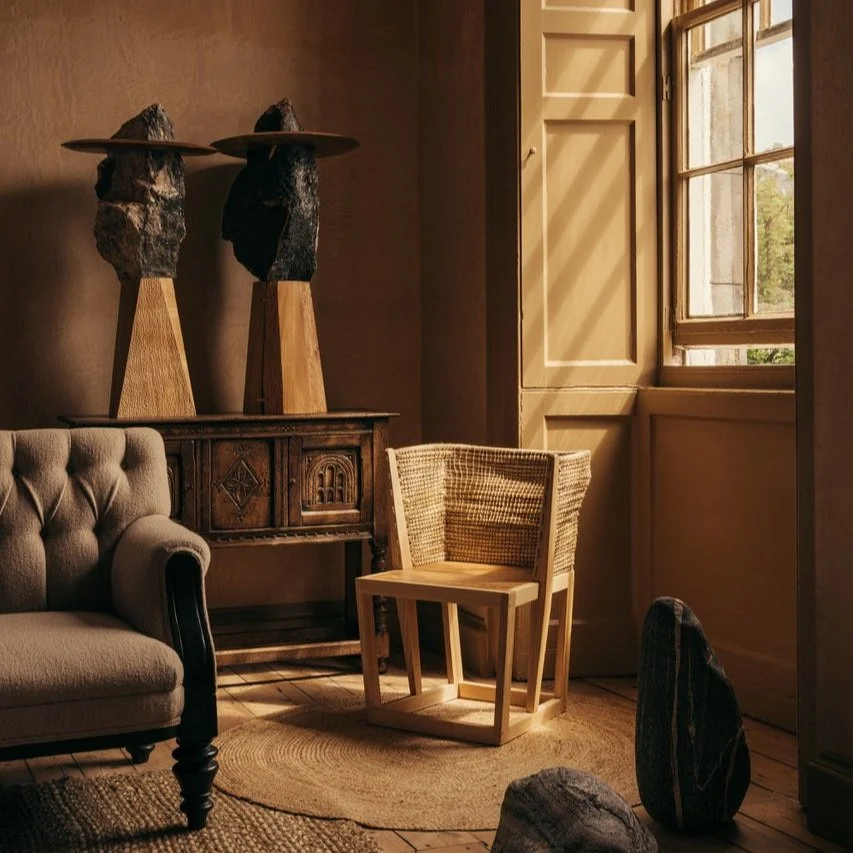
The Fair Isle straw-backed chair provides one of the clearest Scottish examples.
Heritage Crafts classifies the tradition as critically endangered.
The organisation records no practitioner earning their main income from the craft, one person earning side income from it and two trainees.
The chairs are not simply Orkney chairs made somewhere else.
The Fair Isle form has its own timber construction and a distinctive straw-working method in which the back is formed using tightly knotted fishing line rather than the stitched rows associated with neighbouring traditions.
The craft also depends on another vulnerable part of Shetland’s material culture: black oats, traditionally used for the straw.
Heritage Crafts records shortages of suitable locally grown oats, the ageing and ill health of experienced makers, the difficulty of maintaining a craft business on Fair Isle and the island’s small population as threats to continuation.
The survival mechanism is now highly personal.
Skills have been passed from Stewart Thomson, who revived the tradition in the late twentieth century, to Eve Eunson and a small number of trainees. Workshops at Shetland Museum and Archives are helping to transmit straw-working techniques to another generation.
If that chain breaks, no amount of money spent storing old Fair Isle chairs will recreate the unrecorded judgement built through making them.
Other Scottish Traditions Are on the Same National Red List
The Red List also identifies practices with particularly strong Scottish cultural connections including Shetland lace knitting, shinty caman making, sgian dubh and dirk making, sporran making and Scottish vernacular thatching.
Northern Isles basket-making traditions using straw, rush and other locally available materials have also faced serious problems of practitioner numbers, skills transmission and access to raw materials.
Some classifications improve as new practitioners enter a craft. Sporran making, for example, has been reclassified as less endangered in the latest Red List.
That is evidence that decline is not necessarily irreversible.
But improvement generally requires somebody to teach, somebody able to spend time learning and some prospect that the skill can support either income or continued serious practice.
A craft with one or two expert practitioners cannot be rebuilt quickly once that generation is gone.
A £1,200 Grant Can Help, But It Cannot Finance a Succession System
The Traditional Arts and Culture Fund is useful precisely because small sums can make practical activity possible.
£1,200 can help pay an artist’s fee, travel, workshop costs, venue hire, materials or professional development.
For a traditional practice at ordinary risk, that can support valuable work.
For a critically endangered craft, the problem can be much larger.
Training may require months or years beside an experienced practitioner. Specialist tools may no longer be commercially manufactured. Materials may have become difficult to obtain. A trainee may have to give up paid work in order to acquire a skill for which there is initially little market.
The craft may also be geographically fixed. Learning a Fair Isle practice on Fair Isle, or a Shetland practice within the cultural setting that produced it, is different from learning a generic version from a book or online video.
The Red List assesses precisely these conditions: practitioner numbers, age profiles, training opportunities, commercial viability, material supply and whether an effective mechanism exists to transmit knowledge.
Those problems are larger than the maximum £1,200 award available through Scotland’s broad traditional-culture fund.
The Dedicated Endangered Crafts Fund Is Charitable and UK-Wide
The separate Endangered Crafts Fund does target the problem directly.
Heritage Crafts established it in 2019 to support work involving crafts on the Red List.
Applications for the current round close on 16 October, with grants of up to £2,500 available.
The scheme operates across the United Kingdom rather than Scotland alone.
Several awards in the current programme are also geographically ring-fenced through individual donors and charitable support.
The fund is not a large standing Scottish Government programme for endangered Scottish craft.
Heritage Crafts is a charity and its endangered-craft grants depend on fundraising, trusts, foundations and other donors.
That means some of Scotland’s most vulnerable traditional skills currently depend partly on a UK charity finding small pots of money rather than on a dedicated Scottish national safeguarding budget of comparable scale to other cultural programmes.
Scotland Has Now Accepted an International Obligation to Safeguard Living Heritage
The policy context changed when the United Kingdom ratified UNESCO’s Convention for the Safeguarding of the Intangible Cultural Heritage in 2024.
The Convention covers living cultural practices rather than monuments and collections alone.
Its scope includes oral traditions, performing arts, social practices, knowledge concerning nature and the universe and traditional craftsmanship.
The Scottish Government says it is working with the UK Government and the other devolved administrations on implementation of the Convention.
This places traditional craft within a formal international heritage framework.
The concept is significant because it defines heritage as something people do as well as something people possess.
A weaving technique, song tradition, boat-building method or way of working straw can therefore be heritage even when there is no listed building or museum object attached to it.
The Red List Is Designed Around Whether Knowledge Will Reach the Next Generation
Heritage Crafts does not classify a craft as endangered simply because few people practise it.
The assessment examines whether enough practitioners remain to pass the knowledge on.
A craft can become endangered because its practitioners are ageing, because training has disappeared, because tools or materials are unavailable, because demand is too low to make a living, or because too few people possess the complete traditional skill rather than a simplified modern version.
Cultural context can also be part of the classification.
Shetland lace knitting illustrates this.
Knitting lace patterns is not itself exceptionally rare. The threatened tradition is the particular Shetland community of practice: skills passed through an unbroken local lineage, including specific working methods and tools.
Heritage Crafts changed its methodology partly to recognise that cultural specificity.
A technique reproduced elsewhere is not necessarily the survival of the tradition from which it came.
Scottish Cultural Spending Has Been Rising
The small scale of traditional-craft support is occurring while the overall culture budget is moving in the opposite direction.
The Scottish Government has committed to increasing annual culture and arts spending by at least £100 million by 2028–29 compared with 2023–24.
The 2026–27 Budget said the cumulative annual uplift had reached more than £70 million.
Creative Scotland has received additional funding to support a substantially enlarged multi-year programme.
The Government has protected National Performing Companies, increased support for screen activity and continued large investment in national cultural collections.
This is therefore not principally a story about a government reducing cultural spending overall.
It concerns where significantly increased cultural resources are being concentrated.
Living Heritage Has No Equivalent National Institution
Scotland has permanent national institutions responsible for paintings, museum objects, libraries, records, historic buildings and performing arts.
There is no equivalent national institution employing Scotland’s endangered craft practitioners and guaranteeing that every critically endangered Scottish skill is taught to a successor.
Responsibility is dispersed between practitioners, charities, museums, community organisations, Creative Scotland, TRACS, heritage bodies and individual training initiatives.
That structure can support active communities where a tradition remains healthy.
It is less secure where the number of people carrying the knowledge has fallen into single figures.
A craft does not need a large arts organisation in order to survive. It does require at least one viable route through which knowledge passes from one generation to the next.
The Funding Comparison Records a Choice of Scale
Public budgets cannot reveal whether ministers personally value a Fair Isle chair maker, Shetland lace knitter or caman maker.
They can show the scale of institutional priority attached to different activities.
Scotland can commit £56 million towards a new facility to safeguard and improve access to physical national collections. It can budget more than £100 million a year for those collections as a whole. It can allocate more than £100 million to Creative Scotland and almost £25 million to National Performing Companies.
The nationwide small-grants programme spanning traditional music, song, storytelling, dance, crafts, languages and other intangible heritage has £43,000.
A Scottish traditional craft practitioner applying to that programme can receive no more than £1,200.
A practitioner applying to the separate UK-wide charitable Endangered Crafts Fund can seek up to £2,500.
Those figures do not establish an absence of government concern. They establish that living traditional heritage is being supported at a financial scale far below the major institutions, collections and capital projects that dominate Scotland’s cultural expenditure.
The Cost of Waiting Is Different for a Living Skill
Buildings and collections can deteriorate, sometimes severely, when investment is delayed. Their conservation can become more difficult and more expensive.
A living skill has a different point of failure.
Once the last person capable of performing and transmitting a craft is gone, additional money cannot simply purchase the original chain of knowledge back.
Researchers may reconstruct parts of the process from surviving objects, documents, film and oral history. The result is reconstruction rather than uninterrupted transmission.
The Fair Isle chair tradition now has only a handful of people carrying its specialist knowledge forward. Similar vulnerabilities exist around other Scottish crafts on the Red List.
The Government is now participating in implementation of UNESCO’s international convention for safeguarding precisely this category of heritage.
Its next culture budgets will therefore reveal whether recognising intangible cultural heritage internationally is accompanied by a larger domestic mechanism for keeping endangered Scottish skills alive.
Sources
Scottish Budget 2026 to 2027 — Constitution, External Affairs and Culture
Scottish Government, 2026
https://www.gov.scot/publications/scottish-budget-2026-2027/pages/15/
Autumn Budget Revision 2026–2027: Education, Culture and Gaelic
Scottish Government, September 2026
https://www.gov.scot/publications/2026-27-autumn-budget-revision-supporting-document/pages/6/
Scottish Spending Review 2026 — Delivering on our Priorities
Scottish Government, 2026
https://www.gov.scot/publications/scottish-spending-review-2026/pages/2/
Applications Open for Traditional Arts and Culture Fund
Traditional Arts and Culture Scotland, 19 January 2026
https://tracscotland.org/applications-open-for-traditional-arts-and-culture-fund/
Traditional Arts and Culture Fund
Traditional Arts and Culture Scotland, 2026
https://tracscotland.org/traditional-arts-and-culture-fund/
Endangered Crafts Fund
Heritage Crafts, 2026
https://heritagecrafts.org.uk/ecf/
Red List of Endangered Crafts 2025
Heritage Crafts, May 2025
https://www.heritagecrafts.org.uk/wp-content/uploads/2025/05/Red-List-2025-publication.pdf
Fair Isle Straw Back Chair Making
Heritage Crafts, current 2026
https://heritagecrafts.org.uk/craft/fair-isle-straw-back-chair-making/
Categories of Risk
Heritage Crafts, current 2026
https://heritagecrafts.org.uk/categories-of%20risk/
The Art Works
National Galleries of Scotland, current 2026
https://www.nationalgalleries.org/node/71816
Culture Strategies
Scottish Government, current 2026
https://www.gov.scot/policies/arts-culture-heritage/culture-strategy-for-scotland/
Changes to How We Approached the 2023 Edition of the Red List
Heritage Crafts, 2023
https://heritagecrafts.org.uk/our-stories/methodology-2023/
Northern Isles Basket Making
Heritage Crafts, current 2026
https://heritagecrafts.org.uk/craft/northern-isles-basket-making/