

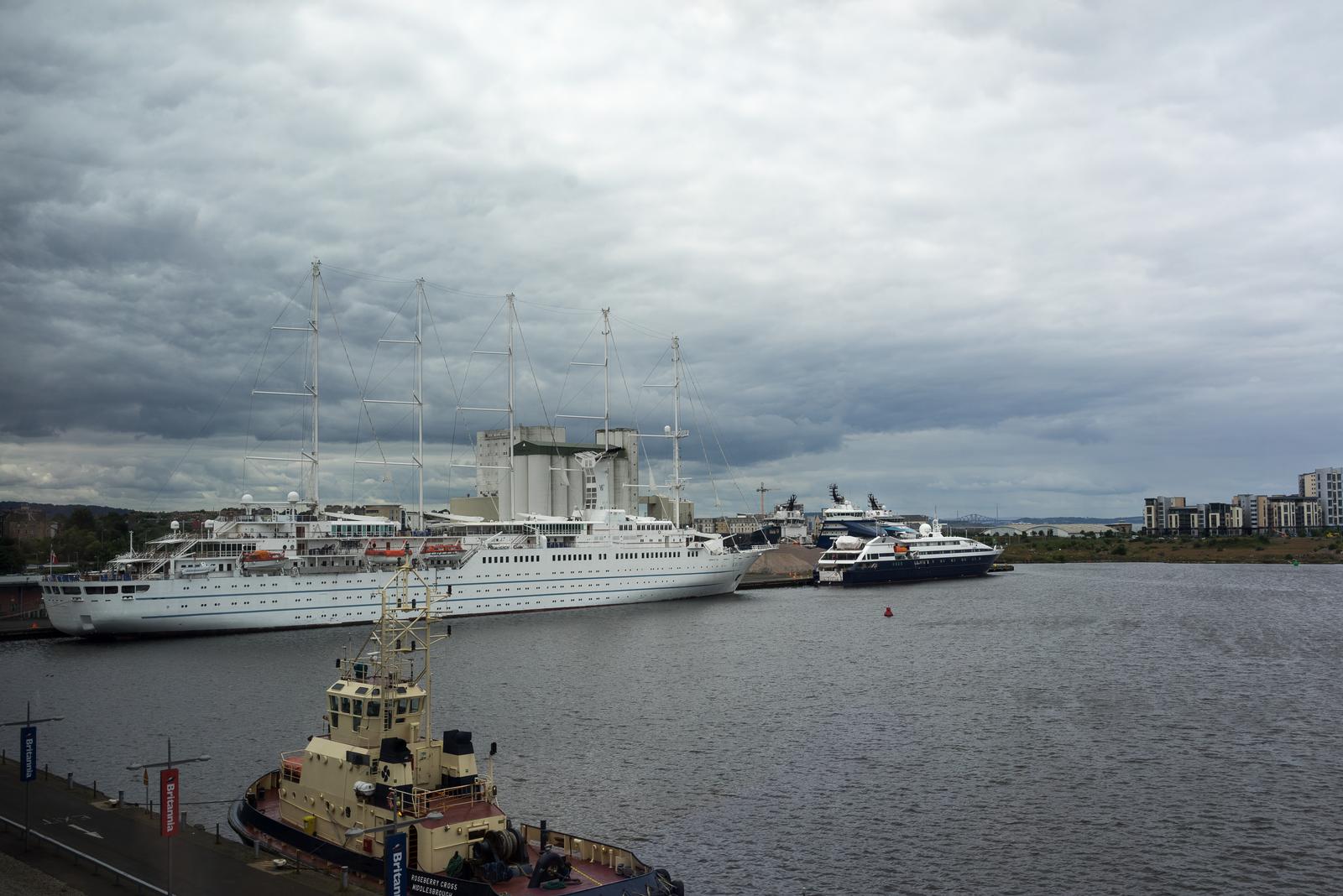
Scotland’s largest commercial airports and some of its most important ports are controlled through international pension funds, infrastructure managers and private-capital groups. Recent transactions at Edinburgh, Glasgow and Aberdeen have made that ownership structure still more concentrated, while the state retains regulatory powers but does not control the commercial decisions of the assets themselves.
Edinburgh Airport is majority-owned by the French infrastructure group VINCI. Glasgow and Aberdeen airports are controlled by an airport investment company owned by one of Canada’s largest pension funds, with Blackstone holding a minority stake. Grangemouth, Leith, Rosyth, Dundee and four other commercial ports belong to Forth Ports, whose investors include Canadian and Australian pension capital and a consortium of British pension funds. On the Clyde, Peel Ports is backed by British, Australian and Dutch-linked infrastructure investors, including a vehicle jointly owned by APG and Global Infrastructure Partners.
The ownership has not arrived through one recent privatisation programme. It has accumulated over more than three decades as former public or listed infrastructure moved into increasingly specialised global investment structures.
The result is a transport system in which some of Scotland’s most important gateways remain physically fixed in Scottish communities while the capital controlling them can change hands internationally.
Edinburgh Changed Hands for £1.27 Billion
The most recent large Scottish airport transaction began in April 2024, when VINCI Airports agreed to buy 50.01 per cent of Edinburgh Airport for approximately £1.27 billion.
The transaction completed in June that year.
The remaining 49.99 per cent continued to be managed by Global Infrastructure Partners, which had owned Edinburgh Airport since buying it from BAA in 2012. In October 2024, BlackRock completed its acquisition of Global Infrastructure Partners, bringing the infrastructure manager into one of the world’s largest asset-management groups.
VINCI describes Edinburgh as a freehold airport under full ownership rather than an operating concession with an expiry date.
That is an important feature of the asset. The airport is not being operated for the Scottish Government for 20 or 30 years before reverting to public ownership. The company owns it.
Edinburgh handled 15.8 million terminal passengers in 2024, according to Transport Scotland, and VINCI says traffic reached almost 17 million in 2025. It is Scotland’s largest airport.
Its ownership is therefore divided between a French infrastructure operator and an investment platform now owned by BlackRock.
Glasgow and Aberdeen Followed in 2025
Glasgow and Aberdeen airports underwent another major ownership change in January 2025.
AviAlliance acquired AGS Airports, the owner of Glasgow, Aberdeen and Southampton airports, from Ferrovial and Macquarie for an enterprise value of £1.53 billion.
AviAlliance is wholly owned by the Public Sector Pension Investment Board, or PSP Investments, one of Canada’s largest pension investment managers. PSP manages money for pension plans covering the Canadian federal public service, Canadian Armed Forces, Royal Canadian Mounted Police and Reserve Force.
Within two months of the AGS acquisition, another investor entered the structure.
Blackstone Infrastructure agreed in March 2025 to acquire a 22 per cent stake in AGS from AviAlliance for £235 million. AviAlliance retained 78 per cent.
AviAlliance describes both Glasgow and Aberdeen as fully privatised airports held for an indefinite duration.
Glasgow Airport generated £153.2 million of revenue and £63.6 million of EBITDA in 2025, according to AviAlliance. Aberdeen generated £58.1 million of revenue and £17.4 million of EBITDA.
These are not passive landholdings. They are operating infrastructure businesses capable of producing substantial recurring cash flows.
The Same Canadian Pension Investor Is Behind Forth Ports
PSP Investments also sits behind another major part of Scotland’s transport system.
It has been a shareholder in Forth Ports since 2011 and became the group’s majority shareholder in October 2018.
Forth Ports owns and operates Grangemouth, Leith, Rosyth, Dundee, Methil, Burntisland and Kirkcaldy in Scotland, as well as Tilbury on the Thames.
The Scottish ports sit at the centre of container traffic, offshore energy development, agricultural imports, project cargo, cruise activity, petrochemicals and other freight movements.
Grangemouth is particularly important because of its position in Scotland’s container and industrial supply chain. The closure of the Finnart oil terminal has also shifted future Scottish liquid-bulk traffic towards Grangemouth, according to Department for Transport freight statistics published this year.
Alongside PSP, Forth Ports lists three other institutional investors.
Aware Super and Cbus are Australian pension funds. GLIL Infrastructure is a British infrastructure investment partnership backed by pension funds including Greater Manchester Pension Fund, Merseyside Pension Fund, West Yorkshire Pension Fund, Local Pensions Partnership Investments and Nest.
Forth Ports describes GLIL’s model explicitly in investment terms: infrastructure is attractive because it can provide stable, inflation-linked returns over long periods.
That characteristic helps explain why ports and airports have become desirable assets for pension and infrastructure funds. They require large initial investment, are difficult to reproduce, possess long operating lives and can generate revenue from users over decades.
Forth Ports Was Once a Public Trust Port
The current structure is the result of a long historical change.
The Forth Ports Authority was created by Parliament in 1967 by bringing together a mixture of trust, municipal and nationally controlled ports around the Firth of Forth.
It operated as a public trust port.
The Ports Act 1991 created a route by which qualifying trust ports could transfer into private companies with ministerial consent. Forth Ports completed that process in 1992 and listed on the London Stock Exchange.
For nearly two decades it remained a publicly traded company.
In 2011, Arcus Infrastructure Partners and PSP Investments acquired Forth Ports and took it private.
PSP subsequently became the majority shareholder and other pension investors entered the structure in 2018.
The ports themselves did not move. The ownership architecture above them did.
The Clyde Has Its Own Global Ownership Structure
Much of the Clyde’s commercial port infrastructure sits within Peel Ports Group.
The group’s Scottish interests include Clydeport operations associated with Greenock and Hunterston, while Peel Ports also owns significant port infrastructure elsewhere in Britain and Ireland.
Its shareholder structure is different from Forth Ports but follows the same broad pattern of infrastructure being held as a long-duration institutional asset.
Peel Group owns 37.6 per cent. AustralianSuper, one of Australia’s largest pension funds, owns 32.4 per cent.
The remaining 30 per cent is held through Lemon 2021 Ltd, a vehicle jointly owned by APG and Global Infrastructure Partners.
APG manages pension assets in the Netherlands. Global Infrastructure Partners became part of BlackRock in October 2024.
Peel Ports finances itself not only through shareholder equity but through secured corporate debt, including bank borrowing, public bonds and private-placement notes.
That means the financial structure supporting a Scottish port can involve several layers: the operating company, institutional shareholders, infrastructure funds and external lenders.
Not All of Scotland’s Gateways Are Privately Owned
The picture across Scotland is not one of universal private ownership.
Several important ports remain trust ports. These include Aberdeen, Cromarty Firth, Inverness, Lerwick, Montrose, Peterhead, Scrabster and Stornoway.
A trust port has no shareholders. Transport Scotland’s governance guidance states that surpluses are reinvested in the port rather than distributed to owners.
Trust-port boards are expected to run commercially and generate acceptable returns, but they hold the port for a wider body of stakeholders rather than for equity investors.
Other harbour infrastructure remains under local-authority or public-company ownership.
The airport system is similarly mixed.
Highlands and Islands Airports Limited is wholly owned by Scottish Ministers and operates 11 regional airports, including Inverness, Sumburgh, Kirkwall, Stornoway, Benbecula, Barra and Islay.
Glasgow Prestwick Airport has also remained under Scottish Government ownership since ministers acquired its parent company in 2013.
The publicly owned airports tend to include services whose economic role cannot be judged solely through commercial passenger volumes. HIAL explicitly identifies lifeline connectivity to remote and island communities as part of its function.
The contrast with Edinburgh, Glasgow and Aberdeen is therefore structural rather than simply one of size. Scotland has retained public ownership where regional connectivity has required continuing state support, while its largest commercial airports sit within global investment portfolios.
Private Ownership Does Not Remove Public Law
Ownership of a port does not give its shareholder unrestricted control over everything that happens within it.
Ports operate through statutory powers that may originate in Acts of Parliament, harbour orders and other legislation. Transport Scotland administers devolved policy under the Harbours, Pilotage and Ports Acts and advises Scottish Ministers on harbour orders.
Statutory harbour authorities may exercise powers over navigation, pilotage, dredging, charging, land and harbour management depending on the legislation applying to each port.
The Harbours Act 1964 also imposes requirements around charges. Certain harbour dues must be reasonable, tariff information must be available, and the legislation provides routes through which eligible users can object to specified dues.
Scottish Government guidance makes another point clearly: company port boards are accountable to shareholders, but any organisation exercising statutory harbour powers remains accountable to the public for the way those powers are used.
Commercial ownership and statutory authority therefore sit on separate tracks.
The State Does Not Set Every Commercial Decision
Those statutory controls do not turn privately owned ports into regulated public utilities.
The Scottish Government’s guidance for trust ports says ministers do not intervene in their ordinary commercial decisions. Privately owned company ports likewise operate commercially within the powers and duties applying to them.
Decisions over capital allocation, shareholder returns, acquisitions, disposals and many commercial service arrangements sit with the companies and their owners rather than Scottish ministers.
Airports operate under a different regulatory regime but arrive at a similar outcome.
The Civil Aviation Authority can impose detailed economic regulation where an airport passes the statutory market-power test under the Civil Aviation Act 2012.
At present Scotland’s major airports are not subject to the price-control economic licences applied to Heathrow and the regulatory arrangements applying to Gatwick.
They remain subject to aviation safety law, competition law and, where applicable, the Airport Charges Regulations, but Scottish ministers do not set the ordinary commercial airport charges levied at Edinburgh, Glasgow or Aberdeen.
Ownership therefore carries genuine commercial authority even where the underlying infrastructure remains heavily regulated.
There Is Now a National-Security Check on Some Sales
The UK Government acquired a significant additional power over infrastructure ownership in 2022 when the National Security and Investment Act came fully into force.
Transport is one of 17 sensitive sectors covered by the mandatory notification regime.
Acquisitions of qualifying ports handling at least one million tonnes of cargo annually can fall within the mandatory notification requirement, as can qualifying airport acquisitions where the airport met specified passenger or freight thresholds.
A transaction that requires mandatory notification cannot lawfully complete until cleared by the UK Government.
The government can also impose conditions, call transactions in for detailed examination and, in exceptional circumstances, block or unwind an acquisition on national-security grounds.
That regime provides an ownership-control mechanism that did not exist when Forth Ports was privatised in 1992 or when it was taken private in 2011.
It is, however, a national-security test. It is not a Scottish economic-policy test of whether a particular investor is the preferred long-term owner of a strategic gateway.
Trust-Port Privatisation Still Requires a Separate Process
Scotland retains another control at the point where a trust port seeks to become privately owned.
Part I of the Ports Act 1991 provides the mechanism through which qualifying statutory harbour undertakings can transfer their property, rights, liabilities and functions into companies.
A Scottish Government response published in 2024 confirmed that ministerial consent under the legislation would be assessed case by case and that ministers had received no recent requests from Scottish trust ports seeking to change ownership status through that process.
That leaves Scotland with a mixed system.
There is a defined ministerial gate when a trust port moves into company ownership. Once an asset is already privately owned, later changes in shareholder control are principally matters for corporate law, competition rules, sector regulation and, where thresholds are met, the UK national-security regime.
The Investors Are Also Funding New Infrastructure
Institutional ownership has not meant an absence of capital spending.
Forth Ports has invested heavily in offshore-wind facilities, freight handling and redevelopment at Leith, Dundee and Grangemouth.
After acquiring AGS Airports, AviAlliance announced a five-year £350 million investment programme across Glasgow, Aberdeen and Southampton.
VINCI has likewise presented Edinburgh as an airport with further passenger and commercial growth potential.
That investment is part of the reason pension and infrastructure capital is used for assets of this type. Ports and airports require large sums over long periods, while institutional investors seek assets capable of producing durable returns over equally long periods.
The financial interests can therefore align: airports and ports need capital, while pension and infrastructure funds need long-duration investments.
The unresolved issue lies in what happens when those interests cease to align.
The Gateway Can Stay in Scotland While Its Owner Changes
Edinburgh Airport illustrates how rapidly the financial ownership above an immovable asset can change.
BAA owned it until 2012. Global Infrastructure Partners then acquired it. VINCI bought control in 2024. Later that year, BlackRock acquired Global Infrastructure Partners itself.
Glasgow and Aberdeen followed another path. Their ownership moved from the BAA structure into AGS under Ferrovial and Macquarie in 2014, then to AviAlliance in January 2025, followed by Blackstone taking 22 per cent of AGS.
Forth Ports travelled from statutory trust port, to listed company, to privately held infrastructure investment.
Each transaction changed the financial interests behind the asset while the runway, harbour, container terminal or shipping channel remained where it had always been.
That is one of the defining characteristics of infrastructure investment. The physical asset cannot ordinarily be moved, but the capital controlling it can be sold repeatedly.
Scotland Retains Regulation, but Not Ownership Control
The current system leaves Scotland with several layers of public authority.
Scottish ministers retain devolved ports responsibilities, harbour-order powers and ownership of Prestwick Airport and HIAL. Statutory harbour law continues to govern privately owned ports. The Civil Aviation Authority regulates aviation safety and competition issues. The UK Government can scrutinise qualifying acquisitions on national-security grounds.
None of those arrangements amounts to general Scottish public ownership of Edinburgh, Glasgow or Aberdeen airports, Grangemouth, Leith or the major Clydeport assets.
The commercial owners decide where their capital is invested within the constraints of contracts, legislation, planning permission, competition law and statutory duties.
The investors behind those owners are not a single category. Some are state-backed pension funds. Some manage retirement savings for public-sector workers. Some are infrastructure specialists. Others are among the largest private-capital and asset-management businesses in the world.
What they share is an investment purpose: capital is placed into infrastructure with the expectation of generating long-term returns.
Scotland’s largest commercial gateways therefore occupy two roles at once. They are infrastructure through which passengers, freight, energy equipment and trade move, and they are financial assets held inside global investment portfolios.
The ownership structure is now clear enough to trace. The harder part is determining how much influence Scotland retains over future investment, pricing and ownership changes once an asset has passed permanently into that market.
Sources
Investors
Forth Ports, current 2026
https://forthports.co.uk/investors/
Our History
Forth Ports, current 2026
https://forthports.co.uk/our-history/
Port Governance
Transport Scotland, current 2026
https://www.transport.gov.scot/transport-network/ports-and-harbours/port-governance/
Ports and Harbours
Transport Scotland, current 2026
https://www.transport.gov.scot/transport-network/ports-and-harbours/
Modern Trust Ports for Scotland: Guidance for Good Governance
Transport Scotland, 29 November 2012
https://www.transport.gov.scot/publication/modern-trust-ports-for-scotland-guidance-for-good-governance/
Scottish Trust Ports Assets: EIR Release
Scottish Government, 19 January 2024
https://www.gov.scot/publications/scottish-trust-ports-assets-eir-release/
Peel Ports Group Investor Relations
Peel Ports Group, current 2026
https://www.peelports.com/investor-relations/
VINCI Completes Acquisition of 50.01% of Edinburgh Airport
VINCI, 25 June 2024
https://www.vinci.com/en/newsroom/press-releases/vinci-completes-acquisition-5001-edinburgh-airport
Edinburgh Airport
VINCI Airports, current 2026
https://vinci-airports.com/en/our-airports/united-kingdom/edinburgh-airport/
BlackRock Completes Acquisition of Global Infrastructure Partners
BlackRock, 1 October 2024
https://ir.blackrock.com/news-and-events/press-releases/press-releases-details/2024/BlackRock-Completes-Acquisition-of-Global-Infrastructure-Partners/
AviAlliance Completes Acquisition of AGS Airports
AviAlliance, 28 January 2025
https://www.avialliance.com/avia_en/Pressrelease-80.jhtml?pid=9776
Blackstone Infrastructure to Acquire Minority Stake in AGS Airports
AviAlliance, 28 March 2025
https://www.avialliance.com/avia_en/press-80.jhtml?pid=9780
Glasgow Airport
AviAlliance, current 2026
https://www.avialliance.com/avia_en/Glasgow-Airport-35.jhtml
Aberdeen International Airport
AviAlliance, current 2026
https://www.avialliance.com/avia_en/Aberdeen-International-Airport-31.jhtml
Scottish Transport Statistics 2025 — Air Transport
Transport Scotland, 2026
https://www.transport.gov.scot/publication/scottish-transport-statistics-2025/chapter-8-air-transport/
Scottish Government Ownership of Prestwick Airport: FOI Release
Scottish Government, 24 October 2023
https://www.gov.scot/publications/foi-202300372316/
Strategic Commercial Assets — Shareholder Interventions
Scottish Government, updated 21 January 2026
https://www.gov.scot/publications/strategic-commercial-assets/pages/shareholder-interventions/
Who We Are
Highlands and Islands Airports Limited, current 2026
https://www.hial.co.uk/hial-group/who-we-are
National Security and Investment Act: Details of the 17 Types of Notifiable Acquisitions
UK Government, updated 6 February 2024
https://www.gov.uk/government/publications/national-security-and-investment-act-guidance-on-notifiable-acquisitions/national-security-and-investment-act-guidance-on-notifiable-acquisitions
Airport Market Power Assessment
UK Civil Aviation Authority, current 2026
https://www.caa.co.uk/commercial-industry/economic-regulation-and-competition-policy/competition/airport-market-power-assessment/
Responsibilities of Economic Regulation and Competition Policy
UK Civil Aviation Authority, current 2026
https://www.caa.co.uk/commercial-industry/economic-regulation-and-competition-policy/overview-of-economic-regulation-and-competition-policy/responsibilities-of-ercp/
Harbours Act 1964
UK Parliament, 1964
https://www.legislation.gov.uk/ukpga/1964/40/contents
Port Freight Annual Statistics 2025
Department for Transport, 29 July 2026
https://www.gov.uk/government/statistics/port-freight-annual-statistics-2025