
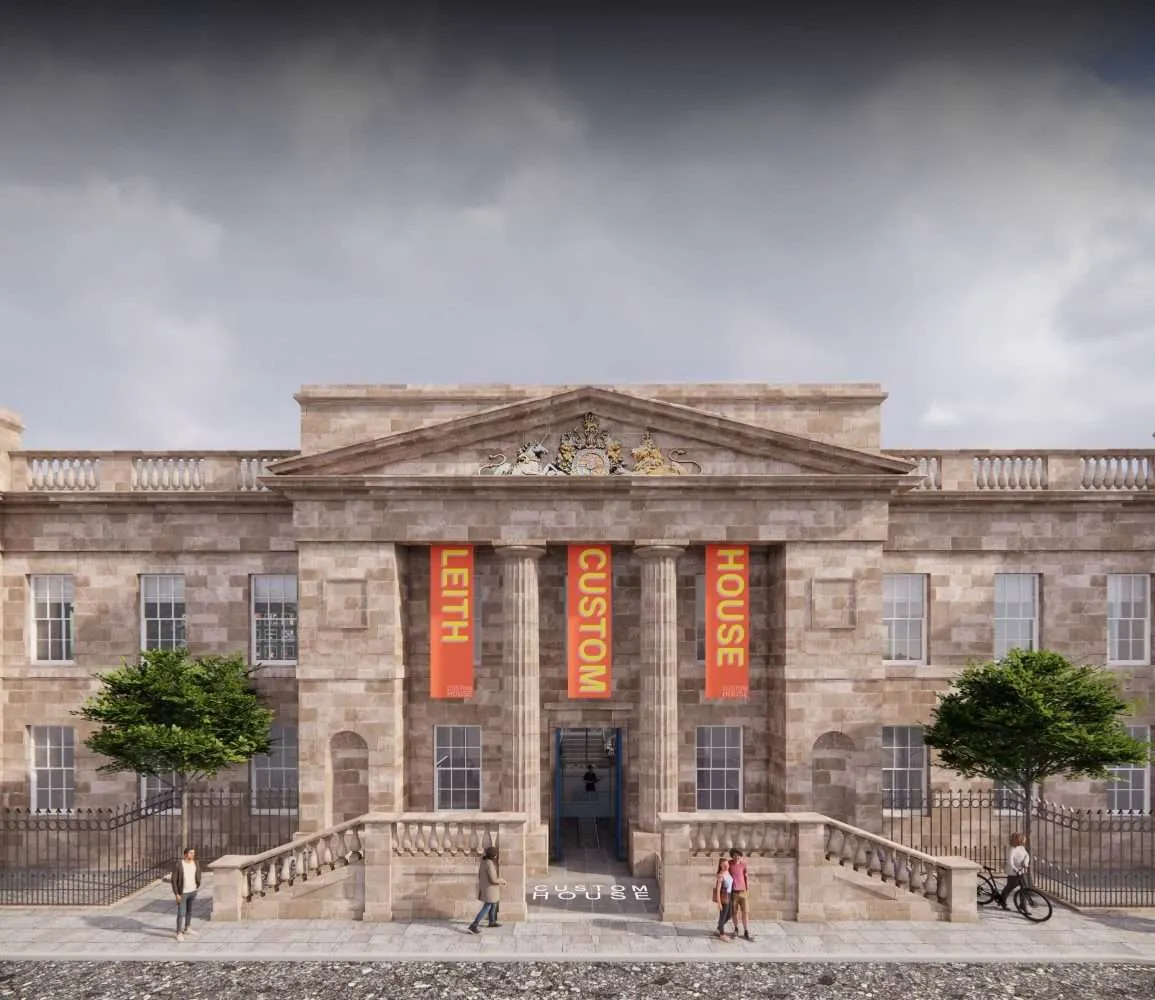
Plans for the Category A listed building would turn Scotland’s first purpose built Custom House into a digital led museum, creative hub and renewed civic space.
There are buildings that sit in a city like evidence. Leith Custom House is one of them. It stands on Commercial Street, close to the Shore, with the severity of a building designed to remind people that trade, empire, tax and government once passed through the port not as abstractions, but as daily fact. It is handsome, but not gentle. Its stone carries authority. Its façade faces a district that has changed repeatedly around it, sometimes by prosperity, sometimes by neglect, and now by the more complicated force of regeneration.
The proposal now being advanced by Scottish Historic Buildings Trust is to restore and transform the building into a digital led museum for Leith, alongside community creative studios, event space, commercial uses and a renewed public route through Custom Lane. The vision document, prepared with Richard Murphy Architects, describes the aim as creating “Leith’s town square for the twenty first century” and sets out a hybrid cultural, civic and commercial use for one of the area’s most important historic buildings.
That is a large claim. It should be taken seriously, the building deserves the attention. Historic Environment Scotland records Leith Custom House as a Category A listed building, designed by Robert Reid in 1810 to 1812, with additions and alterations by William Burn in 1825. It describes a symmetrical neo classical building, with Burn’s later additions including the external staircase, pavilions and links to the rear stable range.
In plain terms, this was not a decorative civic building. It was part of the machinery of the port. Custom houses existed because ports were places of revenue, regulation, inspection and national interest. Goods moved through Leith. Duties were collected. Ships entered and left. The business of government stood close to the business of trade.
Leith’s historic importance is not a romantic invention. VisitScotland describes Leith as Edinburgh’s historic port district and says it was once Scotland’s main gateway for global trade, with eighteenth century ships carrying goods including wool, wine, raw materials and spices. The Custom House vision document places the building within that wider port story, noting that Leith’s proximity to Edinburgh made it a port of national importance and that the building was constructed beside the entrance to the East Dock, completed in 1806, with the West Dock following in 1817.
The proposed regeneration matters because Leith is no longer merely the port of old Edinburgh. It is one of the city’s most changed and contested districts: desirable, creative, pressured by development, rich in identity, and still marked by inequalities that cannot be wished away with good coffee and exposed stone. The vision document itself recognises that Leith has undergone rapid change, describing it as one of Scotland’s most densely populated neighbourhoods, with rapid gentrification and residential development alongside enduring pockets of economic deprivation.
That honesty is important. Heritage regeneration in such a place must do more than polish a building. It must answer a public question. Who is the restored building for?
The strongest part of the proposal is its attempt to make the Custom House public in a way it has never fully been. According to Scottish Historic Buildings Trust, the plan is for a landmark hybrid use space incorporating Scotland’s first fully digital museum, with eight exhibition rooms on the first floor using video walls, listening booths, screens and projectors to display digital content. The material could include historic documents, 3D object scans, photography, oral history archives, film, animation and digital contemporary art.
The trust’s own phrase is worth pausing over: “a museum for Leith, rather than a museum of Leith.”
That distinction is not cosmetic. A museum of a place can easily become a cabinet in which a community is arranged for visitors. A museum for a place has a harder duty. It must allow people to recognise themselves, argue with memory, add to the record, and see the ordinary life of a district treated as history rather than local colour.
The proposal’s digital model is partly born of practical necessity. This would be, in SHBT’s words, a museum largely without objects. The vision document imagines a digital collection for Leith, drawing on institutional holdings and material “digitally donated” by the community. Family photographs, oral histories, documents and local memories could become part of the museum’s changing displays without requiring the building to operate as a traditional object based museum.
That idea has real promise. Leith’s history cannot be told only through objects already held by national institutions. It is also in households, family albums, working lives, shipyard memory, migration stories, tenement life, trade, religion, labour, pubs, docks, music, protest, shopfronts, football, schools, clubs and small private archives that are at risk of vanishing whenever a cupboard is cleared.
Digital collection could make that memory visible.
It could also become shallow if badly handled. A digital museum is not automatically more democratic because it has screens. Technology can invite participation, but it can also flatten complicated history into atmosphere. The test will be curatorial seriousness. Who selects the stories? How are community contributions verified and preserved? How are difficult subjects handled? What happens to digital material over time? How does the museum avoid becoming a rotating display of pleasing fragments, rather than a durable civic archive?
Those questions do not weaken the scheme. They make clear what must be done well.
The infrastructure argument is just as important as the heritage one. The vision document places access at the centre of the architectural proposal, including removal of unnecessary steps, more entrances, a reconfigured and accessible main entrance from Commercial Street, new access from Custom Wharf and Dock Place, and a new public space along Custom Lane linking the Water of Leith with Victoria Quay.
That is not just architecture. It is civic repair. At present, too many historic buildings are admired from the outside by people who cannot easily enter them, use them, or feel any claim upon them. The Leith Custom House proposal recognises that a severe neo classical building, originally associated with government authority and the collection of import duties, must be made to work differently if it is to serve contemporary Leith. The point is not simply to conserve stone. It is to change the relationship between the building and the street.
The project also proposes community creative spaces, a café, museum shop, event space, retail units and commercial opportunities intended to support the building’s long term sustainability. SHBT says the ground floor would include studios for artists and makers, with commercial and retail uses helping to secure the building’s future. Richard Murphy Architects says its proposals would make the once private government offices into a fully accessible public building, with a major digital museum on the first floor, public uses on the ground floor and a lively lane of cafés and restaurants at the rear.
This is where the balance must be watched carefully. Heritage projects need income. Empty virtue does not pay for roofs, heating systems, conservation work or staff. But if commercial use begins to dominate the civic purpose, the building risks becoming another handsome piece of urban theatre for those already comfortable in the new Leith economy.
The proposal must therefore be judged by the public benefit it actually delivers: accessible heritage, affordable creative space, community involvement, educational value, and a genuine place for Leithers old and new. A high end restaurant may help sustain the building. It cannot be allowed to become the point of the building.
There is a strong story in how the Custom House reached this moment. SHBT says that after the National Museum of Scotland completed a new collections facility at Granton, the museum planned to sell the Custom House for redevelopment in 2015. The City of Edinburgh Council then purchased the building and leased it to SHBT, with initial council funded repairs allowing it to reopen for interim uses while long term plans were developed.
A City of Edinburgh Council committee report from December 2022 records that the council acquired Custom House from National Museums Scotland for £650,000 using Common Good funding on 7 April 2015. That detail matters because Common Good funding carries a particular civic weight. It suggests that the building was not simply rescued as an asset, but held for public benefit.
The building’s previous life also complicates the story in a useful way. After its customs use declined, the vision document records that it later housed other functions, including a Post Office from 1906 and the Mercantile Marine Office in the 1960s, before being sold in 1980 and used largely as storage for the national collections. A building once central to the movement of goods and people became, for a time, a storehouse for things. Now the ambition is to make it a place of public memory again.
That arc is powerful, but it should not be sentimentalised. Leith’s port history is not a simple tale of honest trade and picturesque ships. The vision document itself describes the Custom House as a neo classical building from “Scotland’s colonial age”, once used for the payment of import duties. Any serious museum for Leith will have to find a way to tell the full story of maritime trade, not merely its handsome side.
That means commerce, labour, migration, empire, class, poverty, wealth, regulation, seafaring, shipbuilding, dock work, war, decline and redevelopment. It means the history of goods, but also the history of people. It means asking what passed through Leith, who profited, who worked, who arrived, who left, and what traces remain.
A digital museum could be especially well suited to this kind of layered history. It can change. It can hold multiple voices. It can show maps, ships, documents, images, oral testimony and contemporary art together. It can let residents contribute to the record. It can allow a district to tell its story without pretending that one permanent gallery can settle the matter for all time.
But the digital promise must be matched by institutional seriousness. Digital archives require maintenance, rights management, long term storage, accessibility standards, technical renewal and curatorial discipline. Screens age. Software changes. Files become unreadable. A museum without objects still needs a conservation philosophy. Otherwise the future becomes a very expensive slideshow.
The proposed building works also deserve attention. The vision document says the project seeks £500,000 in 2025 to move to RIBA Stage 4, achieve listed building consent and planning approvals, design an energy efficient heating system, and undertake development work up to the capital delivery phase. That means the project, while well developed in vision, still sits before the hardest part of many heritage schemes: securing permissions, funding and delivery without losing the public purpose along the way.
There is also the architectural significance of the interior. The vision document highlights William Burn’s internal dual flighted imperial staircase, intended to be newly revealed as a centrepiece of the building. That matters because regeneration should not merely insert new uses into an old shell. At its best, it allows the old building to become more legible. If Burn’s staircase can be revealed and made part of public circulation, the project may allow visitors to understand the building as architecture, not only as venue.
The location adds another layer. The proposal would open Custom Lane and improve movement between the Shore, Dock Place, Commercial Street, Custom Wharf and Victoria Quay. The ground floor plan in the vision document shows new and reconfigured entrances from several sides, suggesting a building that would no longer sit as an inward looking institutional block, but as a connector between parts of Leith’s public realm.
That is why Infrastructure is the right primary section for Modern Scot. This is not only a heritage conservation story. It is about public access, civic space, adaptive reuse, the relationship between a listed building and its surrounding streets, and the attempt to create cultural infrastructure in a rapidly changing district.
Heritage is still essential. Without the history, the project has no soul. But infrastructure is what will decide whether the history becomes useful to the public.
The central risk is that Leith Custom House becomes too many things at once: museum, event space, café, restaurant, studios, retail, visitor attraction, creative hub, public lane, heritage monument and regeneration symbol. Such projects can become overburdened with expectation. Scotland has seen enough glossy visions to know that every proposed civic space is described as vibrant until someone has to pay the heating bill.
Yet this proposal has strengths that should not be dismissed. The building is genuinely important. The community need is credible. The interim creative uses have already begun to return life to the place. The architectural team is experienced. The digital museum idea responds to the fact that Leith’s heritage is widely dispersed across institutions, private memory and living community. The use of Common Good funding in the building’s rescue gives the project a public obligation as well as a public opportunity.
The question now is whether the next stages can hold the balance.
Leith does not need a museum that embalms it. It does not need a commercial venue with heritage as wallpaper. It does not need another polished development that honours the past while pricing out the people who carry it. What it may need, and what this project appears to be trying to create, is a public building where the district can examine itself across time.
That is a serious ambition. If it succeeds, Leith Custom House could become more than a restored Georgian landmark. It could become a civic instrument: a place where port history, contemporary creativity, public access and local memory meet without one cancelling the others.
For now, the promise should be recorded carefully. The proposal is not yet the finished building. The museum is not yet open. Funding, consent, delivery and governance still matter. But the direction is important.
A building that once measured the value of goods entering Scotland is now being asked to measure something more difficult: the value of a place’s memory, and whether it can still belong to the people who live around it.