
For generations, Scotland’s energy story was associated with coalfields, hydroelectric dams and later the offshore oil and gas industry of the North Sea. Today, another chapter is being written, more quietly, and with consequences that are only beginning to be understood.
Scotland’s renewable energy infrastructure is increasingly becoming part of the physical foundation of the global artificial intelligence economy. As demand for data centres, cloud computing and AI services grows, electricity generation, grid capacity and power management are no longer background technical issues. They are becoming central to the future of digital infrastructure.
The clearest recent example came in 2025, when Google announced a two year, £5 billion investment in the United Kingdom, including the opening of a new data centre at Waltham Cross in Hertfordshire. Much of the announcement focused on artificial intelligence, jobs, cloud services and Google’s wider UK presence. Yet within the energy arrangements attached to the project was a connection that matters directly to Scotland.
Google said its UK energy strategy would include an agreement with Shell Energy Europe to help manage power supply and support grid stability. That agreement includes the management of electricity linked to Google’s existing clean energy portfolio, including power from its long term agreement connected to the Moray West offshore wind project in Scotland.
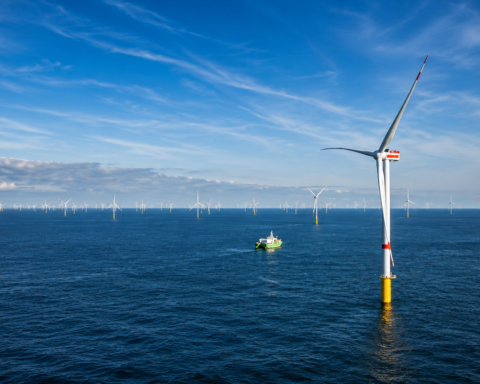
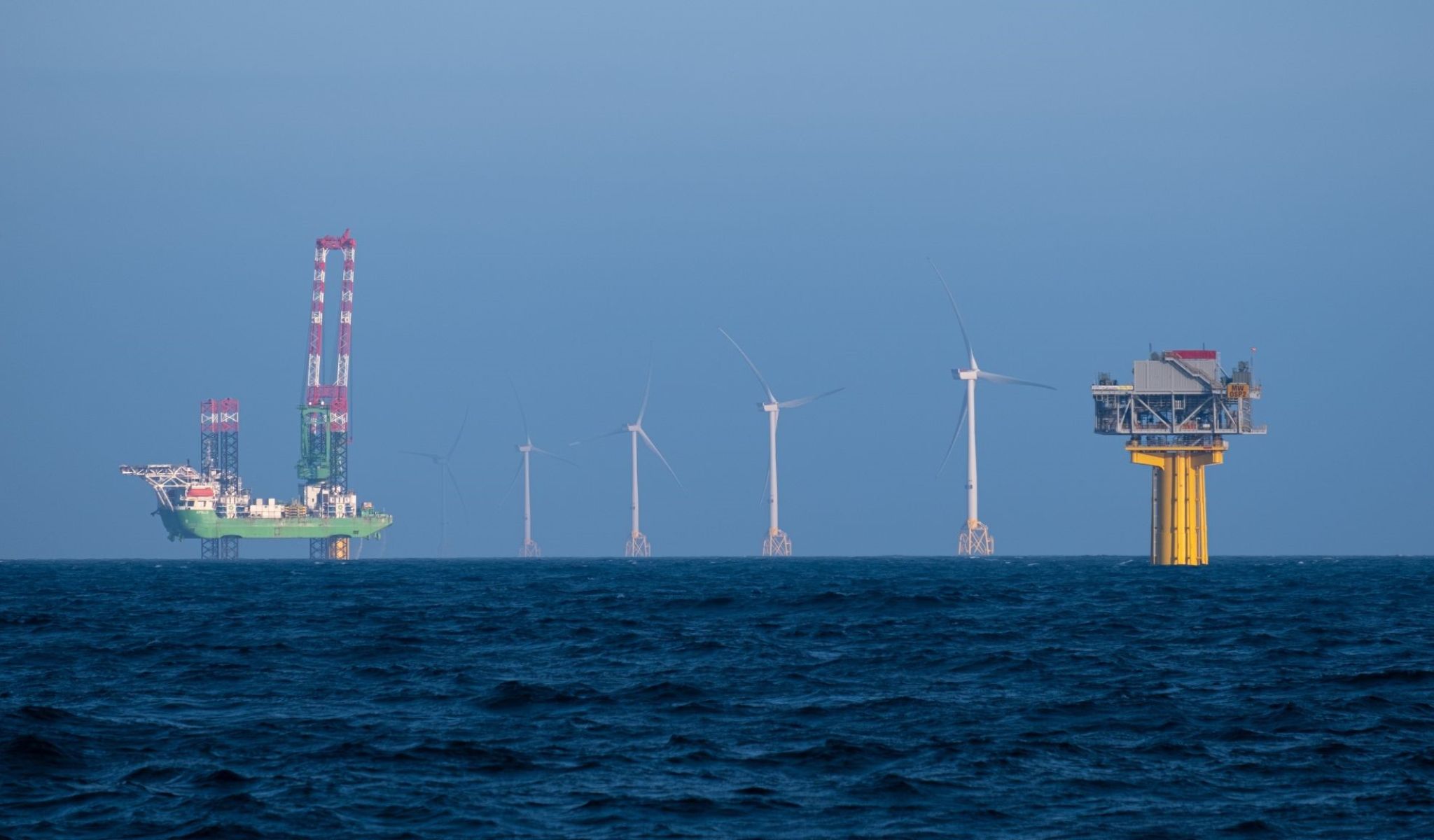
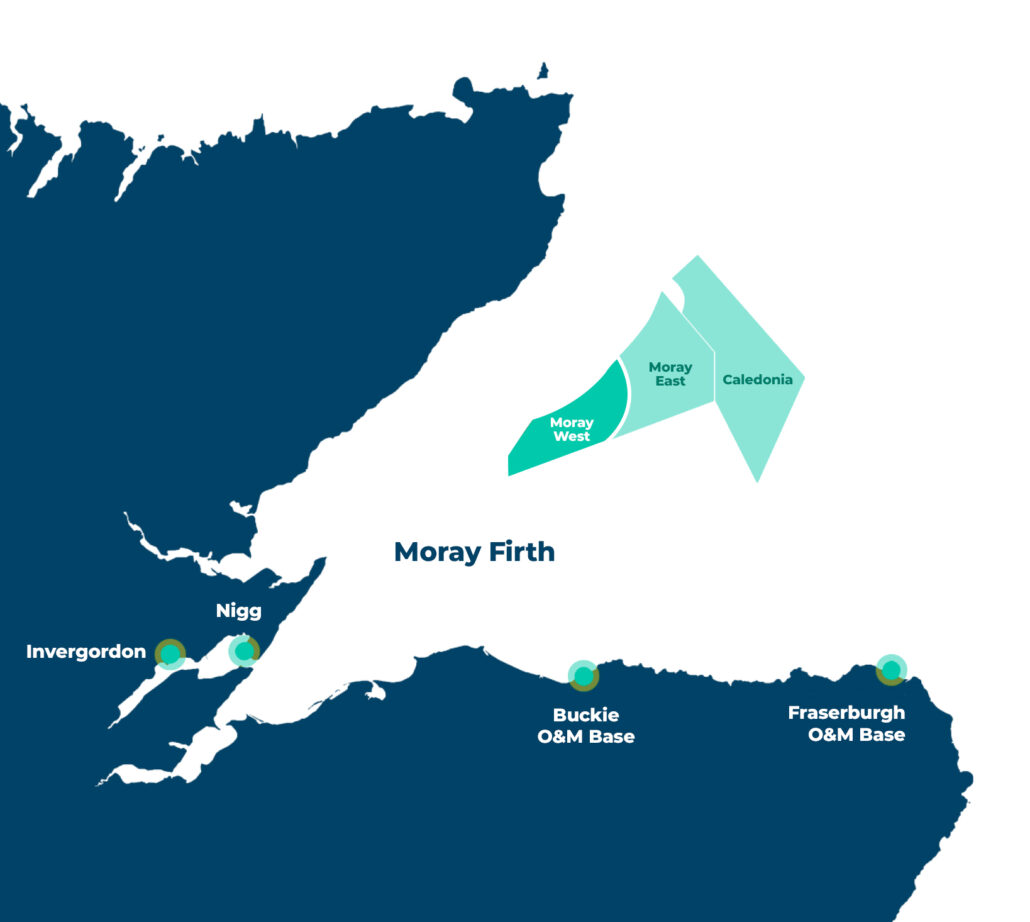
Moray West sits in the Moray Firth, off Scotland’s north east coast. It is part of a much wider transformation of the Scottish coastline into a centre of offshore renewable generation. The Moray Firth has already become one of the most important offshore wind zones in the UK, with projects such as Moray East and Moray West placing the waters between Caithness, Moray and Aberdeenshire at the heart of Britain’s energy transition.
This is not an abstract development. The same coastal waters once associated with fishing, shipping, oil support activity and North Sea weather are now tied to the electricity demands of digital systems used across the country and beyond. The power generated there enters the wider UK electricity system, where it can support homes, businesses, public services, transport networks and industrial users, including the infrastructure behind AI and cloud computing.
That matters because artificial intelligence is not weightless. Public discussion often treats AI as software, a matter of models, prompts and digital services. In reality, it depends upon very physical systems: data centres, electricity generation, cooling technology, battery storage, transmission networks and grid balancing. Every search, calculation, image generation, cloud service and AI assisted workplace tool has a material infrastructure behind it.
Large data centres require continuous, reliable electricity. Renewable power, including offshore wind, can provide substantial generation, but it is variable by nature. Wind output rises and falls. Demand from data infrastructure does not conveniently rise and fall with it. That is why companies such as Shell Energy Europe are now involved in managing power portfolios, battery storage and balancing arrangements.
Shell’s role in this context is not simply the familiar one of an oil and gas company. It is operating as an energy manager within the electricity market, helping match renewable generation, storage and demand across time. That reflects a broader shift in which traditional energy companies are increasingly active in power trading, battery systems and renewable electricity management.
For Scotland, this creates a more complicated story than a simple announcement of green investment.
The country has major renewable resources. It has offshore wind in the Moray Firth, onshore wind across upland areas, hydroelectric schemes that reshaped parts of the Highlands in the twentieth century, and expanding transmission projects designed to move more electricity through the grid. Scotland has long exported energy in one form or another. What is changing is the destination and purpose of that energy within a more digital economy.
The hydro schemes of the Highlands were once presented as modernising projects, bringing electricity, employment and industrial ambition into remote areas. North Sea oil later made Scotland central to the energy politics of Britain and Europe. Offshore wind now occupies a similar strategic position, though under very different environmental and economic conditions.
The question is no longer whether Scotland can generate energy. It plainly can. The question is how the benefits, costs and visible infrastructure of that generation are distributed.
That question becomes sharper because Scotland continues to face severe fuel poverty. Official Scottish Government estimates indicate that around 732,000 households are in fuel poverty, with around 357,000 in extreme fuel poverty. In rural and island areas, the pressure can be especially acute because of colder conditions, older housing, limited heating options and higher costs associated with distance and infrastructure.
This creates a difficult public policy contrast. Scotland is producing and transmitting increasing amounts of renewable electricity into the wider UK system at the same time as hundreds of thousands of Scottish households struggle with the cost of heating and power. The existence of renewable generation in Scotland does not automatically mean lower bills for Scottish households, because electricity is priced through wider UK market arrangements rather than reserved locally.
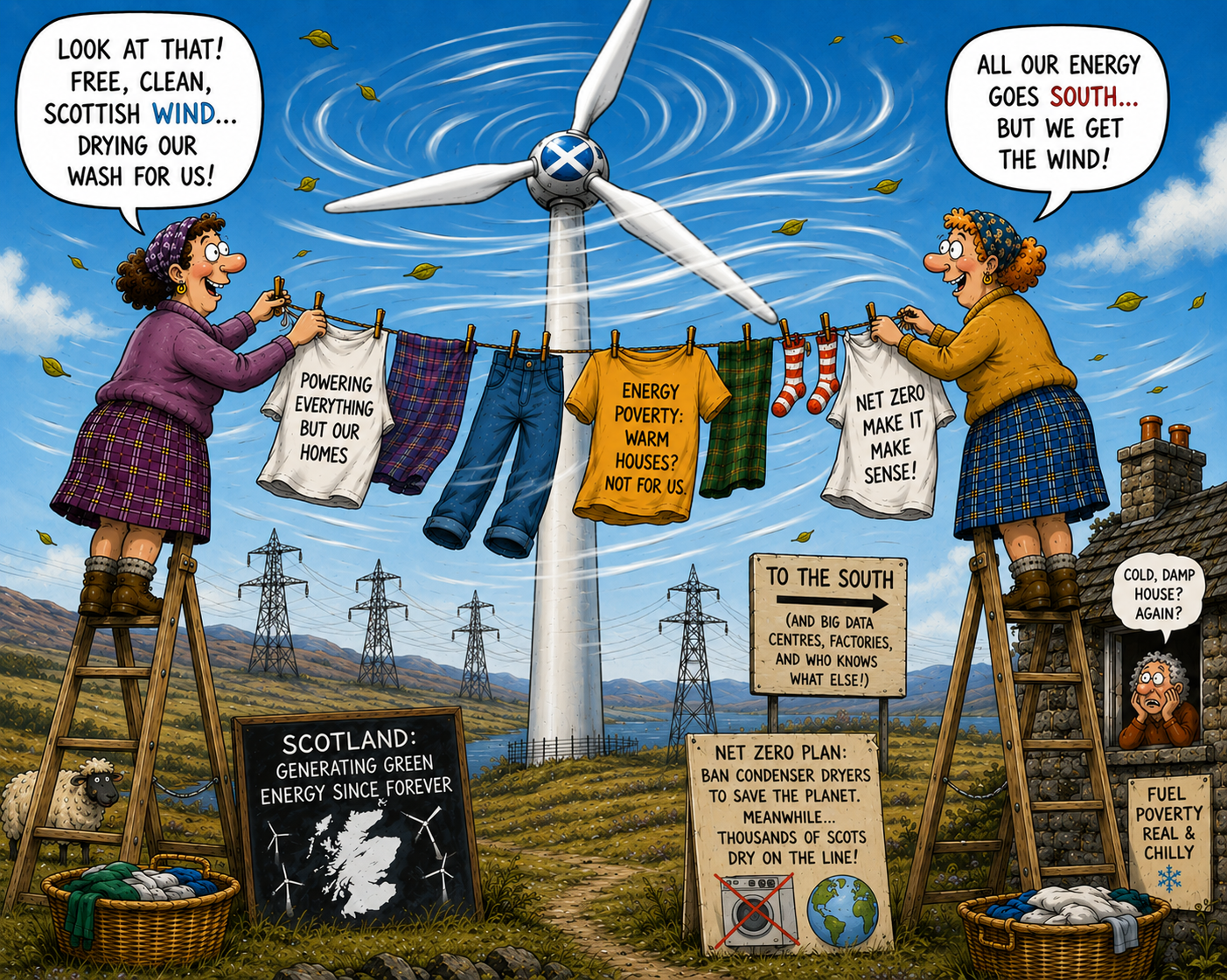
That distinction is crucial. Power generated from Scottish offshore wind projects enters the national system. It is not set aside first for nearby communities, nor does a data centre elsewhere simply draw a labelled Scottish electron down a dedicated private line. The system is more complex, involving contracts, balancing, supply agreements and the wider electricity market. But the practical reality remains that Scotland’s renewable infrastructure is helping support growing demand across Britain, including demand from major technology companies.
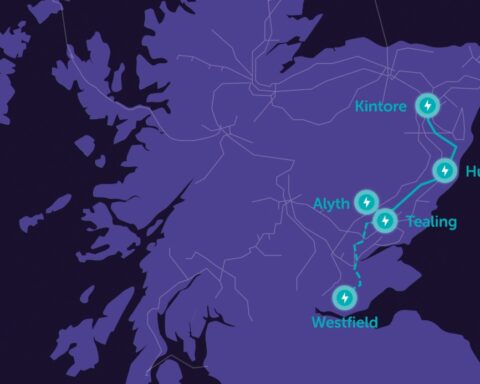
Transmission infrastructure is therefore becoming a major part of the story. New substations, overhead lines, converter stations and grid reinforcement projects are increasingly visible in parts of rural Scotland. These are not decorative additions to the landscape. They are the physical means by which renewable energy is moved from where it is generated to where it is used.
For some communities, that brings opportunity. Renewable development can support engineering work, port activity, maintenance jobs, land payments, local investment and supply chain contracts. Ports such as those in the north east and Highland regions have already become part of the wider offshore wind economy. The growth of renewables can also attract further industrial activity if manufacturing, servicing and grid investment remain connected to Scottish places.
But the benefits are not automatic. Nor are they always felt evenly. One of the central questions for Scotland is whether the country will remain mainly a source of generation and transmission, or whether more of the higher value economic activity connected to AI, data infrastructure and advanced energy systems will also take root here.
Google’s Waltham Cross data centre is in England. The AI and cloud services it supports are part of a UK and global business. The renewable power arrangements connected to Scottish offshore wind help strengthen the energy position behind those operations. The direct economic benefit to Scotland is therefore more indirect than if the data centre, associated research activity or high value digital employment were located in Scotland itself.
That does not make the arrangement improper. Energy markets routinely operate across regions. Renewable generators need buyers. Large companies need stable power. Grid systems depend upon balance. But it does make the public interest question unavoidable: what should Scotland receive, economically and socially, when its energy geography becomes increasingly important to the infrastructure of the AI age?
The issue is likely to become more prominent. International energy bodies have warned that data centre electricity demand is expected to rise sharply as AI adoption expands. Governments are simultaneously encouraging electrification of transport, heating and industry. That means AI demand will arrive alongside other rising pressures on the grid.
In Scotland, those pressures will intersect with existing debates about pylons, community benefit, offshore leasing, fuel poverty, planning consent, port redevelopment and the pace of grid upgrades. These are not separate stories. They are now part of the same national infrastructure question.
The Scottish Government has consistently promoted renewable energy as both a climate necessity and an economic opportunity. Offshore wind in particular has been described as a long term asset capable of supporting jobs, investment and decarbonisation. That may prove correct. But the Google and Shell arrangement shows that Scotland’s renewable infrastructure is also being drawn into a much larger technological system, one in which artificial intelligence, cloud computing and electricity markets are increasingly connected.
For the public, the important point is not that Scotland is somehow powering one company. The reality is more subtle and more significant. Scotland is becoming part of the energy base of a digital economy whose physical needs are expanding rapidly.
That makes fuel poverty harder to ignore, not easier. A country cannot be asked to accept new transmission lines, offshore infrastructure and energy market complexity without also asking how ordinary households experience the benefits of that transition. If renewable energy is to be understood as a national asset, the public will reasonably expect that its value is felt not only in corporate contracts and grid statistics, but in warmer homes, stronger local economies and visible Scottish advantage.
For now, the long term consequences remain uncertain. What is clear is that Scotland’s energy landscape is no longer only about climate targets or domestic power supply. It is becoming part of the machinery behind the next global technological economy.
And that raises a simple question that will become harder to avoid.
As Scotland helps power the future, who in Scotland will feel the benefit?