
A new report commissioned by Confor challenges a Royal Society of Edinburgh inquiry into public support for forestry. Behind the technical dispute lies a larger question for Scotland: how to balance timber, carbon, biodiversity, rural jobs and the country’s dependence on imported wood.
Scotland’s forests are being asked to do almost everything.
They are expected to store carbon, support wildlife, provide public access, protect soils and water, supply timber, sustain rural jobs, help build homes, reduce imports and fit into landscapes where farming, rewilding, peatland, sporting estates, conservation and local communities are all competing for space.
It is little wonder the argument has become heated. Trees grow slowly. Policy does not. Money moves faster than both.
A new report by Dr Andrew Cameron, Emeritus Senior Lecturer at the University of Aberdeen’s Institute of Biological and Environmental Sciences, argues that public support for forestry and timber production delivers significant benefits to Scotland. The report was publicised by Confor, the forestry and wood trade body, which says it confirms the value of Scottish Government investment in productive forestry and rebuts an earlier Royal Society of Edinburgh inquiry into public financial support for tree planting and forestry.
The source of the new report matters. Confor represents the forestry and timber sector, and has a clear stake in the future of public support for productive forestry. That does not make the argument wrong. It does mean the article must treat the report as an intervention in a live policy dispute, not as a neutral finding above dispute.
The dispute began with the Royal Society of Edinburgh’s 2024 inquiry, which called for a “radical rethink” of tree planting in Scotland. The RSE recommended that the Scottish Government discontinue subsidies for commercial conifer planting and redirect money towards tree planting designed to provide long term carbon sequestration, biodiversity and public benefits. It also called for changes around tax reliefs, environmental impact assessment, soil disturbance, native planting, riparian planting and scrutiny of forestry applications.
That was a significant recommendation. In Scotland, conifers are not a minor part of forestry. Forest Research statistics for 2024 show that woodland covers about 19 percent of Scotland’s land area, compared with about 14 percent across the UK, and that conifers account for a much larger share of Scotland’s woodland than in England.
The RSE’s case was built around environmental and social concerns. It questioned whether public money was delivering sufficient public benefit and argued for support to be reorganised around climate, biodiversity and community outcomes. That is not an unreasonable field of inquiry. Public subsidy should be examined. Tree planting has sometimes been done badly. Scotland has memories of poorly sited commercial plantations, damage to peatlands, insensitive landscapes and local resentment. Those realities should not be brushed aside with a cheerful brochure and a photograph of a seedling.
But Dr Cameron’s report says the RSE’s analysis went too far, and in the wrong direction. It argues that the inquiry did not give sufficient weight to timber production and the economic role of forestry. It also criticises the RSE’s methodology, including its reliance on an online public call and targeted invitations that produced 45 responses, which Cameron argues created a risk of bias and did not amount to a rigorous evidence base for such far reaching conclusions.
That criticism is not a mere procedural quibble. In public policy, method matters. If a report recommends ending support for a major part of Scotland’s forestry model, readers need to know whether its evidence was gathered in a way that can bear that weight. Cameron argues that the RSE report gave too little attention to economic evidence, timber security and the consequences of importing more wood from elsewhere.
This is where the story becomes larger than forestry politics.
Scotland’s forestry sector is not small. A Scottish Government release in July 2024 said forestry contributes £1.1 billion to Scotland’s economy each year and supports more than 34,000 jobs. The same release said the independent study found direct employment of 10,380 people, with a further 5,630 working across wood processing and forest activities, and 18,130 in forestry related tourism.
Those figures do not settle the environmental argument. An industry can be economically important and still require reform. But they do mean that commercial forestry cannot be treated as a decorative extra. It is part of Scotland’s rural economy, especially in areas where large scale alternatives are limited.
There is also the question of timber itself. Scotland does not use wood only because it has trees. It uses wood because houses, fences, pallets, panels, packaging, paper, energy systems and construction supply chains all require material. If Scotland produces less timber, it does not automatically use less timber. It may simply import more.
Cameron’s report makes that one of its central objections. It argues that reducing productive forestry at home risks “offshoring” environmental harm, because timber demand does not disappear when domestic supply falls. It cites concerns about global timber demand, illegal logging, pressure on natural forests abroad and the wider biodiversity effects of wealthy countries importing the products they do not produce themselves.
That is the uncomfortable part of the debate. It is easy to prefer native woodland in Scotland if the timber Scotland needs is assumed to arrive cleanly from somewhere else. It is much harder if the environmental cost has simply been moved beyond Scottish view. A policy can look green at home while exporting pressure abroad. That is not conservation.
The carbon argument is also more complicated. Native broadleaved woodland can bring major biodiversity and landscape benefits, and in the right places it is essential. Ancient and semi natural woodlands, riparian planting, habitat networks and woodland expansion designed for nature recovery all have a strong environmental case. Scotland needs more of that work, not less.
But productive forests can also store carbon, especially when timber is used in long lived products and substitutes for more carbon intensive materials. Cameron argues that the RSE’s treatment of carbon was too narrow and that it did not sufficiently consider the combined role of forest growth, harvested wood products and material substitution in construction. His report points, for example, to timber frame construction and the potential carbon savings from using wood in place of higher carbon materials.
A tree stores carbon while it grows. If it is left standing, it may continue storing carbon for a long time, depending on species, site, health, age and future disturbance. If it is harvested and used in a building, some of that carbon can remain locked in the wood product, while the next rotation of trees begins growing again. If that timber also replaces concrete, steel or masonry, there may be further emissions benefits. The calculation is not simple. It depends on timescales, soil, species, management, product use and what would have happened otherwise.
That is precisely why the debate should not be reduced to “conifers bad, native trees good” or “commercial forestry good, critics wrong.” Both versions are too crude for Scotland’s future. The country needs timber. It also needs richer habitats, restored peatlands, better designed forests, more native woodland, stronger rural economies and a serious carbon strategy. The hard part is not choosing one virtue and ignoring the rest. The hard part is making land use do several difficult things at once.
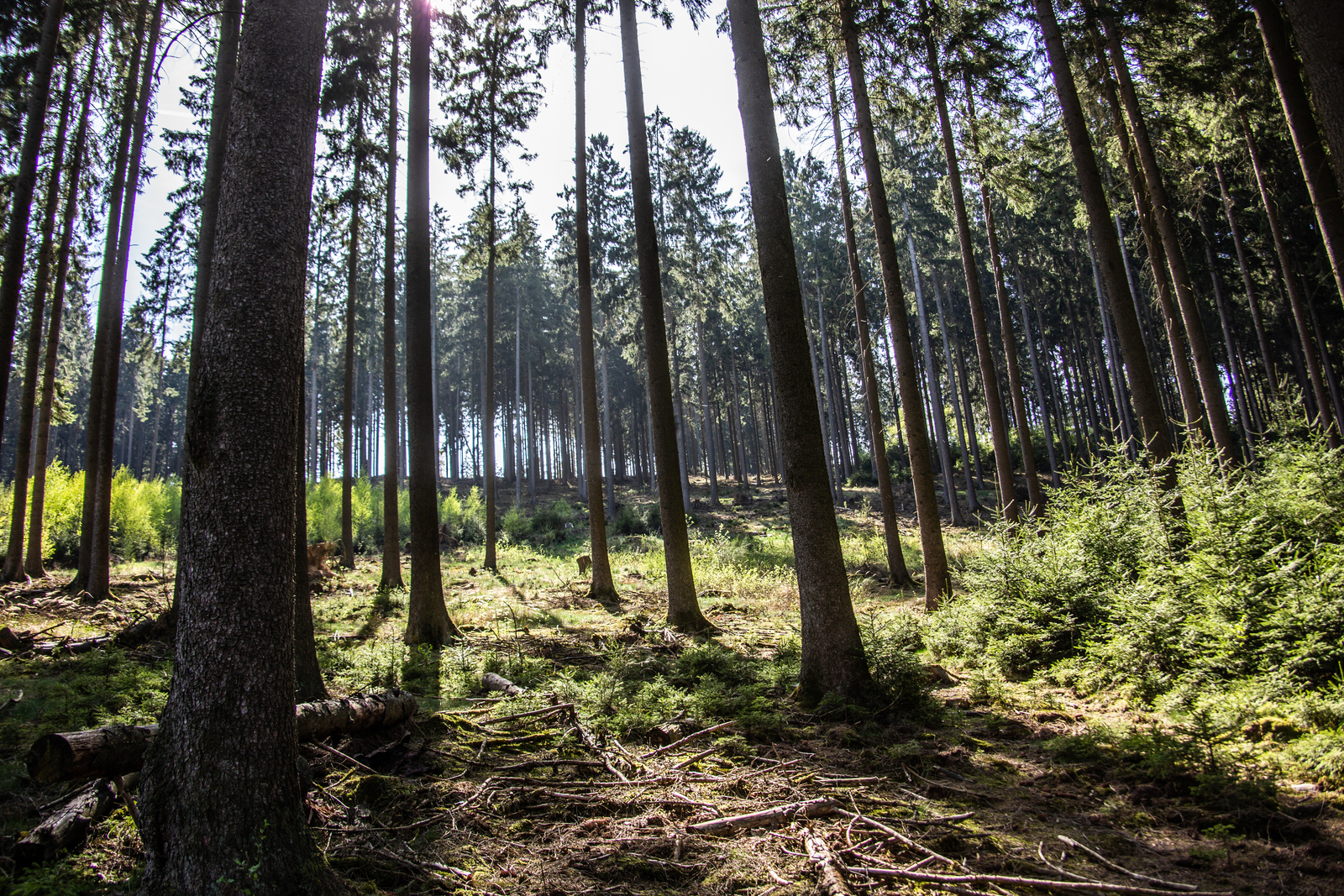
Biodiversity is the most sensitive point. Critics of commercial forestry often object to dark, even aged conifer blocks, limited species diversity, landscape impact, clear felling, damage to peatland and effects on local communities. Those concerns are real in parts of Scotland’s forestry history, and they should not be dismissed as sentimental hostility to timber.
At the same time, modern forestry standards are not the same as the worst examples of the past. The RSE itself acknowledged Scotland’s wider woodland and climate ambitions, while its recommendations included more mixed planting, native planting along watercourses and stronger scrutiny. Cameron argues that some of these principles are already embedded in current forestry policy and that productive forests can also provide biodiversity, recreation and water benefits when properly designed and managed.
Scotland should not be asked to choose between lifeless timber factories and untouched native woodland, as if those were the only two futures available. The real policy question is design: where productive forestry should be planted, where it should not be planted, how peat and carbon rich soils should be protected, how much species diversity should be required, how riparian zones, open ground, native woodland, recreation routes and landscape impact should be handled, how much local employment and processing value Scotland should expect in return for public support, and how communities should be consulted before large planting schemes change the character of a place.
Those are better questions than a simple argument over subsidies.
The RSE was right to put public support under scrutiny. Forestry receives public money, and the public has the right to ask what it receives in return. The report’s concerns about climate, nature, public benefit and land use are legitimate topics for inquiry. But Cameron’s critique raises an equally important warning: if timber production is pushed too far out of the discussion, Scotland may end up with a policy that looks environmentally virtuous while weakening rural industry, increasing import dependence and shifting ecological pressure elsewhere.
That is why this matters beyond the forestry sector.
Scotland has already learned, often the expensive way, that land use decisions echo for generations. The forests planted after the wars were shaped by timber security. Later, parts of the country paid for poor decisions in landscape, peatland and biodiversity. Today’s choices will be judged just as firmly. The question is not whether Scotland should plant trees. It is what kind of forests Scotland now wants to create, where, for whom, and with what evidence.
There is a housing dimension too. The Scottish Government has acknowledged forestry’s economic role, and timber remains central to construction. Scotland already uses timber frame construction extensively, and pressure for lower carbon building materials is unlikely to disappear. If Scotland wants more homes, lower embodied carbon and stronger domestic supply chains, productive forestry cannot be treated as an embarrassment at the edge of environmental policy.
There is also a rural community dimension. Productive forestry can support jobs in planting, harvesting, haulage, sawmilling, panel manufacture, fencing, nursery production, machinery, engineering and recreation. But forestry can also change local landscapes and affect farming, roads, housing, local services and the sense of place. Both things can be true.
The danger in this debate is that each side reaches for the simplest moral image. One side imagines native woodland, birdsong and restored nature. The other imagines timber mills, rural jobs and low carbon homes. Scotland needs all of these, but not all in the same place, and not without trade offs.
A mature forestry policy would begin by admitting that trees are not automatically good simply because they are trees. A badly sited plantation can damage important habitat. A poorly designed woodland can disappoint wildlife and communities. A policy that ignores timber demand can export environmental harm. A native woodland grant can still raise land value and alter rural economies. A commercial forest can be productive and still be expected to meet higher standards for biodiversity, water, access, soils and landscape.
That is the real public interest.
The new Cameron report is useful because it challenges an influential conclusion at a moment when Scottish parties are thinking about land use, climate, housing, growth and rural employment. But it should not be read as the final word. It is part of a contested argument, and it comes through a sector body that wants productive forestry defended. The RSE report should not be treated as the final word either. It made bold recommendations, but Cameron’s critique raises questions about whether those recommendations gave enough weight to timber, economic evidence and the international consequences of reducing domestic production.
The best conclusion is not that one report has defeated the other. The best conclusion is that Scotland needs better forestry journalism, better public explanation and better policy scrutiny.
The country’s forests are too important for that.
They are not only scenery, carbon, habitat, or timber. They are part of Scotland’s future economy, climate response, housing system, rural employment, biodiversity recovery and cultural landscape. Public money should demand public benefit, but public benefit must be defined honestly and fully. That means asking whether a forest stores carbon, supports wildlife, supplies useful material, sustains skilled work, respects local communities, protects soil and water, fits the landscape and reduces pressure somewhere else. A forest that does only one of those things may no longer be enough. Scotland’s task is to grow forests that can do several of them, and to be honest about the costs when they cannot.