
Norwegian Constitution Day will be marked in Kirkwall this weekend, but in Orkney the annual celebration is more than a borrowed national holiday. It reflects a relationship with Norway shaped by settlement, language, church history, civic friendship and public ceremony.
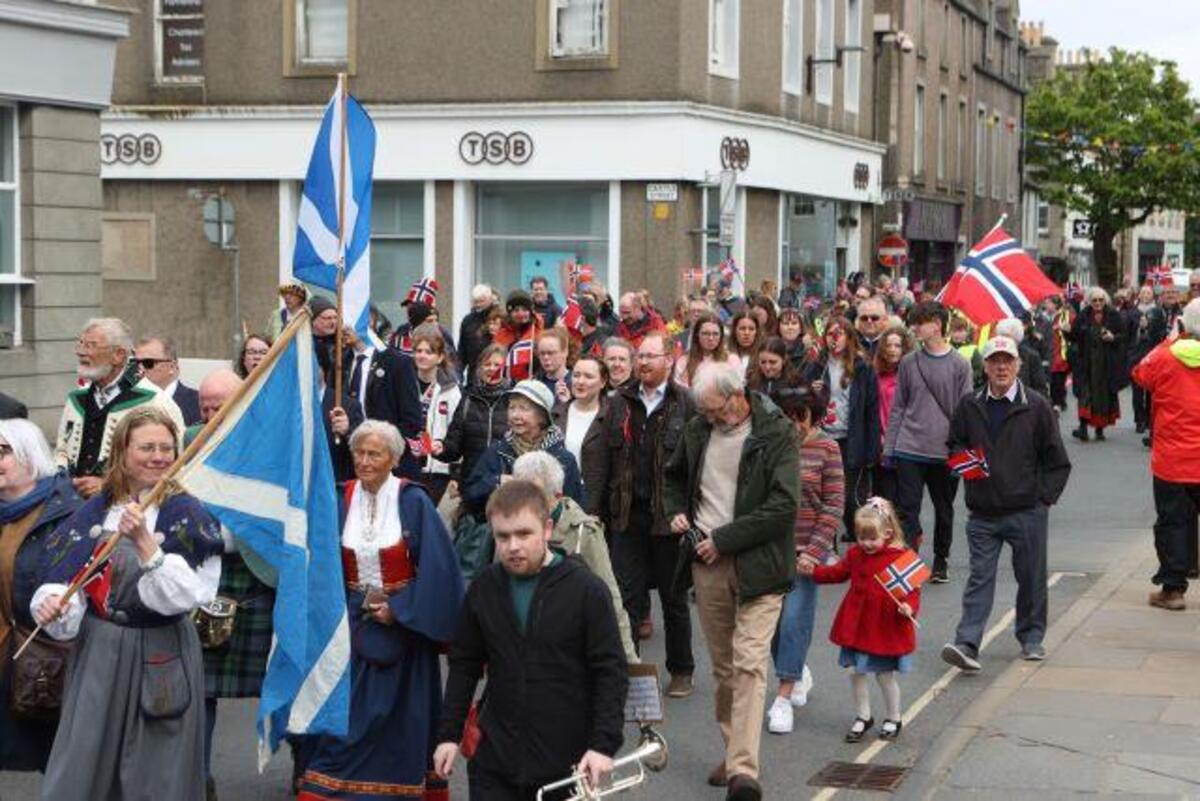
Orkney will mark Norwegian Constitution Day this weekend with a parade through Kirkwall, speeches at St Magnus Cathedral and a concert inside one of the clearest symbols of the islands’ historic relationship with Norway.
The annual celebration commemorates the signing of Norway’s constitution at Eidsvoll in 1814. In Norway, it is the national day, marked by parades, speeches, music, flags and public gatherings. In Orkney, it has a different but related meaning: it is an expression of a northern relationship that has survived in place names, architecture, civic links and local memory.
The significance of the Kirkwall event is not simply that Orkney is joining in another country’s celebration. The islands’ relationship with Norway is part of their own history. Norse settlement, Norwegian rule, ecclesiastical ties, language and later civic friendship have left Orkney with a northern inheritance that remains unusually visible in Scotland. Norwegian Constitution Day is one of the moments when that inheritance becomes public ceremony.
The main Kirkwall programme will take place on Sunday, 17 May. The Tog parade is due to leave Kirkwall Pierhead at 3pm and proceed to St Magnus Cathedral, where speeches will be held outside before a concert inside the cathedral. Members of the public, including local schoolchildren, have been invited to take part.
This year’s guest of honour is Beate Skretting, Grimstad’s first female mayor. She was elected mayor of Grimstad for the periods 2019 to 2023 and 2023 to 2027, and represents Høyre, Norway’s Conservative Party. Orkney receives a Christmas tree each year from Grimstad for the inside of St Magnus Cathedral, with a second tree from Vestland placed outside.
That exchange of trees may sound modest, but such gestures matter in civic relationships. They give visible form to a friendship that might otherwise exist only in council minutes and formal agreements. In Orkney, where public memory is often carried through repeated acts, the annual Norwegian tree and the May parade belong to the same pattern of recognition.
Norwegian Constitution Day itself marks a decisive moment in Norway’s modern national story. The constitution was passed by the Eidsvoll Assembly on 16 May 1814 and signed the following day. It became the foundation of Norway’s national day, although the country soon entered a union with Sweden. Visit Norway notes that the celebrations were at times restricted in the early 19th century, with King Karl Johan banning festivities from 1820 until 1829.
In Orkney, however, the day is not observed as a simple act of Norwegian patriotism. It is marked because the islands have their own claim on the northern world. Norse shaped the names of places, the political imagination of the islands and the religious geography of medieval Kirkwall.
St Magnus Cathedral gives the event particular weight. The cathedral was founded in the 12th century in honour of St Magnus, Earl of Orkney, and remains central to Kirkwall’s identity. Its presence links the town not only to the medieval earldom but to the wider Norse and ecclesiastical world in which Orkney once stood.
The modern civic link is more recent, but it is now well established. Orkney’s twinning agreement with Hordaland was first signed on 13 June 1983. After Norwegian county reorganisation, the relationship was reaffirmed with Vestland County, which was created in 2020 from the merger of Hordaland and Sogn og Fjordane. Orkney Islands Council has described the arrangement as a long standing friendship agreement, reaffirmed in 2022 and strengthened again in later civic exchanges.
This matters because Orkney’s relationship with Norway is both ancient and current. It is not only a story of the Viking Age or medieval church history. It is also a relationship maintained through council links, visiting delegations, cultural events, school participation and annual public ceremonies.
The use of the Norwegian greeting “Gratulerer med dagen”, meaning “congratulations on your day”, also reflects how the event is shared. In Norway, the phrase is a customary national day greeting. In Orkney, its use signals friendship and familiarity rather than official distance.
There is a wider Scottish point here. Much of Scotland’s public identity is framed through Edinburgh, Westminster, the Highlands or the central belt. Orkney complicates that map. Its cultural memory looks north as well as south. Its heritage is Scottish, but it is also Atlantic and Nordic. Norwegian Constitution Day gives public expression to that layered identity.
That does not mean Orkney is Norwegian in any simple modern sense. Nor does it reduce the islands to their Norse inheritance. The point is subtler. Orkney’s relationship with Norway is one of the ways the islands understand their own distinctiveness within Scotland. The parade is a community event, but it is also a reminder that Scottish places do not all inherit the same past.
The presence of the mayor of Grimstad underlines the contemporary character of the relationship. Grimstad’s annual Christmas tree gift to St Magnus Cathedral connects a Norwegian municipality with one of Orkney’s defining public buildings. Vestland’s continuing role does the same at county level. These links are symbolic, but they are also sustained. Symbolism is not trivial when it is repeated over time and recognised by both sides.
The practical programme in Kirkwall is straightforward: a parade, speeches and a concert. The importance lies in why those acts are still being done. Orkney is not merely hosting an event for visitors. It is renewing a relationship that can be traced through centuries of contact and decades of formal civic friendship.
That is why Norwegian Constitution Day belongs in Orkney’s public calendar. It is not a foreign commemoration placed artificially into local life. It is a celebration that fits the islands because the islands have long stood within a northern cultural world.
This weekend’s events will give that history its annual public form. The parade from the pierhead to the cathedral will be brief in distance, but long in meaning. In Orkney, Norway Day is not only about Norway. It is also about Orkney remembering one of the relationships that helped make it itself.