
A new intervention from marine energy advocates argues that wave power should become one of the United Kingdom’s next major clean energy industries. The case is serious, especially for Scotland. It is also made by organisations with a direct interest in the sector’s success.
The Atlantic has been striking Scotland for longer than any minister, investor or technology company has been trying to turn it into electricity.
That is part of the attraction. Wave energy has always carried a certain obviousness. Britain and Ireland sit beside immense marine power. Scotland, in particular, has the coastline, the island communities, the engineering history and the test facilities to make the argument feel almost inevitable. Yet energy policy is rarely kind to the obvious. Technologies that look simple from the shore often become more difficult once steel, salt water, finance, maintenance and grid connection are involved.
A new opinion piece issued by the UK Marine Energy Council, Ocean Energy Europe, CorPower Ocean and Professor Henry Jeffrey of the University of Edinburgh argues that wave energy must now become the United Kingdom’s next great green frontier. The intervention is forceful. It presents wave power not as a distant experiment, but as a technology whose time has arrived.
That claim deserves attention. It also deserves scrutiny.
The strongest part of the argument is that wave energy has moved beyond the old language of permanent promise. For decades, wave power has been discussed as though commercial success were always just beyond the next storm. That history matters, because the sea has defeated many confident machines. Devices must not only generate electricity. They must survive, be maintained, connect to the grid, justify their costs and operate long enough to attract serious capital.
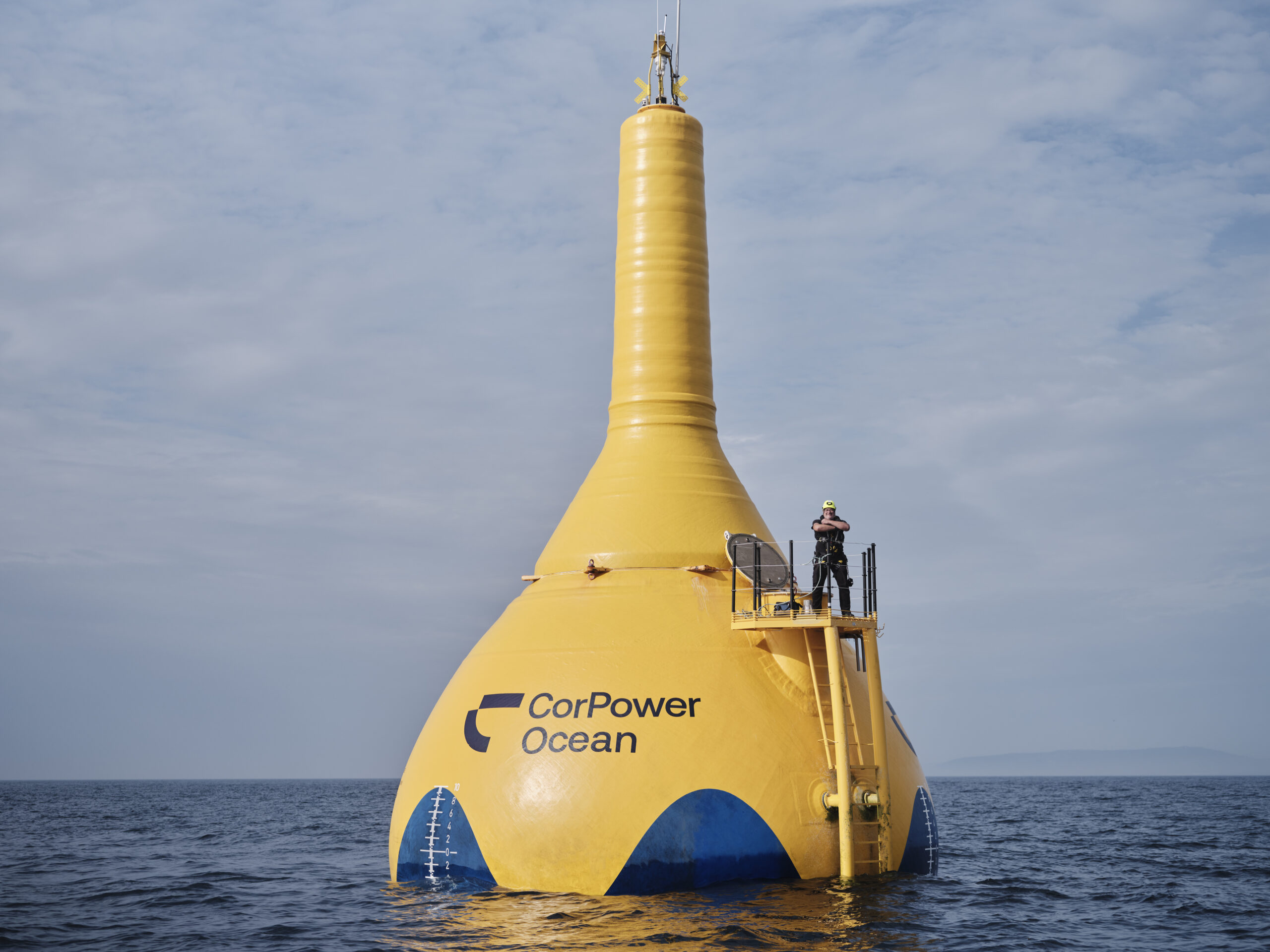
There is now more evidence than there once was. CorPower Ocean, a Swedish wave energy company, has demonstrated its technology in Portugal and is preparing a 5 MW project at the European Marine Energy Centre in Orkney. EMEC announced in May 2025 that CorPower had signed a berth agreement for what it described as the United Kingdom’s largest wave energy project, to be deployed at its Billia Croo site. Scotland’s Deputy First Minister, Kate Forbes, announced the agreement at the All Energy conference in Glasgow.
That makes Orkney central to the story. EMEC has long been one of Scotland’s most important marine energy assets, not because it gives speeches about the future, but because it exposes machines to the hard facts of the sea. If wave power is to become a serious contributor to the electricity system, it will have to pass through places like Orkney, where theory meets weather and optimism is forced to wear a lifejacket.
The new argument from the marine energy sector also leans heavily on energy security. That is understandable. The shock to energy prices after Russia’s invasion of Ukraine left a deep mark on households, businesses and government finances. The Climate Change Committee has recently argued that reaching net zero by 2050 would cost less than the economic damage caused by a single major fossil fuel price shock. In plain terms, the committee’s point is that continued dependence on volatile fossil fuel markets carries its own large and recurring cost.
This strengthens the case for domestic renewable energy. It does not, by itself, prove that wave power should receive large scale public support ahead of every other option. That is the distinction policymakers must hold onto. A technology may be desirable, domestic and low carbon, yet still require difficult judgement on cost, reliability, planning, grid connection, environmental impact and industrial return.
Wave energy’s advocates point to one genuine advantage. Waves are more predictable than wind and solar, and wave output can be stronger in winter, when electricity demand is high. That could make marine energy a useful complement to the wider renewables system. A grid built around wind and solar will need diversity, storage, interconnection, demand management and other sources of reliable low carbon power. Wave energy may have a role in that mix.
The question is scale.
The United Kingdom already has a large offshore wind sector. Solar is far cheaper than it once was. Batteries are developing quickly. Grid constraints remain a serious problem. Ports, vessels, subsea cabling, planning consent, marine protection and local community benefit all sit between a promising machine and a working industry. Wave power may be ready for larger demonstration and early commercial deployment. That is not the same as saying it is ready to carry the next national energy strategy on its back.
There is also a Scottish industrial question. If public support is used to help wave energy grow, Scotland should ask what remains here. It is not enough for Scottish waters to provide the test bed while manufacturing, intellectual property, profits and strategic control move elsewhere. Coastal communities have heard many promises attached to energy transitions. They are entitled to ask who owns the technology, where the supply chains sit, who gets the skilled work, and whether local places are being built into the industry rather than merely being asked to host it.
The Argyll dimension requires particular care. The opinion piece refers to a proposed 2 GW project connected with AI data centres. Separate reporting has described major plans for renewable powered data centre infrastructure in Argyll, including the Killellan AI Growth Zone on the Cowal Peninsula. These proposals could bring investment and jobs, but they also raise questions about electricity demand, land use, water use, grid priority and whether renewable generation is being used to decarbonise essential public need or to feed a rapidly expanding private digital economy.
That does not make the proposal wrong. It makes it important.
Scotland should be wary of two forms of laziness. The first is the lazy dismissal of wave energy as a technology that has always promised more than it delivered. That view ignores genuine progress and the strategic value of marine innovation. The second is the lazy embrace of every green technology claim as though a low carbon label settles all practical questions. It does not. Environmental policy is not made serious by enthusiasm alone.
A proper Scottish approach would ask harder questions while still recognising the opportunity. What level of public support is justified for wave energy in the next Contracts for Difference rounds? How should early projects be protected without creating permanent subsidy dependence? What evidence is available on lifetime costs and maintenance? What environmental monitoring is needed around marine habitats, seabed use, navigation and fishing grounds? How much of the supply chain can be anchored in Scotland? What role should EMEC, Orkney and Scottish universities play in keeping expertise here?
Those questions do not weaken the case for wave power. They make the case usable.
The marine energy sector is right about one thing. The Atlantic is not a metaphor. It is a physical resource, and Scotland has spent generations living beside it, working around it, crossing it, fearing it and learning from it. If modern engineering can turn part of that force into dependable electricity, the country should take the possibility seriously.
But Scotland should not simply applaud the next frontier because it has been described in green language. It should examine it, test it, price it, regulate it and ask who benefits. If wave energy is to become part of the country’s future, it must be built with the discipline of an industry, not the romance of a campaign.
The sea will provide no favours. That may be its greatest service. It will test every claim made on its behalf.