
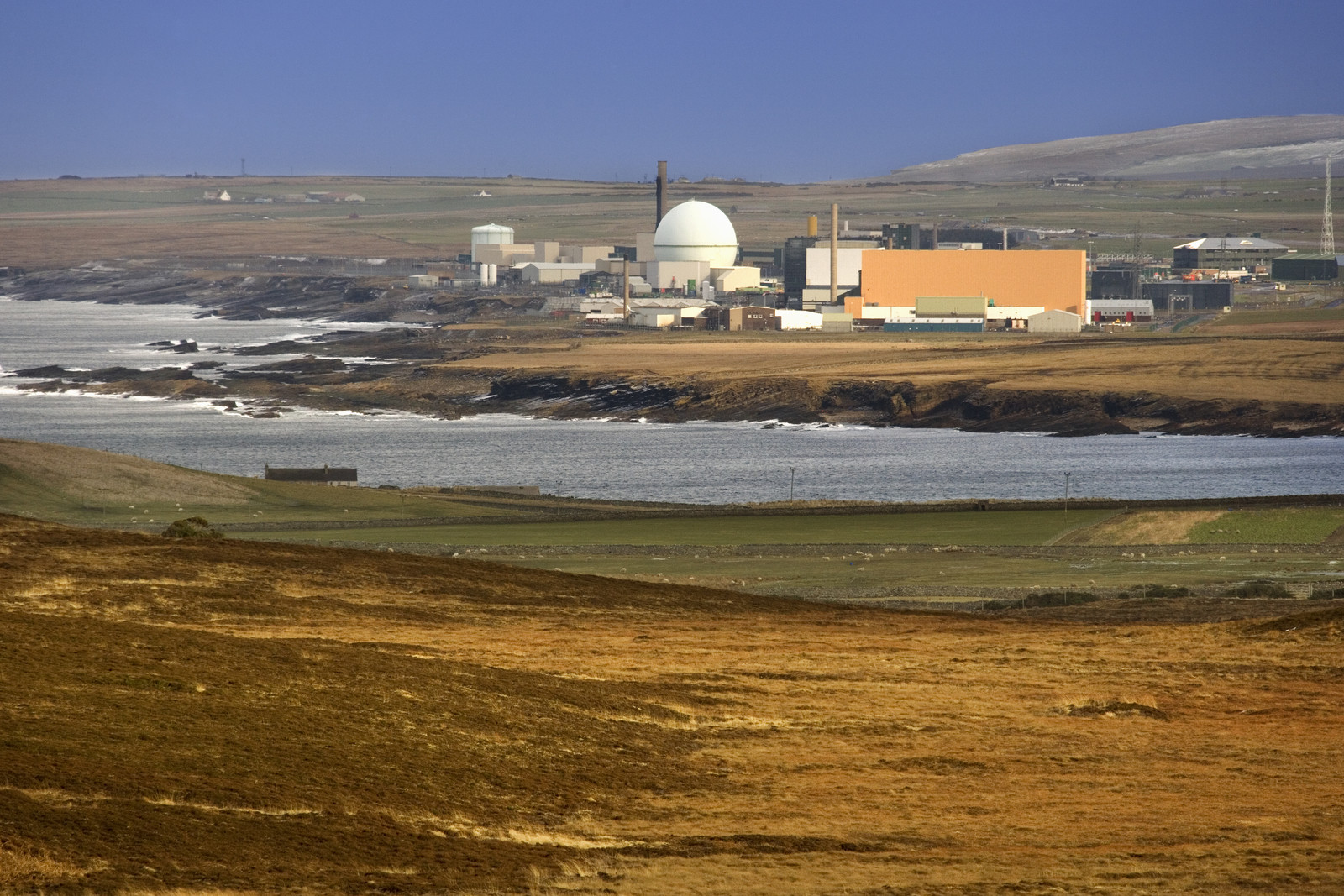
Scotland helped establish Britain’s nuclear industry, building experimental reactors, electricity-generating stations and an engineering workforce that transformed communities from Caithness to Ayrshire. Seventy years later, the Scottish Government opposes constructing new nuclear power stations. The policy emerged through decades of environmental objections, disputes over electricity and employment, radioactive-waste investigations, organised protests and decisions taken by successive governments.
In June 2026, the UK Government published a technical assessment identifying Scottish locations with potential for new nuclear power development. The study, commissioned from Great British Energy–Nuclear, examined areas around Torness in East Lothian, Hunterston in North Ayrshire and Dounreay in Caithness, together with land around the Firth of Forth and Scotland’s eastern coastline. It found areas with high technical potential but did not identify approved construction projects, calculate how much electricity could be generated or determine the employment that future development might provide.
The Scottish Government maintained its opposition to constructing new nuclear stations. Its policy supports the continued operation of Torness while safety and environmental conditions permit, but does not support new reactors using current technologies, including the small modular reactors being developed for future projects.
In September, the Nuclear Industry Association published figures comparing employment growth in England and Scotland. According to its annual Jobs Map, civil nuclear employment in England had approximately doubled since 2014, while Scotland’s workforce had increased by 13.4 per cent. The industry body argued that Scotland could have gained almost 5,000 nuclear jobs over that period if employment had grown at England’s rate, attributing much of the difference to the Scottish Government’s opposition to new construction.
Scotland’s position developed through a longer history than the present dispute between governments and industry. Nuclear research and electricity generation were welcomed by communities seeking employment and investment during the 1950s. Other residents questioned the safety of unfamiliar technology, the location of generating stations and the information provided by the authorities responsible for development. Those objections expanded into organised campaigns involving environmental groups, farmers, fishermen, coal miners, scientists, politicians and nuclear-disarmament activists.
By the time the SNP formed its first Scottish Government in 2007, opposition to new nuclear construction had already become part of the devolved administration’s policy under Labour and the Liberal Democrats. The SNP subsequently maintained that position and developed a separate Scottish approach to radioactive-waste management. Scotland’s planning and consenting responsibilities provided the means through which opposition to future reactors could be exercised.
The Atomic Age Comes to Caithness
During the early 1950s, Britain was expanding a nuclear programme that combined defence requirements, scientific research and the development of civilian electricity generation. Nuclear technology promised new engineering capabilities and the possibility of producing substantial quantities of electricity without burning coal or oil. The government was particularly interested in reactor designs capable of using uranium more efficiently, including experimental fast-breeder technology.
On 1 March 1954, ministers announced that a large experimental fast reactor would be constructed at Dounreay on the north coast of Caithness. The government considered the site suitable because it offered extensive land, access to the sea for cooling water and effluent discharge, a freshwater supply and proximity to Thurso. The establishment would be developed under the government’s atomic energy programme and subsequently operated by the United Kingdom Atomic Energy Authority.
The government’s statement to the House of Commons set out its economic expectations. When fully operational, Dounreay was expected to provide employment for approximately 600 people, around half recruited locally. Ministers described the development as a contribution to the economic revival of the Highlands. They also explained that the reactor would be enclosed within a large spherical steel shell and acknowledged the remote possibility of radioactive leakage in the event of a failure. Arrangements for responding to such an event were being developed with local authorities.
Construction brought rapid changes to Caithness. New housing and services were needed for the incoming workforce, while scientists, engineers, technicians and their families moved north. Thurso expanded as the establishment developed, acquiring the description Atom Town. The nuclear industry introduced technical careers and industrial employment into a region where such opportunities had previously been limited.
A 1966 information film, also titled Atom Town, depicted the social changes accompanying the development. Among those interviewed was a young man whose family had moved from north-east England after his father obtained employment at Dounreay. He hoped to become a nuclear technician himself. Historian Linda Ross’s research into the establishment’s early years records substantial local support for the investment, employment and educational opportunities it brought.
The planning arrangements differed from those ordinarily applied to major industrial development. Under the Atomic Energy Authority Act 1954, the authority was exempt from submitting planning details to local authorities through the normal process. Dounreay was consequently developed without the public inquiry that objections to an equivalent private industrial project might have triggered.
Wendy Wood’s Warning and the First Hunterston Objections
One of the earliest identifiable Scottish objections to nuclear development preceded Dounreay’s formal establishment. In 1953, artist and Scottish nationalist campaigner Wendy Wood wrote publicly to the provost of Thurso expressing concern about the hazards associated with the proposed nuclear installation. The correspondence is documented in historical research by Linda Ross and Ewan Gibbs, who examined the emergence of nuclear opposition in Scotland through archival material and interviews with campaign participants.
Wood had been involved in founding the National Party of Scotland in 1928, an organisation that subsequently combined with the Scottish Party to establish the Scottish National Party in 1934. Her concerns about Dounreay arose during a period when the proposed development was being promoted for its scientific and economic benefits. They did not result in a substantial local campaign, and the establishment proceeded with considerable support from residents, local authorities and politicians.
Wood continued to oppose nuclear development in later decades. During the late 1970s she joined campaigns against proposals to investigate sites in southern Scotland for the disposal of radioactive waste, maintaining a position first expressed before the country’s experimental nuclear programme had become established.
The proposed Hunterston A power station on the North Ayrshire coast produced a more formal planning dispute. In 1956, the South of Scotland Electricity Board submitted applications to construct the station on the Hunterston Estate near West Kilbride. The proposals involved the construction of a nuclear generating installation, associated access and the compulsory acquisition of land.
Historical research into the applications records 42 objections and a petition carrying 208 signatures. Objectors questioned the choice of a relatively undeveloped coastal location and the adequacy of information provided about alternative sites. The concerns arose before Hunterston had begun operating and before Scotland possessed the extensive anti-nuclear campaigning organisations that subsequently developed.
Public inquiries commenced on 29 January 1957 under Sheriff Sir Randall Philip QC. He died before completing his report, and a second inquiry was held under Sheriff Harald Leslie QC, beginning on 4 June. The proceedings examined the electricity board’s applications, the objections and the conditions under which development might proceed.
Scottish Secretary John Maclay authorised the station on 29 July 1957. His decision, published in the House of Commons the following day, concluded that construction was in the national interest. The approval was accompanied by conditions and undertakings concerning the appearance of the station, protection of the surrounding environment, cooling-water arrangements and radioactive discharges.
The electricity board was required to consult the Royal Fine Arts Commission for Scotland and the amenity committee before finalising the siting and appearance of buildings and structures. It was also required to consult the fisheries committee and install appropriate screens around the cooling-water intakes and outlets. The approval letter referred expressly to undertakings controlling radioactive discharges from the station.
Hunterston A entered service during the 1960s. Scotland’s commercial nuclear industry had already begun developing elsewhere, with Chapelcross near Annan entering operation in 1959. The Dumfriesshire establishment was originally built to produce weapons-grade plutonium as well as electricity, according to the Nuclear Decommissioning Authority. Its early operations belonged to a British nuclear programme in which military requirements and civilian generating activity were closely connected.
From Nuclear Weapons to Civilian Protest
During the late 1950s, opposition to nuclear weapons developed into an organised movement throughout Britain. Scottish CND emerged in 1958, drawing support from political activists, religious organisations, trade unionists, peace campaigners and members of the public concerned about nuclear testing and the possibility of nuclear war.
The location of nuclear military facilities in Scotland gave the movement particular geographical concerns. American Polaris submarines began operating from Holy Loch in 1961, while Faslane developed as a base for Britain’s nuclear submarine forces. Demonstrators objected to the presence of nuclear weapons, the possibility that Scottish installations could become military targets and the consequences of decisions taken by British and American defence authorities.
The disarmament movement was principally concerned with nuclear weapons rather than electricity generation. Some participants supported civilian nuclear technology while opposing nuclear armaments. Others questioned the relationship between military and civilian research, the movement of radioactive materials and the institutional secrecy associated with the early nuclear programme.
Chapelcross’s original role in producing weapons-grade plutonium provided a direct example of the relationship between defence and electricity generation. Environmental campaigner and journalist Rob Edwards, who later worked for the Scottish Campaign to Resist the Atomic Menace, recalled in an interview with Ross and Gibbs that the connection between nuclear power and nuclear weapons was a principal influence on his opposition to civilian nuclear generation.
The disarmament organisations also developed campaigning networks that extended across Scotland. Their members organised marches, meetings, fundraising events and the distribution of publications. During the following decades, some of those networks became involved in opposing new nuclear stations and radioactive-waste investigations, although the objectives of individual organisations remained different.
The Nuclear Station Proposed for Stake Ness
Not every Scottish nuclear proposal failed because of environmental opposition. During the early 1970s, the North of Scotland Hydro-Electric Board considered building a nuclear power station at Stake Ness in Banffshire as part of its plans to meet increasing electricity demand in north-east Scotland.
On 20 July 1972, Lord Polwarth told the House of Lords that the region would require additional generating capacity by the winter of 1978–79. The board was considering a nuclear station at Stake Ness or an oil- or gas-fired station near Peterhead. The decision was affected by a UK Government review of reactor policy, which created uncertainty over the technology and timescale for a new nuclear development.
On 9 August 1972, Scottish Secretary Gordon Campbell announced that the board had chosen an oil-fired station at Boddam, near Peterhead. He explained that delays in resolving national reactor-policy questions meant the proposed nuclear station could not be delivered in time to meet the expected demand. Stake Ness was retained as a possible location for future nuclear development, and ministers confirmed in 1973 that it remained available for reconsideration.
The decision preceded the mass protests against Torness and was not attributed by ministers to anti-nuclear campaigning. Electricity planning, construction timescales and uncertainty over reactor technology determined the board’s immediate choice.
Environmental activists subsequently organised activity around Stake Ness as the movement against nuclear expansion developed. Robin Callander, interviewed decades later by Ross and Gibbs, recalled efforts to establish opposition at locations beyond Torness and to coordinate local campaigning across Scotland.
Torness and the Campaign That Brought Thousands to East Lothian
The South of Scotland Electricity Board’s proposal for a nuclear station at Torness, near Dunbar in East Lothian, became the centre of Scotland’s largest organised campaign against civilian nuclear generation. The project was intended to provide substantial generating capacity, but opponents questioned whether the additional electricity would be needed, how much construction would cost and what arrangements would be required for radioactive waste after the station began operating.
A public inquiry was held from 18 to 27 June 1974 and again on 23 July. The Office for Nuclear Regulation’s historical records give 24 May 1978 as the date of consent. By then, opposition had developed through environmental organisations, student groups, peace activists and people living or working near the proposed site.
The Scottish Campaign to Resist the Atomic Menace, known as SCRAM, emerged in 1975. Its campaigning combined objections to nuclear development with arguments for electricity conservation and alternative generating technologies. Organisers distributed publications through universities, local environmental groups, independent shops and informal networks that connected activists across Britain.
Among those involved were Pete Roche, Rob Edwards and Linda Hendry, who helped organise the campaign and communicate its arguments. The movement also attracted support from people outside established environmental organisations, particularly those concerned about the effect of the proposed station on fishing, farming and employment in other industries.
Thousands attended demonstrations during 1978 and 1979. Organisers estimated approximately 5,000 participants at a major gathering in May 1978 and around 10,000 at another in May 1979. The figures were campaign estimates rather than independently verified attendance totals. Demonstrators marched to the site, occupied land and organised non-violent direct action intended to challenge construction.
The prolonged occupation during the summer and autumn of 1978 developed around Half Moon cottage, which campaigners used as a base. They also erected a windmill to demonstrate an alternative method of producing electricity. According to the campaign accounts and interviews examined by Ross and Gibbs, contractors later demolished the cottage and windmill with a bulldozer as work proceeded at the site.
The occupations produced disagreements among campaigners about the permissible extent of direct action. Some favoured symbolic protest and strict non-violence; others supported physical intervention intended to delay construction. The documentary film On Site Torness, made by Alistair Scott and Mike Sharples in 1979, recorded the campaign and some of those disagreements. The film survives in the National Library of Scotland’s Moving Image Archive.
Students formed part of the protest network. Clare Simpson, who moved from Newcastle to study at Dundee University in 1976, joined Students Against Nuclear Energy and became involved with SCRAM. She later recalled studying for university examinations in a caravan used by protesters beside the A1 near Torness. She subsequently participated in protests against American cruise missiles at Greenham Common and in further direct action against construction at Torness.
Folk and punk music events helped raise funds, while universities and environmental groups provided volunteers and meeting places. The campaign developed beyond East Lothian, with demonstrations taking place elsewhere in Scotland and supporters travelling considerable distances to participate.
Fishermen, Farmers and Miners Had Different Reasons to Object
The communities surrounding Torness depended heavily upon agriculture and fishing before the nuclear development began. Some residents objected to the introduction of a large industrial installation into an agricultural and coastal landscape. Others feared that radioactive releases or changes to the marine environment could affect their livelihoods.
Dorothy Aitchison, whose father was a fisherman from Burnmouth in Berwickshire, became involved in organising local opposition. She helped establish an anti-nuclear group and arranged an exhibition in Eyemouth presenting the campaign’s concerns about nuclear development and its potential effects on fishing communities.
Farmers also participated. A Scottish Television programme broadcast in 1980 examined changes in the agricultural and fishing area surrounding Torness and included interviews with Stuart Ritchie and his son Andrew. They described concerns about the future of the local countryside as construction proceeded.
In June 1978, farmers took part in a tractor procession through Princes Street in Edinburgh. Pete Roche later recalled that local farmers assisted protesters occupying Torness by supplying a truck used to move stone slabs while the campaigners were working at Half Moon cottage.
The electricity board maintained that the station could operate within the applicable safety and environmental requirements. Campaigners disputed the industry’s assessments and argued that the consequences of accidents, contamination and waste disposal had not been adequately addressed.
Scotland’s coal industry supplied another source of opposition. Electricity generation was an important market for Scottish coal, and some miners and trade unionists believed additional nuclear capacity could reduce demand for fuel produced in Scottish coalfields. The debate was taking place during a period of economic pressure and uncertainty affecting the mining industry.
SCRAM developed relationships with sections of the labour movement, including members of the Scottish area of the National Union of Mineworkers. A Trade Unions Against Torness conference held in 1978 received support from 13 trade unions, according to historical research based on campaign records. Campaign publications argued that Scotland could meet its electricity requirements through coal, hydroelectric generation, conservation and developing renewable technologies rather than expanding nuclear capacity.
Trade-union opinion was not unanimous. Nuclear installations also supported engineering and industrial employment, and some workers regarded future reactor construction as an opportunity to sustain skilled jobs. The relationship between nuclear generation and other industries was debated within organised labour as well as between political parties.
In 1987, the Scottish Trades Union Congress adopted a moratorium position on further nuclear construction, moving away from its earlier support for nuclear development. Midlothian miner Robert Amos spoke in favour of the change. The debate combined concerns about reactor safety following Chernobyl with the continuing consequences of electricity policy for Scottish employment.
Robin Cook and the Political Campaign Against Torness
Opposition to Torness developed across political parties and was not confined to the SNP. Labour MP Robin Cook supported the campaign after his election to Westminster in 1974 and served as SCRAM’s honorary secretary. He questioned the economic justification for additional generating capacity and the public accountability of institutions responsible for nuclear development.
Pete Roche and Rob Edwards, both Labour Party members during their involvement with SCRAM, worked as campaign organisers. Their activities connected the environmental movement with Labour organisations and elected representatives. Other campaigners supported the SNP or emerging environmental parties, while many participated without a party affiliation.
Cook raised concerns about the Torness project in Parliament, including the level of scrutiny given to electricity-demand forecasts and the decisions taken by the electricity authorities and government. During the same period, campaigners circulated technical arguments questioning the projected requirement for additional nuclear generating capacity.
Environmental writing influenced sections of the movement. Rachel Carson’s Silent Spring and E. F. Schumacher’s Small Is Beautiful contributed to wider debates about industrial development, environmental protection and the organisation of energy production. Campaign publications such as the SCRAM Energy Bulletin sought to present alternative assessments of nuclear power and its economic and environmental consequences.
The Conservative government formed in 1979 retained support for Torness. Construction began in 1980, and the station first generated electricity on 25 May 1988. Margaret Thatcher formally opened it in May 1989. The station’s completion followed more than a decade of public inquiry, organised opposition, political argument and construction.
Where Would the Radioactive Waste Go?
Radioactive waste became a separate focus of opposition during the 1970s. Electricity generation, nuclear research and fuel processing produced materials requiring controlled handling, storage and eventual disposal. Some radioactive wastes require management over periods extending far beyond the operating life of the establishments that produced them.
In September 1976, the Royal Commission on Environmental Pollution published its sixth report, Nuclear Power and the Environment, chaired by Sir Brian Flowers. The commission examined the environmental implications of nuclear development and raised concerns about the adequacy of arrangements for the long-term management of highly radioactive waste.
The commission questioned the wisdom of committing Britain to a substantial expansion of nuclear power without sufficient assurance that the resulting waste could be safely contained. The report placed radioactive-waste disposal within the wider assessment of whether and how the nuclear programme should develop.
The United Kingdom Atomic Energy Authority was investigating geological disposal as a possible long-term method of isolating radioactive waste. Scientific work concentrated on the properties of different rock formations and the movement of groundwater, since water passing through rock could affect the long-term containment of radioactive materials.
Several possible investigation areas were identified, including locations in Scotland. One was Mullwharchar, a granite hill near Loch Doon in the Galloway uplands. The authority sought permission for exploratory drilling as part of its research programme.
The proposal provoked opposition among local residents, conservationists and political campaigners. They feared that geological investigation could lead to the selection of the area for a permanent radioactive-waste repository. The Atomic Energy Authority maintained that the proposed boreholes were for scientific research and did not amount to approval of a disposal facility.
Campaigners were concerned about the possibility of future waste shipments into the area, the effect of disposal on land and water, and the duration for which radioactive materials would need to remain isolated. They also challenged the power of central government institutions to pursue such work against local opposition.
Mullwharchar and the People’s Planning Inquiry
Kathleen Miller, associated with the Scottish Conservation Society, became a prominent organiser of opposition to the Mullwharchar proposal. She was also a member of the SNP, and the campaign received support from Scottish nationalist politicians as well as environmental organisations and local residents.
In August 1978, SNP MP George Thompson participated in a public hearing concerning the Atomic Energy Authority’s planning application. Wendy Wood, who had objected to Dounreay in the 1950s, also supported the campaign. Correspondence examined by Ross and Gibbs indicates that SNP leader Gordon Wilson was concerned to avoid presenting the wider coalition as an exclusively partisan undertaking.
Jim Sillars also challenged the nuclear industry during public meetings concerning the proposal. Sillars had left Labour in 1976 to establish the breakaway Scottish Labour Party and subsequently joined the SNP in 1980. His involvement came during a period of wider political disagreement about Scottish devolution and industrial development.
Kyle and Carrick District Council refused permission for the exploratory drilling. The Atomic Energy Authority appealed, and a public inquiry was held at Ayr in February and March 1980. Its remit concerned the planning application for test boreholes rather than the wider question of whether nuclear waste should eventually be disposed of in Scotland.
Campaigners disputed the limited scope of the proceedings. The Scottish Conservation Society organised a separate People’s Planning Inquiry, chaired by Sir Patrick McCall, to examine broader questions about radioactive-waste disposal, environmental safety and public decision-making.
The disagreement was raised repeatedly in the House of Commons. George Foulkes, the Labour MP for South Ayrshire, challenged the government’s handling of the application and the scope of the inquiry. Ministers maintained that exploratory drilling was intended to provide geological information rather than authorise a permanent disposal facility.
On 8 December 1981, Scottish Secretary George Younger explained that the boreholes were intended to investigate groundwater movement through rock formations as part of an international research programme. He stated that the proposal did not constitute a decision to dispose of nuclear waste at Mullwharchar.
Eight days later, on 16 December, Younger announced that he was dismissing the planning appeal and refusing permission. His stated reason was the redirection of the geological research programme, which meant exploratory drilling would not be required for that purpose at the time.
The refusal ended the immediate proposal. The parliamentary record attributes the decision to the change in the research programme rather than solely to pressure from campaigners. The proceedings had nevertheless involved a local authority refusal, an official inquiry, a separate inquiry organised by opponents and repeated challenges in Parliament.
By March 1980, historical research using contemporary contact lists identified at least 104 groups in Scotland involved in nuclear-related campaigning. They included local environmental organisations, CND branches, conservation groups, political organisations and campaigners concerned about particular nuclear facilities or radioactive-waste proposals.
Three Mile Island, Chernobyl and the Environmental Record
The accident at Three Mile Island in Pennsylvania on 28 March 1979 occurred while the Torness campaign was active. A partial reactor-core meltdown prompted investigations into equipment failures, operating procedures and the performance of protective systems.
Scottish anti-nuclear campaigners cited the accident as evidence that serious reactor failures could occur despite engineering safeguards. The South of Scotland Electricity Board offered a different interpretation, arguing in its public information material that the protective systems had limited the consequences of the accident and prevented a more severe outcome.
On 26 April 1986, the explosion of a reactor at Chernobyl in Soviet Ukraine released radioactive material into the atmosphere. Fallout spread across international boundaries and reached Britain, including parts of Scotland. Radioactive contamination affected agricultural land and livestock, leading to monitoring and restrictions on sheep movements in affected upland areas.
Scotland’s remaining practical sheep movement controls ended in 2010. The Scottish statutory instruments associated with the restrictions were subsequently revoked by the Food Protection (Emergency Prohibitions) (Radioactivity in Sheep) and the Export of Sheep (Prohibition) Revocation (Scotland) Order 2012, which came into force on 1 October that year.
The effects of Chernobyl extended into farming and rural communities far from the damaged reactor. Monitoring, livestock controls and restrictions on the movement of agricultural produce remained part of the response for years after the accident.
Campaigners against nuclear power incorporated the events into their arguments about reactor accidents and the movement of radioactive contamination. Dorothy Aitchison later recalled taking precautions and warning others during the period after the fallout reached Scotland. Her recollections were among the interviews examined by Ross and Gibbs in their study of Scottish anti-nuclear activism.
Scotland’s own nuclear operations also left environmental liabilities. At Dounreay, historic fuel-processing work generated fragments of radioactive material, some of which entered the establishment’s effluent system and were discharged into the sea. Routine coastal monitoring began detecting radioactive particles during the early 1980s.
Government investigations subsequently identified historic fuel-processing discharges as the source of the particles. Operating practices were changed to prevent further discharges of that kind. Monitoring and removal of detected particles remain part of the environmental programme around Dounreay.
The UK Government’s published assessments distinguish between particles according to their size and radioactivity. Smaller, less active particles have generally been found on beaches accessible to the public, while larger fragments have been detected on the foreshore at Dounreay. Current expert advice describes the risk to people using nearby beaches as very low, with no restrictions on ordinary public beach access. As a precaution, however, harvesting seafood remains prohibited within a two-kilometre radius of a specified point near Dounreay, where the largest and most hazardous fragments have been detected. The Scottish Environment Protection Agency regulates the continuing monitoring programme, which includes the removal of particles found along the coast.
Dounreay continued supporting specialist employment after its experimental research work ended. The same establishment that had brought scientific and industrial activity to Caithness became one of Britain’s substantial nuclear decommissioning projects, involving the management of radioactive materials, dismantling of redundant facilities and remediation of contaminated areas.
From Protest to Scottish Government Policy
During the 1970s and 1980s, opposition to nuclear development became increasingly connected with debates about Scottish political authority. Decisions affecting generating stations, radioactive-waste investigations and energy infrastructure were made by British government departments, statutory electricity authorities and research organisations.
Some campaigners argued that Scottish communities and institutions should exercise greater control over developments affecting land, employment and the environment. Those arguments overlapped with the wider movement for devolution, although opposition to nuclear development was not confined to supporters of Scottish independence.
Labour politicians, SNP members, environmental organisations, conservationists and trade unionists participated in different campaigns. SNP energy-policy material from the 1970s already contained arguments against increasing Scotland’s reliance on nuclear generation, referring to other Scottish energy resources and concerns about radioactive waste.
During the same period, opposition to nuclear weapons remained a prominent issue at Holy Loch and Faslane. Faslane Peace Camp was established in 1982 as part of the movement opposing Britain’s nuclear weapons programme. Its continuing activities kept nuclear defence policy visible in Scottish public life, although the campaign’s principal purpose remained distinct from the debate over civilian generating stations.
The establishment of the Scottish Parliament in 1999 created a different institutional setting for energy-related decisions. Nuclear safety regulation, defence and substantial parts of energy policy remained reserved to Westminster. Planning and consenting responsibilities gave Scottish ministers considerable influence over the location and approval of new generating developments.
The Labour–Liberal Democrat Restriction of 2005
On 14 April 2005, the Scottish Parliament debated nuclear power under the Labour–Liberal Democrat Scottish Executive. The debate was initiated through an SNP motion lodged by Richard Lochhead, but the Executive secured agreement to an amended motion setting out its own position.
The amended motion endorsed the Executive’s policy of not supporting further nuclear power station development while radioactive-waste management issues remained unresolved. It also supported renewable generation, including wind, wave, tidal, solar, hydrogen, biofuels and biomass, and the Executive’s target for renewable electricity generation.
The motion was approved by 65 votes to 43, with three abstentions. The parliamentary proceedings recorded disagreements among parties and within Labour over the future role of nuclear electricity.
Some Labour members defended the contribution of existing nuclear stations to employment and electricity generation and supported keeping future options available. Liberal Democrat representatives supported the Executive’s position linking new construction to unresolved waste management. Conservatives argued for retaining nuclear power as part of Scotland’s future energy supply. The SNP advocated a future without additional nuclear stations.
The Executive’s position was conditional rather than an absolute statutory prohibition. It nevertheless established opposition to further nuclear construction as formal Scottish administration policy two years before the SNP entered government.
The SNP Government Changes Waste Policy
The SNP formed its first Scottish Government in May 2007. Within weeks, ministers announced a change in the approach to managing higher-activity radioactive waste.
In July 2006, the independent Committee on Radioactive Waste Management had recommended geological disposal as the best available long-term approach, supported by interim storage until a suitable facility could be developed. The Labour–Liberal Democrat Scottish administration accepted those recommendations in October 2006, alongside the UK Government and other devolved administrations.
On 25 June 2007, Cabinet Secretary Richard Lochhead announced that the new Scottish Government would not endorse the proposed geological-disposal programme. Ministers continued supporting robust interim storage but rejected the approach of permanently disposing of higher-activity waste deep underground.
The Scottish Government instead supported long-term facilities near the surface and close to the sites where waste was produced. Its stated intention was to keep the material monitorable and retrievable while limiting the need to transport it over long distances.
The announcement reversed the previous administration’s acceptance of geological disposal as the preferred long-term approach for Scotland. It concerned radioactive-waste management rather than enacting a new statutory prohibition on nuclear construction.
In January 2008, Energy Minister Jim Mather set out the SNP Government’s wider energy position to the Scottish Parliament. The administration argued that Scotland’s renewable resources, existing generating capacity, energy efficiency and other technologies could meet future requirements without constructing new nuclear stations.
National Planning Framework 2, published in 2009, stated in paragraph 153 that the Scottish Government did not support the construction of new nuclear power stations in Scotland. The same passage supported timely decommissioning and environmental remediation of redundant nuclear installations and recognised the need for facilities to manage waste arising from that work.
The Policy Under Scotland’s Current Planning Framework
Scotland’s planning arrangements have developed since 2009. National Planning Framework 4, adopted in February 2023, replaced the earlier national planning frameworks and Scottish Planning Policy, bringing the national spatial strategy and national planning policies together as part of the statutory development plan.
The framework supports renewable, low-carbon and zero-emission technologies, electricity networks, energy storage and related infrastructure. The Scottish Government’s separate published nuclear policy continues to oppose new nuclear stations using current technologies.
The government’s explanation includes construction costs, radioactive-waste management and the length of time required to deliver new generating stations. It cites the financing arrangements for Hinkley Point C in Somerset and questions whether new nuclear construction represents good value for electricity consumers.
The government also opposes new small modular reactors using present nuclear-fission technologies. It acknowledges interest in their different manufacturing and construction methods but maintains that their economic competitiveness has not yet been demonstrated through commercial deployment and that they share waste-management and environmental requirements with other reactors.
Scottish ministers exercise important consenting responsibilities for major onshore generating stations under the Electricity Act 1989. Nuclear regulation, reactor safety and much of the wider energy market remain UK responsibilities. The Scottish Government’s opposition operates through its policy and consenting position rather than through a general criminal prohibition on nuclear technology.
The government supports extending the operating life of Torness where strict environmental and safety requirements continue to be satisfied. The station remains Scotland’s only operating nuclear power station.
The Stations That Closed and the Industry That Remained
Scotland’s older nuclear installations have progressively moved from electricity generation and research into defuelling, decommissioning and environmental remediation.
Hunterston A ceased generation in 1990. Chapelcross stopped producing electricity in 2004, ending a period of operation that began in 1959. Hunterston B generated its final electricity on 7 January 2022, after more than four decades of operation.
On 1 April 2026, Hunterston B transferred from EDF into the ownership of the Nuclear Decommissioning Authority, with Nuclear Restoration Services taking responsibility for decommissioning the site. The transfer formed part of the wider programme for Britain’s ageing advanced gas-cooled reactor stations.
Dounreay’s experimental research programme had already ended, leaving a complex undertaking involving redundant reactors, former fuel-processing facilities, radioactive materials and contaminated areas requiring treatment or remediation.
Decommissioning continues to support substantial engineering and technical employment. It involves the removal and treatment of materials, dismantling of equipment, management of radioactive waste, site monitoring and preparations for eventual changes in land use.
Torness remains operational in East Lothian. Construction began in 1980 and generation commenced on 25 May 1988. The station operates two advanced gas-cooled reactors and has supplied electricity for nearly four decades. EDF’s December 2024 lifetime review extended its expected generating life to March 2030, subject to continued technical and regulatory assessment.
EDF reported in 2025 that Torness had reached a cumulative generation milestone of approximately 300 terawatt-hours. The operator’s station information lists approximately 550 full-time employees and more than 180 full-time contracting partners.
The Scottish Government reported that nuclear power accounted for approximately 17 per cent of electricity generated in Scotland in 2024. Torness continues contributing to electricity supply while Scotland’s renewable generation capacity and associated infrastructure expand.
The Costs and Technologies in the Present Debate
The technical and economic circumstances of nuclear generation have changed substantially since Hunterston was authorised in 1957 or Torness began construction in 1980.
Modern nuclear power stations generate electricity with low direct carbon emissions during operation. Their output does not depend upon daily variations in wind or sunlight, although reactors require planned maintenance, refuelling and may experience unplanned outages. Nuclear generation also requires regulated fuel handling, management of radioactive materials and eventual decommissioning.
New stations involve substantial capital expenditure, licensing and regulatory procedures, construction programmes and long-term financing arrangements. The eventual cost of electricity depends upon construction expenditure, financing costs, operating performance, the duration of generation and the allocation of financial risk.
Large nuclear projects in Britain have experienced construction delays and increases in projected costs. The Scottish Government cites those developments in explaining its position. Nuclear industry representatives argue that a programme of new reactors could preserve industrial skills, provide dependable low-carbon generation and support companies across engineering, manufacturing and construction.
Electricity-system comparisons also involve costs outside individual power stations. Renewable generation requires transmission and distribution infrastructure, balancing arrangements and, depending upon the composition of the system, storage or other forms of generation able to meet demand when output is low. Nuclear stations have their own requirements for network connections, operational flexibility, maintenance and reserve capacity.
Small modular reactor developers propose different methods of manufacture and construction intended to reduce some of the difficulties associated with building large stations. The cost and delivery performance of particular designs depend on commercial projects, supply-chain capacity, licensing and the number of reactors ordered.
The Scottish Government and nuclear industry have reached different conclusions about the place of these technologies within Scotland’s future electricity system. Their assessments concern capital investment, projected demand, alternative generating capacity, waste management, energy security and the distribution of costs between governments, investors and consumers.
The 2026 Assessment of Scottish Nuclear Sites
On 30 June 2026, the Department for Energy Security and Net Zero published a technical siting assessment prepared by Great British Energy–Nuclear.
The study identified areas associated with existing or former nuclear installations, including Torness, Hunterston and Dounreay, together with other land along Scotland’s eastern coast and around the Firth of Forth. It concluded that Scotland had areas with high technical potential for future nuclear development.
The exercise was a high-level desktop assessment. It did not identify a final site for construction, establish which reactor technology would be used or calculate the capacity, expenditure or employment associated with a future station. Further environmental, geological, infrastructure, regulatory and commercial investigations would be required for individual proposals.
In parliamentary answers during July, UK energy minister Michael Shanks confirmed that the assessment had not determined generating capacity and acknowledged the Scottish Government’s existing planning position. UK ministers remained open to discussions about future nuclear development in Scotland.
No replacement nuclear station had been approved for construction in Scotland by October 2026. Any proposal would require a developer, financing arrangements, detailed site investigations, the necessary consents and the applicable nuclear-safety approvals.
The Claim That Scotland Missed Almost 5,000 Nuclear Jobs
The Nuclear Industry Association’s September 2026 employment analysis compared the growth of the civil nuclear workforce in Scotland and England since 2014.
According to the association’s figures, Scotland’s employment increased from 4,922 in 2014 to 5,583 in 2026, an increase of 661 positions. England’s reported employment increased from 47,344 to 94,836 over the same period, an increase of 47,492.
| Country | 2014 | 2026 | Change |
|---|---|---|---|
| Scotland | 4,922 | 5,583 | +661 |
| England | 47,344 | 94,836 | +47,492 |
The association’s Jobs Map is based on information from participating NIA members. It is an industry survey rather than an official census of every person employed in Britain’s nuclear economy.
England’s reported workforce approximately doubled over the twelve-year period, while Scottish employment rose by 13.4 per cent. Applying England’s proportional increase to Scotland’s 2014 workforce would produce a hypothetical Scottish workforce of approximately 9,860 in 2026.
That would represent a hypothetical increase of about 4,940 jobs from the 2014 baseline, compared with the actual reported Scottish increase of 661. The difference between the hypothetical 2026 workforce and the reported Scottish workforce is approximately 4,280 positions.
The NIA describes the hypothetical increase as evidence that Scotland could have created almost 5,000 additional nuclear jobs over the period. Its analysis attributes the difference substantially to the Scottish Government’s opposition to new construction.
England’s nuclear employment growth reflects investment in major projects including Hinkley Point C and Sizewell C, together with supply-chain activity. Such projects generate employment during construction, while the eventual operating workforce may be smaller. Nuclear employment also includes manufacturing, research, engineering, site maintenance, fuel activities and decommissioning.
Scotland’s existing civil nuclear workforce is concentrated heavily in decommissioning and work at established sites. The NIA reports that decommissioning at Dounreay, Chapelcross, Hunterston A and Hunterston B supports the majority of Scottish civil nuclear jobs. Torness provides additional operating employment.
Scottish companies and workers also participate in nuclear projects elsewhere in Britain. The NIA reports that Scottish workers have been employed on construction at Hinkley Point C, while companies based in Scotland contribute to the wider nuclear supply chain.
The industry employment comparison does not establish that Scotland had specific financed projects capable of providing another 4,280 positions, or that equivalent employment would necessarily have developed if Scottish planning policy had been different. The figures also do not distinguish the full duration of construction employment from permanent operational positions within the hypothetical calculation.
Establishing the employment associated with a proposed Scottish nuclear development would require specific assumptions about the site, reactor technology, construction programme, financing, procurement, workforce requirements and subsequent operation.
Scotland’s Nuclear Industry in October 2026
Scotland’s nuclear establishments remain part of the national energy and industrial landscape. Dounreay, Chapelcross and Hunterston A are undergoing decommissioning. Hunterston B entered the Nuclear Decommissioning Authority’s estate in April 2026. Torness continues producing electricity, with generation presently expected to end in March 2030.
The present planning policy was preceded by objections dating to the 1950s, organised campaigns during the 1970s and 1980s, and the conditional restriction adopted by the Labour–Liberal Democrat Executive in 2005. Successive SNP administrations have maintained opposition to new nuclear construction, while supporting continued operation of Torness subject to safety and environmental requirements.
Elsewhere in Britain, investment continues in new nuclear generation and associated industrial supply chains. The 2026 technical assessment identified areas of Scotland that could be examined for future development, but no approved Scottish construction project or associated employment programme followed from the study.
Another nuclear station in Scotland would require a change in the present policy position, a commercially viable development proposal, the relevant planning and generating consents, and nuclear-safety regulatory approvals. The existing industry continues operating and decommissioning its established facilities under the arrangements already in place.
Sources
The Making of Anti-Nuclear Scotland: Activism, Coalition Building, Energy Politics and Nationhood, c.1954–2008. Linda Ross and Ewan Gibbs, Contemporary British History, volume 38, issue 2, 2024. Peer-reviewed historical research drawing on original campaign records, political archives and interviews. Complete open-access study.
Atomic Energy Authority Bill. House of Commons, 1 March 1954. Includes the announcement of the Dounreay fast-reactor establishment, employment expectations, cooling and effluent arrangements, and the government’s assessment of reactor containment. Hansard.
Nuclear Generating Station, Hunterston. House of Commons, 30 July 1957. John Maclay’s announcement and the conditions attached to the South of Scotland Electricity Board’s consent. Hansard.
Electricity Generating Station Project, Hunterston. House of Commons, 14 May 1957. Parliamentary record of the circumstances surrounding the second public inquiry. Hansard.
NDA Showcases the Positive Impact of Nuclear Clean-Up in Scotland. Nuclear Decommissioning Authority, 16 May 2018. Historical information on Chapelcross, including its original plutonium-production and electricity-generating roles. Nuclear Decommissioning Authority.
Scottish Electricity Supplies: Stake Ness Scheme. House of Lords, 20 July 1972. Parliamentary discussion of the proposed nuclear station and alternative development near Peterhead. Hansard.
Electricity. House of Commons, 9 August 1972. Gordon Campbell’s explanation of the decision to construct an oil-fired station at Boddam rather than proceed immediately with Stake Ness. Hansard.
Planning Consent for Nuclear Power Stations. Office for Nuclear Regulation, February 2020. Historical record of the Torness public inquiry and consent. Regulatory disclosure.
SCRAM Energy Bulletin Archive. Scottish Campaign to Resist the Atomic Menace, original campaign periodicals digitised and preserved by the Laka Foundation. Historical publication archive.
National Library of Scotland: Torness Protest Collections. Peter Lennard’s papers and diaries, Acc.14753/1–7, and protest photographs, Acc.14808. Historical archival material relating to the demonstrations and occupations of 1978–1979. Archival catalogue.
Sixth Report: Nuclear Power and the Environment. Royal Commission on Environmental Pollution, September 1976. Chaired by Sir Brian Flowers. Digitised original report, Wellcome Collection.
Loch Doon (Test Bores). House of Commons, 21 November 1979. Questions concerning the scope of the proposed public inquiry into exploratory drilling. Hansard.
Nuclear Waste (Disposal). House of Commons, 8 December 1981. Parliamentary questions on Mullwharchar, groundwater movement and geological investigations. Hansard.
Loch Doon. House of Commons, 16 December 1981. George Younger’s decision to refuse permission for exploratory drilling following changes to the geological research programme. Hansard.
The Food Protection (Emergency Prohibitions) (Radioactivity in Sheep) and the Export of Sheep (Prohibition) Revocation (Scotland) Order 2012. Scottish Ministers, SSI 2012/263. Scottish legislation.
Information Leaflet About the Monitoring of Beaches Near Dounreay. UK Government / Nuclear Restoration Services, updated 10 June 2026. History of radioactive particles, environmental monitoring, the precautionary seafood-harvesting restriction and remediation. Official information.
Onshore Monitoring of Radioactive Particles Near Dounreay. UK Government, updated June 2026. Monitoring information and recorded particle finds. Monitoring records.
The Scottish Parliament: Nuclear Power Debate. Official Report, 14 April 2005. Records the Labour–Liberal Democrat Executive’s conditional position, party arguments and parliamentary divisions. Official parliamentary proceedings.
Radioactive Waste Policy Statement. Scottish Government, 25 June 2007. Richard Lochhead’s announcement rejecting geological disposal as Scotland’s preferred approach and supporting long-term near-surface, near-site management. Scottish Government statement.
National Planning Framework for Scotland 2. Scottish Government, 2009. Paragraph 153 sets out opposition to construction of new nuclear power stations. Original planning framework.
National Planning Framework 4. Scottish Government, adopted February 2023. Scotland’s current national spatial strategy and statutory development-plan policy framework. Current national planning framework.
Electricity Act 1989, Section 36. UK Parliament, 1989. Statutory consenting provisions for the construction, extension and operation of generating stations. Legislation.
Nuclear Energy: Scottish Government Policy. Scottish Government. Current policy concerning new nuclear construction, existing stations and reactor technologies. Government policy.
Nuclear Stations. Scottish Government. Current information on Scotland’s nuclear installations, decommissioning and the operation of Torness. Government station records.
Hunterston B Nuclear Power Station Has Transferred to the NDA. Nuclear Decommissioning Authority and Nuclear Restoration Services, 1 April 2026. Confirms the transfer from EDF and responsibility for decommissioning. Official announcement.
Torness Achieves Significant Generation Milestone. EDF Energy, 3 March 2025. Station history, generation statistics and operating-life extension. EDF operator statement.
Torness Nuclear Power Station. EDF Energy. Reactor specifications, employment, generating capacity and operational information. Station records.
Potential Future Nuclear Power Plant Siting in Scotland. Department for Energy Security and Net Zero / Great British Energy–Nuclear, 30 June 2026. Technical desktop assessment of possible Scottish development areas. Original technical report.
NIA Jobs Map 2026. Nuclear Industry Association, September 2026. Industry employment survey and regional workforce figures. Original industry dataset.
Scottish Nuclear Ban Bites as Jobs Growth Slows to a Crawl. Nuclear Industry Association, 17 September 2026. Employment comparison between Scotland and England and the industry’s hypothetical Scottish jobs calculation. Original NIA analysis.