
Before the potato became ordinary, and before sugar became cheap, there was skirret.
In Scotland it was known as crummock, a word recorded in Scots for the plant Sium sisarum. The Dictionaries of the Scots Language give Scottish references from the early eighteenth century, including Orkney in 1701 and an account book entry from 1703 listing “crumocks” among kitchen-garden produce. The same source notes the word in Older Scots from 1693 and connects it with Gaelic crumag.
Skirret is a perennial root vegetable in the carrot family, Apiaceae. It produces clusters of long, pale, finger-like roots rather than one neat taproot. The flavour is usually described as sweet, nutty and somewhere between carrot and parsnip, though older roots can contain a woody core.
Its antiquity is remarkable. Pliny the Elder mentioned a root called siser, often associated with skirret, as a favourite of the Roman emperor Tiberius, though some caution remains over whether the ancient plant name always referred to the same species. By the Middle Ages, skirret was widely grown and eaten in Europe, appearing in medieval cookery and later in early modern gardens.
The Scottish evidence is quieter, but important. Early Scottish gardening is poorly documented. One study of historic Scottish gardens notes that the first Scottish gardening book, John Reid’s The Scots Gard’ner, was not published until 1683, and that formal gardening before the late sixteenth century was largely associated with royalty, monasteries and the very wealthy.
That matters because skirret belongs to the old kitchen garden, not the show garden. It was a practical crop, grown for winter roots, sweetness and nourishment. In Scotland’s older food world, where kale, oats, pulses, onions, leeks and hardy roots mattered, crummock would have fitted naturally into the small enclosed yard, the monastic plot, the laird’s kitchen garden and eventually the better supplied household garden.
Its decline was not mysterious. The potato was more productive, easier to store and better suited to feeding large populations. Skirret also had a nuisance hidden in its charm: many roots contain a woody central thread that must be removed. Once potatoes, carrots and parsnips became common, and imported sugar became cheaper, the sweet white root lost its reason to command space. By the end of the eighteenth century, skirret had largely disappeared from ordinary cookery.
Yet it never ceased to be suitable for Scotland. The plant is hardy, perennial and tolerant of cold. It prefers moist, fertile ground and can grow in full sun or light shade. Plants for a Future records it as hardy in UK conditions, flowering in July and setting seed in September. It prefers moisture, and dry conditions can make the roots tough.
To grow, sow seed in spring in modules or a prepared seed bed, then transplant young plants into rich, moisture-retentive soil. Space them generously, around 30 to 40 centimetres apart. It can also be propagated by division from offsets or root crowns, which is often the better method once a good plant has been established. Keep the ground damp through summer, mulch well, and do not be alarmed if the first year’s roots are modest. This is a patient vegetable that pays off in the cold winter months.
Harvest begins when the plant is dormant, usually from late autumn through winter. Lift the clump carefully with a fork, remove several roots, and replant a crown or offset for the next year. The roots do not store especially well once lifted, so they are best harvested as needed. Scrub rather than peel. Boil or steam them first, then draw out the woody core if present.
The simplest old preparation is still the best. Boil the roots until tender, remove any core, then dress with butter, salt and a little vinegar or lemon. Early sources also describe skirrets being parboiled and fried in oil or butter.
For a Scottish kitchen, skirret belongs beside leeks, oats, butter, cream, smoked fish, game and winter herbs. It can be folded into a leek and root gratin, added to a cock-a-leekie style broth for sweetness, roasted with carrots and parsnips, or mashed with butter and a little cream. In a more historic spirit, it can be baked in a small pie with apples, dates, spices and a little suet or butter, echoing early modern sweet-savoury cookery. Skirret pies and fritters both appear in historic cookery traditions.
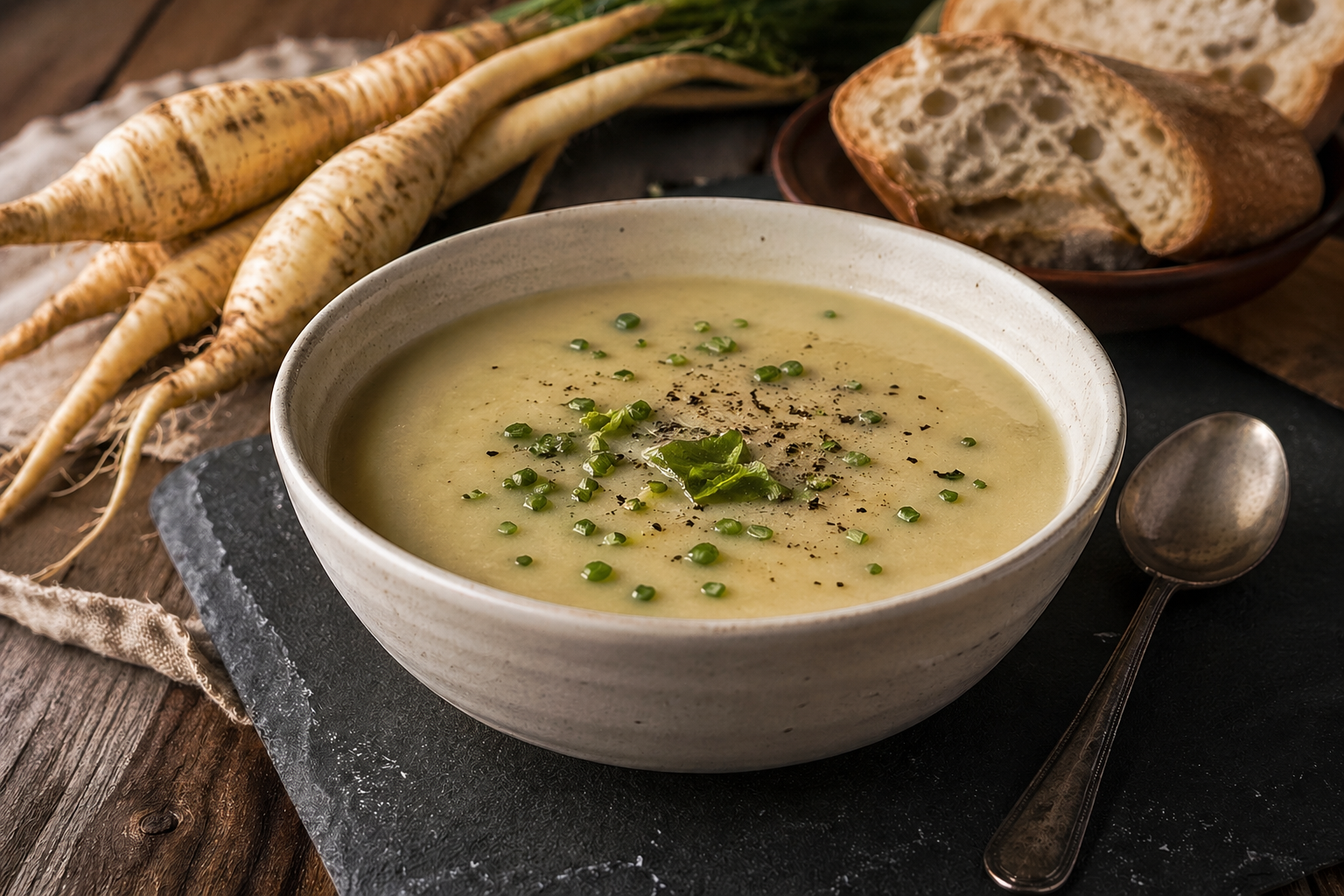
A good modern recipe is skirret fritters. Parboil the roots, remove the core, dip them in a batter of egg, flour, salt and a little milk or ale, then fry in butter until golden. Serve at once with chopped parsley and a sharp relish. Another is skirret soup: soften leeks in butter, add chopped skirret and a floury potato if desired, cover with stock, simmer, then blend with cream. The skirret gives sweetness and body.
Crummock deserves recovery not because it is quaint, but because it tells the truth about Scottish food history. The old table was not barren. It was seasonal, practical, enclosed by climate and class, but richer in cultivated plants than modern memory allows.
To regrow skirret is to restore one small thread of that memory. A white root, crooked and sweet, once known in Scotland, nearly lost, and waiting in the ground with admirable patience.
Skirret and Leek Soup:
A rich soup where skirret shows its natural sweetness without interference.
Ingredients
- 300g skirret roots (about 10–12 small roots)
- 2 medium leeks, trimmed and sliced
- 25g butter (2 tbsp)
- 1 medium floury potato (optional, for body)
- 750ml light stock (chicken or vegetable) (3 cups)
- 100ml double cream (optional) (½ cup heavy cream)
- Salt and black pepper to taste
- Fresh parsley or chives, finely chopped
Method
- Prepare the skirret
Scrub the roots thoroughly. Boil gently for 10–15 minutes until just tender.
Remove and split lengthwise to pull out any woody core. - Build the base
Melt the butter in a heavy pot over low heat. Add the leeks and cook slowly for 8–10 minutes until soft but not coloured. - Add body
Chop the skirret (and potato if using) and add to the pot. Stir gently. - Simmer
Pour in the stock. Bring to a gentle simmer and cook for 20 minutes until everything is soft. - Blend
Blend until smooth. Return to the pot and stir in cream if using. - Finish
Season carefully. Serve warm with herbs scattered over.
- The flavour should be subtle and slightly sweet, not heavy.
- Avoid overpowering with garlic or spices. This is an old root, not a modern experiment.
Skirret Fritters
This is closer to older Scottis cooking. It is simple, direct, and surprisingly elegant.
Ingredients
- 300g skirret roots (about 10–12 small roots)
- 75g plain flour (½ cup)
- 1 egg
- 100ml milk or ale (½ cup)
- Pinch of salt
- Butter or oil for frying
- Fresh parsley
Method
- Prepare the skirret
As above, scrub, boil for 10–15 minutes, and remove any woody core. - Make the batter
Whisk together flour, egg, milk (or ale), and salt until smooth. It should be slightly thicker than cream. - Heat the pan
Melt butter (or use oil) in a heavy frying pan over medium heat. - Cook
Dip each skirret root into the batter and place gently into the pan.
Fry for 2–3 minutes per side until golden. - Drain and serve
Remove to a cloth or paper. Sprinkle with parsley and a little salt.
- Best served immediately, as these do not wait well.
- A sharp accompaniment (mustard, vinegar, or a light relish) balances the sweetness.