
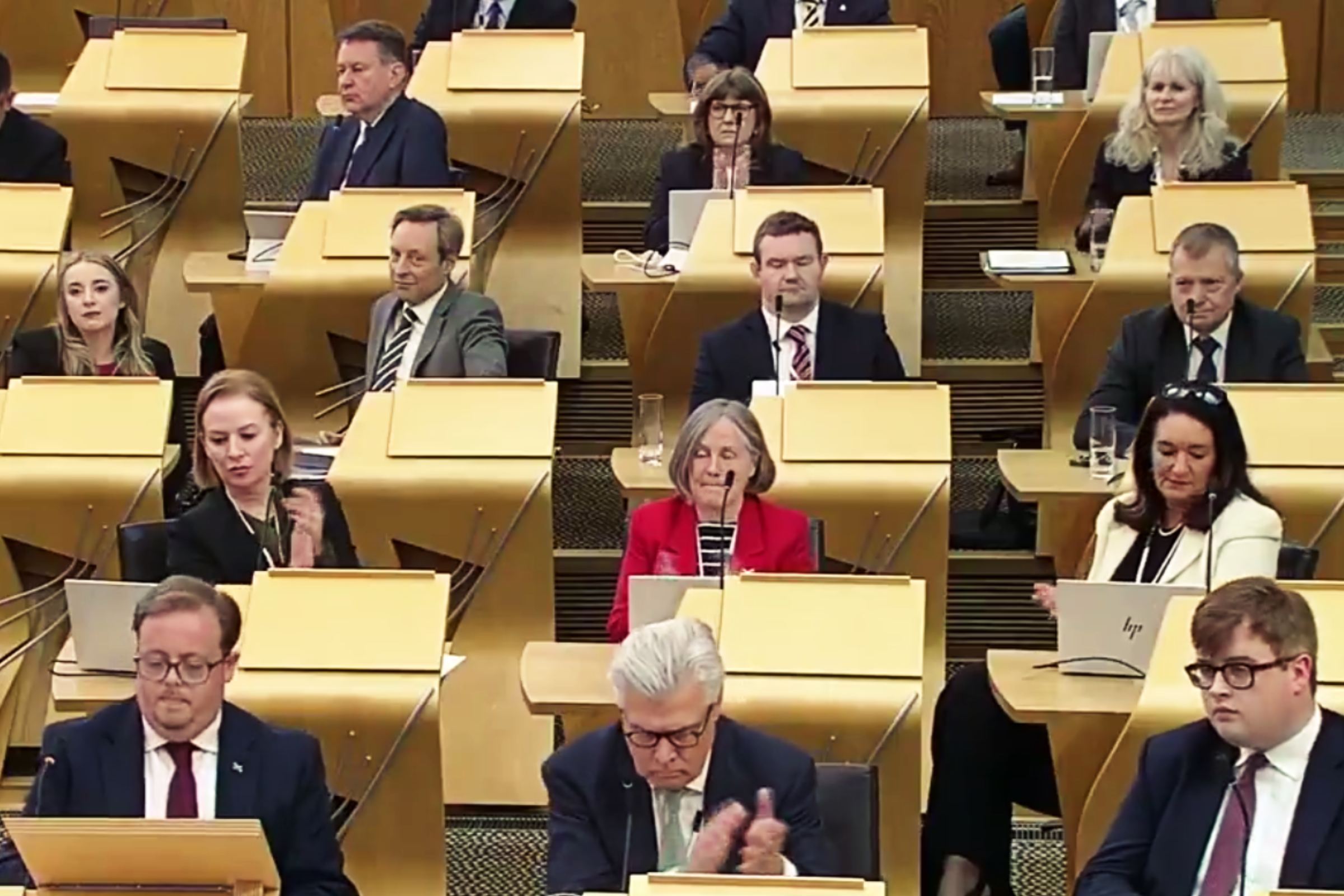
The First Minister’s first major programme debate of the new Parliament will ask MSPs to support a call for Westminster to devolve the power to hold another independence referendum.
John Swinney will put Scotland’s constitutional question back before Holyrood on Tuesday, when the Scottish Parliament is scheduled to debate a Scottish Government motion calling on the UK Government to make a Section 30 order to allow a referendum on Scottish independence.
The motion, titled “Ambitious for Scotland”, has been lodged in Swinney’s name and is due to be debated after a First Minister’s statement of the same title on Tuesday 26 May. The parliamentary business bulletin confirms that the statement and debate are scheduled for Tuesday afternoon, with decision time listed for 5pm.
The text of the motion links constitutional change with the new Government’s wider priorities. It says Parliament should welcome what it describes as an “emphatic democratic mandate” for reform, including commitments to eradicate child poverty, strengthen the NHS and public services, build a more prosperous economy, help people through the cost of living crisis and tackle climate change. It then states that the people of Scotland have returned the largest pro-independence majority ever elected to the Scottish Parliament, and calls on the UK Government to make a Section 30 order under the Scotland Act 1998 to devolve the powers for Holyrood to hold an independence referendum.
The political basis for the motion lies in the May 7 election result. The SNP returned as the largest party, with 58 seats according to the Scottish Parliament Information Centre, while the Scottish Greens won 15. Taken together, the SNP and Greens hold 73 of Holyrood’s 129 seats. Reform UK and Scottish Labour each won 17 seats, the Conservatives 12 and the Liberal Democrats 10.
That gives the pro-independence parties a parliamentary majority, though not an SNP majority. The distinction is central to the argument that will now unfold. Swinney had previously made an SNP majority the clearest trigger for a renewed push, but the Parliament returned something different: a larger pro-independence bloc made up of two parties, alongside a fractured opposition and a markedly changed unionist landscape.
Speaking to the Press Association, Swinney said he intended to bring forward the motion after a statement on the Government’s priorities, subject to parliamentary agreement. He said the purpose was to give Parliament the opportunity to state that Scotland’s constitutional future should be decided by referendum, delivered through a Section 30 order involving a transfer of powers.
The Scottish Greens have pressed for the vote to be brought forward quickly. Green co-leader Gillian Mackay said Scotland had voted for a pro-independence majority and argued that the mandate did not belong to one party alone. Her position is that Green votes were also votes for independence and for Scotland’s right to choose its constitutional future.
The motion is not itself a referendum bill. It is a political instruction and parliamentary position. Under the Scotland Act 1998, constitutional matters relating to the Union and the UK Parliament are reserved to Westminster. The 2014 independence referendum proceeded after the UK and Scottish Governments agreed a Section 30 order temporarily giving the Scottish Parliament the competence to legislate for that vote. The House of Commons Library notes that Section 30 orders can alter Holyrood’s legislative authority, but require approval by both Houses of the UK Parliament and the Scottish Parliament before becoming law.
The legal position has hardened since 2014. In 2022, the UK Supreme Court ruled that the Scottish Parliament could not legislate for an independence referendum without a change to reserved powers, because a referendum on whether Scotland should become independent related to reserved matters including the Union and the Parliament of the United Kingdom. The Court’s judgment means that, absent a Section 30 order or other Westminster legislation, Holyrood cannot unilaterally hold a lawful independence referendum.
That makes Tuesday’s vote less a direct route to a referendum than a formal renewal of pressure on the UK Government. If the motion passes, as appears likely given the combined SNP and Green numbers, the immediate question will move from Holyrood to Westminster: whether the UK Government will agree to another transfer of powers. Recent precedent suggests that is unlikely. Previous requests for a second referendum were refused by UK Governments, and there is no public sign that the present UK Government is preparing to change that position.
Opposition parties have already moved to reframe the debate away from the constitution. Liberal Democrat leader Alex Cole-Hamilton has lodged an amendment which would replace most of Swinney’s motion and argue that the SNP sought an overall majority before the election but achieved fewer votes and seats than in previous elections. His amendment says the Scottish Government should focus on the NHS and care, the cost of living, roads and ferries, and education.
Scottish Conservative leader Russell Findlay has lodged a separate amendment calling for the seventh session of Parliament to focus exclusively on issues such as NHS waiting times, education standards, the benefits bill and value for taxpayers. It urges the Scottish Government to drop its demands for a second independence referendum.
The Greens, meanwhile, have lodged an amendment which supports greater use of existing devolved powers and argues that Scotland’s challenges require a significant escalation in action and ambition. The wording recognises that no one party holds a majority in the current session, but says there is a clear majority for progressive values and calls for constructive work among progressive parties.
The coming debate therefore has two layers. One is constitutional: whether a pro-independence majority at Holyrood should be treated as a mandate for another referendum request. The other is practical: whether the new Government’s early parliamentary time should be used to press Westminster on independence or to foreground public services, living costs, transport, education, energy and economic management.
The facts point in both directions. The SNP and Greens do hold a majority of seats and both parties support Scottish independence. The SNP also remains by far the largest party in the new Parliament. But the SNP did not win an overall majority, and the combined pro-independence majority exists inside an electoral system where seat numbers, vote shares and constitutional preference do not always say the same thing with perfect neatness. A parliamentary mandate is real, but it is not the same as a referendum result.
For Swinney, Tuesday’s motion will allow him to show independence supporters that the issue has not been deferred indefinitely after the election. For the opposition, it offers an early chance to argue that the Government is returning to constitutional confrontation before addressing the pressures voters feel in daily life.
The likely outcome is a Holyrood vote in favour of requesting referendum powers, followed by a Westminster refusal or silence. That would leave Scotland once again with a familiar constitutional problem: a Parliament with a pro-independence majority able to ask for a referendum, but not able to legislate for one without the consent of the UK state.
The significance of Tuesday’s debate lies in documenting the opening position of the new Parliament. Swinney will argue that Scotland has returned a mandate that must be respected. His opponents will argue that Scotland returned a Government without a majority and with urgent domestic business to attend to.
The question that remains is the same one Scotland has been circling since 2014: who decides when a mandate is enough.
Sources
Scottish Parliament, Business Bulletin, Thursday 21 May 2026, including motion S7M-00105, “John Swinney: Ambitious for Scotland,” and the scheduled Tuesday 26 May 2026 debate.
Scottish Parliament, Votes and Motions search, amendments to S7M-00105 from Alex Cole-Hamilton, Russell Findlay and Ross Greer.
Scottish Parliament Information Centre, Election 2026, Scottish Parliament election result and seat distribution.
Nation Cymru / Press Association report Independence motion to face Holyrood vote on Tuesday, says Swinney, including Swinney and Gillian Mackay comments.
House of Commons Library, Scottish Devolution: Section 30 Orders, explanation of Section 30 orders and the 2014 referendum mechanism.
UK Supreme Court, Reference by the Lord Advocate of devolution issues under paragraph 34 of Schedule 6 to the Scotland Act 1998, summary of the 2022 judgment on Holyrood’s competence to legislate for an independence referendum.