
Volunteers and school leaders from Lewis, Harris and Benbecula have met in Stornoway to examine how distance, limited local provision and the practical demands of the Duke of Edinburgh’s Award can be managed more fairly across the islands.
A national youth programme can appear relatively straightforward on paper. In the Western Isles, delivering it requires schools and volunteers to work across a dispersed chain of islands, where suitable activities, adult supervision and transport cannot always be taken for granted.
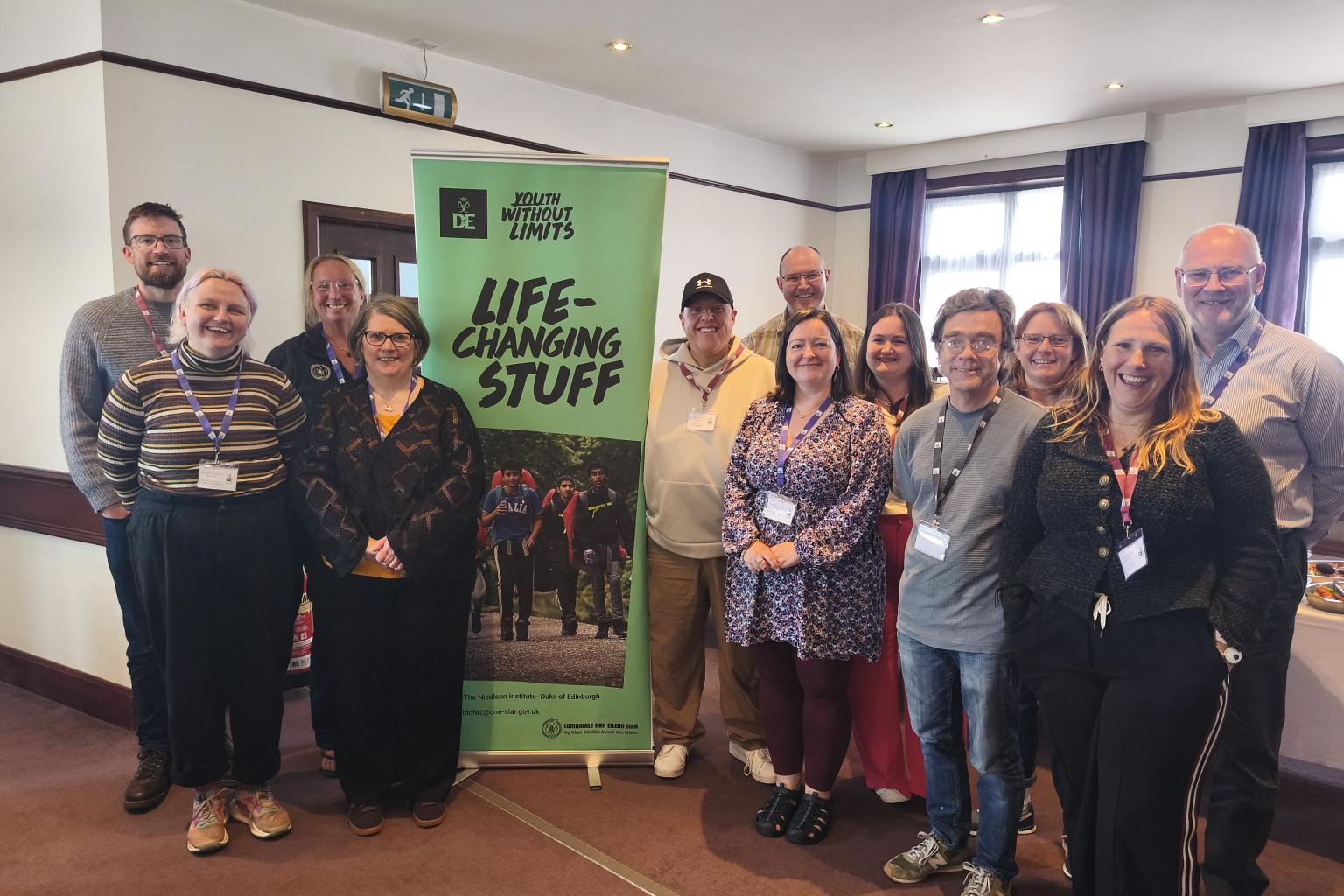
Duke of Edinburgh’s Award leaders and volunteers from the Nicolson Institute, Sir E Scott School and Sgoil Lionacleit met at the Caladh Inn in Stornoway on Saturday 30 May. The three schools serve young people in Lewis, Harris and Benbecula respectively, giving the event a geographical reach extending across much of the Outer Hebrides.
The meeting was opened by DofE Scotland director Helen Anderson, supported by operations officer Alice Illingworth. It allowed those responsible for delivering the programme to compare experiences, discuss national rules and consider how the Award can remain accessible when local circumstances make conventional arrangements difficult.
Comhairle nan Eilean Siar has operated as a licensed DofE organisation for more than 25 years. During that period, it says more than 2,000 young people have started an Award through the local programme.
In the latest year, Western Isles participants recorded 1,885 hours of voluntary service within their communities. That represents a substantial amount of unpaid work by young people, although the published figures do not identify the organisations supported, the types of work undertaken or how those hours were distributed between islands.
The practical discussions in Stornoway included widening access, finding acceptable ways for participants to meet volunteering requirements and examining the possible use of virtual expedition arrangements. One attendee said the opportunity to discuss difficulties with people delivering the Award elsewhere had been useful and had encouraged them to promote the programme more widely.
Those conversations go to the centre of the challenge facing island participants. DofE programmes require young people to undertake sustained activities in volunteering, physical development and skills, as well as completing an expedition. Gold participants must also complete a residential section. Activities can be delivered online or in person in some sections, but expeditions must be conducted through a licensed organisation or approved provider.
The expedition element is intended to test teamwork, preparation, navigation and independent decision-making. DofE guidance permits remote supervision, but that still requires trained adults, appropriate routes, risk assessments, communication plans and the ability to provide help quickly when necessary. Remote supervision means adults observing participants from a distance; it does not mean leaving groups unsupported or replacing an outdoor journey with an online exercise.
That distinction may require clearer explanation following the Stornoway discussions. The reference to “virtual expeditions” in the account of the event was not accompanied by details about what form these would take, whether they would replace any part of a qualifying expedition or how they would satisfy the Award’s existing requirements.
Flexibility is reasonable where geography or individual needs create genuine barriers, but the value of the Award also depends upon maintaining a recognisable standard. The proper objective is to remove avoidable obstacles without quietly reducing the substance of what participants are expected to accomplish.
Transport support removes part of the financial burden. Young people under 22 in Scotland are eligible for free bus travel, while residents of the Outer Hebrides in the same age group can use their National Entitlement Card for free foot-passenger travel on inter-island ferry services within the council area. That assistance cannot by itself ensure that transport is available at the time an activity, placement or expedition begins and ends.
Finding regular volunteering placements can also be more complicated in small communities. A suitable role must meet the Award’s requirements, remain available for the necessary period and provide someone able to assess the participant’s work. Where the number of organisations and adult volunteers is limited, several young people may be drawing upon the same small pool of opportunities.
Alice Murray, DofE operations manager for the Western Isles, said bringing volunteers together had allowed them to exchange ideas and learn from the difficulties encountered in different parts of the islands.
“The DofE is more relevant now than ever before for young people,” she said, pointing to resilience, teamwork and self-belief among the skills developed through the programme.
The networking day was supported financially by the Western Isles Development Trust. The amount awarded for the event was not stated, nor was a breakdown provided showing how the money was used.
Across Scotland, more than 19,000 young people began a DofE programme during 2025–26, while more than 33,800 were actively participating. The charity says Scottish participants contributed more than 370,000 volunteering hours, to which it assigned a total value of £2.9 million. That figure is an estimated economic value for the time contributed rather than money paid to local organisations or to the young people themselves.
The charity’s new UK strategy aims to provide more than two million young people with a DofE experience by 2031. Its stated priorities include reducing financial barriers for low-income families and reaching more young people outside conventional education, including those within the youth justice system. Between April 2021 and March 2026, it says 1.6 million young people started an Award and more than £4.2 million was distributed to help disadvantaged participants.
The Western Isles figures demonstrate sustained local participation, but they offer only part of the picture. The council has reported how many young people started an Award over 25 years, without publishing how many completed Bronze, Silver or Gold, how participation differs between islands, or how many withdrew because of cost, transport, staffing or difficulty securing an activity.
Starting an Award and achieving one are different measures. Completion figures would allow the council and local volunteers to identify where young people are being lost from the programme and whether the barriers discussed in Stornoway are being removed in practice.
The next test will be whether the ideas exchanged at the Caladh Inn lead to more placements, stronger volunteer support and a clear route to completion for young people throughout the islands. Anyone interested in supporting the Western Isles programme can contact Alice Murray at widofe2@cne-siar.gov.uk