
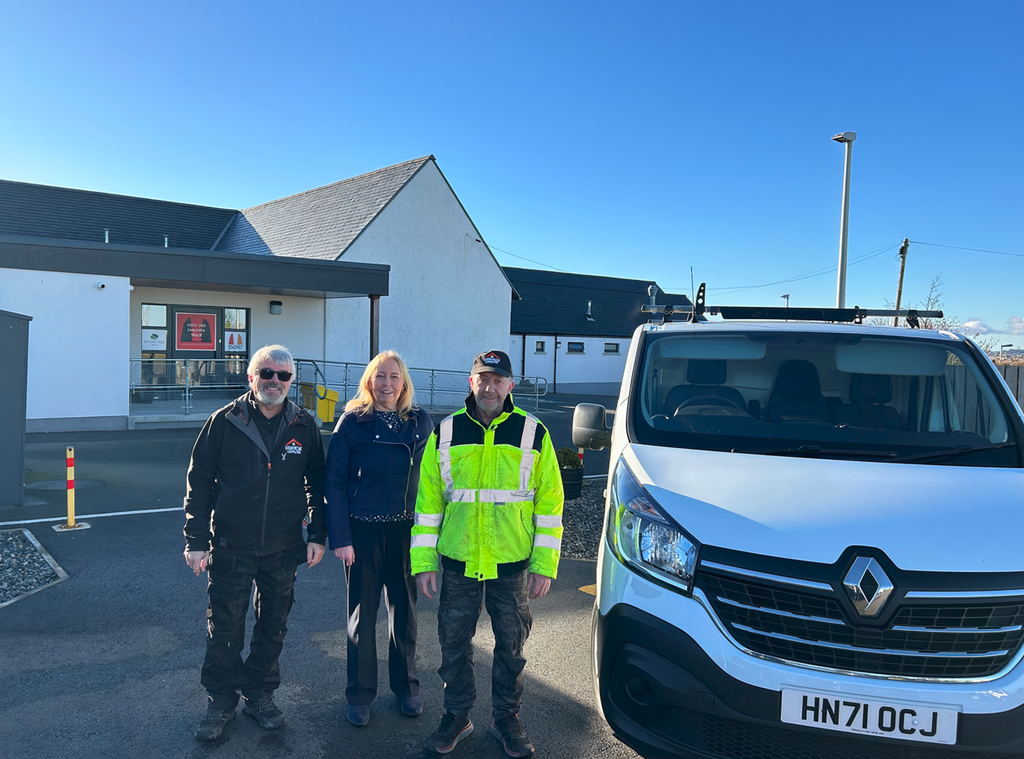
A new vehicle will strengthen a community project helping households affected by fuel poverty, damp housing and the health consequences of living in cold homes.
NHS Western Isles has awarded £15,994 in capital funding to Point and Sandwick Trust to purchase a dedicated vehicle for tackling dampness and mould in homes on the Isle of Lewis.
The grant, announced on 10 November, will support the trust’s Warmth Without Worry project, which provides financial assistance, practical household improvements and energy advice to residents struggling to keep their homes warm.
The vehicle will allow the project’s technician to respond to household problems more efficiently and transport equipment needed for smaller interventions before dampness and mould become more serious.
The funding reflects a growing recognition that housing conditions are a public health concern, particularly in communities where high heating costs, older properties and limited household incomes make it difficult to maintain warm, dry homes.
The award is being made from capital funding available to NHS Western Isles separately from its core operational budget, intended to support third-sector and not-for-profit organisations.
A Project Already Supporting Island Households
Warmth Without Worry was launched in March 2026 after Point and Sandwick Trust secured £192,674 from the Energy Saving Trust’s Energy Redress Scheme.
The two-year initiative operates through the trust’s Energy Support Unit and concentrates on households in the Point and Sandwick area of Lewis.
Its approach goes beyond conventional advice about reducing energy consumption. Staff assess actual household energy use against modelled requirements, helping identify situations where residents are using less heating than their homes need because they cannot afford the cost.
This allows the project to offer individually assessed energy crisis grants alongside practical measures to improve living conditions.
Assistance may include dehumidifiers, ventilation improvements, moisture-management advice and help with heating arrangements. Households can also be referred to other organisations for financial advice, energy tariff assistance and support with disputes involving utility companies.
The latest NHS funding adds a practical resource to that work, enabling technicians to reach households and transport the equipment required for smaller dampness and mould interventions.
Stewart Wilson, Energy Support Unit Manager at Point and Sandwick Trust, explained in the NHS announcement that having a dedicated vehicle would allow the technician to respond more quickly and address problems before they became more serious.
Gillian McCannon, Chair of NHS Western Isles, described the project as an example of practical community support that could improve wellbeing and help prevent more serious health problems.
Four in Ten Western Isles Households Experience Fuel Poverty
The need for such interventions is illustrated by the Scottish Government’s most recent local authority fuel poverty statistics, published in May 2026.
The Scottish House Condition Survey estimated that 40% of households in Na h-Eileanan Siar experienced fuel poverty during 2022–2024, compared with 31% across Scotland over the same period.
Extreme fuel poverty affected an estimated 27% of Western Isles households, against the national figure of 17%.
Under Scotland’s statutory definition, fuel poverty takes account of both the cost of maintaining adequate heating and whether sufficient income remains for an acceptable standard of living. Extreme fuel poverty applies a higher threshold of required fuel expenditure.
The figures place the Western Isles among Scotland’s most severely affected local authority areas.
The geographical and physical characteristics of island housing contribute to the problem.
Scotland’s National Islands Plan, published in 2026, reports that 89% of homes in Na h-Eileanan Siar are not connected to the gas grid. Many households instead depend on electricity, heating oil or solid fuels, limiting their choice of heating systems and exposing them to different energy costs.
The age, construction and condition of properties also matter. Older buildings can be expensive to insulate or retrofit, while poorly insulated homes require more energy to maintain comfortable temperatures.
For households already rationing their heating, these difficulties can create conditions in which condensation accumulates and mould develops.
Why Damp Housing Is a Health Issue
The connection between damp housing and ill health is well established.
NHS inform identifies respiratory infections, asthma, allergies and other breathing difficulties among the health problems associated with exposure to damp and mould.
Babies, children, older people and those with existing respiratory conditions or weakened immune systems are particularly vulnerable.
Problems can develop when a household cannot afford sufficient heating, particularly if the property also suffers from poor insulation or inadequate ventilation. However, dampness can also result from leaks, water penetration and structural defects.
These distinctions are important because removing visible mould does not necessarily resolve the underlying cause.
Where moisture enters through a defective roof, wall or window, permanent repairs may be necessary. Where condensation contributes to the problem, suitable heating and ventilation can help, although residents need practical solutions that do not make an already unaffordable energy bill worse.
Warmth Without Worry’s combination of financial assistance and physical intervention is intended to address several of these problems together.
The new vehicle will not, by itself, resolve the wider fuel poverty problem. Its value will depend on the number of households reached, the improvements carried out and whether those improvements produce lasting changes in living conditions.
Community-Owned Wind Power Funds Household Support
Point and Sandwick Trust’s work also demonstrates an important connection between community renewable energy and local welfare.
Its Energy Support Unit receives funding generated by the community-owned Beinn Ghrideag wind farm on Lewis. That income has supported direct financial assistance, energy advice and advocacy for households experiencing hardship.
In May 2026, the trust reported that its Energy Support Unit had distributed more than £476,750 in assistance since January 2023.
At that point, Warmth Without Worry itself had reached more than 100 individual households and issued 86 grants.
The Energy Support Unit was also named Energy Champion of the Year at the 2026 Energy Awards, recognising its work addressing fuel poverty.
The figures show that the project was already delivering support before the latest NHS grant. The additional vehicle is intended to strengthen the practical side of an established service rather than create an entirely new programme.
It also illustrates the different funding arrangements supporting the initiative: community wind farm income sustains the wider Energy Support Unit, the Energy Redress award supports the two-year Warmth Without Worry project, and the new NHS capital grant is specifically for the vehicle.
Preventing Problems Before They Become More Serious
There is a significant difference between helping a household pay an immediate heating bill and making its home less vulnerable to dampness and cold.
Emergency payments can prevent hardship, but lasting improvements may require attention to insulation, ventilation, building defects and the affordability of heating.
The NHS Western Isles investment concentrates on the practical assistance available to households, with the intention of addressing relatively small problems before they cause greater damage or contribute to worsening health.
It also raises a wider question for public health services: how much ill health might be prevented if suitable housing interventions were available before residents developed conditions associated with cold and damp homes?
For the Western Isles, where fuel poverty remains substantially above the Scottish average, the answer will depend on both immediate support and longer-term improvements to housing and energy affordability.
Residents of the Point and Sandwick area seeking help with fuel poverty, dampness or mould can contact the Energy Support Unit confidentially on 07887 371887 or 01851 619 471, Monday to Thursday, between 10am and 4pm.
Sources
NHS Western Isles Awards Capital Grant Funding to Support Warmth Without Worry Project. NHS Western Isles. 10 November 2026.
https://www.wihb.scot.nhs.uk/nhs-western-isles-awards-capital-grant-funding-to-support-warmth-without-worry-project/
Point and Sandwick ‘Warmth Without Worry’ Project Launched with £192,674 Grant. Point and Sandwick Trust. 6 March 2026.
https://www.pointandsandwick.co.uk/point-and-sandwick-warmth-without-worry-project-launched-with-192674-grant/
Point and Sandwick Trust Energy Support Unit Recognised as National Energy Champions. Point and Sandwick Trust. 14 May 2026.
https://www.pointandsandwick.co.uk/point-and-sandwick-trust-energy-support-unit-recognised-as-national-energy-champions/
Scottish House Condition Survey Local Authority Tables 2022–2024: Fuel Poverty. Scottish Government. 26 May 2026.
https://www.gov.scot/publications/scottish-house-condition-survey-local-authority-tables-2022-2024/pages/fuel-poverty/
Scottish House Condition Survey Local Authority Tables 2022–2024: Extreme Fuel Poverty. Scottish Government. 26 May 2026.
https://www.gov.scot/publications/scottish-house-condition-survey-local-authority-tables-2022-2024/pages/extreme-fuel-poverty/
National Islands Plan. Scottish Government. February 2026.
https://www.gov.scot/publications/national-islands-plan/
Damp and Mould Indoors. NHS inform. 2026.
https://www.nhsinform.scot/healthy-living/indoor-health/damp-and-mould-indoors/
Energy Support Unit. Point and Sandwick Trust. Undated, accessed 11 November 2026.
https://www.pointandsandwick.co.uk/about-us/what-we-do/energy-support-unit/