
The Duke of Edinburgh’s visit to Montrose Port gave Angus a ceremonial moment. Behind it sits a more important question: whether one working Scottish harbour can turn offshore wind, shore power, skills training and maritime heritage into a lasting local transition.
The most important part of the Duke of Edinburgh’s visit to Montrose Port was not the ceremony.
It was the itinerary.
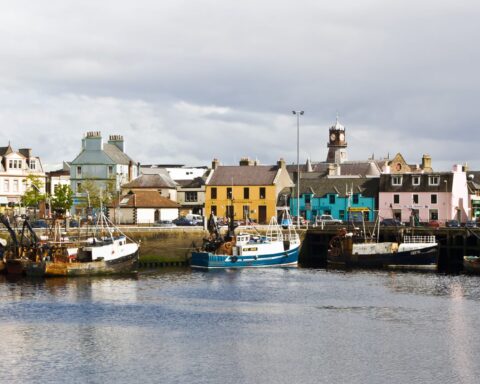
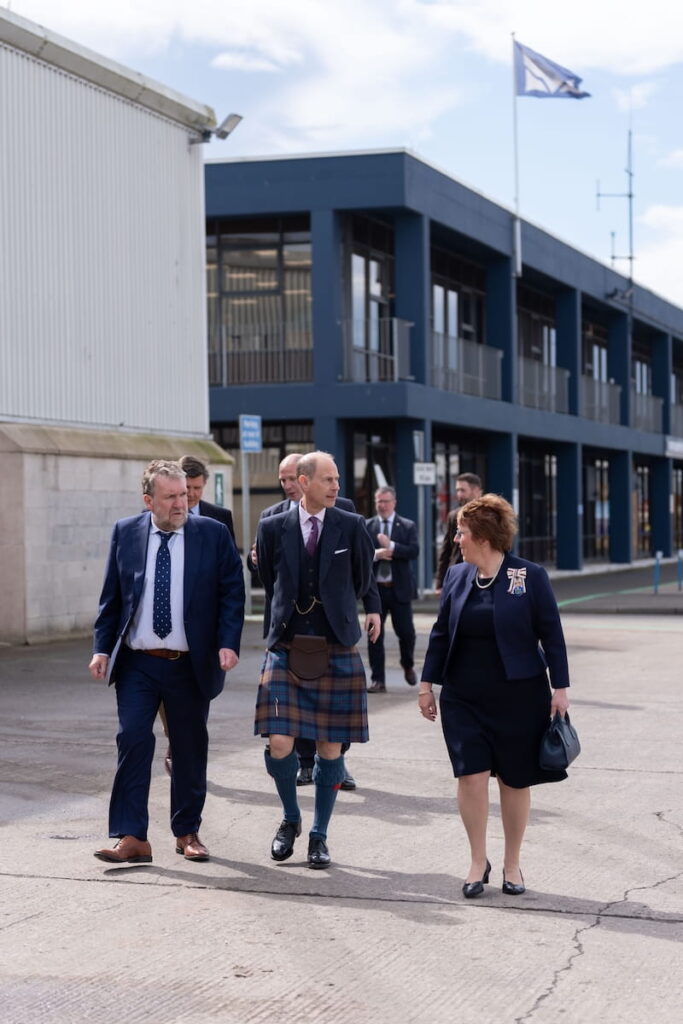
On Monday 27 April 2026, His Royal Highness visited Montrose Port Authority in recognition of the port’s work on decarbonisation and its role as an operations and maintenance hub for offshore wind on Scotland’s east coast. The official welcome brought the expected civic formality. Angus Lord Lieutenant Patricia Sawers was present, along with Lord Provost Craig Fotheringham, Angus Council chief executive Kathryn Lindsay and Montrose Port chief executive Tom Hutchison. Pupils from nearby Ferryden Primary School also greeted the Duke and presented a framed drawing.
Such moments matter. They give local work national visibility. They bring attention to places that are often discussed only when something has gone wrong. But the stronger story at Montrose was not that royalty had arrived. It was that the route through the port traced several of the harder questions now facing Scotland’s energy transition.
The Duke met representatives from Montrose Port, SSE, SSE Renewables and TotalEnergies, then visited the South Quay, where Seagreen Offshore Wind Farm has its operations and maintenance base. Seagreen is Scotland’s largest operational offshore wind farm, with a total operational capacity of 1,075 MW, located around 27 kilometres off the Angus coast in the North Sea. SSE Renewables describes it as Scotland’s largest offshore wind farm and says it has the deepest fixed bottom foundations of any wind farm in the world.
That makes Montrose more than a convenient harbour. It is part of the machinery by which Scotland’s offshore energy is managed day by day. SSE said the Duke’s visit highlighted the port’s role in the safe and efficient running of Seagreen, and the wider impact of offshore wind through investment, skills development and employment.
The port is also preparing for the next stage. Construction is under way on an operations and maintenance base for Inch Cape Offshore Wind Farm. Inch Cape says the project will have a capacity of around 1.1 GW, will use 72 turbines in the North Sea, 15 kilometres off the Angus coast, and is due to become fully operational in 2027. Montrose Port says the Inch Cape operations and maintenance base will support up to 56 direct, full time equivalent, long term jobs, including turbine technicians, asset managers and office staff.
Those figures give the visit its substance. Offshore wind is often spoken of in national terms, as capacity, targets, investment and clean power. In Montrose, the question is more local and more testable. Does the energy transition leave skilled work in Angus? Does it create a supply chain that reaches beyond construction into long term operations? Does it give young people in the area a credible route into the industry, or does the value move elsewhere once the photographs have been taken?
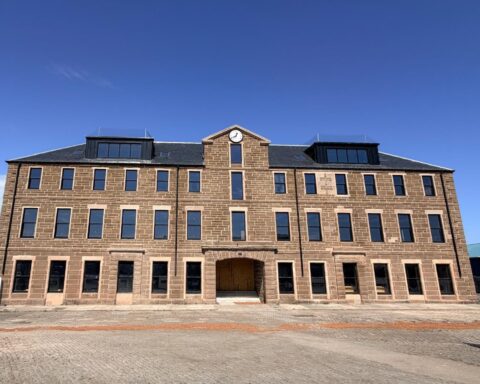
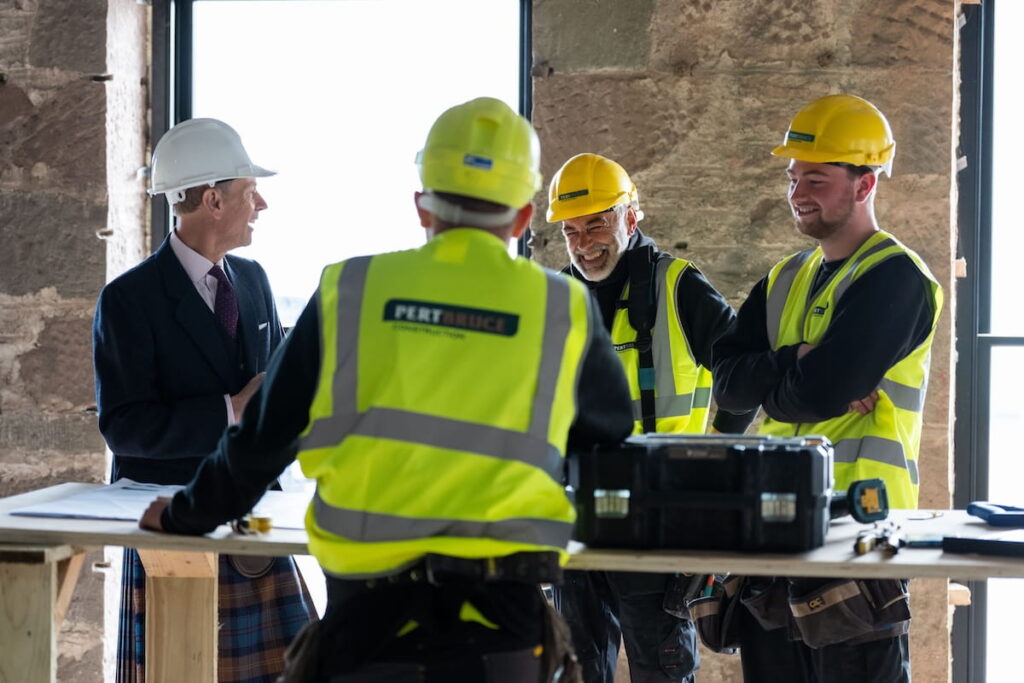
That is why the Customs House part of the visit matters. The Duke also saw the renovation of the historic Customs House, a B listed building being turned into commercial space for the renewables supply chain and a dedicated offshore wind Skills Academy, described by Montrose Port as the first of its kind in Angus.
The academy is not a decorative addition. It is one of the tests of whether the transition becomes rooted locally. In November 2024, Montrose Port announced that Angus Council, Montrose Port Authority and Dundee and Angus College had signed a memorandum of understanding to develop the facility within Customs House. The academy received £1.25 million of funding from the Scottish Government’s Tay Cities Industrial Investment Programme, with the stated aim of supporting training for offshore wind, low carbon technology and clean growth across the Tay Cities region.
Dundee and Angus College already lists a Futures in Offshore Wind course at its Arbroath campus. The college describes it as an introductory programme for those looking to become offshore wind turbine technicians, combining practical learning with theory in mechanical, electrical and hydraulic systems and including an SVQ Performing Engineering Operations qualification at SCQF Level 4.
This is where the article should avoid the easy language of celebration. Training schemes are valuable only if they connect to real jobs, real employers and real progression. Montrose has some of the right ingredients: a working port, live offshore wind operations, future development at Inch Cape, a college partner and a historic building being reused for a modern purpose. But the promise will have to be judged by outcomes, not by ceremony. How many local people enter the training? How many complete it? How many move into sustained employment? Which employers take them on? Those are the questions that will decide whether the Skills Academy becomes a local asset or another well intentioned project with a handsome sign above the door.
The port’s decarbonisation work is also more substantial than a slogan. Plug Montrose, its shore power facility, went live in April 2024. Montrose Port says it was the first Scottish port to provide shore power for offshore energy supply vessels. The facility allows vessels at berth to switch off onboard engines and connect to electricity from the port grid, reducing emissions, fuel use and noise during port stays.
The Scottish Parliament has also noted Plug Montrose as a £1 million, 50 to 50 joint venture between Montrose Port Authority and Plug Shore Power Limited, the UK based arm of Norwegian company Plug. The parliamentary motion said the facility enables vessels to connect to the grid at Montrose Port, where electricity is backed by Renewable Energy Guarantees of Origin, and turn off diesel generators while at berth.
By November 2025, Montrose Port said the shore power system had supplied 1 GWh of power and prevented more than 740 tonnes of carbon dioxide emissions. It also said shore power had been expanded from berths 1 and 2 to berth 3, bringing coverage to 30 percent of the port’s berths, with a longer term aim of electrifying all berths as part of future quay improvements.
The newer figure cited around the Duke’s visit was higher, with Montrose Port saying the facility had prevented more than 1,122 tonnes of carbon dioxide, equivalent to a car driving around the world 212 times. That claim should be attributed to the port, not treated as independent measurement unless further evidence is provided. It is still material. Shore power is a practical intervention, particularly because emissions from vessels at berth can be a significant part of port pollution. Montrose Port cited Department for Transport evidence in 2024 stating that 70 to 90 percent of port emissions are generated by vessels, with emissions from vessels at berth notably higher than those from manoeuvring vessels.
The limit is equally important. Shore power does not decarbonise shipping as a whole. It does not remove emissions from offshore construction, supply chains, steel, turbine manufacture, maintenance vessels, grid constraints or wider marine operations. What it does is narrower and still useful: it reduces emissions while compatible vessels are berthed and connected. That distinction matters because environmental reporting should not allow one credible measure to stand in for the whole transition.
Montrose is therefore becoming a useful case study because it shows the transition in its practical form. Not as a ministerial target. Not as a corporate slogan. Not as a single ribbon cutting. It is a port adapting its berths, hosting offshore wind operations, restoring a listed maritime building, preparing training routes and trying to capture local value from a national energy shift.
That effort deserves recognition. It also deserves scrutiny.
The strongest claim for Montrose is that several pieces are being assembled in one place. Seagreen is operational. Inch Cape is under construction. Shore power is in use. Customs House is being renovated. The Skills Academy has public sector, port and college involvement. The port has a clear role in the east coast offshore wind economy. For Angus, that is more than symbolic.
The risk is that Scotland has heard many confident promises from energy industries before. Oil and gas transformed parts of the country, but the benefits were unevenly distributed and the long term consequences are still being managed. Offshore wind brings a different environmental purpose, but the same questions about ownership, supply chains, local employment, public subsidy and community benefit remain. A greener industry is still an industry. It must be examined as one.
There are also heritage questions here, and they are not sentimental. The reuse of Customs House matters because it suggests that the future of a working port need not erase its past. Scotland’s maritime buildings are part of the country’s civic memory. Turning a B listed port building into a renewables skills centre is, if done well, a more intelligent form of regeneration than leaving heritage to decay while new industry builds around it without reference to place.
That is the deeper force of the Montrose story. The Duke’s visit supplied the public attention. The port supplied the substance. A royal engagement can draw the eye, but it cannot create the facts. Here, the facts are in the quay, the control room, the shore power cables, the training plan and the old building being brought back into use.
For Modern Scot, the story is not that Montrose has completed a transition. It has not. No port can claim that because it has installed shore power at some berths, hosted offshore wind operations and planned a skills academy. The transition is still being built and must still prove itself.
The more careful conclusion is stronger.
Montrose Port is becoming one of the places where Scotland’s energy transition comes ashore. Its progress is visible, practical and locally important. The work now is to ensure that decarbonisation is measured honestly, that offshore wind creates durable employment, that training leads to real opportunity, and that the benefits of the renewables economy remain in Angus as well as passing through it.
The flags and formal greetings will fade. The test will be what remains on the quayside.