
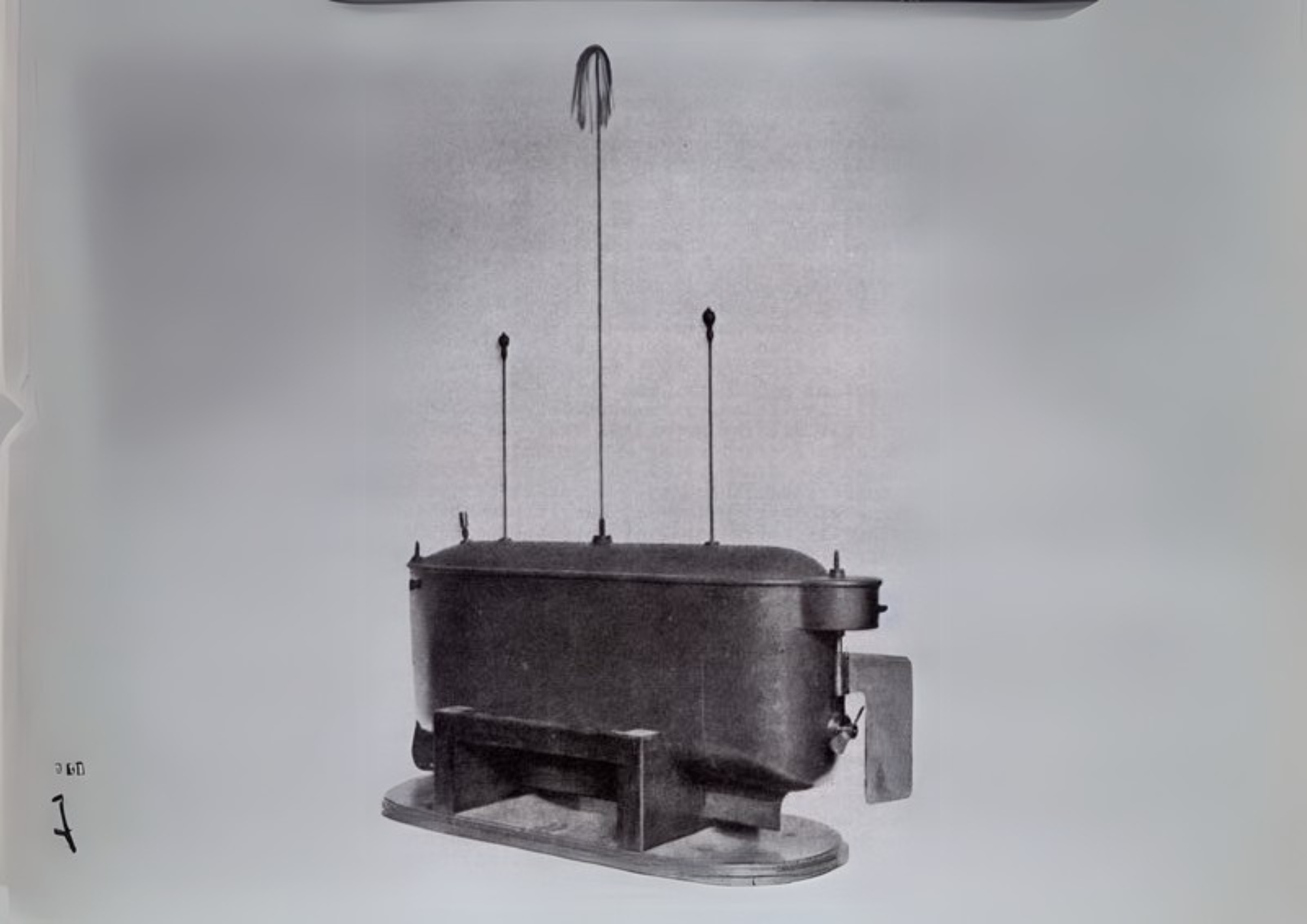
In the closing years of the nineteenth century, before the language of artificial intelligence had even been formed, there was a moment when a machine moved without touch, without tether, and without any visible cause.
It happened in 1898, inside Madison Square Garden, where Nikola Tesla demonstrated a small radio controlled boat to a crowd that did not quite believe what it was seeing.
There were no wires. No visible mechanism of control. Only a vessel, responding to commands that travelled invisibly through the air.
The audience, confronted with something that did not fit within their understanding, reached for the only explanations available to them. Some suspected deception. Others suggested telepathy. A few recognised that they were witnessing something more consequential, though they could not yet define it.
Tesla, characteristically, encouraged the ambiguity.
By that stage in his career, he had already reshaped electrical engineering through his work on alternating current and electromagnetic systems. Yet this particular invention, which he described as “teleautomatics,” pointed in a different direction. Not toward power, but toward control.
The idea was disarmingly simple. A machine could be operated at a distance, without direct human contact, using signals transmitted through space. But within that simplicity lay a profound shift. Control no longer required proximity.
The boat itself was a compact assembly of batteries, motors, and circuitry. At its core was a receiver tuned to respond to specific radio signals. Tesla, using a handheld transmitter, could send commands that altered the boat’s direction and behaviour. The rudder moved. The propeller engaged. The vessel responded.
More intriguingly, the system was not limited to a single action. It could interpret different signals and produce different outcomes. In effect, the machine could be instructed.
Tesla understood what that implied. He suggested that such systems might one day be extended, refined, and given a degree of independence. Machines could act, not merely as tools, but as agents operating beyond immediate human reach.
The term he chose, teleautomaton, carries a certain precision. It was not simply remote control. It was automation at a distance.
The demonstration itself was conducted with a touch of theatre. Tesla invited members of the audience to call out commands, then manipulated the controls in such a way that the boat appeared to respond to their voices. It was a deliberate illusion, but an instructive one. The appearance of intelligence can be as persuasive as its presence.
That lesson has not been lost on modern systems.
The immediate reaction from institutions, however, was less imaginative. Tesla approached the United States Navy with the concept of remotely controlled vessels, proposing what he described as intelligent torpedoes. The response was dismissive. The notion that a machine might operate without a human aboard was regarded as impractical, if not fanciful.
History, as it tends to do, has been unkind to that judgement.
The principles demonstrated in that small boat now underpin entire industries. Modern drones, autonomous vehicles, and remotely operated systems all rely on the same essential idea. Signals transmitted through space, interpreted by machines, resulting in action.
The connection is not metaphorical. It is direct.
In robotics and artificial intelligence, the separation between instruction and execution has become routine. Systems receive input, process it, and respond, often without human intervention at the point of action. Whether in a warehouse robot navigating aisles or an autonomous vehicle adjusting to its surroundings, the lineage can be traced back to that initial demonstration.
The same applies to wireless communication. Tesla’s work contributed to the development of radio transmission, which would later evolve into the technologies that now carry data across the globe. Tesla, Waymo, and countless others operate within a framework that depends on reliable, invisible communication between systems.
Even the so called Internet of Things, where devices communicate and act without direct human control, echoes Tesla’s early vision. Machines responding to signals, coordinating actions, performing tasks.
Yet at the time, the invention was largely set aside.
Part of the reason was technical. Wireless communication was not yet well understood. The supporting infrastructure did not exist. But part of it was perceptual. The idea itself was ahead of the framework required to recognise its value.
Tesla, for all his insight, lacked the financial backing to develop the concept further. Without institutional support, the teleautomaton remained an isolated demonstration rather than the beginning of an industry.
One is left with the sense of a moment that might have unfolded differently.
Had the technology been pursued, the development of remote systems and autonomous machines might have advanced decades earlier. Instead, the idea lay dormant, waiting for the surrounding conditions to catch up.
Today, it no longer appears unusual for a machine to operate at a distance, or even to operate independently. The spectacle has become routine. But the underlying principle remains the same as it was in 1898.
A signal is sent. A system receives it. An action follows.
Tesla saw, perhaps more clearly than most, that this sequence could be extended. That machines might not only respond, but decide. Not only act, but operate within a framework of instructions that allowed for variation.
He did not have the language of artificial intelligence. He did not speak of algorithms or learning systems. But the direction of thought is unmistakable.
The boat in the water, responding to invisible commands, was not merely a demonstration of control. It was an early suggestion that machines might one day stand apart from their operators.
Not entirely independent, but no longer tethered.
That distinction, subtle at the time, has since become the defining feature of modern automation.