
The family bakery founded in Kilmarnock in 1945 expanded its Asda range from early May 2026, but the larger story is one of Ayrshire craft, family continuity and the survival of local food identity at scale.
Scotland has many food products that travel further than the places that made them, but the best of them carry their origin rather than shed it. Brownings the Bakers began as a Kilmarnock family bakery. Brownings’ latest supermarket expansion is a commercial story on the surface. Look more closely, and it is also a heritage story about how a local Ayrshire bakery, founded in the first year after the Second World War, has remained attached to place while growing far beyond its original shopfront.
The company was established in 1945 by John Howie Browning and his wife Margaret in Wellbeck Street, Kilmarnock. From those beginnings, Brownings developed into one of Scotland’s largest traditional craft bakeries, producing morning rolls, potato scones, oven scones, buttermilk soda scones and savouries, including the Kilmarnock Pie for which it is now especially known.
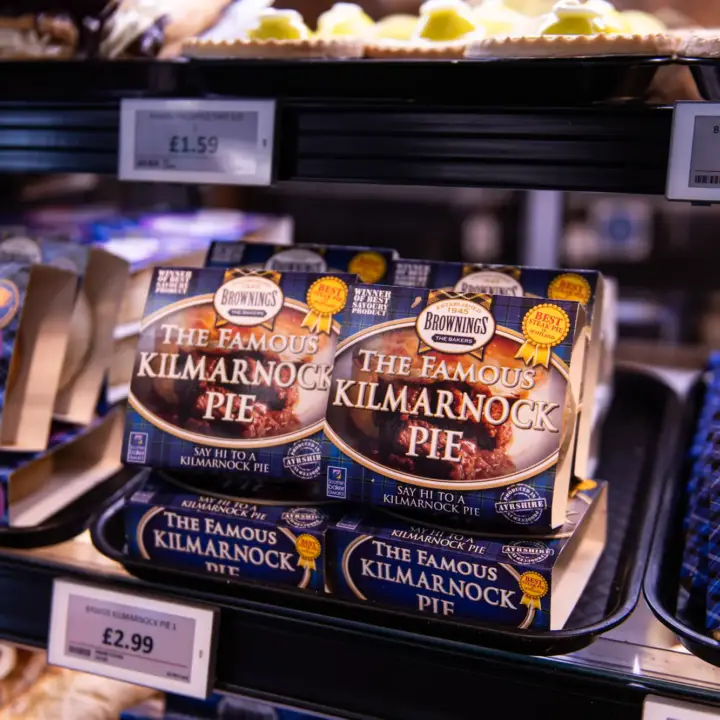
The present news is that Brownings has expanded its partnership with Asda, with the Big Kilmarnock Pie, Belter Bridie and Steak and Haggis Pie launching in more than 50 stores across Scotland from early May. The new lines build on the existing supermarket presence of the Kilmarnock Pie, already stocked by Asda. For Brownings, it is another milestone in its 80 year story.
The company has also remained a family business across generations. In 2022, Brownings announced Fraser Gall as Sales Director and described the firm as a fourth generation family business in Kilmarnock, first established by Managing Director John Gall’s grandparents in 1945.
That succession is part of what makes the story worth telling. In modern Scotland, many local food businesses either disappear, become nostalgic labels detached from their origins, or are absorbed into larger ownership structures until the founding place becomes a marketing line. Brownings has taken a different course. It has grown, modernised and supplied national retailers while retaining its Kilmarnock identity.
The Kilmarnock Pie is central to that identity. Brownings describes it as its most famous product. The company’s pies and pastries are produced in its purpose built Pie Factory in Kilmarnock. There is a quiet importance in that. The Asda expansion places three more Brownings savoury lines into the weekly shopping habits of customers across Scotland. Managing Director Declan McMahon said the company was pleased to see the Asda relationship continue to grow and described the Big Kilmarnock Pie, Belter Bridie and Steak and Haggis Pie as products that had already proved popular with Brownings customers.
There is still a fair question to ask. Supermarket growth can help a local producer reach more people, but it can also test the very qualities that made the producer worth noticing in the first place. Scale brings opportunity, but also pressure: price pressure, volume pressure, supply chain pressure and the quiet danger that a product becomes flattened to fit a shelf. That is the balance Brownings must continue to manage. The company’s heritage has commercial value precisely because it is rooted in a real place with a local following. The more widely those products travel, the more important it becomes that the Kilmarnock character remains more than just a name on a packet.
A pie may seem a small thing on which to hang a story of Scottish continuity. But Scotland’s food heritage has often lived in small things: a roll bought before work, a bridie taken home, a pie eaten at a match, a cake made by someone who learned the trade by hand and passed it on.
Brownings the Bakers now finds itself in a familiar Scottish position: old enough to be heritage, modern enough to compete. That is not an easy balance. It is, however, a valuable one.