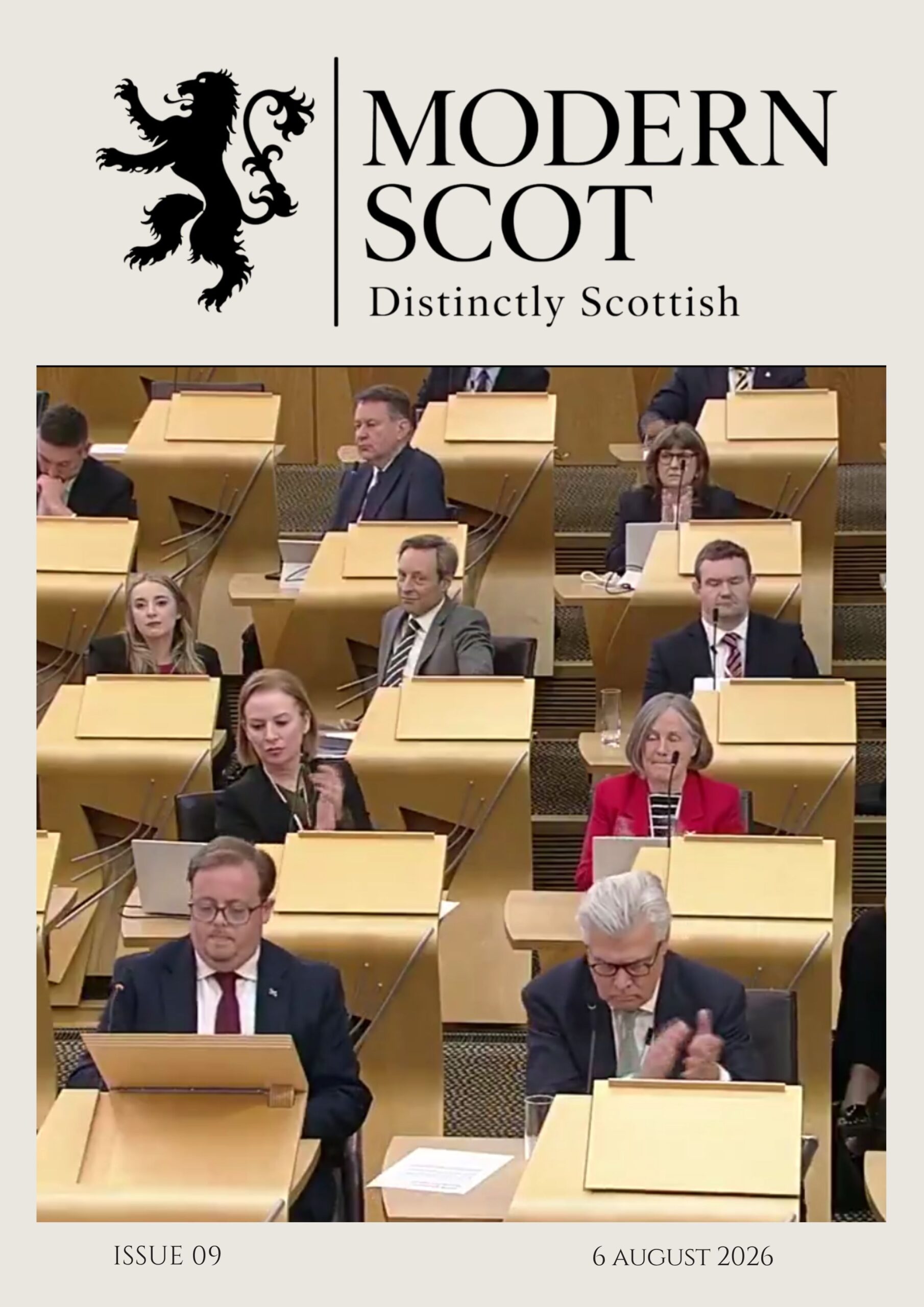

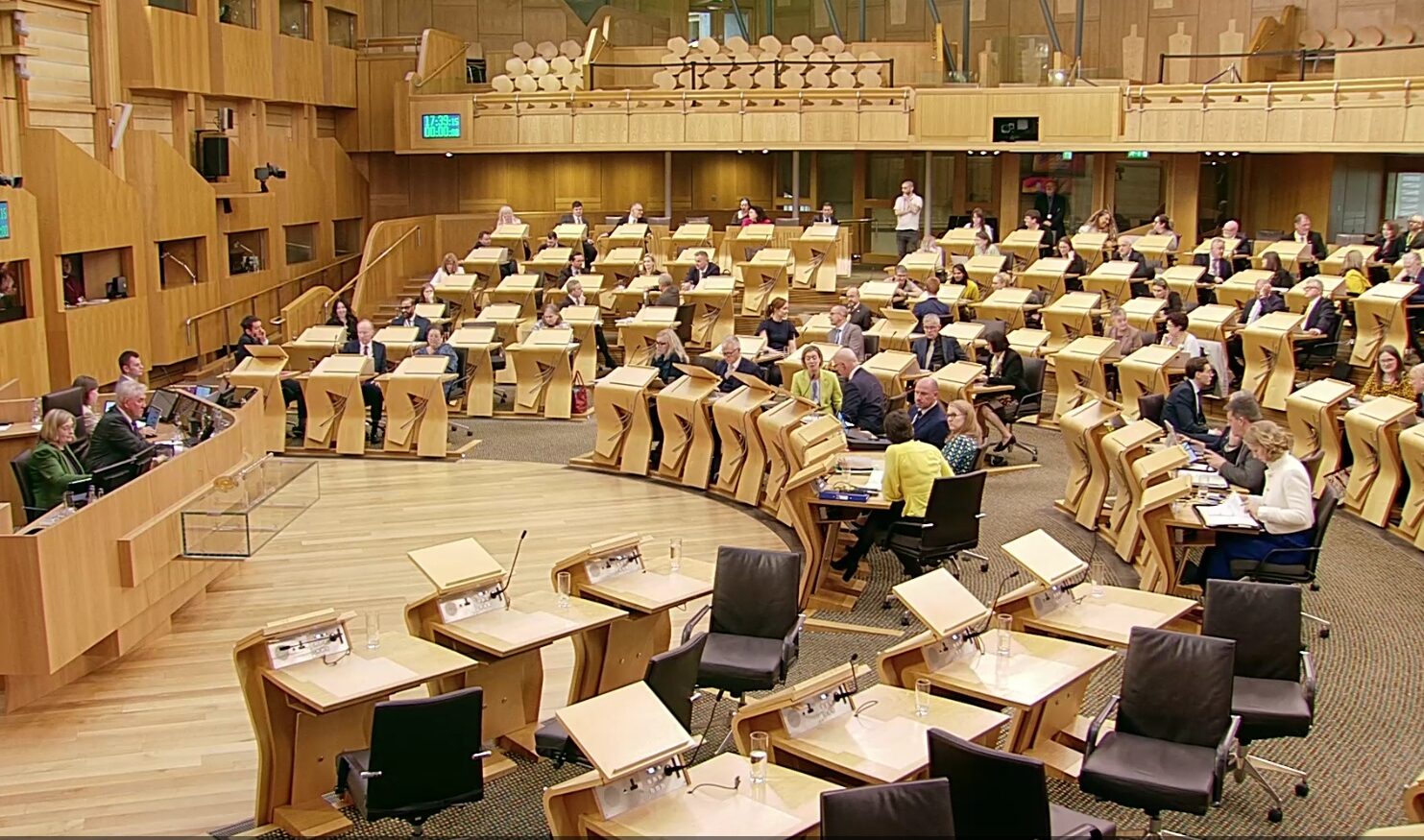
Scottish Labour joined the SNP and Greens to back the principle that Scotland has the right to determine its own future, producing an 84–18 majority at Holyrood. The vote does not authorise another independence referendum, but it creates a much broader parliamentary majority around the question of who should ultimately decide Scotland’s constitutional future.
Scotland’s constitutional argument shifted at Holyrood on Tuesday, although not in the way a vote on independence itself would have done.
MSPs were not asked whether Scotland should leave the United Kingdom. They were not asked to authorise another referendum, and the Scottish Parliament was not being given the legal power to hold one.
They were asked something more fundamental: whether Scotland is a nation with the right to decide its own future.
Eighty-four MSPs voted in favour. Eighteen voted against.
The size of the majority came from an unusual alignment. Scottish Labour joined the SNP and Scottish Greens in supporting the final motion despite continuing to oppose independence and another referendum under present circumstances. Conservatives and Liberal Democrats opposed it. Reform UK’s MSPs walked out before the final vote.
That makes Tuesday’s division different from the familiar parliamentary split between supporters and opponents of independence.
The SNP and Greens already hold a pro-independence majority at Holyrood. Together they have 73 of the Parliament’s 129 seats following the May election. Labour’s support pushed the proposition considerably beyond that bloc.
The original motion lodged by First Minister John Swinney was only one sentence long:
“That the Parliament agrees that Scotland is a nation that has a right to decide its own future.”
It contained no proposed referendum date, no instruction to begin separation negotiations and no declaration that Scotland should become independent.
That narrow wording left room for parties which disagree profoundly about independence to consider a different question: whether the choice itself ultimately belongs to Scotland.
Swinney told Parliament that supporters and opponents of independence could disagree about where Scotland should end up while accepting the right of its people to decide. He argued that the existing constitutional arrangements offer Scotland no guaranteed mechanism through which voters can trigger another referendum, regardless of how future Scottish elections are fought or decided.
The point goes directly to the unresolved constitutional question left after the 2014 referendum and the Supreme Court judgment eight years later.
Scotland voted by 55.3 per cent to 44.7 per cent to remain in the United Kingdom in September 2014. That referendum took place because the UK and Scottish governments agreed beforehand to create the legal route for it. A Section 30 order temporarily altered the limits of Holyrood’s powers, allowing the Scottish Parliament to legislate for the vote.
No permanent mechanism was created for deciding when, or under what circumstances, another referendum could be held.
That absence became decisive in 2022.
The UK Supreme Court unanimously ruled that the Scottish Parliament could not legislate unilaterally for an independence referendum because a bill providing for such a vote would relate to matters reserved to Westminster, including the Union and the UK Parliament.
The judgment settled the legal question under the existing Scotland Act arrangements. It did not settle the political question of what would have to happen before Westminster should agree to another vote.
Tuesday’s debate returned directly to that gap.
Labour’s position made the vote particularly notable.
New Scottish Labour leader Michael Marra had already said that he believed Scotland had the right to decide its future. He also said that Scotland exercised that right in 2014 and argued that supporters of constitutional change would have to establish a sufficiently strong and settled public demand before another referendum should take place.
In the chamber, Labour did not endorse the SNP’s argument for an immediate route to another vote. Marra instead challenged the Government over its priorities and used Labour’s amendment to place child poverty, employment, education, housing and stronger communities alongside the constitutional proposition.
The amendment committed Parliament to treating child poverty as an immediate national priority and reaffirmed the statutory target of reducing relative child poverty to fewer than one child in ten by 2030.
Parliament accepted it.
That produced an unusual final position: Labour voted for a motion declaring Scotland’s right to decide while simultaneously arguing that the circumstances for another referendum have not been established.
The distinction is central to understanding the 84–18 vote.
It was not an 84-vote majority for independence.
It was not an 84-vote majority for holding a referendum immediately.
It was an 84-vote majority for the proposition that Scotland possesses the right to determine its constitutional future.
The Greens successfully added another element. Their amendment stated that the May 2026 Scottish Parliament election had returned the largest ever majority of pro-independence MSPs.
The arithmetic supports the parliamentary claim.
The SNP won 58 seats and the Greens 15, creating a combined pro-independence bloc of 73 MSPs. The equivalent total after the 2021 election was 72.
That result is politically important, but it also requires careful interpretation.
Before the May election, the SNP had placed particular weight on winning an outright parliamentary majority itself. Swinney argued that an SNP majority would provide a mandate based on the precedent of the 2011 election, after which the UK Government agreed to the process that led to the 2014 referendum.
The SNP won 58 seats in May, seven short of the 65 required for an outright majority.
It also lost six seats compared with 2021.
The Greens, however, increased their representation sharply, from eight MSPs after the previous election to 15. The result therefore produced the largest combined parliamentary bloc for parties supporting independence even as the SNP failed to secure the majority it had identified as its own electoral test.
Opposition parties have focused heavily on that difference.
The Liberal Democrats’ amendment recalled the 2014 referendum and the SNP’s failure to win an overall majority in May. It argued that the Government should instead concentrate on the NHS and social care, the cost of living, roads and ferries, education and transferring greater power to communities.
The Conservatives took a similar position on the authority of the 2014 vote.
Scottish Conservative leader Russell Findlay’s amendment sought to replace the Government’s central wording with a statement that Scotland had already voted decisively to remain within the United Kingdom and that government should concentrate on taxation, economic growth and public services.
Reform UK went further by challenging the debate itself.
Scottish Reform leader Malcolm Offord raised a point of order arguing that it was inappropriate for Holyrood to spend time debating a reserved constitutional matter.
Presiding Officer Kenneth Gibson rejected that argument, noting that parliaments are free to debate matters whether or not they possess legislative competence over them.
Offord subsequently withdrew his amendment and led Reform’s MSPs from the chamber. He described the debate as a farce and an insult to voters, arguing that Parliament should be dealing instead with subjects including homelessness, public finances and drug deaths.
The walkout meant Reform’s 17 MSPs did not participate in the final 84–18 division.
The disagreement over whether another referendum should take place also sits against a changing argument at Westminster.
When Prime Minister Andy Burnham met Swinney in Glasgow in July, Downing Street said Burnham had stated that another independence referendum was “off limits”, arguing that government attention should remain on economic growth and household living costs.
His language became less absolute during Prime Minister’s Questions on 9 September.
Asked by SNP MP Chris Law why Northern Ireland has a statutory route towards a border poll while Scotland has no equivalent mechanism, Burnham referred to the requirement for sufficient public support before a Northern Ireland referendum would be considered and said he regarded Scotland as being in the same situation.
He then added that he was not aware of majority public support for another Scottish referendum and said there would not be one until that changed.
Downing Street subsequently maintained that the Government’s underlying position had not changed and repeated that another referendum remained off limits under present circumstances.
Swinney seized on the Prime Minister’s Commons remarks and wrote to him the following day, asking for talks on turning the principle into a defined legal mechanism.
That exchange exposes another difference at the centre of the debate.
Northern Ireland has a statutory constitutional route written into law. Scotland does not.
The Scottish Government argues that if Scotland is part of a voluntary union, there must ultimately be a practical means by which the electorate can choose to reconsider membership of it.
Opponents of another referendum argue that the 2014 decision should continue to carry authority unless a sufficiently clear change in public opinion can be demonstrated, and that repeated parliamentary motions do not themselves establish such a change.
The question is complicated further by the difference between parliamentary representation and public opinion.
The May election produced 73 MSPs from the SNP and Greens, both of which support independence. That is a clear parliamentary majority.
It does not by itself establish that a majority of Scottish voters currently support independence or another referendum at a particular time. Holyrood’s electoral system combines constituency and regional voting, and seats are not a direct percentage translation of national votes cast.
The same caution applies to Tuesday’s 84 votes.
The result establishes what the Scottish Parliament decided. It does not convert that parliamentary division into a referendum result, nor into evidence that 84 out of every 102 Scottish voters would take the same position.
What it does establish is a broader parliamentary agreement around one part of the constitutional argument.
That is new enough to matter.
In May, Holyrood voted by 72 to 55 for an amended motion calling on the UK Government to make a Section 30 order transferring the necessary referendum power. That majority broadly reflected the pro-independence strength of the Parliament.
Tuesday’s motion reached 84 votes because the proposition was different.
Labour was not asked to endorse independence. It was able to affirm Scotland’s right to decide while maintaining that no case has yet been made for exercising that right through another referendum now.
The SNP and Greens can therefore point to a parliamentary majority for independence-supporting parties and an even larger majority accepting the principle of Scotland’s right to determine its constitutional future.
The Conservatives and Liberal Democrats can point to the 2014 result, the SNP’s failure to win its own majority in May and the absence of agreement on when another referendum should be held.
Reform can argue that Holyrood’s time should be spent on devolved government rather than another constitutional debate.
And Westminster still holds the legal power required to turn any parliamentary declaration into a referendum under the existing settlement.
The 84–18 result resolves none of those disputes.
Instead, it defines them more precisely.
The argument is no longer simply between MSPs who believe Scotland has a right to choose and those who reject that proposition. Labour’s vote has made that division less straightforward.
The remaining disagreement is over what turns the right to decide from a principle into an exercisable democratic process: an election result, a sustained polling majority, an agreement between governments, some other defined threshold, or a decision ultimately retained by the UK Government.
Holyrood has now answered one question by a large margin.
It has said Scotland has the right to decide.
It has not decided who determines when Scotland gets to exercise it.
Sources
Scottish Parliament. Scotland’s Right to Decide, motion S7M-01264, lodged 21 September 2026.
Scottish Parliament motion S7M-01264
Scottish Parliament. Scotland’s Right to Decide: Amendment 2, lodged by Michael Marra MSP, Scottish Labour, 21 September 2026.
Labour amendment S7M-01264.2
Scottish Parliament. Scotland’s Right to Decide: Amendment 5, lodged by Gillian Mackay MSP, Scottish Green Party, 21 September 2026.
Green amendment S7M-01264.5
Scottish Parliament. Scotland’s Right to Decide: Amendment 4, lodged by Russell Findlay MSP, Scottish Conservative and Unionist Party, 21 September 2026.
Conservative amendment S7M-01264.4
Scottish Parliament. Scotland’s Right to Decide: Amendment 1, lodged by David Green MSP, Scottish Liberal Democrats, 21 September 2026.
Liberal Democrat amendment S7M-01264.1
Scottish Parliament. 2026 Election Results, Scottish Parliament election held 7 May 2026.
Scottish Parliament 2026 election results
Scottish Parliament. Meeting of the Parliament, 26 May 2026: Ambitious for Scotland / Independence Referendum. Final amended motion carried by 72 votes to 55.
Official Report, 26 May 2026
UK Supreme Court. Reference by the Lord Advocate of devolution issues under paragraph 34 of Schedule 6 to the Scotland Act 1998, [2022] UKSC 31, judgment 23 November 2022.
UK Supreme Court case record
UK Government. David Cameron signs historic deal granting Scottish referendum, 15 October 2012, including the Edinburgh Agreement and Section 30 process.
UK Government: Edinburgh Agreement and referendum process
Prime Minister’s Office, 10 Downing Street. PM meeting with First Minister of Scotland John Swinney: 23 July 2026.
Downing Street meeting record
Scottish Government. FM writes to PM on Scotland’s right to decide, 10 September 2026.
First Minister’s letter to the Prime Minister