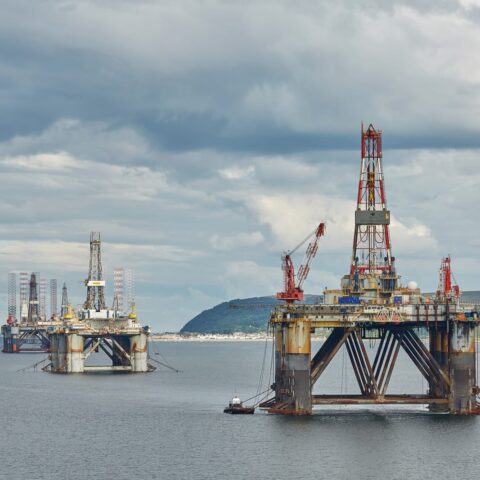

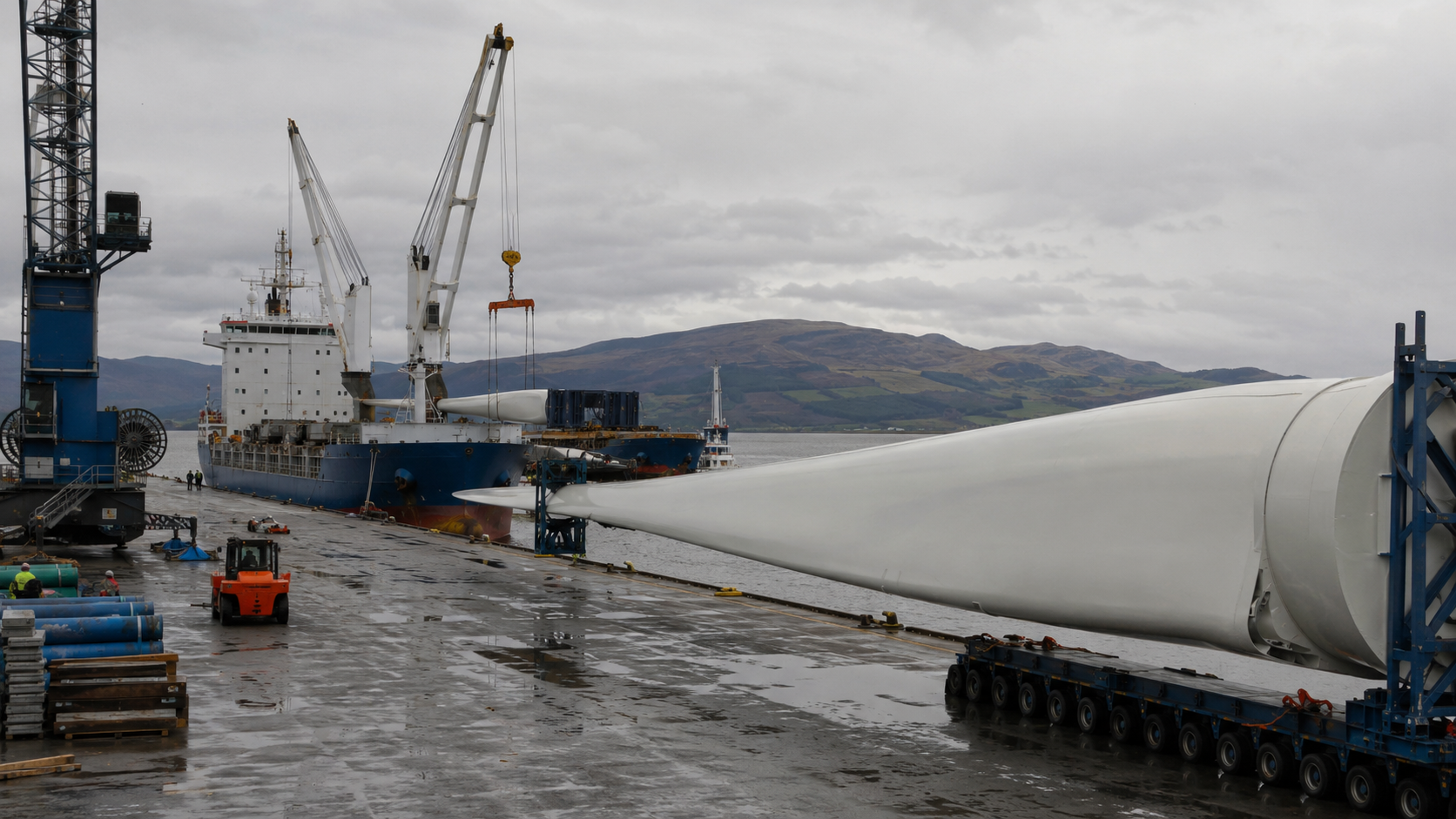
Power-generating machinery accounted for around two-fifths of the increase in Scotland’s goods imports in the year to March 2026. The statistics do not identify wind turbines specifically, but the rise comes as Scotland commits hundreds of millions of pounds to capturing more of the manufacturing value created by its renewable-energy expansion.
Buried inside Scotland’s latest international trade figures is an unusually large movement in machinery.
In the year ending March 2026, Scotland’s international goods imports increased by 17 per cent to £25.7 billion, while international goods exports fell by 3 per cent to £24.2 billion, according to inflation-adjusted figures published by the Scottish Government in June. The statistics cover international trade in goods but exclude services, oil and gas, and trade between Scotland and the rest of the UK.
The largest contribution to the increase in imports came from power-generating machinery.
Imports in that category rose by 46 per cent in real terms compared with the previous year and accounted for around two-fifths of the entire increase in Scottish goods imports. Imports of power-generating machinery from EU countries rose 28 per cent, while those from non-EU countries increased by 54 per cent.
The numbers arrive at an important moment for Scotland’s industrial policy.
Scotland has a pipeline of around 40GW of offshore wind capacity, in addition to about 3GW already installed in Scottish waters. The Scottish Government has separately estimated that the potential global capital expenditure associated with ScotWind, INTOG and related port and supply-chain projects could reach approximately £100 billion if the full pipeline is developed.
Ministers have committed up to £500 million over five years to strengthen Scotland’s offshore wind infrastructure and supply chain, with an explicit objective of securing more manufacturing, fabrication and industrial activity inside Scotland.
That makes the trade figures worth examining. But they require care.
The 46 per cent increase cannot simply be described as a surge in imported wind turbines.
HM Revenue & Customs classifies “power generating machinery and equipment” within a relatively broad international goods category. Regional trade data is not detailed enough to isolate Scottish wind-turbine imports from other generating machinery and equipment. HMRC also allocates much business trade to regions according to the proportion of a company’s employees working there, rather than necessarily according to the final destination of each imported item.
There is another important qualification.
The latest increase follows a very weak previous year. In the year ending March 2025, Scottish imports of power-generating machinery had fallen by 50 per cent in real terms. The subsequent 46 per cent increase therefore partly represents a recovery from that fall and should not, on its own, be interpreted as evidence of a continuing import boom.
Scotland is also exporting large amounts of machinery classified under the same heading.
Power-generating machinery was Scotland’s second-largest international goods export category in the year ending March 2026, worth £4.6 billion, behind drink at £4.9 billion. Exports of power-generating machinery increased by 30 per cent during the year and accounted for 19 per cent of Scottish international goods exports.
Scotland is therefore both a substantial importer and exporter of equipment falling within this broad category.
The more consequential economic question is what lies inside those movements — and how much of the extraordinary expenditure associated with Scotland’s energy transformation ultimately becomes Scottish manufacturing, Scottish wages and permanent industrial capacity.
That is a question the Scottish Government has itself been attempting to address.
Its 2022 Onshore Wind Policy Statement acknowledged that Scotland’s manufacturing supply chain for the wind industry was weak, despite the country’s long experience in renewable generation. It called for Scottish suppliers to receive realistic opportunities to compete for manufacturing contracts and for greater domestic manufacturing capability to be developed as wind deployment increased.
Research commissioned by the Government into offshore renewables identified similar gaps. At the time of that work, Scotland had no major offshore-wind rotor or nacelle manufacturing facilities and no capability to manufacture high-voltage cables for offshore wind. The report identified competition from suppliers outside Scotland as one of the principal barriers to capturing greater economic benefit domestically.
There are now tangible signs of that position changing.
A £350 million Sumitomo Electric subsea cable manufacturing facility is being developed at the Port of Nigg in the Highlands. The Scottish Government says the project is among almost £900 million of public and private investment unlocked for offshore-wind ports and supply chains, with projects also involving Ardersier, Kishorn, Lerwick, Scapa, Montrose and Stornoway.
Sumitomo says its Nigg facility will manufacture high-voltage transmission cables in Scotland, including 525kV HVDC cable, while its latest plans envisage cable manufacturing for the proposed Shetland 2 connection beginning in 2027.
That is precisely the kind of industrial investment Scotland’s strategy is intended to attract: turning an energy project into a manufacturing facility with the potential to serve projects beyond the immediate development that brought it here.
But Scotland’s offshore wind programme also illustrates how international the supply chain remains.
The 1.1GW Inch Cape Offshore Wind Farm, under construction off Angus, provides a useful example.
Its published construction supply chain includes Vestas for the turbines, CWHI and Dajin Offshore for monopile foundations, COOEC-Fluor for jacket foundations and Orient Cable for export-cable fabrication. Scottish facilities nevertheless play substantial roles: Leith is being used for foundation marshalling, Dundee for turbine marshalling and Montrose as an offshore construction and operations base.
Some of the largest physical components have travelled considerably farther.
CWHI says the 32 enormous monopiles it supplied for Inch Cape were fabricated at its Qinzhou yard in China before being transported to the Port of Leith. Each is up to 103 metres long and can weigh as much as 2,300 tonnes.
That does not mean Scotland receives little economic benefit from Inch Cape. Scottish ports, construction services, engineering, logistics and long-term operations can all capture value even where equipment is manufactured elsewhere.
It does, however, demonstrate the distinction between hosting an energy project and manufacturing the capital equipment used to build it.
The size of that distinction is likely to become increasingly important.
Crown Estate Scotland’s latest Supply Chain Development Statements show that 16 ScotWind projects currently anticipate £25.5 billion of expenditure in Scotland, an average of £1.6 billion per project across development, construction, manufacturing, operations and maintenance.
Those figures are projections rather than money already spent. Crown Estate Scotland itself says the statements are intended to provide visibility of anticipated supply-chain activity as projects develop and are updated as technology, timing and procurement become clearer.
That will matter enormously when Scotland eventually assesses what its offshore-wind programme actually delivered economically.
A project can create Scottish jobs without manufacturing its turbines here. It can use Scottish ports while importing its foundations. It can support domestic engineering companies while buying major electrical equipment overseas. Equally, an imported technology today can lead to a factory being established in Scotland tomorrow, as the Nigg cable investment illustrates.
Simple claims that Scotland is either “winning” or “losing” the renewable supply-chain race therefore obscure a much more useful question.
How much of the value is Scotland actually retaining?
The latest trade statistics cannot answer that.
They establish that imports of the broad power-generating-machinery category increased sharply in the latest year, while exports from the same category also increased substantially. They do not reveal which individual renewable-energy projects generated those flows, exactly which components were involved, where each component was manufactured or how much of its value remained within Scotland.
There is a further reason to avoid drawing conclusions the statistics cannot support. The Scottish Government describes this inflation-adjusted regional trade series as official statistics in development, meaning there is greater uncertainty than would apply to fully accredited official statistics. HMRC’s regional methodology and broad commodity classifications introduce further limitations when trying to trace individual pieces of industrial equipment.
Yet the figures illuminate the economic question Scotland will increasingly have to answer.
The country possesses the wind resource. It is leasing the seabed. Ports are being expanded. Transmission infrastructure is being rebuilt. Public money is being committed to attracting factories. Developers are forecasting tens of billions of pounds of Scottish expenditure.
The eventual measure of industrial success cannot therefore be generating capacity alone.
It will be whether that enormous programme leaves Scotland with factories, skills, suppliers, intellectual property and exportable industrial capability capable of surviving long after the construction phase has ended.
The more revealing ledger will be the one showing where the turbines, towers, cables, foundations and electrical equipment were made — and where the money used to make them ultimately stayed.
Sources
- Scottish Government — Inflation Adjusted HMRC Regional Trade Statistics for Scotland Q1 2026: Key Findings
https://www.gov.scot/publications/inflation-adjusted-hmrc-regional-trade-statistics-for-scotland-q1-2026/ - Scottish Government — Inflation Adjusted HMRC Regional Trade Statistics for Scotland Q1 2026: Goods Imports
https://www.gov.scot/publications/inflation-adjusted-hmrc-regional-trade-statistics-for-scotland-q1-2026/pages/goods-imports/ - Scottish Government — Inflation Adjusted HMRC Regional Trade Statistics for Scotland Q1 2026: International Goods Exports
https://www.gov.scot/publications/inflation-adjusted-hmrc-regional-trade-statistics-for-scotland-q1-2026/pages/international-goods-exports/ - HM Revenue & Customs — UK Regional Trade in Goods Statistics Q1 2026: Explanatory Notes
https://www.gov.uk/government/statistics/uk-regional-trade-in-goods-statistics-first-quarter-january-to-march-2026/uk-regional-trade-in-goods-statistics-first-quarter-january-to-march-2026-explanatory-notes - Scottish Government — Inflation Adjusted HMRC Regional Trade Statistics for Scotland Q1 2025: Goods Imports
https://www.gov.scot/publications/inflation-adjusted-hmrc-regional-trade-statistics-for-scotland-q1-2025/pages/goods-imports/ - Scottish Government — Green Industrial Strategy: Wind
https://www.gov.scot/publications/green-industrial-strategy/pages/5/ - Scottish Government — Offshore Wind Focus
https://www.gov.scot/publications/offshore-wind-focus/ - Scottish Government — Offshore Wind: Potential Project Capital Value
https://www.gov.scot/publications/offshore-wind-potential-project-capital-value-factsheet/ - Scottish Government — Onshore Wind Policy Statement 2022: Benefits and Supply Chain
https://www.gov.scot/publications/onshore-wind-policy-statement-2022/pages/6/ - Scottish Government — Scenario Mapping for Offshore Renewable Energy Development Economic Benefits: Supply Chain Assessment
https://www.gov.scot/publications/case-studies-support-scenario-mapping-offshore-renewable-energy-development-economic-benefits/pages/10/ - Crown Estate Scotland — ScotWind Developers Set Out Latest Multi-Billion-Pound Supply Chain Commitments, 2026
https://www.crownestatescotland.com/news/scotwind-developers-set-out-latest-multi-billion-pound-supply-chain-commitments - Crown Estate Scotland — Supply Chain Information and ScotWind Dashboard
https://www.crownestatescotland.com/supply-chain-information - Scottish Government — Scotland’s Climate Change Plan 2026–2040: Offshore Wind Investment Case Study
https://www.gov.scot/publications/scotlands-climate-change-plan-2026-2040-annexes/pages/4/ - Sumitomo Electric — UK Power Cables Facility, Port of Nigg
https://sumitomoelectric.com/company/office_group_companies/sumitomo-electric-uk-power-cables-ltd - Inch Cape Offshore Wind Farm — Supply Chain and Principal Construction Suppliers
https://www.inchcapewind.com/supply-chain/ - CWHI — Delivery of Inch Cape Monopiles Manufactured at Qinzhou
https://www.cwhi.com/newsroom_0226/105.html