
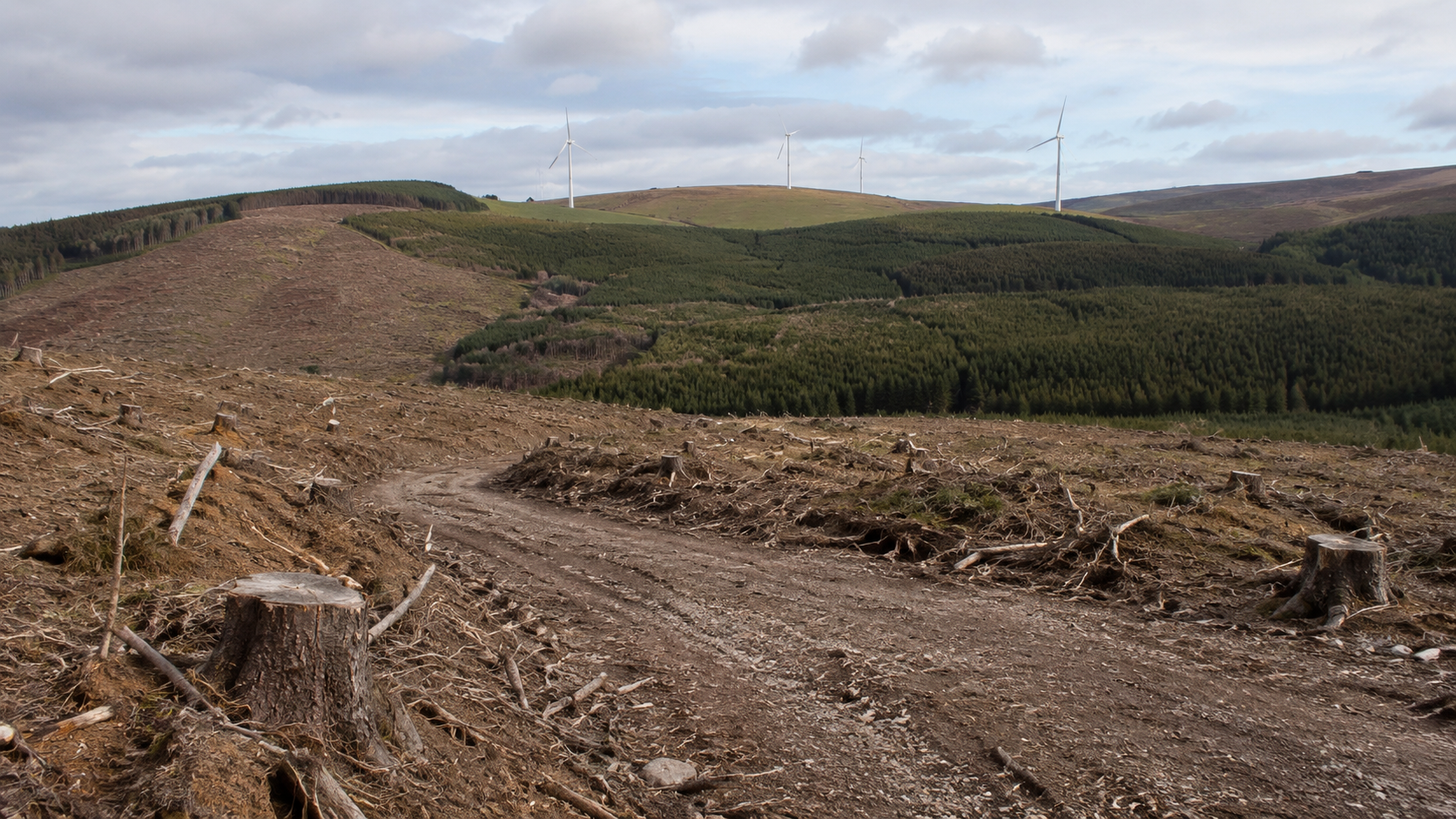
Forestry and Land Scotland has disclosed the individual developments associated with more than 8,600 hectares of forestry felling on Scotland’s national estate, but says it lacks complete restocking data and cannot calculate the resulting net woodland loss.
Forestry and Land Scotland has disclosed the individual wind-farm developments behind more than 8,600 hectares of forestry felling on land it manages for the Scottish Ministers since 2000.
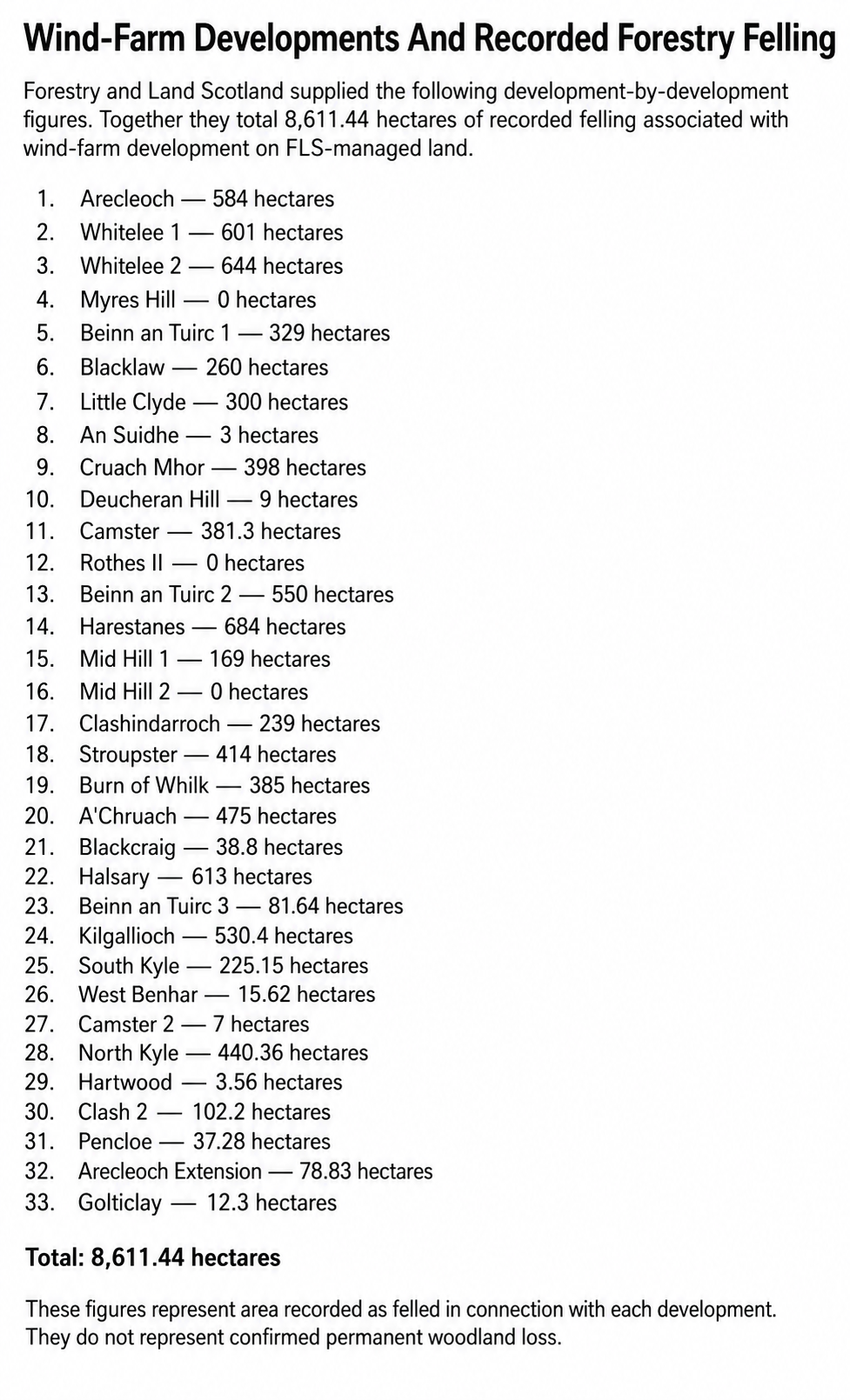
The information, released to Modern Scot on 10 August, identifies 33 development entries associated with 8,611.44 hectares of recorded felling.
The largest recorded area is at Harestanes, with 684 hectares felled. Whitelee 2 accounts for 644 hectares, Halsary 613 hectares, Whitelee 1 601 hectares, Arecleoch 584 hectares, Beinn an Tuirc 2 550 hectares and Kilgallioch 530.4 hectares.
The ten largest entries alone account for about 5,536 hectares, or 64 per cent of the total.
The disclosure provides a clearer picture of which developments account for the felling, but it also exposes a substantial gap in the national record: FLS says it cannot calculate how much woodland has actually been lost as a result of wind-farm development.
That is particularly notable because an official Scottish Government environmental information response published on 15 July said that many of the trees would have been due for normal forest-management felling and many would have been replaced through replanting and compensatory planting, “meaning the net loss for renewables developments is small.”
FLS’s subsequent response to Modern Scot is considerably less certain.
Asked how much of the 8,611 hectares represented permanent woodland removal and how much had subsequently been restocked on the original sites, FLS said it does not have complete data on the number of hectares restocked following wind-farm-related felling.
Asked directly for its calculation of the net woodland loss attributable specifically to wind-farm development, the agency said it currently has “insufficient data available in order to calculate the net loss of woodland due to windfarm development.”
The two statements do not necessarily prove that the Scottish Government’s assessment is wrong. They do, however, leave an important evidential gap between describing the net loss as small and being able to calculate what that loss actually is.
There is also an important qualification surrounding the Scottish Government’s estimate that 17.2 million trees have been felled.
The July response calculated that figure by multiplying the 8,611 hectares by an average of 2,000 trees per hectare.
FLS has now clarified that 2,000 trees per hectare is intended only as a guide, based on initial planting densities. Older tree crops, it said, naturally contain fewer surviving trees as they age.
The 17.2 million figure should therefore not be understood as a count of individual trees known to have been felled. The more firmly established figure is the area recorded as felled: 8,611 hectares, or 8,611.44 hectares when the individual entries supplied by FLS are totalled.
The disclosure also shows that the land affected extends beyond turbine positions themselves.
Modern Scot asked whether the total included woodland removed for access roads, substations, transmission infrastructure, compounds, borrow pits and other associated works.
FLS said that, with the exception of transmission infrastructure, all of those elements are included in the total.
The agency also said the figures relate to conifer plantations rather than native or ancient woodland sites.
That distinction is important because much of the national forest estate consists of commercial forestry intended to be harvested and replanted.
The Scottish Government made that point explicitly in 2024, when the corresponding figure stood at 8,503 hectares. It said the majority represented commercial forestry which would eventually have been felled at the end of its normal rotation.
Modern Scot therefore asked how much of the felling would have occurred through ordinary commercial harvesting if the wind-farm developments had never proceeded.
FLS responded that all woodland on the sites was projected to be felled during a period falling within the respective developments’ lease terms.
That response does not provide a numerical answer to the counterfactual question. It does not establish how much woodland was felled earlier than it otherwise would have been, how much was subsequently replanted on the original site, or how much land was permanently converted to infrastructure.
Those distinctions determine the difference between gross felling and permanent woodland loss.
The record becomes still more fragmented when compensatory planting is considered.
FLS says determining the amount of compensatory planting required for these developments is outside its control and that the relevant planning authorities must instead be contacted.
It does not hold project-level records identifying the location, planting date, developer and species associated with each compensatory planting scheme. Nor does it hold information showing whether developers failed or were delayed in meeting those obligations, or whether enforcement action followed.
There is therefore no single FLS record from which the public can establish how much woodland was permanently removed, how much was restored on the original sites, how much compensatory woodland was required elsewhere, how much was actually planted and how much remains outstanding.
FLS cannot provide a year-by-year history of the felling either. It says its current information records felling according to the order in which schemes were developed rather than separating it by year. The increase from the previously reported 8,503 hectares to 8,611 hectares represents an additional year of data.
It also says it does not hold project-level carbon assessments bringing together tree felling, peat and soil disturbance, construction, electricity generation and replacement planting.
None of this establishes that 8,611 hectares of woodland have been permanently lost. That would be an inaccurate conclusion from the available evidence.
What the disclosure establishes is more precise.
More than 8,600 hectares of conifer plantation on FLS-managed land have been recorded as felled in connection with wind-farm development since 2000. We now know the individual development figures behind that total.
But after more than two decades of development, the national land manager says it does not have complete restocking data and cannot calculate the resulting net woodland loss.
The Scottish Government has described that loss as small.
The number demonstrating how small it is remains unavailable.
Sources
Forestry and Land Scotland — Environmental Information Response SEC-26-151: Woodland Felling for Wind-Farm Development, 10 August 2026
Provided directly to Modern Scot. The response confirms that FLS does not have complete restocking data; cannot calculate the net woodland loss attributable to wind-farm development; does not hold project-level compensatory planting records or project-level carbon assessments; and confirms what associated infrastructure is included in the 8,611-hectare total. EIR Response Letter SEC-26-151
Forestry and Land Scotland — D Scheme Felling Totals 2026
Attachment supplied with response SEC-26-151. This document gives the individual felling figures for all 33 development entries, totalling 8,611.44 hectares. D Scheme Felling Totals 2026
Scottish Government — Forestry and Land Scotland: Number of Felled Trees for Windfarm Development, EIR/202600515058, published 15 July 2026
https://www.gov.scot/publications/foi-202600515058/
This is the source for the Government’s figure of 8,611 hectares, its estimated 17.2 million trees based on an average of 2,000 trees per hectare, and its statement that replanting and compensatory planting mean that the net loss for renewable developments is “small”.
Scottish Government — Hectares of Forestry Used for Wind Farms, EIR/202400408449, published 30 April 2024
https://www.gov.scot/publications/eir-202400408449/
This is the source for the earlier 8,503-hectare figure and the Government’s statement that the majority was commercial forestry which would have been felled at the end of its normal rotation. It also records that FLS did not hold compensatory-planting and year-by-year information at that time.
Scottish Forestry — Control of Woodland Removal Policy
https://www.forestry.gov.scot/publications/control-woodland-removal-policy
The policy defines woodland removal as permanent removal of woodland for a change of land use and sets out the Scottish Government’s policy and regulatory framework governing such removal.
Scottish Forestry — Scottish Government’s Policy on Control of Woodland Removal: Implementation Guidance
https://www.forestry.gov.scot/publications/scottish-governments-policy-control-woodland-removal-implementation-guidance
The implementation guidance specifically applies to proposals affecting forests, including wind farms, roads and power lines, and explains how consenting authorities and applicants should apply woodland-removal policy.