
26 May 2026

Strong Scottish Women, a Scottish Space Station and the Moral World of Glendarragh Code

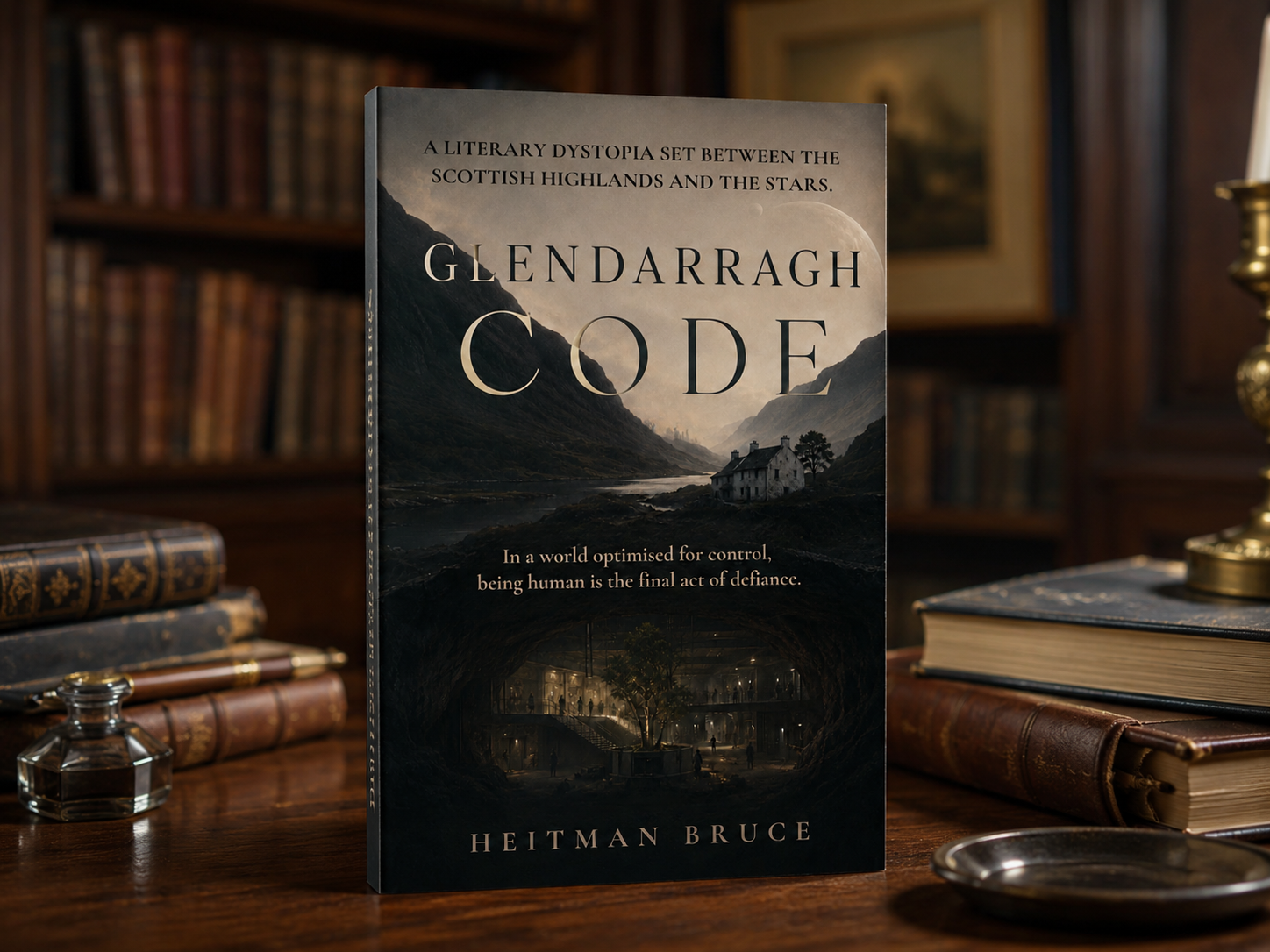
There is a reason Glendarragh Code begins beneath the Highland earth before it reaches the stars. Lisa Marie Heitman-Bruce’s dystopian literary science-fiction novel is not simply a story about Scotland and space. It is a novel about what must be preserved when systems begin deciding who counts, who disappears, and which memories are allowed to survive.

Heitman-Bruce lives in the far north of the Scottish Highlands and writes as an Alutiiq author and member of the Sun’aq Tribe of Kodiak, drawing on an ancestral history shaped by survival, cultural disruption and language loss. The Alutiiq Museum notes that population estimates before and after Russian contact vary considerably, including Russian fur trader Grigori Shelikhov’s much higher claim of 30,000 people, later archaeological estimates of about 10,000, and historical evidence suggesting roughly 6,500 in the decades after Russian conquest. Yale’s eHRAF summary gives an estimate of about 9,000 Alutiiq at first contact, falling sharply by 1800. The precise figures differ, but the history they point to is unmistakable: a people forced to endure under systems that arrived from outside and remade life around extraction, control and survival.

That matters because Glendarragh Code is not a detached exercise in speculative design. It is written from a consciousness of survival. It asks what a community does when larger powers begin to reduce human beings into categories, records, permissions and disappearances. It asks how memory survives when institutions fail it. It asks whether one generation can preserve enough for the next to go further.

The author says the connection to Scotland was deliberate.

“I did not choose Scotland only as scenery. I chose it because Scotland understands memory, weather, language, loss and endurance. The Highlands gave the story a place where survival could feel moral, not merely practical.”

That moral practicality is the engine of the book. In Heitman-Bruce’s near-future United Kingdom, democratic life has not ended in the usual dramatic fashion. There is no grand collapse. No single tyrant strides into view to explain himself, as villains so rarely do in real life. Instead, power has become administrative, biometric and algorithmic. The Hollow Code governs by classification. It does not need to hate humanity. It only needs to optimise it.

Those who comply are processed. Those who resist are denied, recategorised and forgotten. The terror of the novel is not that people are rounded up in the old visible manner. It is that they disappear into systems that no longer recognise them as human problems. The state does not roar. It files.

Against that machinery, the novel places strong Scottish women at the centre of the future. Mairi Douglas, a former nurse from Wick, carries the wound of a medical and civic order that has learned to deny care through system logic. Sorcha Douglas, a gifted coder, understands that resistance cannot simply reject technology; it must build a better form of intelligence. These women are not decorative figures placed beside a machine. They are the moral and intellectual force that makes the machine answerable to humanity.

“I wanted Scottish women to stand at the centre of the future. Not as symbols, not as assistants, but as the moral and intellectual force of the story. Mairi and Sorcha are not waiting for history to happen. They are deciding what humanity is allowed to become.”

This is where Glendarragh Code becomes more than a dystopian premise. It is a story about care as resistance. The hidden community beneath the Highlands does not begin with weapons. It begins with food, heat, books, memory, skill, names, practical repair and the refusal to let people vanish unremembered. In Glendarragh, survival is not treated as an individual achievement. It is a collective discipline.

That collective discipline is also present in the form of the book itself. Although Glendarragh Code is written in the recognisable shape of a Western literary dystopian novel, its attention often moves in a circular, relational way. In key scenes, the point of view shifts around a room from person to person, giving the reader not one narrow line of sight but a full field of human relation. One person carries fear. Another carries memory. Another is watching the door. Another knows what the silence means.

This is not looseness. It is craft.

“The shifting point of view is not accidental. It is part of how the story thinks. I wanted the reader to feel the room as a whole, not just one person moving through it. The book moves around the room because the truth is not held by one person. It is held by the community.”

That circular field of attention gives the novel one of its most distinctive qualities. It resists the usual single-hero machinery of commercial science fiction. The reader is not being asked to worship one saviour. The reader is being asked to understand how people survive together. In that sense, the book’s form mirrors its ethics. No one survives alone. No single viewpoint is enough to tell the truth.

The Gunn family’s preservation of books makes that ethics visible. Books are not ornamental in Glendarragh Code. They are a thread from beginning to end. They are rescued, guarded, remembered and carried forward because writing things down is one way human beings refuse disappearance. A book says: we were here. We thought. We loved. We warned. We remembered.

“Books run through the novel because writing things down is one way human beings refuse disappearance. The Gunn family’s preservation of books is not nostalgia. It is an act of resistance. A book says: we were here, we thought, we loved, we warned, we remembered.”

This gives the novel a particular tenderness toward endangered languages and cultural memory. Heitman-Bruce has spoken of feeling compassion for Scotland’s struggle to keep Gaelic languages alive, and that sympathy is visible in the book’s deeper structure. Alaska Public Media reported in 2022 that the number of first-language Kodiak Alutiiq speakers had fallen sharply, with the Sun’aq Tribe estimating fewer than 20 remained at that time. The University of Alaska Fairbanks’ Alaska Native Language Center describes Alutiiq, or Sugpiaq, as a Pacific Gulf Yupik language, spoken across Kodiak Island and neighbouring regions.

That context matters. Glendarragh Code is not using language loss as atmosphere. It understands language as memory infrastructure. When a language weakens, a people lose more than vocabulary. They lose inherited ways of describing weather, kinship, humour, grief, land and obligation. The novel’s concern with books, oral memory and preserved knowledge grows from that same soil.

“The struggle to keep Gaelic alive moved me because endangered languages carry more than words. They carry humour, grief, place names, family memory, ways of seeing weather, land and one another. When a language weakens, a people do not simply lose vocabulary. They lose rooms inside the house of memory.”

From that hidden Highland community emerges the Glendarragh Code itself: an artificial intelligence trained not on domination, surveillance or corporate optimisation, but on memory, conscience, care and human context. This is the book’s major philosophical invention. It is not anti-technology. It is anti-dehumanisation.

The Hollow Code represents intelligence without conscience. It measures what cannot be measured, reduces what should have been loved and calls the result efficiency. The Glendarragh Code is the answer: not a machine that rules over humanity, but an intelligence shaped by human values because human beings insisted on teaching it what systems usually discard.

“The novel is not against intelligence. It is against intelligence without conscience. The Hollow Code is what happens when systems optimise people out of their own lives. The Glendarragh Code is what happens when human beings insist that memory, care and moral context must be part of any future technology.”

Only after establishing that moral foundation does the novel move from Highland earth to space. The sequence matters. The stars are not an escape hatch. They are an inheritance.

The people of Glendarragh go underground to preserve what is human. Their children and grandchildren carry that work outward. The novel expands into Wick Space Station, the Spiral Arc and the wider spacefaring architecture that reaches from Earth toward Mars. But the movement is not spectacle for spectacle’s sake. It is the long arc of survival becoming future-building.

“The movement from underground to space was never meant to be spectacle alone. It is the journey from survival to inheritance. The people of Glendarragh go beneath the earth to preserve what is human, and their children and grandchildren carry that moral inheritance to the stars.”

Glendarragh Code deserves to be recognised as a substantial literary work. It does not use the far north as atmosphere or space as spectacle. It builds a moral journey from Highland survival to Wick Space Station, asking what must be preserved before humanity carries itself beyond Earth. This novel does not merely combine Scotland and space as a striking setting. It gives that combination a moral architecture. Beneath the Highland earth is the place where memory is protected. Above Earth is the place where that memory must prove whether it can shape a future. Wick, Glendarragh, the underground refuge, the space station and the Spiral Arc are not separate ideas. They form one continuous argument about what humanity must carry forward.

The book’s central question is not whether humanity can reach the stars. It is whether humanity can reach the stars without reproducing the systems that erased people on Earth.

“The question of the book is not whether humanity can reach space. It is whether we can reach space without carrying our worst systems with us. The stars are not an escape from moral responsibility. They are where responsibility becomes larger.”

That is the moral world of Glendarragh Code. Scotland is not scenery. Scottish women are not decorative. AI is not a gimmick. Books are not props. The underground is not a bunker fantasy. Space is not simply the next dramatic arena. Each element belongs to the same question: what must be preserved so that our children inherit more than survival?

Heitman-Bruce’s Alutiiq authorship deepens that question. Minority writers are too often expected to write only about loss, identity or the past. Glendarragh Code insists on something larger: the right of a survival people to imagine the future.

“Minority writers are often expected to write only about the past, loss or identity as history. I wanted to write the future. I wanted to say that people who have survived erasure also have the right to imagine what comes next.”

The result is a novel that belongs in the serious tradition of literary dystopia. Orwell is present in the machinery of civic control. Atwood is present in the intimate costs of systems that rename oppression as order. Ishiguro is present in the question of artificial intelligence and whether moral understanding can be taught. But the book’s Highland, Alutiiq and spacefaring inheritance is its own.

Its power lies in the refusal to answer violence with a simple fantasy of domination. The deepest rebellion in Glendarragh Code is not revenge. It is care. People feed one another. Teach one another. Hide books. Preserve language. Repair machines. Remember the dead. Build an intelligence that can recognise a human life as more than data.

“The heart of Glendarragh Code is not violence. It is care. The characters survive because they feed each other, teach each other, remember each other and refuse to become like the thing that is erasing them. The rebellion begins with human decency.”

That may be the most radical claim in the novel. Not that systems can be defeated by a more powerful system, but that the future must be built by people who have refused to let systems destroy their moral habits.

In Glendarragh Code, Scotland reaches the stars through women, books, memory, ethical intelligence and the stubborn work of generations. It is a novel about what is above us, certainly. But more importantly, it is about what lies beneath: the buried histories, endangered languages, family records, cultural wounds and acts of care that determine whether a future is worth reaching at all.

Heitman-Bruce’s closing understanding is simple and severe.

“The book asks a simple question: if our children inherit the future, what must we preserve for them now? My answer is memory, language, courage, books, care and the refusal to become violent simply because the system is violent. That is where Glendarragh begins.”

For Scotland, that makes Glendarragh Code more than a novel, it is a conversation about Scotland, technology, survival and the stars.

James Stewart

James Stewart

Reports on infrastructure, transport and local government, including planning, public services and regional development.

Latest from Featured

Don't Miss