
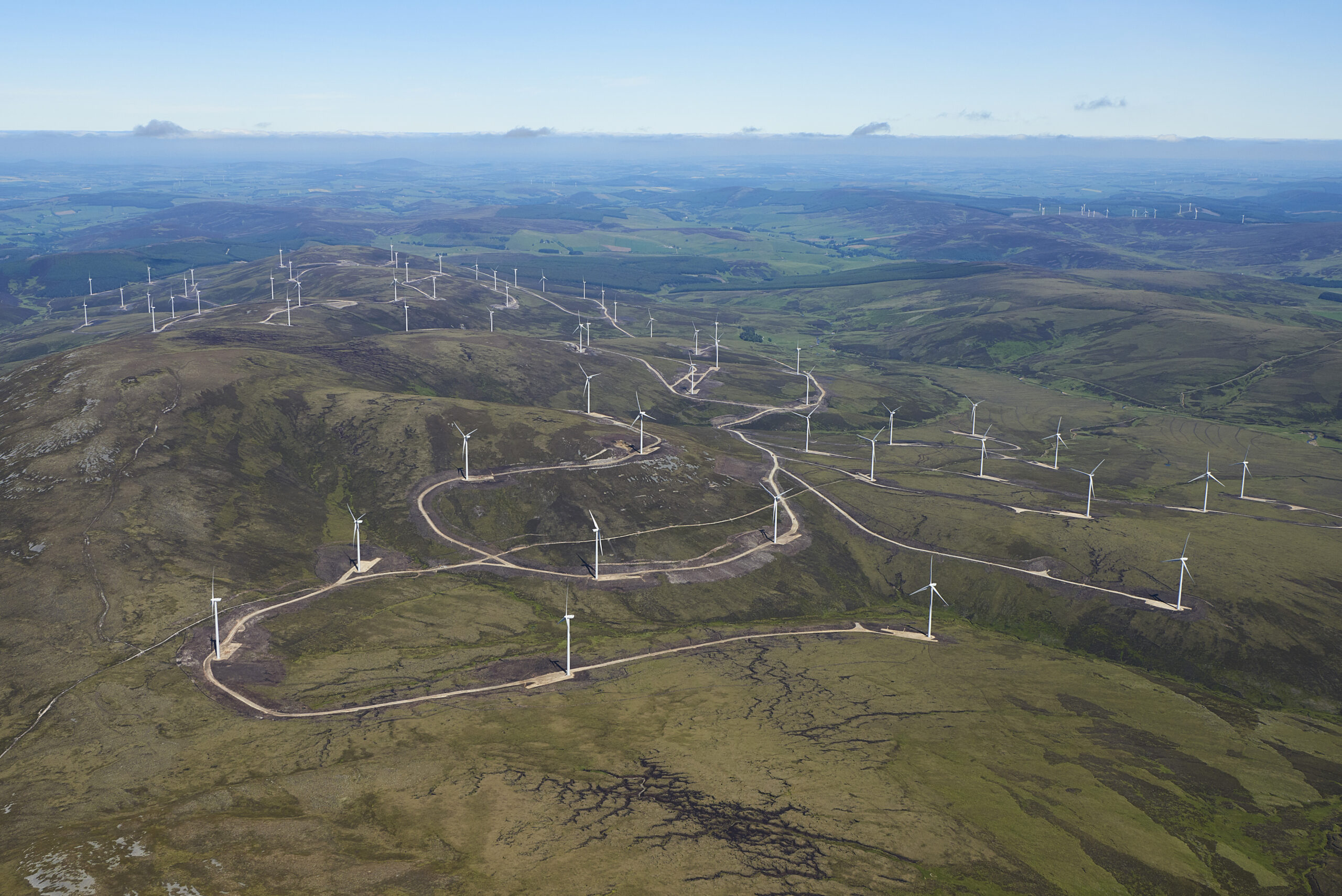
Court papers exposed an index-linked £6 million minimum rent at Dorenell Wind Farm; subsequent reporting found the land payment had reached about £11 million a year. Now a much larger extension is under consultation in Moray, as Scotland considers raising what developers are encouraged, but not required, to give neighbouring communities.
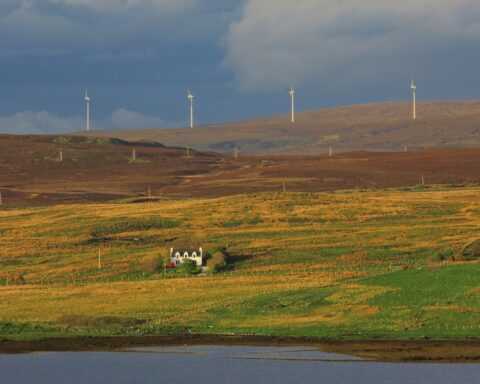
Fifty-nine turbines stand on the hills south of Dufftown. Each reaches about 126 metres at blade tip. Together they form the 177MW Dorenell Wind Farm, fully commissioned in March 2019 and capable, according to its operator, of producing enough electricity for up to 106,000 homes.
For years, one of the most consequential numbers attached to those turbines was invisible to the people living around them: what the land itself was worth to the company using it.
Then the landlord and the wind-farm company went to court.
The dispute between Glenfiddich Wind Limited and Dorenell Windfarm Limited reached the Outer House of the Court of Session in 2025. It was a commercial action about the interpretation of the lease covering Scaut Hill, but the judgment did something much more unusual. It opened part of the financial machinery behind a major Scottish wind farm to public view.
The lease provided for an index-linked minimum annual rent of £6 million. The actual rent could be higher because it was calculated by reference to elements of the wind farm’s gross income. Court papers record that Dorenell had paid £8,496,981 for one disputed rent year, £9,480,725 for the next and £10,406,641 for the following year. Glenfiddich Wind argued that further sums were due. Lord Sandison’s findings produced a mixture of outcomes on the disputed contractual issues, with the precise orders left for the parties to address afterwards.
The disagreement centred in part on what happens financially when Dorenell is able to generate electricity but is instructed to reduce output because the transmission system cannot accommodate all of it. Electricity generators can submit bids through the Balancing Mechanism to reduce generation during such constraints. The lease dispute concerned whether benefits arising in those circumstances should feed into the calculation of rent.
What had been a private commercial agreement was suddenly capable of being measured.
The Ferret subsequently reported, using the court material alongside its wider investigation into Scottish wind-farm land rents, that the annual payment associated with Dorenell had risen to about £11 million in 2025. It reported that this was 23 times the £464,625 paid to communities that year.
Land rent and community benefit are not equivalent payments. The first is consideration negotiated under a commercial lease. The second is a voluntary arrangement intended to leave benefits in communities hosting renewable infrastructure. One does not create a legal entitlement to the other, and the difference between them does not establish wrongdoing.
But the difference reveals something about the rules governing each side of the hill.
The landowner’s minimum rent is contractual, index-linked and capable of rising with defined wind-farm income. Community benefit operates under a different system altogether.
Foundation Scotland, which administers the existing Dorenell Community Benefit Fund, says approximately £447,000 was paid into the fund in its first year, equivalent to £2,525 for every megawatt of installed capacity. The annual donation then rises with the Retail Price Index. The fund serves Cabrach, Dufftown and District, Glenlivet and Inveravon, and Glenrinnes.
Its latest detailed report provides another useful distinction. Between April 2024 and March 2025, £397,353 was awarded to 22 projects. That is money granted out of the fund during the year, rather than the annual contribution made into it, and should not be confused with The Ferret’s £464,625 payment figure. The projects ranged from community facilities and youth work to heritage, energy efficiency and a new footpath network. More than £2 million had been awarded in the fund’s first five years of grant-making.
It matters because another Dorenell is now before the Scottish Government.
The Dorenell Extension Wind Farm remains listed by the Energy Consents Unit as under consultation. The application, received on 8 August 2025, is for 67 turbines, ranging from 149.9 metres to 250 metres high, alongside associated infrastructure and a battery energy storage system. The Energy Consents Unit records a maximum total development capacity of 497MW. Developer Galileo gives the wind-generation component as 476.6MW.
This is therefore not an abstract debate about the economics of a development already built. Moray is considering what could amount to a second, substantially larger generation project on the Cabrach and Glenfiddich estates at the same time as the financial arrangements around the first have become unusually visible.
Galileo says the extension would provide a community package of almost £2.4 million a year, which it describes as worth about £100 million over an expected 40-year operating life. The proposal includes annual electricity-cost contributions of £1,849 for households within five kilometres of the wind-farm boundary and £924 for households between five and eight kilometres, with those household contributions intended to rise with inflation. It also proposes £50,000 a year for local skills, £100,000 a year for biodiversity and nature, a regeneration fund of up to £1.6 million, two local project workers and continued exploration of community ownership of up to five per cent of the wind farm.
The £2.4 million figure has an interesting provenance.
Scotland’s current Good Practice Principles recommend that onshore wind developers provide community benefit worth £5,000 per installed megawatt each year, index-linked over a project’s operating life. These principles are voluntary and community benefit is not a material consideration when deciding whether a development receives planning consent.
Multiply Galileo’s stated 476.6MW wind capacity by that £5,000 benchmark and the result is £2.383 million a year.
That is almost exactly the community package being proposed.
But in February 2026 the Scottish Government proposed changing the benchmark to £6,000 per MW per year, also index-linked. It acknowledged that £5,000 from 2014 would be worth approximately £6,900 after inflation, but said its proposed £6,000 figure balanced the loss of value to communities against increased costs and other pressures facing developers. The refreshed guidance has been presented as a proposal, rather than a statutory charge.
Apply £6,000 to Dorenell Extension’s stated 476.6MW wind capacity and the result is £2,859,600 a year.
That is £476,600 more than the calculation at £5,000 per MW. Over 40 years the difference would be £19.064 million before indexation.
This is a Modern Scot calculation using only Galileo’s stated wind-generation capacity. It does not include the proposed battery system, for which the Scottish Government is separately considering a community-benefit benchmark of at least £150 per MW per year.
None of that means the extension’s present community offer breaches Scottish Government guidance. The £6,000 figure remains proposed guidance; community benefits remain voluntary; and the Government itself says arrangements can take different forms following negotiation between developers and communities. But it demonstrates how much money can turn on a change of £1,000 per megawatt when a development approaches 500MW and may operate for four decades.
The financial offer is also only one part of the extension decision.
The Cairngorms National Park Authority objected to the application in March 2026. Its assessment said the scale and proximity of the development would significantly exacerbate adverse effects on the landscape qualities of parts of the National Park. Nineteen of the proposed turbines would reach 250 metres, compared with the existing Dorenell turbines at about 126 metres, and the closest proposed turbines would stand about half a kilometre from the Park boundary.
NatureScot also objected to the submitted design unless changes were made. Its January response said the proposal as submitted would have significant adverse effects on the special qualities of the Cairngorms National Park and recommended the removal, relocation or reduction of a number of turbines.
There is a further financial history at Dorenell that sits separately from both the lease dispute and community benefit.
In March 2024, Ofgem said Dorenell Windfarm Limited had accepted that its bidding approach during transmission constraints breached a condition of its electricity generation licence. The company regarded the breach as unintentional and said it had not intended to obtain excessive benefit. It changed its bid-pricing policy and agreed to pay £5.53 million into the Energy Redress Fund. Ofgem then closed the matter without a formal enforcement investigation.
The Ofgem case and the landlord’s Court of Session action concerned different legal questions and should not be conflated. Their common feature is that both illuminate the unusually complicated economics that can arise when abundant renewable generation meets limited transmission capacity.
The community side of the arrangement is, by contrast, deliberately kept outside the planning balance. Moray Council said in a 2025 freedom of information response that it has no role in administering or monitoring the Dorenell Community Benefit Fund, precisely because of the risk that community payments could be perceived as influencing planning decisions. The council separately receives £50,000 for public-access works for the duration of the wind farm.
That leaves an unusual asymmetry.
A community can know the recommended number of pounds per megawatt. It can know the value of grants awarded locally. It can examine a planning application several thousand pages long. What it will rarely know is the commercial price being paid for the land hosting the turbines.
Dorenell became an exception because its landlord and operator disagreed strongly enough to litigate.
That gap sits within a much older Scottish pattern. The Scottish Land Commission currently highlights research showing that 408 owners control 50 per cent of privately owned rural land in Scotland. Scottish Government statistics record 213,803 hectares in community ownership at the end of 2024, 2.7 per cent of Scotland’s total land area.
There is nothing inherently improper about receiving substantial rent for land required by a commercial energy project. Nor should community-benefit funds be dismissed as trivial: Dorenell’s own reports document youth services, community staff, halls, heritage projects, energy improvements and infrastructure that might otherwise struggle for finance.
The harder issue exposed at Dorenell is transparency.
One payment is negotiated according to the commercial value of scarce land and protected by contract. The other is shaped by voluntary national guidance intended to recognise the communities living beside the infrastructure. Scotland is now considering another 67 turbines on the same landscape while proposing to change that community benchmark.
For once, Moray enters that decision with some knowledge of what the first wind farm was worth on the other side of the lease.
At Dorenell, transparency arrived through litigation. It would be a poor model for the rest of Scotland.
Sources
Glenfiddich Wind Limited against Dorenell Windfarm Limited [2025] CSOH 62 — Outer House, Court of Session — 10 July 2025
https://www.bailii.org/scot/cases/ScotCS/2025/2025csoh62.html
Dorenell Wind Farm — EDF power solutions UK and Ireland
https://www.edf-powersolutions.uk/our-sites/dorenell/
Dorenell Extension Wind Farm — Scottish Government Energy Consents Unit, ECU00004862
https://www.energyconsents.scot/ApplicationDetails.aspx?cr=ECU00004862
Dorenell Extension Wind Farm and Biodiversity Enhancement Plan — Galileo
https://dorenellextension.co.uk/
Onshore Renewable Energy — Refreshing the Good Practice Principles for Community Benefits: Working Paper — Scottish Government — 18 February 2026
https://www.gov.scot/publications/refreshing-good-practice-principles-community-benefits-onshore-renewable-energy-working-paper/pages/3/
Communities Benefit From Renewable Energy — Scottish Government — 18 February 2026
https://www.gov.scot/news/communities-benefit-from-renewable-energy/
Dorenell Extension Wind Farm Committee Report — Cairngorms National Park Authority — 13 March 2026
https://cairngorms.co.uk/documents/item9-dorenellextensionwindfarmcommitteereport/html
NatureScot Comments: Dorenell Extension Wind Farm — 26 January 2026
https://cairngorms.co.uk/documents/item9-appendix3-dornellwindfarm-pre20260004/html
Compliance of Dorenell Windfarm Limited With the Transmission Constraint Licence Condition — Ofgem — 4 March 2024
https://www.ofgem.gov.uk/cy/publications/compliance-dorenell-windfarm-limited-tclc
Dorenell Wind Farm Community Benefit Fund — Foundation Scotland
https://www.foundationscotland.org.uk/dorenell
Dorenell Wind Farm Community Benefit Fund Report 2024–2025 — Foundation Scotland
https://www.foundationscotland.org.uk/sites/default/files/2025-07/Dorenell%20Wind%20Farm%20Community%20Benefit%20Fund%20Report%202024-25%20FINAL_0.pdf
Dorenell Wind Farm Community Benefit Fund — Freedom of Information Response — Moray Council — 11 July 2025
https://www.moray.gov.uk/information-governance-access-to-information-requests/foi-requests-responses/foi-requests-by-month-2025/foi-request-dorenell-wind-farm-community-benefit-fund/
Making More of Scotland’s Land / Land and Power — Scottish Land Commission
https://www.landcommission.gov.scot/
Community Ownership in Scotland 2024 — Scottish Government — 25 November 2025
https://www.gov.scot/publications/community-ownership-in-scotland-2024/
Wealthy Landowners Are Making Millions From Scottish Wind Farms. You’re Subsidising Them — The Ferret — Louis Boyd-Madsen and Paul Dobson — 10 May 2026
https://www.theferret.scot/landowners-making-millions-wind-farms-scotland/