
Scotland’s temperate rainforest survives in fragments along the wet western edge of the country, from Argyll and Lochaber to Wester Ross, Skye and the islands. It is one of Scotland’s rarest habitats, rich in mosses, lichens, liverworts, fungi, ferns and old native woodland. New species recording in West Cowal and fresh restoration funding across the west have brought renewed attention to a landscape that has often been seen without being properly counted.
Scotland has rainforest. It does not look like the tropical canopy most people imagine when they hear the word. It is cooler, darker, lower and quieter, spread in broken pieces along the Atlantic edge of the country where rain, ocean air and mild temperatures keep bark, stone and soil damp enough for a small world to grow. 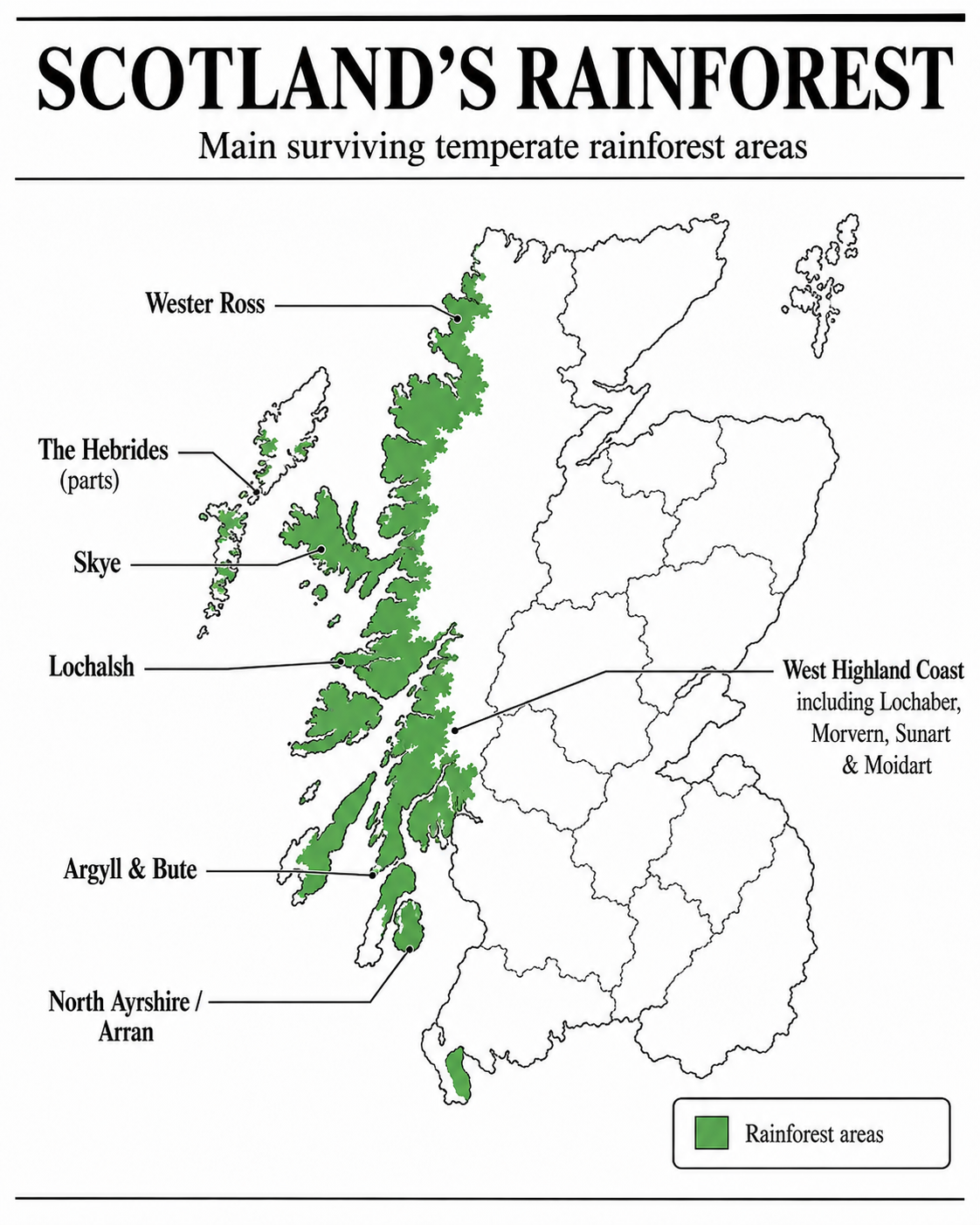
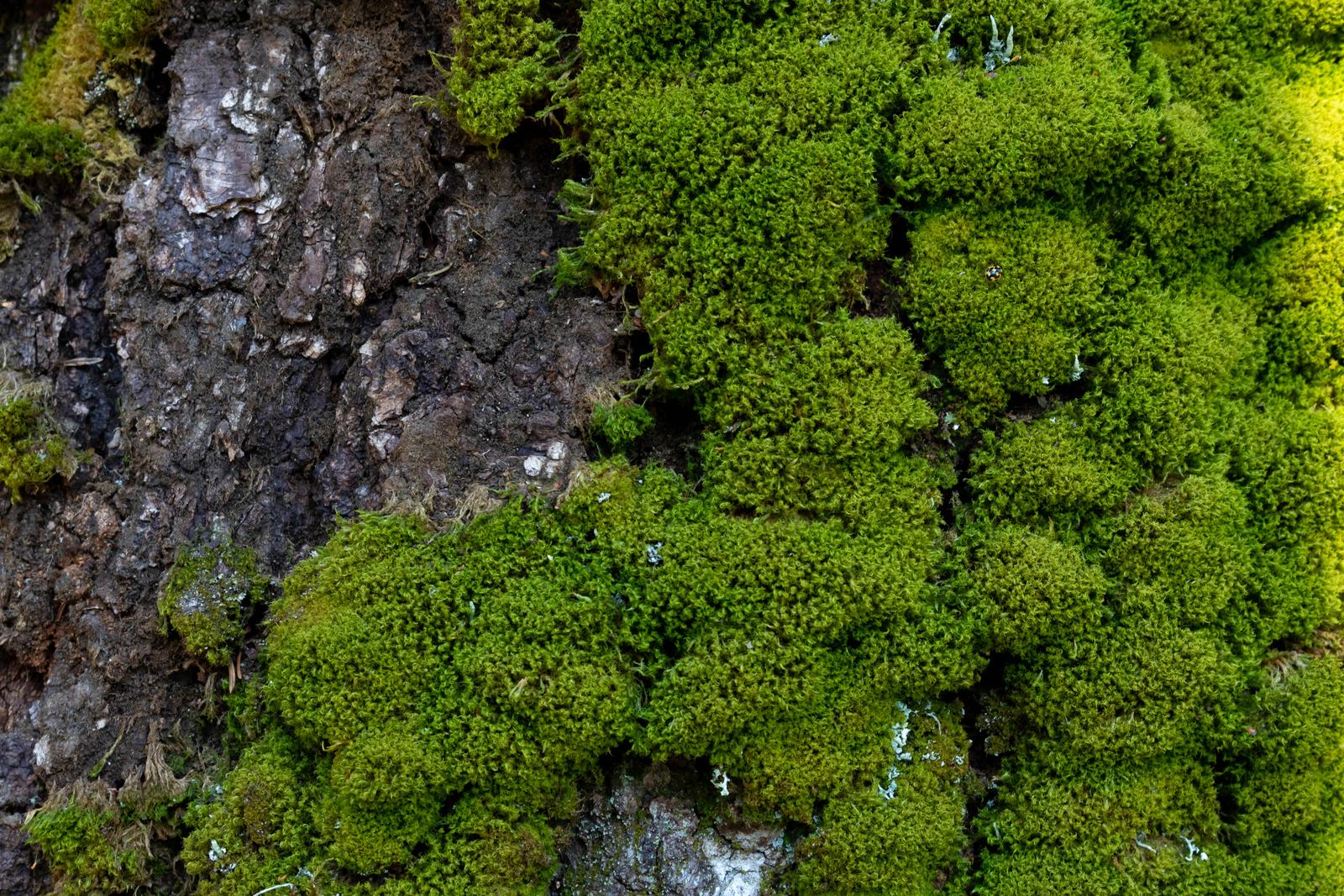
These woods are known as Scotland’s rainforest, Atlantic woodland or Celtic rainforest. They occupy the country’s hyper-oceanic western zone, where humidity, rainfall and relatively mild conditions create habitats of international importance. Ancient oak, birch, ash, hazel and Scots pine carry carpets of mosses and liverworts. Lichens grow on trunks and branches. Ferns crowd wet hollows. Fungi and slime moulds appear in places where the eye has been trained to slow down.
Only around 30,000 hectares remain. NatureScot has described the surviving rainforest as fragmented and roughly the size of Edinburgh. The Woodland Trust says it represents about two per cent of Scotland’s woodland cover. That small area carries weight out of proportion to its size. It supports rare species, holds carbon, helps slow water, reduces erosion and preserves remnants of woodland that once formed a far more continuous western habitat.
The recent attention around West Cowal shows how much is still being uncovered. Since 2024, volunteers and recorders working through the West Cowal Habitat Regeneration Project have recorded more than 1,100 species, including glow-worms, rare lichens, fungi and slime moulds. The work has helped fill gaps in a landscape that had seen little detailed recording since the 1970s.
The glow-worm discoveries drew public interest because they feel almost improbable. In ecological terms, their presence is a sign of something more precise: habitat structure, prey, open spaces and woodland edges working well enough to support a species that has become rare in many parts of Britain. The public sees a small light in the dark. The recorders see evidence that a neglected habitat still has working parts.
West Cowal sits within one of the strongest areas for Scotland’s rainforest. Argyll’s coast, peninsulas and islands give the habitat much of what it needs: rain, shelter, old woodland, ravines, burns, low light and long continuity of dampness. Similar fragments occur further north and west, through Lochaber, Morvern, Sunart, Moidart, Wester Ross, Skye, Lochalsh and parts of the Hebrides. These are not decorative woods attached to scenic routes. They are living archives.
The history of the rainforest is tied to how people used the western Highlands and islands. These woods were shaped by crofting, grazing, wood pasture, charcoal, tanbark, fuel, timber, shelter, estates, forestry and later conservation. They were never untouched wilderness in the simple sense. Generations of people moved animals through them, cut from them, worked around them and named them. At Balmacara, the National Trust for Scotland describes rainforest woodland whose mosaic of habitats has been influenced by generations of crofters grazing animals among oak and birch.
That human history matters because the future of the rainforest will also depend on people.
Rhododendron ponticum is one of the heaviest threats. Introduced to Britain as an ornamental plant in the eighteenth century and widely planted on estates, it has become a serious invasive species in the west. In rainforest woods, dense rhododendron can shade out young native trees, suppress ground flora and smother the lower vegetation on which many rare mosses, lichens and liverworts depend. Clearing it is labour-intensive, expensive and usually has to be repeated until regrowth is controlled.
Overgrazing is the other great pressure. Deer, sheep and other herbivores can prevent young trees from establishing, leaving old woodland unable to replace itself. The problem is subtle at first. A wood can still look beautiful while its future is being eaten away at ankle height. Mature trees remain. The next generation does not appear.
The Alliance for Scotland’s Rainforest has warned that high numbers of deer and livestock have prevented many rainforest remnants from regenerating and expanding naturally. Woodland structure suffers. Bryophytes and lichens lose the varied conditions they need. The forest becomes older without becoming younger.
Some rainforest sites face a further complication from past forestry decisions. Ancient woodland areas were planted with non-native conifers during an era when timber production was treated as the main public objective for much of Scotland’s woodland. Those plantations on ancient woodland sites can still contain surviving rainforest features, but restoration often requires gradual removal of non-native trees, deer control, rhododendron clearance and careful recovery of native woodland.
New funding is beginning to follow the science. In January 2026, NatureScot announced more than £1.76 million for ten rainforest restoration projects across western Scotland through the Scottish Government’s Rainforest Restoration Fund. Projects from Argyll to Assynt are intended to restore and expand native woodland, remove invasive species and support habitats that have become fragmented or degraded.
The Nevis Nature Network’s rainforest restoration work was among those funded, with plans for habitat restoration, community engagement and removal of invasive non-native species. NatureScot noted that rhododendron ponticum is present across around 400 hectares of the Ben Nevis and Glen Nevis project area. That figure gives some sense of the scale of the work. Restoration is not a matter of planting a few trees and issuing a photograph. It can mean years of cutting, treating, fencing, monitoring, deer management and follow-up.
The carbon figure adds another reason for attention. NatureScot says Scotland’s remaining rainforest captures up to one million tonnes of carbon dioxide each year, while also helping prevent flooding and soil erosion. The habitat is therefore part of climate policy, biodiversity policy and rural land management at the same time. Its value is not confined to the species list.
There is also a cultural value that sits beside the ecological one. These woods are part of the old Atlantic Scotland: wet paths, burns, hazel stools, oak leaves, moss-covered stone, crofting memory, Gaelic place names, sea air and the long human habit of making life around difficult ground. To lose them would be to lose more than species. It would weaken one of the landscapes through which Scotland understands itself.