
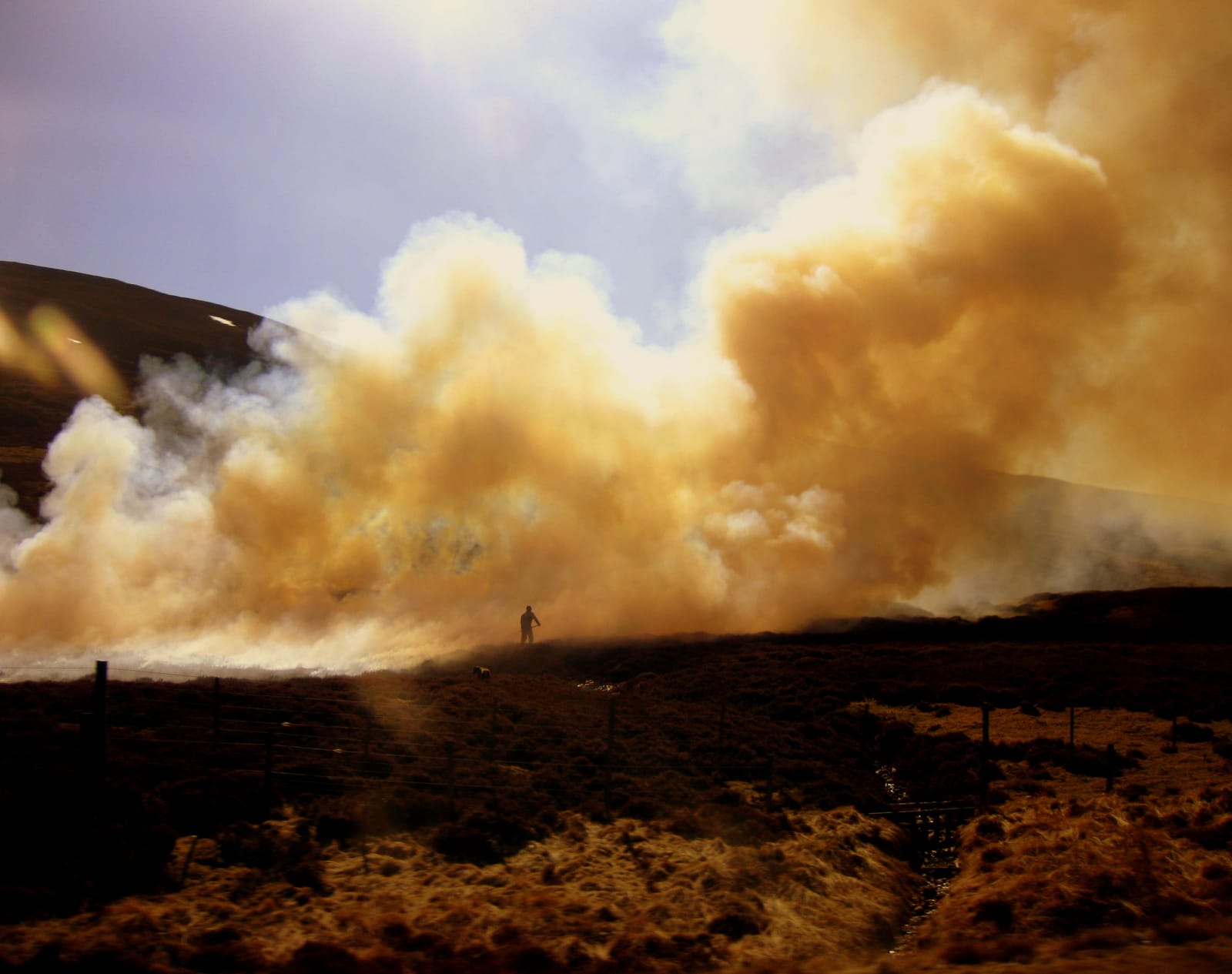
Scotland recorded its most severe wildfire season in 2025, with major fires across moorland, peatland and woodland. A new national action plan now places wildfire beside climate change, land management and rural resilience as one of the country’s growing environmental risks. The change is being felt across the country, from the Flow Country and the Cairngorms to Arran, Galloway and the east coast. Scotland’s old assumption that wildfire is mainly a spring problem is beginning to look unsafe.
Scotland has long thought of wildfire as something that belongs to dry grass, careless campfires, muirburn gone wrong and a few difficult weeks in spring. That view is now being overtaken by the land itself.
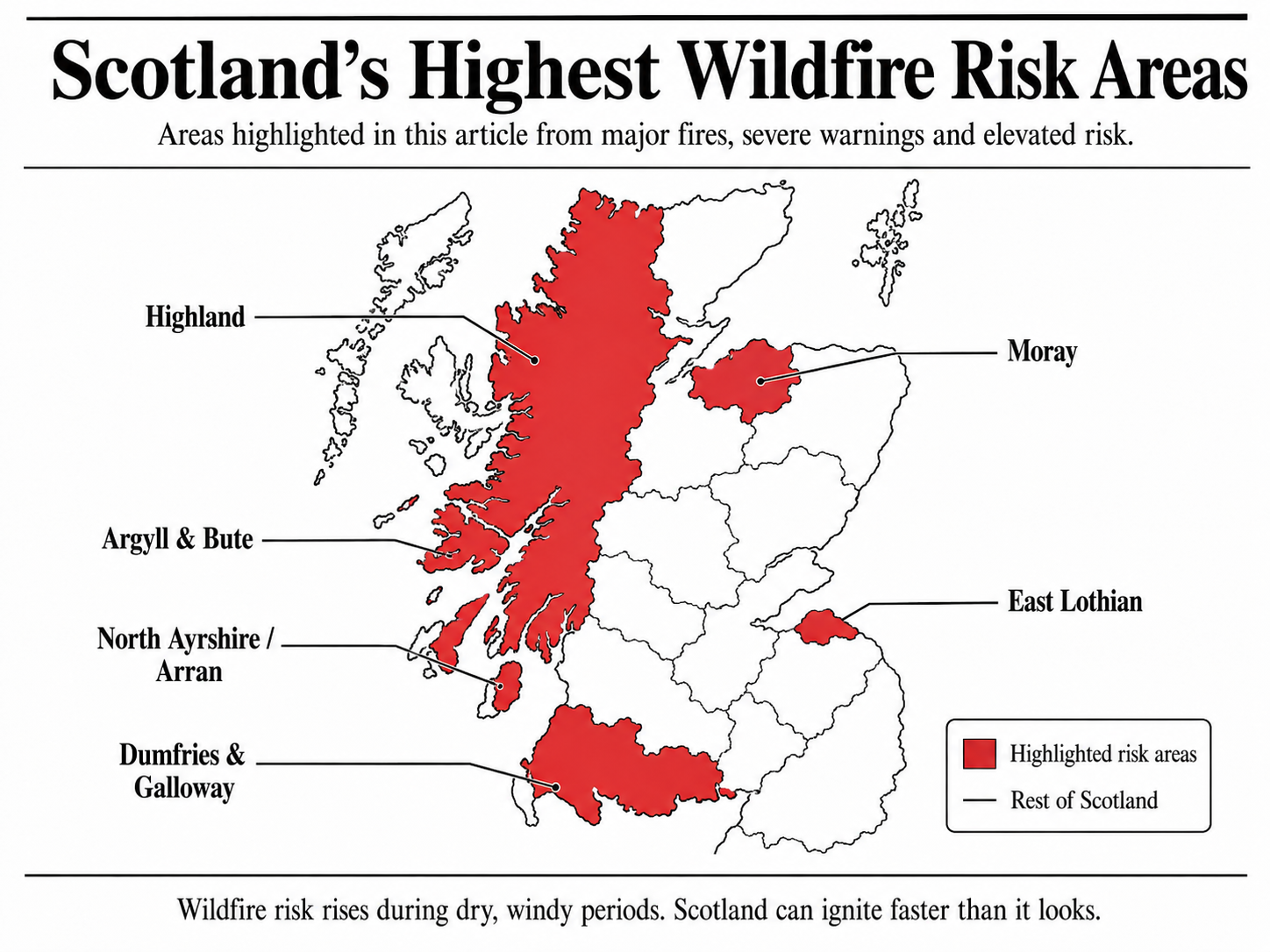
The Scottish Government’s wildfire strategic action plan, published in March 2026, says 2025 was Scotland’s most severe wildfire season on record. The Scottish Fire and Rescue Service recorded 241 wildfire incidents across the year, with 109 in April alone. The same plan records major fires at Glen Rosa on Arran and Glen Trool in Galloway Forest Park, along with the Carrbridge and Dava Moor wildfires that burned between 28 June and 2 July 2025.
Those fires around Carrbridge and Dava Moor are described in the government plan as the largest ever recorded in the UK. Flames reached 20 metres in length and almost 10,000 hectares of moorland, peatland and woodland were burned. Smoke affected air quality in nearby towns. Roads were closed. Fire crews worked for days alongside landowners, land managers, gamekeepers and community volunteers.
The image of Scotland as too wet to burn has become less reliable. Climate projections for Scotland point toward warmer, drier summers, milder and wetter winters, heavier rainfall events and more unpredictable weather. The country is not becoming Mediterranean, and careless comparisons do not help. The more useful fact is that longer dry spells are enough to change the behaviour of Scottish vegetation, peat, moorland and woodland.
Fire does not need a heatwave to become dangerous. It needs fuel, ignition, wind and dry enough ground. Scotland has all four in the wrong weeks more often than it once did.
The Scottish Fire and Rescue Service has already had to stretch its warning season. In March 2026, the service said it had issued 14 wildfire warnings in 2025, with the final warning of the year distributed in October, well beyond the traditional high-risk period. In late April 2026, it issued extreme and very high warnings across parts of Scotland before the May bank holiday weekend. Forestry and Land Scotland also carried warnings in May for south-west and eastern Scotland.
The pattern matters because rural Scotland is full of places where wildfire becomes complicated very quickly. Moorland, forestry, peatland, crofting ground, grazing land, sporting estates, nature reserves, scattered homes, single-track roads, tourist sites and remote telecommunications infrastructure can all sit close together. A fire can begin as a visitor’s mistake or an estate-management failure and become a public-service emergency before most people nearby have understood what the wind is doing.
Human activity remains central. The national action plan points to unattended campfires, equipment sparks, uncontrolled muirburn and debris burning among the causes of ignition. That should keep the debate grounded. Climate change is making conditions more dangerous, but many Scottish wildfires still begin with a person, a tool, a flame, a vehicle, a barbecue, a cigarette or a managed burn that was less managed than advertised.
The history of fire on Scottish land is older than the present emergency vocabulary. Muirburn, the controlled burning of heather and moorland vegetation, has been used for generations to manage grazing, grouse moors and habitats. It has also been disputed for generations. Land managers have argued that controlled burning can reduce fuel load and create habitat mosaics. Environmental groups have warned about damage to peat, carbon stores and biodiversity when burning is poorly used or carried out in the wrong place.
That old argument has now moved into a stricter legal setting. The Wildlife Management and Muirburn Scotland Act 2024 introduced a licensing regime for muirburn. NatureScot’s licensing guidance says peatland is defined as land with peat layers of 40cm or more. Burning on peatland can be licensed only where it is necessary for specified purposes, such as restoring the natural environment or preventing wildfire damage to habitats, people or property. Burning out of season is not permitted for moorland game management or to improve grazing.
Those rules recognise a difficult truth. Fire can be a land-management tool, but it can also damage the very ground Scotland needs to protect.
Peatland is where the environmental stakes become much larger than scorched grass. Scotland’s peatlands store vast amounts of carbon, hold water, support rare habitats and help shape some of the country’s most distinctive landscapes. When peat is healthy and wet, it resists fire. When it is drained, degraded or covered with the wrong kind of dry vegetation, it becomes more vulnerable.
NatureScot’s Peatland ACTION material describes damaged peatlands as more likely to suffer severe fire damage and spread fire to neighbouring areas. Drained or modified peat supports heath and grassy vegetation that increases fuel and dries the peat near the surface. Restoration raises the water table, encourages sphagnum mosses and can reduce fire severity and spread.
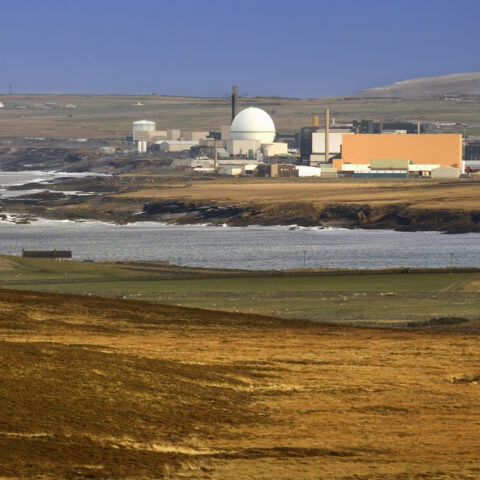
The Flow Country has already shown what can be lost. In May 2019, a wildfire in north-east Sutherland burned for almost six days. A report prepared for WWF estimated the burned area at 54.9 square kilometres, dominated by blanket bog. The study presented a range of possible carbon losses, with mid-range estimates between 230 and 290 kilotonnes of carbon depending on the method used, and much wider possible losses under different fire severity assumptions.
That fire burned in a landscape now internationally recognised for its peatland importance. The Flow Country’s blanket bogs are part of Scotland’s environmental inheritance and climate responsibility. When such places burn, the loss is measured in habitat, stored carbon, water quality, recovery time, firefighting cost and the confidence of communities who live beside land that can change character in a dry week.
The 2025 season deepened that warning. The Carrbridge and Dava Moor fires burned through moorland, peatland and woodland at a scale Scotland had not recorded before. Fire science researchers have since pointed to the risk that high-severity peat fires can release large carbon stores and leave long recovery periods. The more Scotland depends on peatland restoration for climate credibility, the more wildfire becomes a direct threat to national policy.
Forestry brings a different set of risks. Scotland wants more woodland for climate, nature, timber and rural employment. More trees also mean more land where fire planning must be built into access, species choice, maintenance, fuel breaks, water supply and emergency response. Forestry and Land Scotland has already recorded heavy wildfire damage in recent years, including the Cannich fire in 2023, which burned for months and cost large sums to control.
Tourism adds another layer. Wildfire warnings often coincide with public holidays, dry weekends and busy outdoor sites. Campers, walkers, cyclists, campervans and day visitors are part of Scotland’s rural economy, but the behaviour of a small number of people can put large areas at risk. A disposable barbecue on dry grass is not a harmless convenience. In the wrong conditions, it is a public cost carried by firefighters, landowners, communities, wildlife and the atmosphere.
The new national action plan is organised around prevention, preparedness and response. That order is sensible. Once a wildfire is established in remote terrain, Scotland’s fire crews are dealing with geography as much as flame: access, water, wind, smoke, communications, steep ground, peat depth, forestry tracks, road closures and the sheer time needed to reach the seat of a fire.
Prevention will require more than public warnings. Landowners and land managers will have to think about fuel loads, degraded peat, brash left after forestry operations, access tracks, water points, muirburn planning, grazing pressure and the condition of land around vulnerable communities. Councils and emergency planners will have to consider evacuation routes, smoke exposure, rural care settings, tourist sites and infrastructure.
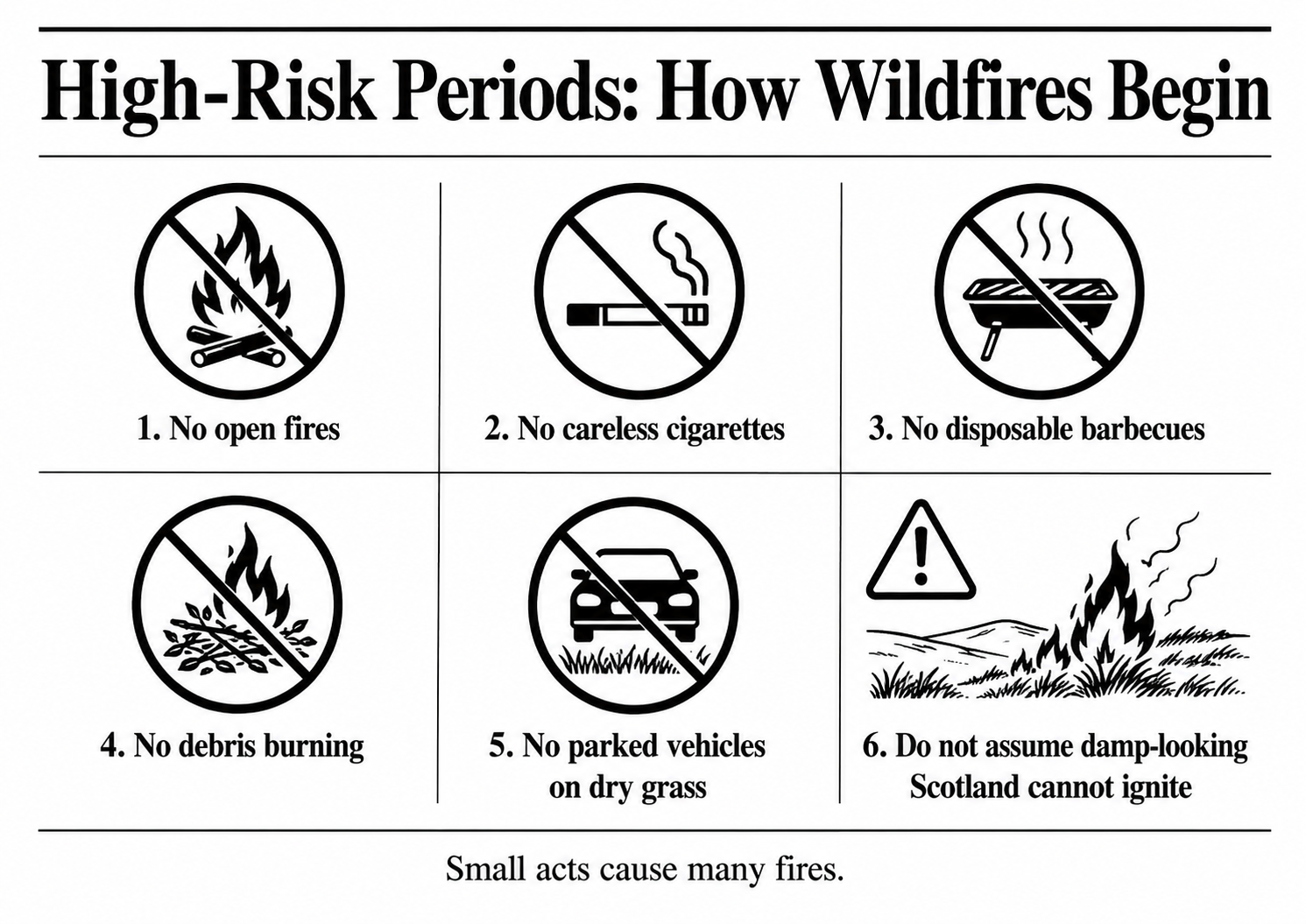
The public has a simpler role, and it is no less important. During high-risk periods, no open fires, no careless cigarettes, no disposable barbecues, no debris burning, no parked vehicles on dry grass, no assumption that damp-looking Scotland cannot ignite. The small acts sound ordinary because they are. They are also how many fires begin.
Scotland is entering a period in which fire belongs in environmental reporting as firmly as flooding, coastal erosion, sewage, biodiversity loss and energy infrastructure. It touches climate projections, rural land use, peatland restoration, forestry strategy, public safety, tourism behaviour and the future cost of emergency response.
The country has lived with controlled fire for centuries. It is now learning to live with a less controllable kind. The difference will be measured in dry springs, summer warnings, longer seasons, burned peat, smoke over towns, closed roads and the growing recognition that land management is no longer just about what Scotland looks like. It is about what Scotland can survive.