

Modern Scot assembled the current official details of Scotland’s serving councillors, MSPs and MPs. The directory contains 1,407 elected representatives: 1,221 councillors, 129 MSPs and 57 MPs. Scotland’s 32 councils provide 1,226 statutory council seats, five of which were vacant when the local-government data were verified.
Modern Scot data feature | Updated 6 August 2026
A spreadsheet of elected representatives ought to be one of the least romantic topics in Scotland. It contains no mist, no ruined castle and no stag standing moodily beside a loch.
Yet put Scotland’s 32 councils, the Scottish Parliament and Scotland’s representation at Westminster into one searchable directory and the result becomes something rather more revealing.
Modern Scot’s completed directory contains 1,407 serving elected representatives: 1,221 councillors, all 129 Members of the Scottish Parliament and all 57 MPs representing Scottish constituencies.
There are, however, 1,412 elected positions across those three tiers. The difference is explained by five vacant council seats.
Scotland’s present local-government arrangements provide 1,226 councillors across 355 wards, a national total confirmed by Boundaries Scotland and the Scottish Government.
| Representation | Serving representatives | Seats or positions |
|---|---|---|
| Councillors | 1,221 | 1,226 |
| MSPs | 129 | 129 |
| MPs | 57 | 57 |
| Total | 1,407 | 1,412 |
That makes the directory considerably more than a council contact list. It is a map of the people through whom Scotland is represented locally, at Holyrood and at Westminster.
Three Different Kinds Of Representative
Scotland has 129 MSPs: 73 constituency MSPs and 56 regional MSPs. Every person in Scotland is represented by one constituency MSP and seven regional MSPs.
Scotland also returns 57 MPs to the House of Commons. The reduction to 57 Scottish constituencies took effect for the 2024 UK general election following the Westminster boundary review.
And beneath both sit Scotland’s 32 councils, where the numerical picture is far less tidy.
The Modern Scot council data records 1,221 serving councillors in 355 wards. Five of the 1,226 statutory seats were vacant on the verification date, giving Scotland a council-seat occupancy rate of approximately 99.6 per cent.
It is within those 355 wards that the spreadsheet becomes particularly interesting.
What The Council Numbers Reveal
Scotland’s local government is rarely governed by outright command.
Twenty-eight of its 32 councils have no single party or grouping holding a majority of the occupied seats.
The SNP is the largest force nationally in the Modern Scot dataset, with 413 councillors, but Dundee is the only council in which a national political party holds an outright majority.
Being the largest group is therefore very different from being in control.
In Dumfries and Galloway, Highland and Edinburgh, for example, the leading group occupies only about a quarter of the available seats. Budgets, administrations and local policies consequently depend upon negotiation, agreements and support extending beyond the largest party.
Scotland also has a formidable local political bloc.
Some 237 councillors sit outside the six principal national parties, including 188 recorded simply as Independents and another 49 belonging to local groups, smaller parties or unaffiliated classifications.
That is only 22 fewer councillors than Labour’s entire local-government representation.
The figures describe 32 separate political settlements rather than a single national map: heavily independent island councils, closely divided urban chambers, local alliances, one-member island wards and large multi-member wards.
Scottish local government is extraordinarily plural.
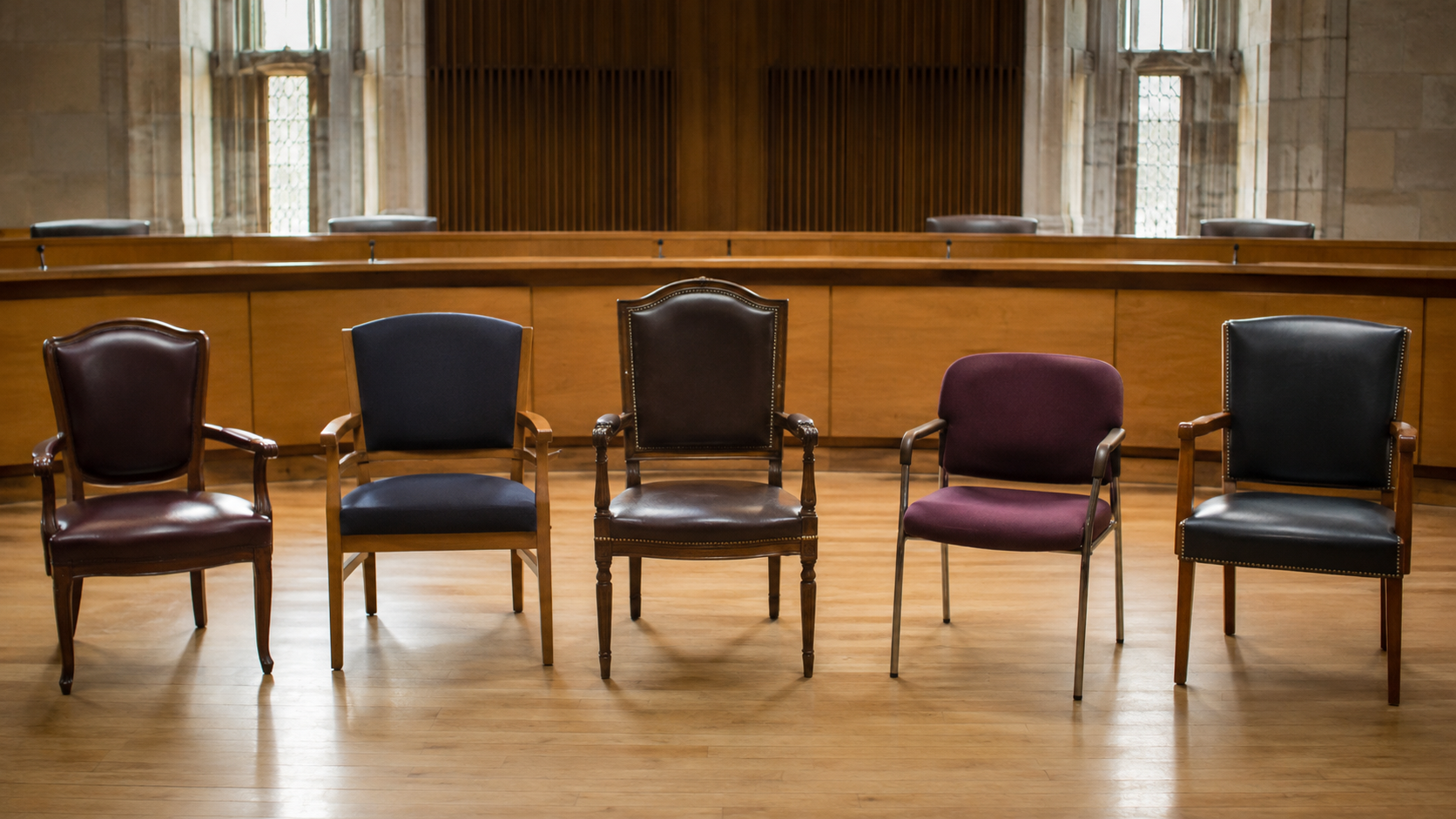
Five Empty Chairs
The five vacant council seats in the Modern Scot snapshot were spread across four authorities: Edinburgh had two, while Highland, South Lanarkshire and Stirling each had one.
| Council | Vacant ward | Reason or status | Election position |
| City of Edinburgh | Ward 15 — Southside/Newington | Resignation of Simita Kumar after moving to Holyrood | By-election 3 September 2026 |
| City of Edinburgh | Ward 17 — Portobello/Craigmillar | Resignation of Kate Campbell after moving to Holyrood | By-election 3 September 2026 |
| Highland | Ward 3 — Wick and East Caithness | Resignation of Willie Mackay | By-election 1 October 2026 |
| South Lanarkshire | Ward 5 — Avondale and Stonehouse | Death of Councillor Margaret Cooper | By-election 17 September 2026 |
| Stirling | Ward 2 — Forth and Endrick | Death of Councillor Paul Henke | Vacancy |
Edinburgh Council confirmed that Simita Kumar and Kate Campbell resigned their council seats before taking up new roles at Holyrood. Both wards will vote on 3 September.
South Lanarkshire’s Avondale and Stonehouse by-election, called following the death of Provost Margaret Cooper, will take place on 17 September.
Highland has since published further information about its vacancy. The Wick and East Caithness seat became vacant following the resignation of Councillor Willie Mackay, and, if contested, polling will take place on 1 October 2026.
Stirling Council announced the death of Councillor Paul Henke on 22 July.
The National Shape Of Scotland’s Councils
Among the 1,221 occupied council seats in Modern Scot’s dataset, the SNP is the largest force with 413 councillors, or 33.8 per cent of serving members.
Labour follows with 259.
There are 188 councillors recorded simply as Independent, 170 Conservatives, 86 Liberal Democrats, 33 Greens and 23 Reform UK councillors.
A further 49 councillors sit under named local groups, unaffiliated descriptions or smaller parties.
| Party or grouping | Serving councillors | Share of occupied seats |
| SNP | 413 | 33.8% |
| Labour | 259 | 21.2% |
| Independent | 188 | 15.4% |
| Conservative | 170 | 13.9% |
| Liberal Democrat | 86 | 7.0% |
| Named local, unaffiliated and other groups | 49 | 4.0% |
| Green | 33 | 2.7% |
| Reform UK | 23 | 1.9% |
| Total occupied seats | 1,221 | 100% |
The SNP has 154 more councillors than Labour, but numerical leadership should not be confused with untroubled command.
Twenty-eight of the 32 authorities have no single group holding more than half of the occupied seats.
Only Four Rooms Have A Majority
Only four council chambers contain a single group with an outright majority of occupied seats.
Three are island authorities dominated by Independents.
Orkney has 19 Independents among 21 serving councillors. Shetland has 18 among 23. Comhairle nan Eilean Siar has 21 among 29.
The sole national-party majority is in Dundee, where the SNP holds 15 of the city’s 29 seats.
Elsewhere, the largest group may be large without being remotely sovereign.
The SNP is the sole largest group in 20 councils and shares first place with Independents in Argyll and Bute.
Labour is the largest group in four councils, Conservatives in three and Independents in four, with Argyll and Bute providing the tie.
Dumfries and Galloway is the chamber in which nobody can plausibly enter wearing a crown.
Its largest group is the SNP with 11 of 43 councillors, or 25.6 per cent.
Highland follows closely, with 19 SNP councillors among 73 occupied seats. Edinburgh’s largest group has 16 of 61 occupied seats.
| Council | Occupied seats | Political labels | Largest group | Share |
| Dumfries and Galloway | 43 | 9 | SNP, 11 | 25.6% |
| Highland | 73 | 8 | SNP, 19 | 26.0% |
| City of Edinburgh | 61 | 6 | SNP, 16 | 26.2% |
| Aberdeenshire | 70 | 5 | Conservative, 21 | 30.0% |
| Argyll and Bute | 36 | 8 | Independent and SNP, 11 each | 30.6% |
Dumfries and Galloway has the greatest variety, with councillors sitting under nine different political labels. Highland and Argyll and Bute each contain eight.
The Islands Decline To Behave
The island councils remain perhaps the clearest evidence that local Scotland does not always accept the party labels offered to it.
In Shetland, 21 of 23 councillors sit outside the six main national parties when Independents and those recorded with no party affiliation are counted together.
In Orkney the figure is 19 of 21.
In the Western Isles it is 21 of 29.
The mainland is not entirely obedient either.
South Ayrshire has 13 councillors outside the six principal national parties, Highland has 28 and Argyll and Bute has 12.
The Highland total includes 18 representatives recorded as Highland Independent and eight as Highland Alliance — reminders that even the word Independent can require footnotes in Scottish politics.
Arran: Scotland’s Loneliest Ward
Then there is Arran.
The North Ayrshire island is Scotland’s sole single-member council ward. Its solitude is deliberate rather than the result of a vacancy.
Boundaries Scotland considered the distinctive geographical circumstances of the island and proposed a single-member Arran ward under legislation permitting greater flexibility for inhabited islands.
Arran therefore has one councillor because the electoral arrangements provide one seat.
It is constitutionally lonely rather than abandoned.
Seven wards are designed to elect two councillors. Nine wards had only two serving councillors in the Modern Scot snapshot because Avondale and Stonehouse and Forth and Endrick were each carrying an empty third seat.
The more easily concealed vacancies were in Edinburgh and Highland.
Southside/Newington, Portobello/Craigmillar and Wick and East Caithness each had three serving councillors, but each is a four-member ward.
Among a national system containing 180 properly constituted three-member wards, an empty fourth chair can hide surprisingly well.
At full complement, Scotland’s 355 wards comprise one one-member ward, seven two-member wards, 180 three-member wards, 164 four-member wards and three five-member wards.
Those three five-member wards are all in North Ayrshire: North Coast, Garnock Valley, and Saltcoats and Stevenston. Boundaries Scotland’s North Ayrshire arrangements also provide the single-member Arran ward.
| Councillors or seats per ward | Wards at current serving level | Wards at full complement |
| 1 | 1 | 1 |
| 2 | 9 | 7 |
| 3 | 181 | 180 |
| 4 | 161 | 164 |
| 5 | 3 | 3 |
| Total wards | 355 | 355 |
The Largest And Smallest Rooms
Measured by statutory seats, Glasgow has Scotland’s largest council chamber with 85.
North Lanarkshire follows with 77, Fife with 75, Highland with 74 and Aberdeenshire with 70. South Lanarkshire has 64 seats and Edinburgh 63. Boundaries Scotland’s national schedule confirms the current 355-ward, 1,226-councillor arrangement.
At the other end, Clackmannanshire, East Renfrewshire and Midlothian each have 18 seats.
| Largest council chambers | Statutory seats |
| Glasgow City | 85 |
| North Lanarkshire | 77 |
| Fife | 75 |
| Highland | 74 |
| Aberdeenshire | 70 |
| South Lanarkshire | 64 |
| City of Edinburgh | 63 |
Holyrood: 129 MSPs
The expansion of the Modern Scot directory beyond councils adds a second, quite different political map.
The Scottish Parliament has 129 MSPs, divided between 73 constituency members and 56 regional members.
The 2026 Scottish Parliament election returned 58 SNP MSPs, 17 Labour, 17 Reform UK, 15 Greens, 12 Conservatives and 10 Liberal Democrats.
There is one wrinkle for anyone comparing the election result with the current directory.
Kenneth Gibson, elected as an SNP MSP for Cunninghame North, subsequently became Presiding Officer and is now officially listed by the Scottish Parliament as having No Party Affiliation.
The current Modern Scot classification therefore records:
| Current MSP classification | MSPs |
| SNP | 57 |
| Labour | 17 |
| Reform UK | 17 |
| Green | 15 |
| Conservative | 12 |
| Liberal Democrat | 10 |
| No Party Affiliation | 1 |
| Total | 129 |
This is why the directory uses the simple representative type MSP for every member of the Scottish Parliament, while constituency and regional representation are retained separately.
An MSP is an MSP. The geography belongs in another column.
Westminster: Scotland’s 57 MPs
The third elected tier in the directory is Scotland’s representation in the House of Commons.
There are currently 57 MPs representing Scottish constituencies.
UK Parliament records the present Scottish party balance as 37 Labour MPs, eight SNP MPs, six Conservatives and six Liberal Democrats.
| Party | Scottish MPs |
| Labour | 37 |
| SNP | 8 |
| Conservative | 6 |
| Liberal Democrat | 6 |
| Total | 57 |
The contrast between the three tiers is striking.
The SNP is the largest party among Scotland’s councillors in the Modern Scot dataset and the largest party at Holyrood, while Labour holds the largest number of Scotland’s Westminster seats.
The same country therefore produces three rather different political maps depending upon which elected institution is being examined.
The John Party
Political labels are not the only possible means of arranging Scotland’s occupied council seats.
There are 45 serving councillors whose first name is John.
Were they to form a disciplined John caucus, it would be larger than Scotland’s entire group of 33 Green councillors and nearly twice the size of Reform UK’s 23.
There are also 31 Davids, 19 Andrews, 19 Jims, 18 Ians and 16 Jameses.
| First name | Serving councillors |
| John | 45 |
| David | 31 |
| Andrew | 19 |
| Jim | 19 |
| Ian | 18 |
| James | 16 |
Campbell is the most common councillor surname in the dataset, appearing 11 times, followed by Cameron and Smith with ten each.
There are three councillors called James Adams: two Conservatives and one Labour, distributed across Aberdeenshire, East Ayrshire and Glasgow.
Scotland has also elected two David Aitchisons, two David Wilsons, two Elaine McDougalls, two Gary Robinsons and two Stephen Currans.
The national directory occasionally resembles less a constitutional database than a determined attempt by Scotland to make email correspondence interesting.
What The Directory Ultimately Shows
Seen council by council, Scottish representation can appear fragmented.
Placed together, it becomes much clearer.
There are 1,407 serving people in the Modern Scot directory: 1,221 councillors dealing with the intensely local machinery of Scotland’s communities; 129 MSPs legislating and scrutinising government at Holyrood; and 57 MPs representing Scottish constituencies at Westminster.
The council map is dominated by negotiation rather than outright majorities. The Scottish Parliament has a different party balance again. Westminster produces another.
The directory also exposes something political summaries tend to conceal: representation is geographical before it is statistical.
Arran has one councillor. Glasgow has an 85-seat council. A Highland ward can cover an immense physical territory while an Edinburgh ward may contain tens of thousands of voters within a few square miles. Every Scottish resident has one constituency MSP and seven regional MSPs, while one MP represents the Westminster constituency in which they live.
The institutions overlap, but the representatives do not perform the same job.
That is why the directory records them separately as Councillor, MSP and MP, while retaining council, ward, constituency, region, party and official contact details beneath those headings.
A list of names, in other words, turns out to be a rather effective picture of how Scotland actually governs itself.
Sources
Boundaries Scotland — Local government electoral arrangements in Scotland: 1995 onwards. Current arrangements show 355 wards and 1,226 councillors.
Scottish Government — Councillors’ remuneration and expenses: recommendations. National local-government figures include 32 councils and 1,226 councillors.
Scottish Parliament — Current and previous MSPs / About MSPs. Current Parliament contains 129 MSPs: 73 constituency and 56 regional members.
Scottish Parliament — 2026 Election Results. Official result by party.
Scottish Parliament — Kenneth Gibson MSP / Presiding Officer. Gibson is currently recorded as No Party Affiliation.
UK Parliament — MPs representing Scotland. Current Scottish representation: 37 Labour, eight SNP, six Conservative and six Liberal Democrat MPs.
City of Edinburgh Council — By-elections to take place in September. Southside/Newington and Portobello/Craigmillar polls scheduled for 3 September 2026.
South Lanarkshire Council — By-election for Avondale and Stonehouse. Poll scheduled for 17 September 2026 following the death of Councillor Margaret Cooper.
Highland Council — Wick and East Caithness by-election. Vacancy follows Willie Mackay’s resignation; polling scheduled for 1 October 2026 if contested.
Stirling Council — Councillor Paul Henke passes away. Council announcement dated 22 July 2026.