
The Scottish Parliament’s Health, Care and Sport Committee has challenged the Scottish Government over plans to replace Scotland’s existing NHS health boards with two strategic authorities, warning that ministers have advanced one of the largest reorganisations of the health service without publishing a completed business case, estimated costs or sufficient evidence of how patients would benefit.
In a report issued on 13 November, the cross-party committee questioned the sequence in which ministers have developed their proposals, the opportunities available for public consultation and the extent to which Parliament will be able to scrutinise the final changes.
The challenge comes as official procurement records confirm that a £400,140 contract, excluding VAT, has been awarded to Deloitte LLP to help prepare an outline business case and draft implementation plan for the NHS Scotland Simplification Programme.
The contract was awarded on 28 October and published on 4 November, nine days before the committee released its report.
The consultancy expenditure is not the estimated cost of reorganising the NHS. That overall figure remains unpublished.
Committee convener Helen McDade MSP said the committee expected substantially more information about the proposals than the “scant details” made available during its inquiry.
The committee is now demanding the evidence supporting the proposed structure, details of the financial consequences, a clear consultation process and measurable improvements against which the changes can be assessed.
From 14 Health Boards to Two
The proposed restructuring was announced by First Minister John Swinney in the Programme for Government on 1 September.
Scotland currently has 14 territorial NHS health boards, responsible for planning and delivering services across their geographical areas, alongside several national boards providing specialised functions.
The government’s original announcement described an intention to replace the 14 territorial boards with two strategic boards, organised broadly around eastern and western Scotland.
Subsequent parliamentary evidence has clarified that the immediate structural proposal concerns the 11 mainland territorial boards. Separate arrangements for the three island boards serving Orkney, Shetland and the Western Isles remain under consideration.
The differences are significant. The geographic and clinical requirements of island health services differ considerably from those of large urban centres. Their dependence on mainland specialist facilities also means changes to regional planning could affect patient transfers, travel arrangements and access to treatment.
The final boundaries, governance arrangements and division of responsibilities have not been settled.
Health Secretary Angela Constance argues that Scotland’s current structure creates unnecessary administrative duplication and makes it harder for neighbouring boards to share staff, specialist facilities and treatment capacity.
At the NHS Scotland Event in October, she questioned the need for 14 separate methods of planning and organising healthcare.
The government maintains that the proposals are not intended to centralise clinical services. Its stated objective is to remove administrative barriers while retaining healthcare delivery close to communities.
Ministers also argue that existing east–west collaborative planning arrangements provide a foundation for more integrated services.
The parliamentary committee has not rejected the need for reform. It has questioned whether the government has demonstrated that its preferred structure is the most effective or financially sustainable way to achieve those objectives.
A £400,140 Contract to Prepare the Business Case
The question of cost has become central to parliamentary scrutiny.
An official contract award notice published through Public Contracts Scotland identifies Deloitte LLP as the successful supplier for the NHS Scotland Simplification Programme’s outline business case.
The contract, valued at £400,140 excluding VAT, was awarded by the Common Services Agency, operating as Public Services Delivery Scotland.
According to the procurement notice, the work involves analysing the business case for reform, providing expertise in large-scale organisational change and developing a draft action plan during the 2026–27 financial year.
Three tenders were received.
The award confirms that external consultancy support has been commissioned for the planning process. It does not establish how much the eventual restructuring will cost, what savings will be delivered or when any savings might materialise.
Large reorganisations can incur substantial transitional expenditure before they produce financial benefits.
Potential costs include transferring staff between employers, combining administrative functions, changing information technology systems, revising contracts, reorganising property portfolios and establishing new governance structures.
The committee’s report states that it had received no estimate of the likely costs of reform or an explanation of how those costs would be funded.
It also warned that the reorganisation itself could divert money and management attention away from healthcare delivery and existing improvement programmes.
The Scottish Government has said the financial costs and benefits will be addressed in the business case, alongside an assessment of the effects on patients and staff.
Parliament Warns Its Powers to Scrutinise the Changes May Be Limited
The committee raised a second concern with potentially important constitutional implications.
The Scottish Government has confirmed that the proposed reorganisation could be implemented under existing powers in the National Health Service (Scotland) Act 1978, without introducing a new Act of the Scottish Parliament.
Instead, the changes are expected to be made through secondary legislation, using Scottish statutory instruments. This is the foudation of the intense concern. Such instruments remain subject to parliamentary procedures, but MSPs cannot amend them in the way they can amend a bill progressing through Parliament. The time and scope available for scrutiny are also more restricted.
The committee expressed concern that the use of secondary legislation would reduce Parliament’s ability to influence the final structure.
It has asked the government to provide advance notice of the proposed instruments and publish the supporting business case, financial assessments and impact studies before they are introduced.
The legal route therefore matters independently of the question of whether NHS reform is desirable.
A structural change affecting the management of healthcare throughout mainland Scotland could proceed without the detailed legislative stages normally associated with major primary legislation.
The committee wants scrutiny to take place while substantive decisions can still be influenced.
Questions Over Rural and Island Healthcare
The implications of the proposed restructuring are particularly important for rural Scotland.
NHS Highland and NHS Grampian already operate across geographically extensive areas, with services covering remote communities where access to hospitals and specialist treatment can involve significant travel.
An east–west structure would place those services within even larger strategic organisations.
That does not automatically mean hospitals would close, services would be transferred or patients would travel farther. No final service configuration has been published.
However, the absence of a completed impact assessment means the government has yet to demonstrate how the proposed structure would preserve local accountability and protect access to care in remote communities.
The issue was raised during parliamentary evidence in September by Jack Middleton MSP, who questioned how an east–west division would accommodate the distinctive needs of northern Scotland.
Constance acknowledged the particular challenges affecting northern, rural and island communities and argued that reform was necessary to protect services facing increasing demand.
The British Medical Association’s Scottish council subsequently voted to oppose the two-board proposal.
In a statement published on 1 October, BMA Scotland described the proposal as the “wrong set of reforms” and called on ministers to withdraw and reconsider it.
Its concerns include the potential for longer patient journeys, reduced local accountability, disruption to medical training and the diversion of resources into administrative reorganisation.
The organisation accepts that NHS reform is necessary but argues that changes must begin with demonstrable improvements to clinical services.
The government, by contrast, maintains that wider cooperation would allow patients to access available treatment capacity across traditional health board boundaries and reduce differences in waiting times and services.
Both arguments identify genuine problems. The outstanding question is whether replacing existing boards with two strategic authorities would solve them more effectively than expanding cooperation under the present structure.
The NHS Faces Financial Pressures Before Reform Begins
The financial context makes that question more urgent.
The committee’s pre-budget report records a Scottish health budget of just under £22.5 billion for 2026–27, with approximately £17.6 billion allocated to NHS boards.
The Scottish Government expects public sector reform and efficiencies to contribute £1.5 billion in savings, with more than £1 billion expected from health and social care.
NHS boards are also expected to deliver recurring annual savings equivalent to three per cent of their baseline revenue resource limits.
Achieving those targets has proved difficult.
Audit Scotland’s December 2025 report found that NHS boards had generated unprecedented savings but continued to face substantial financial pressure.
Seven territorial boards required Scottish Government loans in 2024–25.
The Auditor General, Stephen Boyle, warned that the NHS remained financially unsustainable despite increased spending and called for detailed, measurable action to demonstrate that reform would produce improvements.
The committee’s latest report also records major pressures associated with delayed hospital discharges, hospital maintenance, workforce capacity and demographic change.
Audit Scotland estimated that patients remaining in hospital after they were medically ready to leave were costing approximately £440 million annually.
These pressures will continue whether Scotland has 14 boards, two boards or another administrative structure.
Changing the organisations responsible for healthcare does not, by itself, create additional hospital beds, recruit clinical staff or resolve shortages of community care.
The financial case for reform must therefore demonstrate how structural changes will improve the capacity and effectiveness of services, rather than simply reduce the number of organisations overseeing them.
Social Care Reform Raises Further Questions
The committee’s concerns extend beyond hospitals and NHS administration.
The Scottish Government is also examining changes to social care, with the First Minister suggesting that the NHS could take a leading role in a more integrated system of decision-making, accountability and funding.
This raises questions about the future responsibilities of local councils and Integration Joint Boards, which oversee delegated health and social care functions.
The committee heard concerns that bringing social care more closely under NHS control could place greater emphasis on medical treatment at the expense of wider support for independent living, housing, social participation and everyday care.
Professor Catherine Needham, a social policy specialist at the University of Birmingham, questioned whether putting social care within the NHS would produce better outcomes.
Professor Derek Feeley, who led Scotland’s Independent Review of Adult Social Care, also warned against treating structural reorganisation as the necessary first step.
He argued that the objectives and outcomes of social care should be established before choosing the administrative arrangements intended to deliver them.
The committee has requested clarification of the future role and funding of Integration Joint Boards, together with evidence that the reorganisation would improve services rather than create additional administrative uncertainty.
What Happens Next?
The Scottish Government is due to publish its Budget on 3 December 2026.
The committee’s pre-budget report calls for more substantial information about the NHS reforms, including their objectives, costs, implementation timetable, public consultation and expected effects on patients and staff.
It has also requested regular updates and measurable benchmarks against which progress can be assessed.
Ministers have indicated that further details will be published as the programme develops, and that staff, trade unions, health boards and the public will be involved in shaping the proposals.
The procurement of an external business case demonstrates that preparatory work is progressing. It does not resolve the committee’s central concern: the government announced its preferred two-board structure before that business case had been completed and published.
There is an important distinction between identifying the need for reform and establishing that a particular reform will deliver better results.
The Scottish Government has made a case for reducing duplication, improving cooperation and making better use of clinical capacity. The parliamentary committee is asking for the evidence that connects those objectives to the proposed restructuring, and for an assessment of the financial and practical consequences.
Until that evidence is published, the costs, local accountability arrangements and measurable benefits of replacing Scotland’s mainland NHS boards with two strategic authorities remain unresolved.
The next test will be whether the government provides enough detail for Parliament, healthcare professionals and the public to assess the proposals before the administrative structure of Scotland’s NHS is fundamentally changed.
Sources
Health Committee Concerned About Clarity and Transparency of NHS Reform Plans. Scottish Parliament, 13 November 2026.
https://www.parliament.scot/about/news/news-listing/2026/november/committee-concerned-clarity-and-transparency-nhs-reform-plans
Pre-Budget Scrutiny 2027–28: Preparing for Future Challenges in the Health, Care and Sport Sectors. Health, Care and Sport Committee, Scottish Parliament, 13 November 2026.
https://www.parliament.scot/-/media/files/committees/session-7/health-social-care-and-sport-committee/pre-budget-scrutiny-2027-28/20261113-hcs-committee-prebudget-scrutiny-letter-to-cabinet-secretary.pdf
NHS Scotland Simplification Programme: Outline Business Case, Contract Award C002222. Public Contracts Scotland, 4 November 2026.
https://www.publiccontractsscotland.gov.uk/search/show/search_view.aspx?ID=NOV568122
Health, Care and Sport Committee: Official Report, 4 November 2026. Scottish Parliament, 4 November 2026.
https://www.parliament.scot/chamber-and-committees/official-report/search-what-was-said-in-parliament/HCS-04-11-2026?iob=226682&meeting=20321
Health and Care Reform: Staff Information. Scottish Government, 22 October 2026.
https://www.gov.scot/publications/health-and-care-reform-staff-information/
NHS Scotland Event 2026: Cabinet Secretary’s Speech. Scottish Government, October 2026.
https://www.gov.scot/publications/nhs-scotland-event-2026-2/
Programme for Government 2026–2031: Delivering a Stronger NHS and Public Services. Scottish Government, 1 September 2026.
https://www.gov.scot/publications/programme-government-2026-2031/pages/5/
Programme for Government 2026–2031: First Minister’s Speech. Scottish Government, 1 September 2026.
https://www.gov.scot/publications/programme-for-government-2026-to-2031-first-ministers-speech/
Plan to Reduce Number of Health Boards. British Medical Association, October 2026.
https://www.bma.org.uk/news-and-opinion/plan-to-reduce-number-of-health-boards
NHS Reform Plans Must Be Delivered. Audit Scotland, 4 December 2025.
https://audit.scot/news/nhs-reform-plans-must-be-delivered
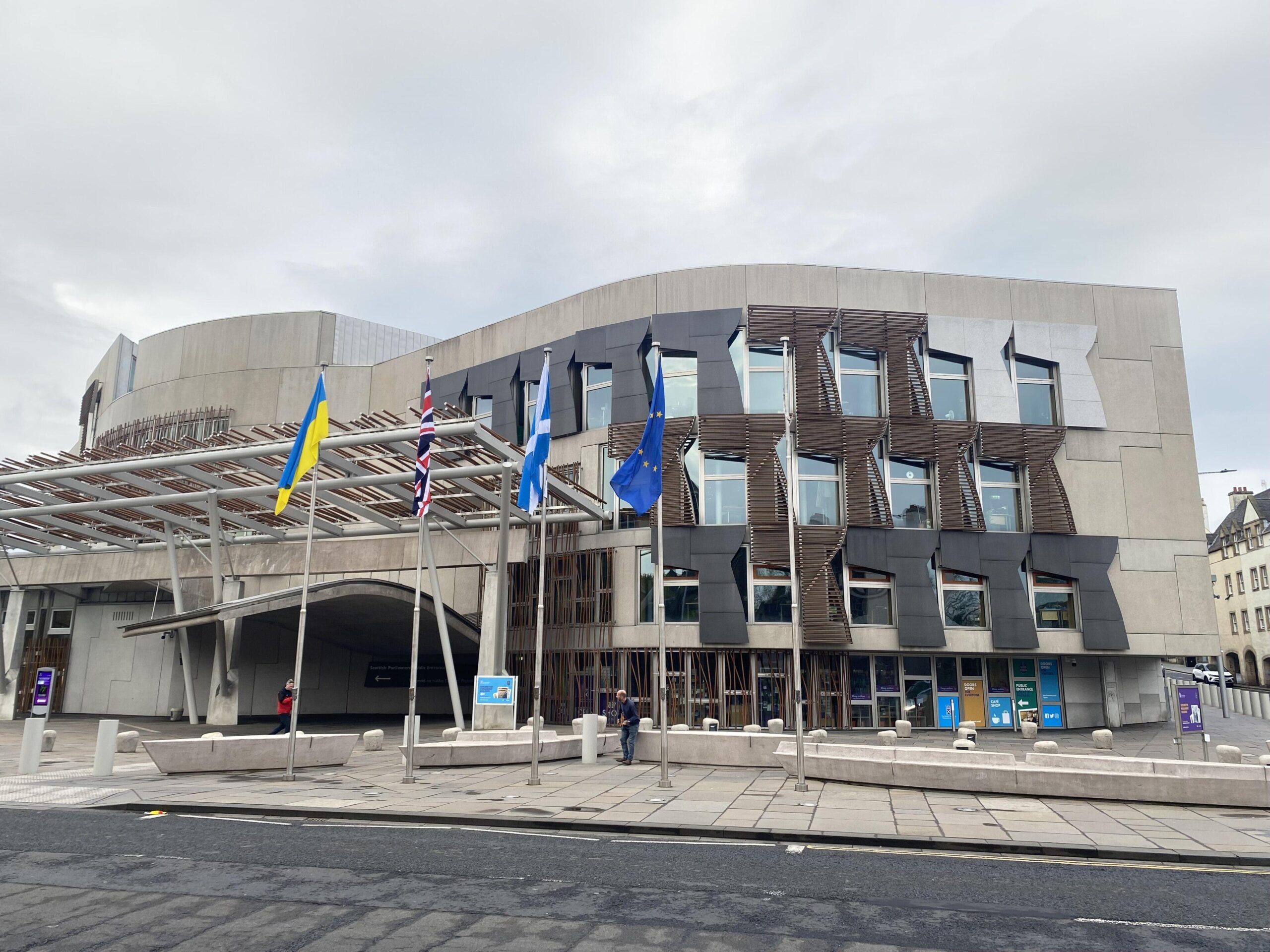
Scottish Parliament Building, Photograph by 瑞丽江的河水. Wikimedia Commons, 19 April 2025. CC BY-SA 4.0.
https://commons.wikimedia.org/wiki/File:Scottish_Parliament_Building_-_2025-04-19.jpg