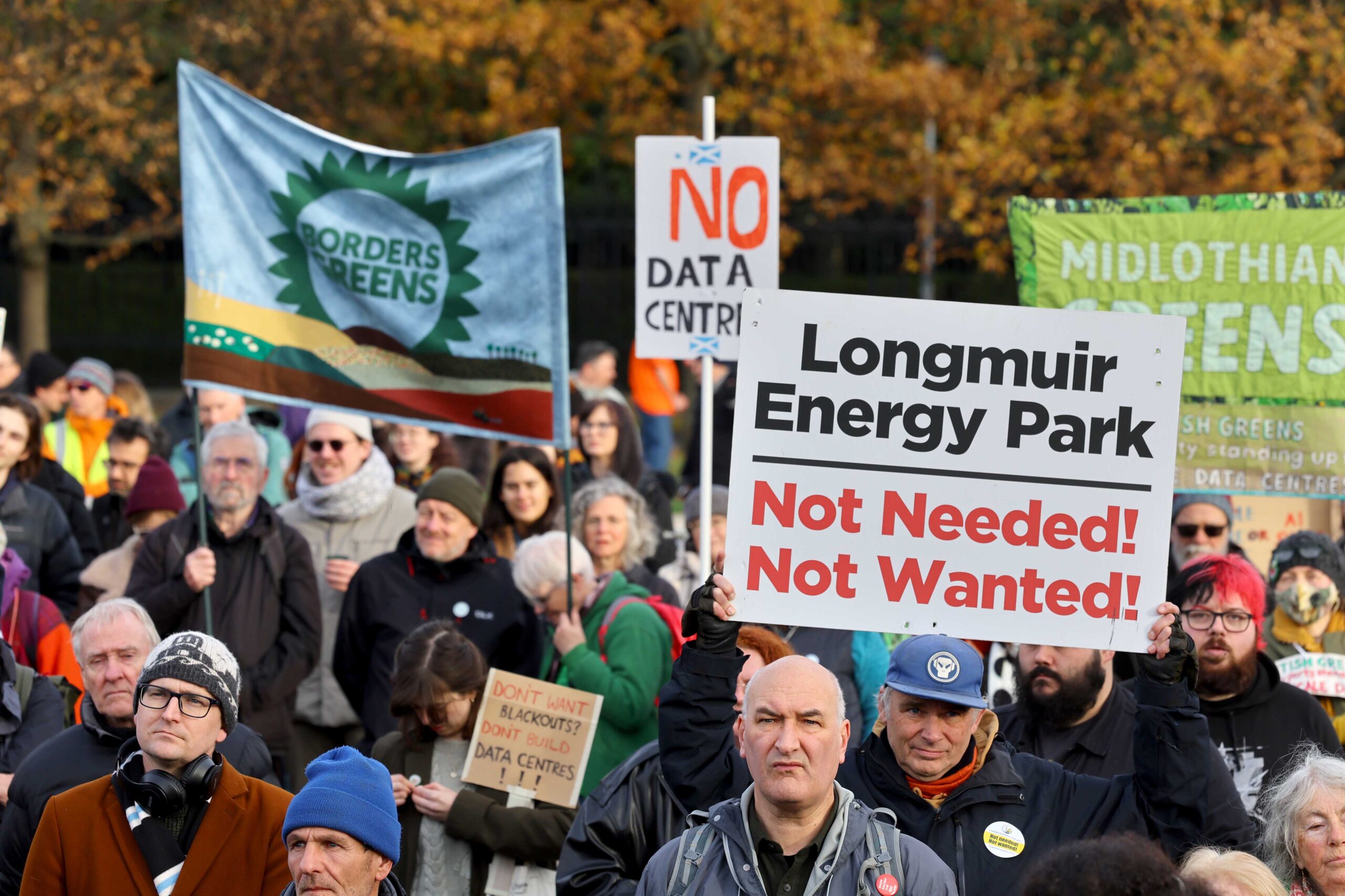
An estimated 6,000 people marched through Edinburgh on Saturday, 14 November, demanding that the Scottish Government halt decisions on large AI data centres until communities have been consulted about their impact on electricity supplies, the environment and public infrastructure.
The demonstration brought together more than 80 organisations, including local campaign groups, environmental charities, trade unions and community organisations. Protesters travelled from across Scotland, gathering at the top of the Royal Mile before marching to the Scottish Parliament.
The attendance figure was provided by organisers Friends of the Earth Scotland and has not been independently verified.
Campaigners march through Edinburgh on 14 November 2026 in opposition to proposed large-scale AI data centres, calling for a national public consultation and stronger environmental safeguards. Photograph: Colin Hattersley / Friends of the Earth Scotland.










































The protest comes as Scottish Government documents published earlier this month reveal that ministers had not established a formal definition of a green data centre when they began developing additional planning safeguards.
The disclosure is particularly significant because green data centres already receive recognition within Scotland’s National Planning Framework, and the government is actively encouraging investment in large-scale artificial intelligence infrastructure.
Although ministers have introduced new environmental assessment requirements, the wider national planning guidance promised before Christmas has yet to be published.
Government Records Reveal a Gap in Planning Guidance
A Freedom of Information response published on 3 November confirms that, as of July, the Scottish Government’s National Planning Hub had not issued formal guidance to planning authorities specifically addressing hyperscale data centre applications.
The response also confirmed that the government held no internal document defining a green data centre under National Planning Framework 4, including minimum environmental standards or measurable thresholds.
A separate response, published on 2 November, confirmed that the government had not produced even a draft document identifying the characteristics that should qualify a data centre as green.
Both responses describe the position in July, when the requests were answered. Since then, ministers have introduced new rules requiring environmental assessments for the largest projects.
However, a Scottish Parliament research briefing prepared in October continued to identify the absence of a firm national definition of a green data centre.
The distinction matters because National Planning Framework 4 gives green data centres recognition under National Development 12, which concerns Scotland’s digital infrastructure.
National development status establishes the need for qualifying development in principle. It does not grant planning permission or exempt a developer from environmental assessment.
Nevertheless, it changes the planning context by recognising certain developments as nationally important before the government has formally established what their green credentials must demonstrate.
The new planning guidance is expected to address that gap. Parliament’s own research service has cautioned that guidance can clarify how existing policies should be applied but cannot, by itself, rewrite statutory planning requirements.
More Than 20 Developments Proposed Across Scotland
Action to Protect Rural Scotland has identified at least 23 proposed hyperscale data centres across the country, with projects at different stages of development and planning.
The sites include proposals affecting Edinburgh, East Lothian, Fife, Falkirk, North Lanarkshire, Inverclyde and Dumfries and Galloway.
Among the largest is a proposed development near the former Chapelcross nuclear power station at Annan, with an electrical capacity of up to 1,000 megawatts.
A 200-megawatt development at Hermiston, west of Edinburgh, has attracted opposition from residents concerned about its proposed location on green-belt land.
Other communities raising objections include Larbert, Cockenzie, Dunbar, Auchtertool and Chapelhall.
These proposals are not all approved schemes or developments under construction. Some remain preliminary, while others have entered the formal planning system.
The Scottish Government’s Planning Directorate has published details of five live applications notified to ministers under its new rules for projects exceeding 50 megawatts.
They concern land at Larbert, Auchtertool, Greenock, Chapelhall and Chapelcross.
A separate planning appeal involving Redheughs Avenue in Edinburgh has been recalled for determination by Scottish ministers.
The distinction between the campaign groups’ wider list of proposals and the government’s register of notified applications is important. They measure different stages of development and should not be treated as interchangeable.
Could Data Centres Triple Scotland’s Electricity Demand?
Electricity consumption is one of the central questions raised by the proposed expansion.
Friends of the Earth Scotland calculates that 23 proposed developments could require approximately 9.1 gigawatts of electrical capacity.
Its calculation compares that figure with existing Scottish peak demand of approximately 5 gigawatts, suggesting that total peak requirements could approach three times current levels if the proposed capacity were fully developed and used.
However, that is a theoretical comparison, not a forecast of actual electricity consumption.
A data centre’s proposed power capacity represents the maximum electrical supply it seeks to make available. Its actual use depends on how much equipment is installed, how intensively it operates and whether the project proceeds at all.
The National Energy System Operator has identified a substantial pipeline of data centre connection requests, but parliamentary evidence indicates that many proposed developments are speculative or unlikely to be completed on their original timetable.
During evidence to Holyrood’s Economy, Tourism and Energy Committee on 15 September, electrical engineer Dr Callum MacIver of the University of Strathclyde warned that the connection queue was exceptionally large and that not every proposed development would proceed.
He also explained that the consequences depend heavily on where a data centre connects to the electricity system.
Scotland already generates substantial renewable electricity, some of which cannot always be transported to customers because of transmission constraints.
New electricity demand in suitable locations could absorb some of that otherwise curtailed renewable power.
Matt Magill, representing the National Energy System Operator, told the committee that its modelling had identified potential network savings of up to £5 billion if 5 gigawatts of data centre demand were located appropriately in Scotland.
That was a conditional system-wide estimate, not a guaranteed saving on household bills or a benefit attributable to every proposed site.
Data centres generally need electricity throughout the day and night. During periods of low wind generation, additional demand can require other sources of supply.
The central questions are therefore how much electricity the developments would actually consume, where it would come from, what additional infrastructure would be required and who would bear those costs.
Claims that all proposed data centres would automatically increase household bills have not been established for every project. Equally, claims that renewable electricity would make all their operations environmentally harmless require more evidence.
Water, Noise and Environmental Effects
The government’s new rules acknowledge that large data centres can affect land use, biodiversity, water resources, noise levels and air quality.
Some facilities require substantial cooling infrastructure. Their water consumption depends on the technology used, whether cooling water is recirculated and local conditions.
Closed-loop cooling systems can considerably reduce water consumption, although that does not eliminate other environmental considerations.
Large developments can also require considerable construction materials, substantial electrical infrastructure and backup generators.
The Scottish Government’s Chief Planner has warned that fossil-fuel-powered data centres could introduce emissions not accounted for in Scotland’s Climate Change Plan.
Since 17 September, new data centre applications exceeding 50 megawatts have been required to undergo an Environmental Impact Assessment.
Projects below that threshold remain subject to existing environmental assessment rules, with their circumstances considered individually.
An assessment requires developers to examine likely significant environmental effects and propose mitigation. It does not automatically prevent permission being granted.
Environmental groups argue that assessments of individual developments are insufficient where several large projects could collectively create substantial demands on Scotland’s electricity grid, water resources and available land.
That cumulative impact is one of the matters the Scottish Government says its developing guidance will examine.
Local Campaigns Become a National Movement
Saturday’s demonstration brought local disputes together into a wider campaign over the future use of Scottish resources.
Friends of the Earth Scotland senior campaigner Kim Pratt said the march reflected growing concern about decisions being made before the public had been adequately consulted.
Kat Jones, director of Action to Protect Rural Scotland, said the Scottish Government must include communities and civil society in decisions about the future of hyperscale data centres.
“Now let us have our say!” she told ministers.
Sarah Finlay, from West Edinburgh Against AI Data Centres, described the campaign as having expanded from local opposition at Hermiston into a nationwide movement.
Sam Gibson, who campaigns against the Chapelcross proposal, called for ministers to intervene in the planning process and reconsider the national approach before further decisions are made.
Campaigners are demanding a national public consultation rather than relying solely on separate planning exercises for individual developments.
They argue that electricity demand, land use and the broader environmental consequences cannot be adequately assessed when projects are considered independently.
The demonstration formed part of a wider European series of protests against large-scale data centre developments, coinciding with international climate negotiations in Turkey.
The Scottish Government’s Case for Investment
The Scottish Government argues that Scotland has an opportunity to benefit economically from the expansion of artificial intelligence and digital infrastructure.
Its Artificial Intelligence Strategy 2026–2031 identifies the country’s renewable energy resources, research institutions and digital industries as important advantages.
The government points to the North Lanarkshire AI Growth Zone, supported by DataVita and CoreWeave, as an example of the potential.
The strategy describes more than £8 billion of proposed private investment associated with the development and projects the creation of more than 3,400 jobs, including 800 specialist AI and digital infrastructure roles.
These are projected economic benefits, not a verified count of employment already created.
Public Finance Minister Hannah Mary Goodlad has said decisions must balance investment and employment opportunities with Scotland’s energy, environmental and community interests.
The government maintains that the environmental assessment rules will help ensure potential harms are identified before permission is granted.
There is also a wider economic argument. Data centres provide computing capacity for scientific research, healthcare, business services and increasingly complex AI systems.
Scotland already has substantial expertise in those fields, and access to computing infrastructure may support future research and commercial development.
The question is not simply whether Scotland should have data centres. It is whether the scale and location of proposed developments, the conditions placed on them and their long-term economic benefits justify the resources required.
The Scottish Government has acknowledged that these decisions involve choices about how electricity capacity is allocated between competing demands.
Parliament Has Already Called for Stronger Controls
The issue reached the Scottish Parliament in September.
Following a debate on 16 September, Parliament agreed an amended motion calling for national guidance, robust environmental assessments, community benefits and consideration of the wider social and economic impacts of hyperscale data centres.
The motion also called for no planning or consenting decisions on relevant applications until the new guidance had been completed.
A parliamentary motion is not, by itself, a legally binding moratorium. Formal restrictions on planning decisions would require an appropriate legal basis.
Ministers have instead introduced mandatory environmental assessments and notification requirements for projects exceeding 50 megawatts, while continuing to develop national guidance.
The distinction has become central to the dispute.
Campaigners want decisions paused while national policy is established. The government is seeking to strengthen oversight without closing the door to investment.
Planning authorities must continue to apply existing legislation and policy to applications before them.
The Scottish Parliament’s Climate Action Committee is also examining the environmental consequences of hyperscale data centres, including their energy demand, water consumption, emissions and effects on biodiversity.
Its investigation provides an additional opportunity to test developers’ claims against independent technical evidence.
The Decisions Scotland Still Has to Make
Saturday’s march has demonstrated the strength of opposition among communities facing large-scale data centre proposals.
It has also exposed questions that cannot be resolved simply by counting protesters or adding together the proposed electricity capacity of every development.
The Scottish Government must determine what qualifies as a green data centre, how cumulative electricity demand should be assessed, what environmental standards developers must meet and how local communities will participate in decisions.
It must also establish whether the promised economic benefits will be sufficiently measurable and enduring to justify the scale of investment and infrastructure involved.
A further question concerns the relationship between national policy and local planning.
Individual councils must assess applications affecting their areas, yet the electricity, climate and economic implications of several large developments may extend far beyond any one council boundary.
The government has promised national planning guidance before Christmas and a broader strategic approach to responsible green data centre investment during 2026–27.
Until those documents are published, developers, local authorities and communities are working within a policy framework that recognises green data centres as nationally important but has not yet settled the standards by which that description will be judged.
That is the central issue now facing ministers: whether Scotland can establish clear rules for one of its fastest-growing proposed industries before decisions are made that will shape its land, electricity system and communities for decades.
Sources
Thousands March to Stop AI Data Centres. Friends of the Earth Scotland, 14 November 2026. https://foe.scot/press-release/thousands-march-to-stop-ai-data-centres/
Over 75 Organisations Back Stop AI Data Centres March in Edinburgh. Friends of the Earth Scotland, 7 November 2026. https://foe.scot/press-release/over-75-organisations-back-stop-ai-data-centres-march-in-edinburgh/
Green Data Centre Guidance: Freedom of Information Release FOI/202600522764. Scottish Government, 2 November 2026. https://www.gov.scot/publications/foi-202600522764/
Data Centre Guidance: Environmental Information Release EIR/202600522802. Scottish Government, 3 November 2026. https://www.gov.scot/publications/foi-202600522802/
Planning Directorate’s Rolling Blog, Updated 13 November 2026. Scottish Government. https://blogs.gov.scot/planning-architecture/2026/11/09/planning-directorate-rolling-blog-update/
Data Centres: Chief Planner Letter and Environmental Impact Assessment Direction. Scottish Government, 16 September 2026. https://www.gov.scot/publications/chief-planner-letter-eia-direction-on-data-centres/
Direction for New Data Centres. Scottish Government, 16 September 2026. https://www.gov.scot/news/direction-for-new-data-centres/
Hyperscale Data Centres: Parliamentary Motion S7M-01177. Scottish Parliament, 16 September 2026. https://www.parliament.scot/chamber-and-committees/votes-and-motions/S7M-01177
Data Centres (Energy Use): Evidence to the Economy, Tourism and Energy Committee. Scottish Parliament, 15 September 2026. https://www.parliament.scot/chamber-and-committees/official-report/search-what-was-said-in-parliament/ETE-15-09-2026?iob=225782&meeting=20231
Environmental Impacts of Hyperscale Data Centres: Committee Evidence and Submissions. Scottish Parliament Climate Action Committee, October–November 2026. https://www.parliament.scot/~/media/committ/13593/Environmental-Impacts-of-Hyperscale-Data-Centres-Clerk-note
Scotland’s Artificial Intelligence Strategy 2026–2031. Scottish Government, 20 March 2026. https://www.gov.scot/publications/scotlands-ai-strategy-2026-2031/
Data Centre Map and Planning References. Action to Protect Rural Scotland, 2026. https://aprs.scot/data-centre-map/
Quantifying the Impact of Artificial Intelligence on the Scottish Economy. Scottish Enterprise, 2026. https://www.scottish-enterprise.com/insights-and-events/research-evaluation-and-insight/2026/quantifying-the-impact-of-artificial-intelligence-on-the-scottish-economy