
Falkirk, Stirling and Clackmannanshire councils have taken a joint Forth Valley tourism offer to international travel buyers, with more than 50 meetings held at VisitScotland Connect in Glasgow. The partnership is trying to turn a region often passed through between Edinburgh, Glasgow and the Highlands into a stronger destination for organised international travel.
Falkirk, Stirling and Clackmannanshire councils are working together to promote Forth Valley to international travel companies, using a shared regional identity and a new trade website to make the area easier to package, sell and visit.
The councils attended VisitScotland Connect 2026 at the Scottish Event Campus in Glasgow under the banner of Scotland’s Forth Valley. More than 50 meetings were held with buyers from markets including the United States, Canada, Germany, France and China, with the councils reporting interest in authentic, less crowded destinations and distinctive visitor experiences.
The work is aimed at the travel trade rather than ordinary leisure browsing. Tour operators, travel agents, destination management companies and other intermediaries shape many international itineraries before visitors arrive in Scotland. For smaller destinations, getting into those itineraries can decide whether visitors stop, spend and stay, or simply pass through on the way to larger names.
VisitScotland describes Connect as its flagship travel-trade event, designed to put Scottish tourism businesses in front of buyers from across the world. The Forth Valley partnership has attended the event as a region for the past three years and has now joined UKinbound, the trade association for inbound tourism businesses across the UK.
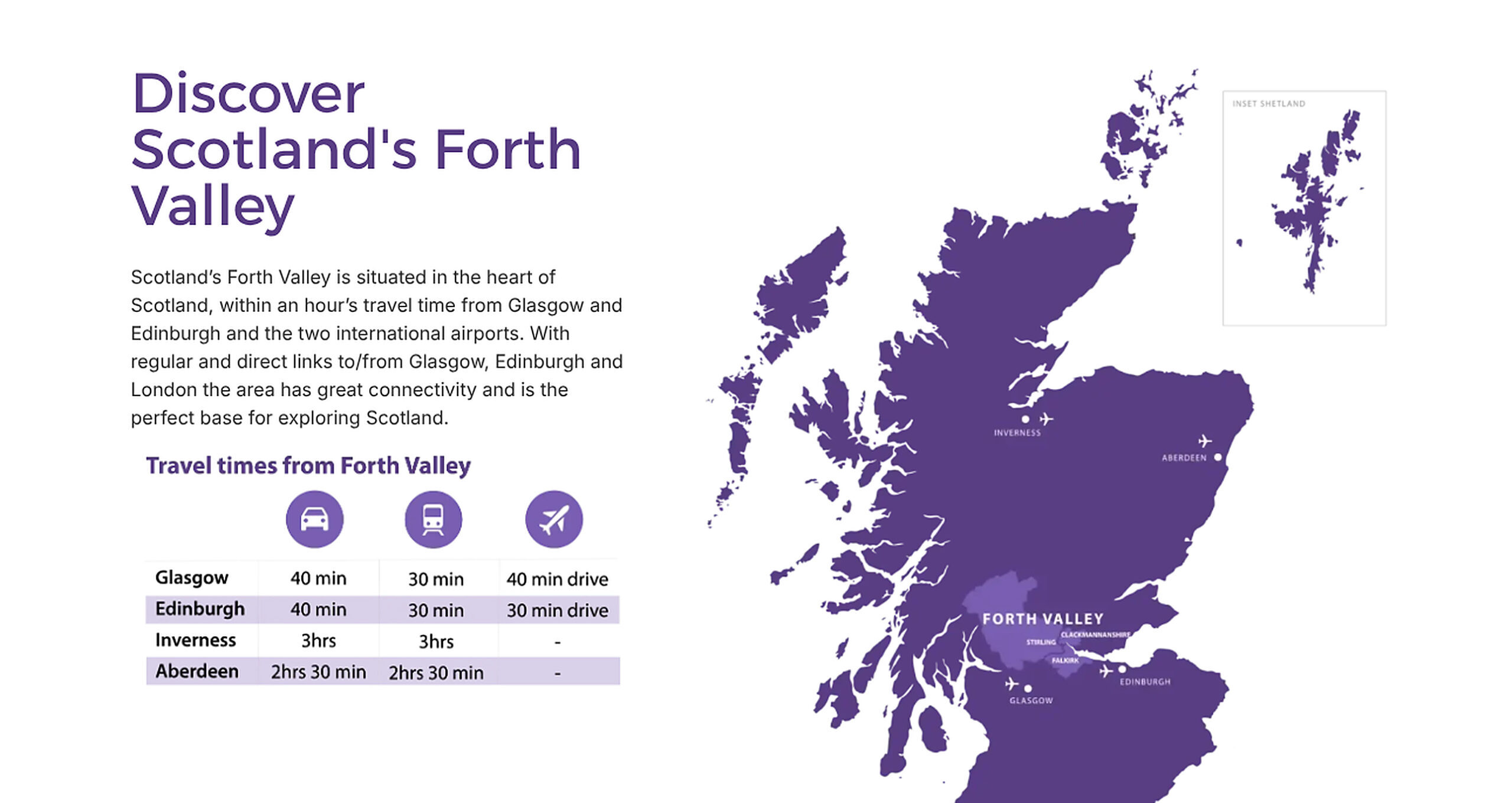
A new dedicated website has also been created for travel buyers. The Scotland’s Forth Valley site brings together information on transport links, marketing material, itineraries, accommodation and more than 60 local businesses offering experiences suitable for the travel trade. The point is practical. A region with good attractions can still be hard to sell if buyers cannot see routes, timing, group options, trade contacts and bookable products in one place.
Forth Valley has a strong hand to play. Stirling Castle, the National Wallace Monument, the Kelpies, the Falkirk Wheel, the Japanese Garden at Cowden and the reopened Rosebank Distillery give the region a mix of history, engineering, landscape, gardens and whisky. The travel-trade offer includes experiences such as engineering tours at the Falkirk Wheel, abseiling at the Kelpies, after-dark tours at the National Wallace Monument and VIP group experiences at Rosebank Distillery.
The history behind the offer is older and richer than the modern tourism language suggests. The Antonine Wall runs across central Scotland and was once the Roman Empire’s most northerly frontier. It is now part of a UNESCO World Heritage Site. The Forth and Clyde Canal and Union Canal gave the area a later industrial geography, now reworked through attractions such as the Falkirk Wheel and the Kelpies. Stirling brings the older national story, with its castle, battlefield associations and position at a historic crossing point between Lowland and Highland Scotland.
That combination matters because international tourism is no longer only about famous landmarks. Buyers increasingly look for experiences that can be arranged, trusted and fitted into routes. A visitor may know Edinburgh and the Highlands before arrival. Forth Valley’s opportunity lies in being close enough to Scotland’s central cities for easy access, while offering reasons to slow down rather than move through.
VisitScotland’s regional research shows the area already has an international audience. In the 2023 Scotland Visitor Survey, 53 per cent of overnight leisure visitors to Stirling were international visitors, while the wider Falkirk and Forth Valley area, excluding Stirling City, was more heavily domestic, with 26 per cent international visitors. That difference helps explain the partnership approach. Stirling has an established global name, while Falkirk and Clackmannanshire may benefit from being sold as part of a wider regional route.
The wider national picture gives the work a commercial edge. VisitScotland says international visitors made 4.4 million trips to Scotland in 2024, staying 30.7 million nights and spending £4 billion. International spend was higher than in 2023 and above 2019 levels. For councils facing pressure on town centres, public budgets and local employment, attracting a share of that spend is more than a marketing exercise.
There are risks in any regional branding exercise. Forth Valley is not one administrative place. It covers different councils, identities, transport links and visitor patterns. A shared label can help buyers understand the offer, but it has to be backed by products that can be booked, staff who can handle groups, transport that works, and businesses ready for international expectations around timing, payment, language, accessibility and service.
The councils appear to understand that point. Their new trade site presents the area as a package for buyers, with itineraries and trade-ready businesses rather than general promotional language alone. A planned travel trade visit in September 2026 will give UKinbound members a chance to experience the region directly.