
Shetland councillors will decide in June which long-term transport options should be taken forward for eight island communities, after new work placed tunnels and ferry upgrades side by side for the first time in detailed cost summaries. The figures show why the debate has changed. Shetland’s ageing ferry network is becoming more expensive to maintain, while fixed links are now being presented by consultants as technically buildable and potentially investable.
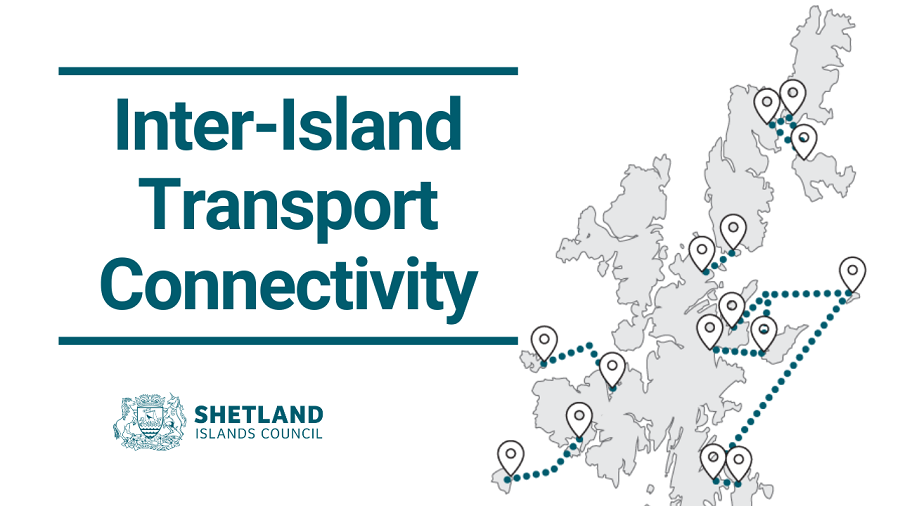
Shetland’s inter-island tunnel debate has moved into a more serious phase. After years of aspiration, public meetings, ferry breakdowns, business cases and comparison with the Faroe Islands, councillors are due to choose preferred options for each of the main island routes at the end of June.
The choice will not be between tunnels and doing nothing. The documents now before islanders compare several futures: continued ferry replacement, larger ferry upgrades, more ambitious ferry services, and fixed links for Bressay, Unst, Whalsay and Yell.
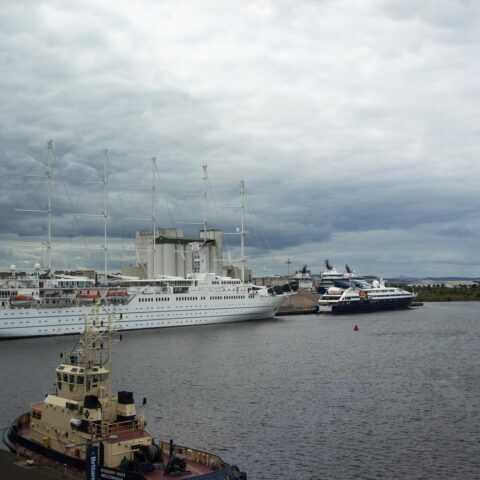
The pressure behind the work is plain. Shetland’s inter-island ferries are lifeline services, not amenities. They carry people to work, school, health appointments, supplies, visitors, livestock, fish, freight and family life. The council says the network’s operating costs have risen to £25 million for 2024 to 2025. The fleet is ageing, with the latest council statement putting the average vessel age at 32.5 years. Earlier evidence to Westminster described a ferry model developed in the 1970s and 1980s that no longer meets modern demands for reliability, capacity, accessibility and carbon reduction.
The scale of the present system explains why the decision matters beyond transport. In 2023, the council said the inter-island ferry service involved 12 vessels, around 70,000 sailings a year to nine islands and roughly 750,000 passengers. Fair Isle now has a separate replacement ferry project under construction, leaving the current programme focused on the remaining eight island communities.
The Inter-Island Transport Connectivity Programme began its present phase in 2024, with Stantec appointed to lead the work alongside Mott MacDonald, COWI and ProVersa. Its purpose is to produce a long-term network strategy and an implementation route map rather than a single isolated project. The Strategic Outline Case was approved in June 2025. The Outline Business Case now moves the work toward preferred options.
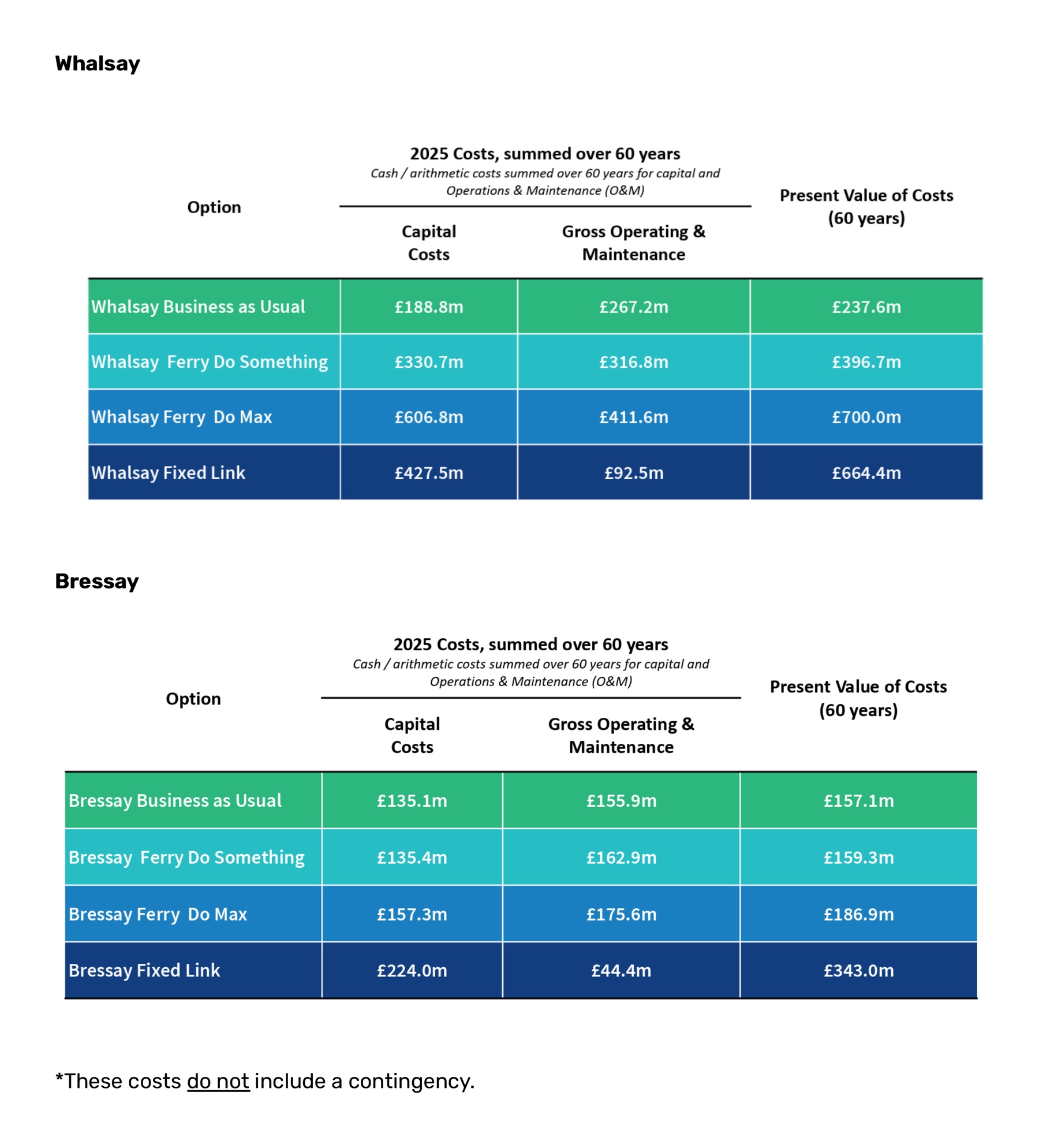
The most striking new material is the cost comparison. The figures are presented over 60 years and include capital costs and gross operating and maintenance costs. The council’s cost summary states that the figures do not include contingency, which means any final project budgets would be expected to carry additional allowance for risk, inflation, ground conditions, procurement and delivery.
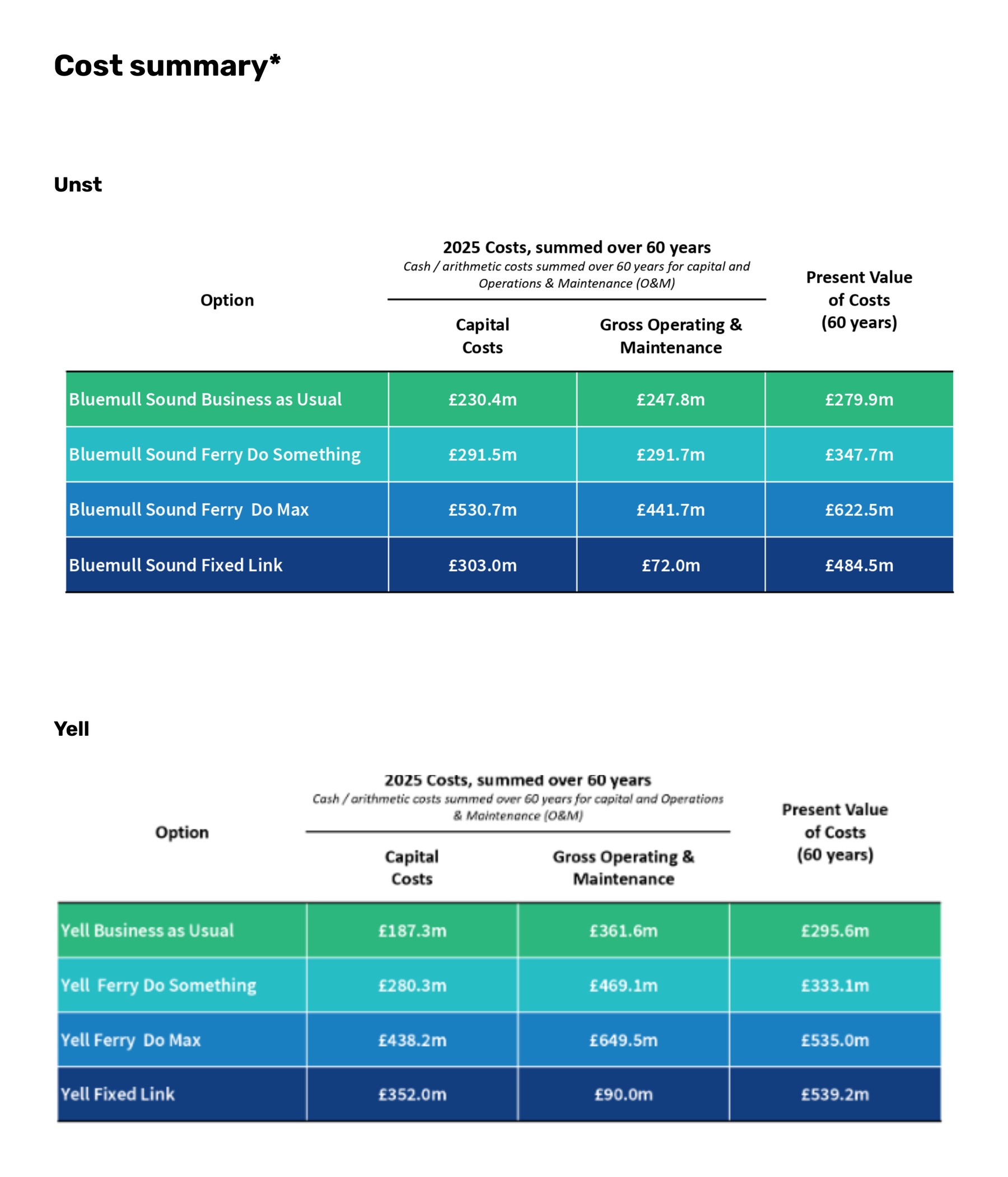
For the Unst route, presented through Bluemull Sound, the fixed link option is costed at £303 million in capital terms, with £72 million in operating and maintenance costs over 60 years. Its present value cost is listed at £484.5 million. That compares with £279.9 million for business as usual, £347.7 million for ferry improvements and £622.5 million for a maximum ferry upgrade.
For Yell, the fixed link option is costed at £352 million in capital terms and £90 million in operating and maintenance costs over 60 years, with a present value cost of £539.2 million. The ferry maximum option is very close on the same measure, at £535 million. Business as usual is listed at £295.6 million, while the intermediate ferry option is £333.1 million.
Whalsay is the most expensive fixed link option in the summary. Its tunnel is costed at £427.5 million in capital terms, with £92.5 million in operating and maintenance costs, giving a 60-year present value cost of £664.4 million. The maximum ferry option is higher, at £700 million, while business as usual is £237.6 million and the intermediate ferry option is £396.7 million.
Bressay fixed link is costed at £224 million in capital terms and £44.4 million in operating and maintenance costs, with a present value cost of £343 million. That is much higher than the business-as-usual ferry option at £157.1 million and the maximum ferry option at £186.9 million.
Those figures do not produce one simple answer. They show a more awkward reality. In some cases, fixed links begin to look competitive when compared with the most ambitious ferry upgrade over a 60-year period. In other cases, especially Bressay, the ferry options remain markedly cheaper on the cost summary alone. The case for tunnels therefore rests on more than price. It depends on the value placed on reliability, 24-hour access, population retention, labour markets, health access, business confidence, emissions over time and the future shape of island life.
The May 2026 drop-in boards make that clearer. For Yell, the fixed link is described as offering 24-hour access between Yell and mainland Shetland, removing capacity constraints and producing wider benefits for the North Isles. The boards say benefits could include £30 million to £60 million in additional annual output by lifting production constraints, much of it driven by aquaculture, while also supporting the growth of SaxaVord Spaceport.
For Unst, the boards describe resilience as the critical issue on Bluemull Sound. Ferry improvements would address ageing vessels and harbours, while a fixed link would remove reliance on sea-based travel for Unst. The documents also note that MV Bigga and MV Geira have passenger accommodation below the waterline, accessible only by steep steps, meaning vessel replacement would bring accessibility gains even without a tunnel.
For Whalsay, the documents describe peak vehicle deck capacity as a major challenge. Ferry upgrades would increase capacity, especially under a three-vessel model, while a fixed link would remove those constraints and provide 24-hour access. The same boards record that ferry improvements would require major harbour works, including possible new or expanded harbour infrastructure.
Bressay carries its own complications. The documents say a fixed link would remove reliance on sea-based travel, but they also note that Bressay has a comparatively large number of foot passengers and strong commuter flows into Lerwick. Since pedestrians and cyclists could not use a road tunnel, the public transport offer through any fixed link would be central. A tunnel that improved car access but made life harder for foot passengers would create a different problem from the one it solved.
The engineering work has given tunnel supporters new confidence. A Fixed Link Model study was commissioned from Stantec and COWI using Yell Sound as a test case. The council says the study involved input from three globally experienced contractors, consulted the financial community and concluded that a tunnel is buildable and investable. COWI’s Andy Sloan has described the engineering as relatively straightforward, with the larger challenge lying in whether Scotland and the UK take a short-term or long-term view.
That language should be read carefully. “Buildable” does not mean funded. “Investable” does not mean approved. A tunnel may be technically possible and commercially interesting while still requiring difficult decisions over public funding, tolls, procurement, risk transfer, long-term maintenance, environmental consent and who carries cost overruns.
Funding sits at the centre of the whole debate. Shetland has argued for years that inter-island transport places a disproportionate and unsustainable burden on the council. The earlier Shetland Inter-Island Transport Study helped secure ferry revenue funding from the Scottish Government and UK Government funding for the Fair Isle ferry replacement. The new tunnel and ferry programme is larger again. It will require a settlement involving Shetland, the Scottish Government, the UK Government and potentially private finance or other investment structures.
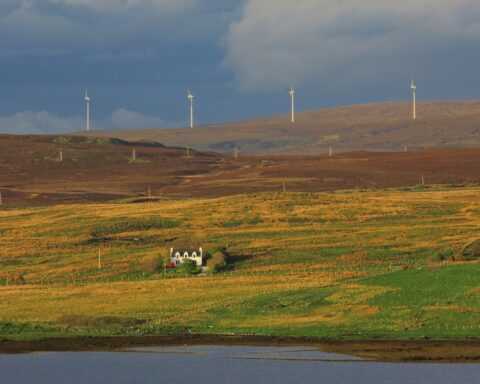
The Strategic Outline Case and Westminster evidence set the issue inside a wider island economy. The in-scope islands have lost almost a quarter of their population over four decades, compared with growth on mainland Shetland and broad stability across Shetland as a whole. The same evidence records older island populations, a higher dependency ratio than mainland Shetland, housing problems caused by high build costs and lower house values, and the need for reliable links to support fisheries, aquaculture, space, energy and tourism.
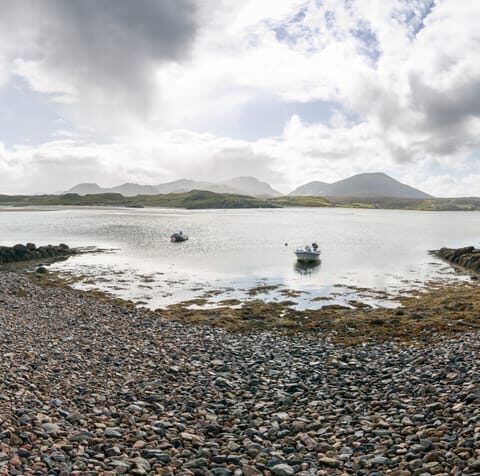
There is also a cultural question that cannot be settled by a spreadsheet. Some islanders want fixed links because ferry dependency restricts working life, family life and economic growth. Others may fear that a fixed link changes the distinctiveness of an island, alters traffic patterns, increases pressure on housing or shifts a community into a suburb of somewhere else. The council’s own evidence says views will be sought on the impact of fixed links on island distinctiveness.
Environmental appraisal complicates the picture further. The drop-in documents consistently point to major embodied carbon and physical environmental impacts from fixed links, particularly around tunnel construction and spoil disposal. Ferry options may carry lower construction emissions but longer-term vessel emissions, depending on how quickly the fleet can be decarbonised. Fixed links would also reduce vulnerability to weather disruption and rising sea levels affecting ferry services. The comparison depends heavily on timescale, technology and assumptions.
The Faroe Islands are the recurring model. Shetland’s evidence to Westminster says Faroese investment in fixed links over decades has helped connect remote communities and points to evidence that tunnelled islands have seen stronger population, age and income outcomes than ferry-served islands. That comparison is attractive, but Shetland will still need its own settlement. Geography, population, public finance, road design, tolling and local economic structure differ. The Faroes show what can be possible; they do not pay Shetland’s invoices.
The June decision will not start construction. It will decide which options enter the next stage as the preferred route choices for the network strategy. Any tunnel would still need its own project-level business case, consents, procurement plan, funding package, environmental work, route design and political agreement.
Even so, the significance of the moment is hard to miss. Shetland is no longer talking about tunnels as a distant hope. The council has placed fixed links into the same appraisal machinery as ferries. It has published route costs. It has heard from contractors and financiers. It has taken the argument to island halls and to Westminster. The numbers are large, the risks are real, and the existing ferry system is not standing still.
For islanders, the choice ahead is not simply ferry or tunnel. It is the shape of daily life over the next 60 years: how people reach work, whether young families can stay, how older residents reach care, how businesses move goods, how children access opportunities, and whether the outer islands continue to feel connected to the rest of Shetland without losing what makes them distinct.
Shetland has reached the point where old ferries, rising costs and long-term depopulation can no longer be treated as separate problems. The tunnel question now sits at the centre of a wider decision about whether island transport is a running cost to be managed, or national infrastructure to be rebuilt.