
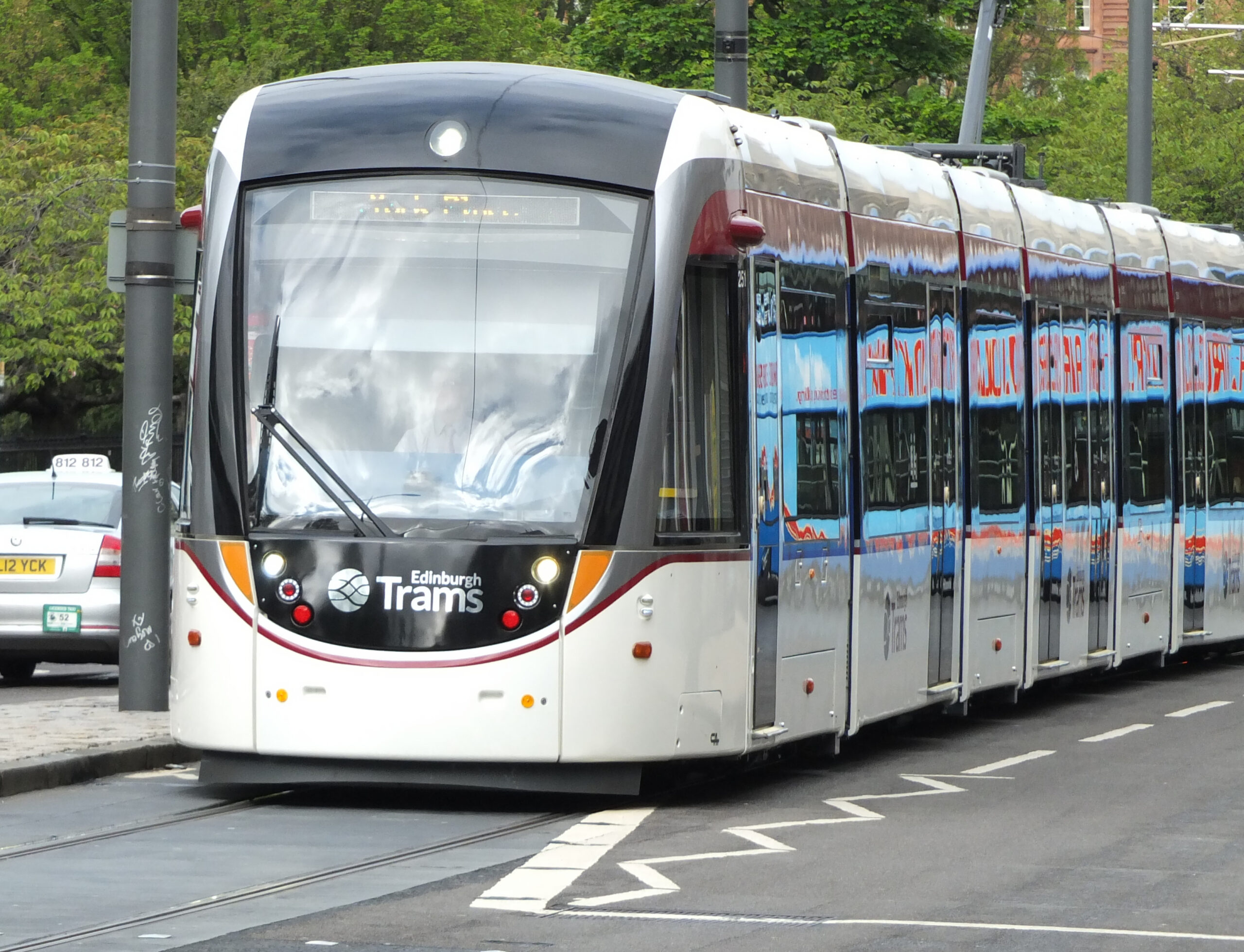
Edinburgh councillors are being asked on 10 September to decide whether the city should advance the next stage of its tram expansion. The full north–south scheme from Granton to the Royal Infirmary and BioQuarter is currently estimated at between £2 billion and £2.9 billion, depending on the route chosen through north Edinburgh. Yet the council’s own work has exposed substantial difficulties on both northern options. The result is that the southern section towards the Royal Infirmary may advance first while the Granton section is paused.
Edinburgh’s next tram decision is not simply about whether the city wants more tram lines. It is about whether a transport project conceived as a single north–south corridor can still be delivered as one project after engineering, environmental and public-acceptability problems emerged along the northern half.
The proposed route would run from Granton through the city centre and then south towards the Royal Infirmary of Edinburgh and the BioQuarter. Beyond the hospital, longer-term options include connections towards Shawfair and other parts of the city region. The scheme has been under development for several years, and a public consultation ran from August to November 2025. On 10 September 2026, the Transport and Environment Committee is due to consider the Strategic Business Case and decide whether work should move to the Outline Business Case stage.
The current cost range is substantial. City of Edinburgh Council says the full north–south scheme is presently estimated at between £2 billion and £2.9 billion, depending principally on the choice of route between Granton and the city centre. Construction would not begin before 2028 at the earliest, and the council has not yet secured the funding required to build it.
The northern route has become the difficult part
Between Granton and the city centre, the council has examined two principal alignments. One would use the former railway corridor along the Roseburn Path before joining the existing tram line near Haymarket. The other would remain largely on-street, travelling through Orchard Brae and across Dean Bridge towards the west end of Princes Street.
The Roseburn route was initially identified as the preferred option in 2024. It was also the cheaper of the two northern options during the consultation stage, with an earlier estimate of approximately £350 million to £480 million for the Granton–city centre section, compared with £650 million to £850 million for the Orchard Brae alignment. The Roseburn option was also forecast to carry slightly more passengers.
Its difficulty lies in the land through which it would pass. Roseburn Path is already an established walking and cycling route running through a green corridor. Council technical work identifies tree loss, landscape change, ecological effects and reduced amenity as significant issues. Designing a tram line while retaining a high-quality walking and cycling route alongside it has proved one of the central problems of the scheme.
The Orchard Brae option avoids converting the Roseburn Path but creates a different set of engineering constraints. It would require trams to cross Dean Bridge, Thomas Telford’s Category A listed structure over the Water of Leith. The council commissioned a dedicated structural assessment because the bridge was built in the 1820s, more than 170 years before modern tram loading was contemplated.
The route would also place tram infrastructure through streets with significant heritage constraints. Council technical work identifies heritage and streetscape effects as more prominent on the Orchard Brae and south-east corridors than on the Roseburn route.
The north of the scheme therefore presents a choice between two different categories of difficulty rather than a simple choice between a good route and a bad one.
The southern section is becoming a project in its own right
South of the city centre, the proposal is more settled. The intended route would run from the centre through North Bridge and South Bridge, continue through Newington, Minto Street and Craigmillar Park, pass Cameron Toll and then reach the Royal Infirmary and Edinburgh BioQuarter.
This corridor serves some of the largest concentrations of employment, education and health activity in the city. The University of Edinburgh has major sites along the route, while the Royal Infirmary and BioQuarter sit at the southern end. The council’s strategic modelling also assumes the possibility of connecting onwards to Shawfair station, creating an interchange with the Borders Railway.
The emerging approach is therefore to consider whether the southern section can be advanced while the northern alignment remains unresolved. That would materially change the shape of the original project. Instead of constructing one continuous route from Granton to the BioQuarter, Edinburgh could proceed in phases, beginning with the section for which the engineering and public-acceptability problems are presently less severe.
A phased approach would also alter the financial problem. A southern-only line would require less capital than the full £2 billion to £2.9 billion scheme, but it would still represent one of the largest local transport investments attempted anywhere in Scotland.
The city is trying not to repeat its first tram experience
Any decision to build another major tram extension in Edinburgh sits beneath the history of the original tram project. The first scheme became synonymous with delay, contractual dispute and escalating cost. A project intended to run from Edinburgh Airport to Newhaven was reduced in scope, and the initial line opened only as far as York Place in 2014.
The subsequent extension from the city centre to Newhaven was delivered under a markedly different management structure. It opened in 2023 and extended the network through Leith to the waterfront. The council has repeatedly presented that project as evidence that lessons from the earlier failure were incorporated into later procurement, governance and construction arrangements.
The next expansion is considerably larger again. The council’s own project material says construction would likely be divided into sections, potentially separating Granton–city centre, the central section and the route from the city centre to the BioQuarter. That approach is explicitly linked to lessons from the previous tram projects.
The financial exposure is also different from the first tram era. Edinburgh now operates an established tram system carrying more than one million passenger journeys a month, rather than attempting to introduce an entirely new mode of transport. At the same time, the city is proposing infrastructure through some of its most congested and historically sensitive streets.
Edinburgh’s population growth is driving the transport case
The council’s case for expansion is tied closely to projected development. Granton Waterfront is one of the largest regeneration areas in the city, while the BioQuarter and south-east Edinburgh are expected to accommodate further employment, housing and institutional growth.
Edinburgh’s transport system is already constrained by the physical structure of the city. Much of the central road network passes through streets laid out long before modern traffic volumes. Bus services carry large numbers of passengers but remain exposed to congestion. The tram case rests partly on creating higher-capacity public transport along corridors where further growth is expected.
The council has therefore modelled not only present demand but future land use, housing and employment. Its strategic model has been updated repeatedly since the original tram business case, incorporating later development assumptions and changes to traffic, fares and public-transport patterns.
The proposed Shawfair connection is one example of how the project extends beyond Edinburgh itself. A tram link from the Royal Infirmary towards Shawfair could connect with the Borders Railway and the expanding settlements of Midlothian. Edinburgh is discussing longer-term regional mass-transit connections with Midlothian, East Lothian and SEStran.
The funding has not been settled
The largest unresolved issue remains money. City of Edinburgh Council says all potential funding sources would be examined during the later business-case stages, including support from the Scottish Government and Transport Scotland. No complete funding package currently exists for the full scheme.
That position matters because the current cost estimate is already between £2 billion and £2.9 billion before detailed design. The range partly reflects uncertainty over the northern route and the engineering treatment required along it. Costs will be refined if the project advances to an Outline Business Case.
At that stage, the council would have to identify a preferred option, develop costs in greater detail, assess value for money and establish how construction could realistically be financed. Further environmental, heritage and health assessments would also be required.
The council cannot therefore decide on 10 September to build a £2.9 billion tram line. It can decide whether enough evidence exists to spend further money developing the proposal towards that point.
The decision now concerns sequence as much as route
The northern difficulties have changed the character of that decision. Roseburn offers a comparatively direct off-street corridor but would transform a heavily used green route. Orchard Brae preserves the path but introduces higher costs, historic structures and more difficult street engineering. Neither has emerged without substantial constraints.
The south-east route has not encountered the same binary route dispute. Its function is also closely tied to the Royal Infirmary, BioQuarter, university sites and future development in south-east Edinburgh.
The choice before Edinburgh is consequently moving towards sequence: whether to continue developing the full north–south scheme together, or advance the southern corridor while allowing more time to determine what should happen between Granton and the city centre.
The original ambition was a tram route crossing Edinburgh from north to south. The Strategic Business Case has now produced a more complicated outcome. The city has accumulated enough evidence to identify where the transport demand lies, but it has also accumulated enough engineering and environmental evidence to show why the northern half cannot simply be drawn across a map and built.
Sources
Trams from Granton to Edinburgh BioQuarter / Royal Infirmary — Latest Updates
City of Edinburgh Council — updated 1 September 2026
https://www.edinburgh.gov.uk/public-transport/trams-granton-bioquarter-beyond/7
Trams from Granton to Edinburgh BioQuarter / Royal Infirmary — Project Stages
City of Edinburgh Council — accessed 10 September 2026
https://www.edinburgh.gov.uk/public-transport/trams-granton-bioquarter-beyond/8
Trams from Granton to Edinburgh BioQuarter / Royal Infirmary — Construction
City of Edinburgh Council — accessed 10 September 2026
https://www.edinburgh.gov.uk/public-transport/trams-granton-bioquarter-beyond/10
Trams from Granton to Edinburgh BioQuarter and Royal Infirmary of Edinburgh and Beyond — Consultation
City of Edinburgh Council — 25 August to 17 November 2025
https://consultationhub.edinburgh.gov.uk/sfc/tram-north-south/consult_view/
Trams to Granton, BioQuarter and Beyond — Strategic Modelling Report
City of Edinburgh Council / Jacobs — 2025
https://www.edinburgh.gov.uk/downloads/file/37915/rp03-strategic-modelling-report-pdf
Trams to Granton, BioQuarter and Beyond — Dean Bridge Structures Report
City of Edinburgh Council / Jacobs — 2025
https://www.edinburgh.gov.uk/downloads/file/37895/rp04a-dean-bridge-structures-report-final
Trams to Granton, BioQuarter and Beyond — Landscape, Streetscape and Heritage Report
City of Edinburgh Council / Jacobs — 2025
https://www.edinburgh.gov.uk/downloads/file/37937/rp05a-landscape-streetscape-heritage-report-final-2
Trams from Granton to Edinburgh BioQuarter and Beyond — Technical Reports
City of Edinburgh Council — accessed 10 September 2026
https://www.edinburgh.gov.uk/downloads/download/16083/trams-from-granton-to-edinburgh-bioquarter-royal-infirmary-of-edinburgh-and-beyond