

The UK Government introduced legislation in Westminster on Wednesday, 4 November, that would permanently end the issuing of new licences for oil and gas exploration in the North Sea, while creating a new system allowing additional production around existing fields.
The Energy Independence Bill, introduced in the House of Commons, would remove the North Sea Transition Authority’s power to grant new oil and gas licences. However, it would not cancel existing licences, close producing fields or impose a general prohibition on drilling.
Instead, the legislation would establish Transitional Energy Certificates, allowing companies to develop certain oil and gas resources within or close to previously licensed areas. The government estimates these arrangements could make approximately 60 million additional barrels of oil available and support hundreds of jobs. Those figures are projections, not confirmed production commitments.
For Scotland, particularly Aberdeen and the wider North East, the legislation represents a significant change in the future regulation of an industry that continues to support offshore employment, engineering businesses, supply chains and energy infrastructure.
The Bill received its first reading on Wednesday. It has not yet become law and must complete parliamentary scrutiny before its provisions can take effect.
The legislation follows the government’s North Sea Future Plan, published in November 2025, which established the policy of ending new exploration licensing while allowing production from previously licensed resources to continue.
The distinction between a licence and permission to produce oil or gas is important. An offshore licence establishes rights over a particular area, but operators generally require separate development, environmental and production consents before extraction can begin. The new Bill would change future licensing powers without automatically removing those other regulatory requirements.
Existing Fields Would Remain Open
Under the proposed Transitional Energy Certificate system, operators could seek permission to extract additional resources within existing fields or from neighbouring areas connected to established infrastructure.
Such arrangements could extend the economic life of offshore installations by making use of pipelines, production platforms and processing facilities already in place.
The government argues that this would help sustain employment and investment while avoiding a return to unrestricted exploration licensing.
Its accompanying policy document acknowledges that North Sea production has declined substantially. UK oil and gas output in 2025 was approximately 75 per cent below its respective historical production peaks, reached in 1999 for oil and 2000 for gross gas.
Ministers argue that further exploration licensing would not reverse the underlying decline or remove Britain’s dependence on imported oil and gas.
The proposals would therefore leave a substantial part of the offshore industry operating under existing rights, potentially for decades, while limiting access to previously unlicensed exploration areas.
Jackdaw Demonstrates What the New Policy Would Still Permit
The implications became particularly clear on 21 October, when the UK Government confirmed production consent for the Jackdaw gas field in the North Sea.
Jackdaw was already licensed. Its approval followed renewed environmental scrutiny after earlier development consents were effectively overturned by the Court of Session in Edinburgh in January 2025.
The government subsequently approved production under the revised environmental assessment arrangements, which require consideration of emissions associated with burning the extracted fuel.
The decision demonstrates that ending new exploration licences does not automatically prevent development of an existing discovery.
The Rosebank field, west of Shetland, is another major licensed project whose development has been subject to environmental and regulatory scrutiny. Its position under the existing licensing system is legally distinct from an application for an entirely new exploration licence.
Scotland’s Government Has No Direct Control Over Offshore Licensing
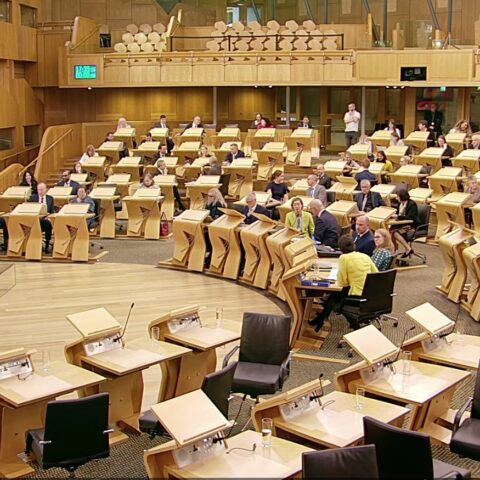
The division of responsibility between Westminster and Holyrood was raised in the Scottish Parliament on the same day the Bill was introduced.
Responding to a question from Reform MSP Duncan Massey about new drilling and Scotland’s net-zero policy, Cabinet Secretary for Climate Action and Rural Affairs Gillian Martin confirmed that offshore oil and gas licensing and consenting decisions remain reserved to the UK Government.
Martin reiterated Scotland’s commitment to achieving net-zero greenhouse gas emissions by 2045.
She also explained that direct emissions from offshore exploration and extraction are accounted for in the UK-wide greenhouse gas inventory rather than Scotland’s territorial emissions figures.
The exchange highlighted the distinction between Scotland’s devolved climate responsibilities and Westminster’s authority over offshore petroleum development.
The Scottish Government can develop climate policy and influence associated economic and environmental decisions, but it cannot independently grant or prohibit offshore oil and gas production licences.
Industry Warns Against Greater Dependence on Imports
The offshore energy industry responded to the Bill by emphasising Britain’s continuing need for domestically produced energy.
David Whitehouse, chief executive of Offshore Energies UK, said energy affordability must be considered alongside security of supply.
The industry organisation argued that Britain already imports more than 40 per cent of the energy it requires, leaving households and businesses exposed to international supply disruptions and price fluctuations.
It maintained that continued North Sea production could support employment, domestic supplies and the industrial capacity needed to develop renewable energy.
The organisation also said approximately 65 per cent of oil produced in the North Sea ultimately serves the UK market, challenging assumptions that offshore production has little domestic economic value.
Environmental campaigners approached the legislation differently.
Oil Change International welcomed the move towards a statutory prohibition on new licences but argued that permitting further production from existing projects undermined the government’s climate objectives.
Its North Sea campaigner, Rosemary Harris, called for stronger commitments to workers and affected communities and criticised the government’s decision to approve Jackdaw. The organisation also opposed approval of Rosebank.
The competing responses reflect a continuing disagreement over the appropriate pace of reducing offshore production, the role of domestic fossil fuels in energy security and the support required for communities moving into alternative industries.
Energy Bills and Household Protections Also Form Part of the Bill
Although the North Sea licensing provisions have particular importance for Scotland, the Energy Independence Bill extends substantially beyond oil and gas exploration.
The legislation includes proposals to strengthen the energy regulator Ofgem, improve consumer protections, reform electricity infrastructure arrangements and expand opportunities for community ownership of energy projects.
The government also intends to give a more permanent statutory basis to its decision to transfer 75 per cent of domestic Renewables Obligation costs from electricity bills to public spending. Ministers say the change has already reduced average annual household bills by approximately £90.
Separately, the government announced plans to bring forward amendments intended to remove standing charges from household gas bills.
According to government estimates, approximately 60 per cent of gas customers could save an average of £45 annually under the proposed changes. Those savings have not been guaranteed, and the required amendments have yet to complete the legislative process.
The government’s accompanying announcement also referred to a £100 winter energy payment for eligible households in England. That England-specific payment should not be confused with a new Scotland-wide entitlement created by the Bill.
The Bill includes a further Scotland-specific provision allowing Scottish ministers to recover the administrative costs of certain offshore renewable-energy decommissioning and safety-zone functions from applicants.
The UK Government says the technical change was requested by the Scottish Government and would correct an omission in the transfer of powers under the Scotland Act 2016.
What Happens Next?
The Energy Independence Bill must now proceed through the House of Commons and House of Lords, where its provisions may be examined and amended before any final legislation receives Royal Assent.
The precise arrangements for Transitional Energy Certificates, the regulator’s revised powers and the proposed consumer protections will depend on the legislation ultimately approved by Parliament and, where necessary, subsequent regulations.
For Scotland, the central consequence is already identifiable.
The government is proposing to close the route to new North Sea oil and gas exploration licences while retaining a legal framework for production from existing fields and certain connected resources.
That is a substantial change in the future of offshore licensing, but it is not the immediate end of North Sea drilling.
The longer-term effect on employment, domestic energy production, tax revenues and investment in the North East will depend on how the new certificate system operates, which existing projects receive consent, and whether investment in alternative energy industries develops sufficiently to support the workforce and communities affected by declining oil and gas production.
Sources
Energy Independence Bill, UK Parliament, 4 November 2026.
https://bills.parliament.uk/bills/4319
Energy Reforms to Cut Bills and Put Power Back in People’s Hands, Department for Energy Security and Net Zero, 4 November 2026.
https://www.gov.uk/government/news/energy-reforms-to-cut-bills-and-put-power-back-in-peoples-hands
Ending New Oil and Gas Licences and Introducing Transitional Energy Certificates, Department for Energy Security and Net Zero, 4 November 2026.
https://www.gov.uk/government/publications/energy-independence-bill-factsheets/ending-new-oil-and-gas-licences-and-introducing-transitional-energy-certificates
Changes to Powers of the North Sea Transition Authority, Department for Energy Security and Net Zero, 4 November 2026.
https://www.gov.uk/government/publications/energy-independence-bill-factsheets/changes-to-powers-of-the-north-sea-transition-authority
North Sea Oil and Gas, House of Commons Library, 29 September 2026.
https://commonslibrary.parliament.uk/research-briefings/cbp-12212/
Jackdaw Gas Field Gets Green Light, Department for Energy Security and Net Zero, 21 October 2026.
https://www.gov.uk/government/news/jackdaw-gas-field-gets-green-light
Meeting of the Parliament: 4 November 2026, Scottish Parliament Official Report, 4 November 2026.
https://www.parliament.scot/chamber-and-committees/official-report/search-what-was-said-in-parliament/meeting-of-parliament-04-11-2026?iob=226629&meeting=20318
OEUK Responds to Publication of the Energy Independence Bill, Offshore Energies UK, 4 November 2026.
https://oeuk.org.uk/oeuk-responds-to-publication-of-the-energy-independence-bill/
Response to Publication of the Energy Independence Bill in the UK, Oil Change International, 4 November 2026.
https://oilchange.org/news/response-to-publication-of-the-energy-independence-bill-in-the-uk/
Scottish Charging Powers, Department for Energy Security and Net Zero, 4 November 2026.
https://www.gov.uk/government/publications/energy-independence-bill-factsheets/scottish-charging-powers