The Scottish Government is urging businesses to accelerate their use of artificial intelligence, citing modelling that suggests the technology could add more than £23 billion to Scotland’s annual GDP by 2035 under favourable conditions.
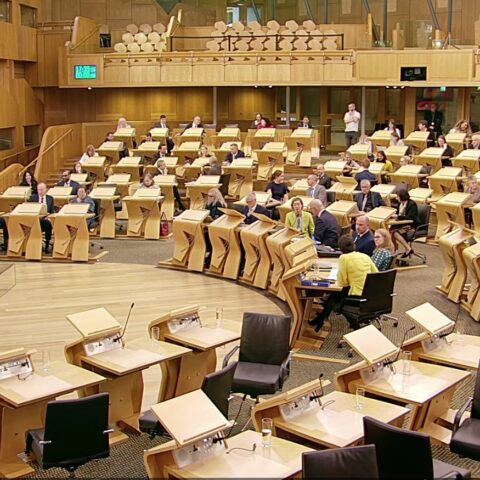
Innovation Minister Alyn Smith convened a discussion with industry representatives at CodeBase in Edinburgh on 3 November. The meeting was intended to examine obstacles to AI adoption, the availability of skills and ways that government and business could support greater use of the technology.
The £23 billion figure is an economic scenario, not income committed to Scotland or growth that has already occurred. It appears in the government’s 2026–2031 AI strategy and is attributed to analysis by GC Insight. The government’s framing makes its realisation conditional on investment, business adoption and leadership across the economy.
Other modelling illustrates why such estimates need careful explanation. Research published by Scottish Enterprise in 2026, also drawing on economic analysis by GC Insight, describes AI-adoption scenarios that would raise Scotland’s GDP by between £2.7 billion and £19.3 billion by 2035 relative to the study’s baseline. The figures are not necessarily directly comparable with the wider government ambition because assumptions and modelled activities differ, but they demonstrate that there is no single inevitable economic result.
The government strategy says 30.7% of businesses were using AI at the time of the analysis. For many smaller organisations, adopting these systems involves more than buying a subscription. Staff need to understand what a tool can do, what information it may receive, the accuracy of its output and when people must review decisions. Costs, unreliable data, cyber security, staff training and sector-specific rules can all affect whether the investment pays off.
A National AI Adoption Programme for small and medium-sized enterprises, launched in August and supported by £1.8 million, is intended to address some of those barriers. The government says the predecessor programme reached more than 1,000 businesses. That is a measure of participation, not yet proof of sustained productivity gains.
The Edinburgh roundtable included representatives of technology companies, professional services, universities and other organisations. Participants were asked what was helping or obstructing adoption, while the government emphasised university research and computing capacity as strengths Scotland could build upon.
The next test for policy is whether firms outside Scotland’s established technology sector can demonstrate gains in productivity, earnings, exports and service quality. Those outcomes, rather than an optimistic headline valuation, will determine how much AI contributes to the economy by 2035.
Sources
Businesses Urged to Seize AI Opportunity — Scottish Government, 3 November 2026. https://www.gov.scot/news/businesses-urged-to-seize-ai-opportunity/
Scotland’s AI Strategy 2026–2031: Case for Change — Scottish Government, March 2026. https://www.gov.scot/publications/scotlands-ai-strategy-2026-2031/pages/4/
Quantifying the Impact of Artificial Intelligence on the Scottish Economy — Scottish Enterprise, 2026. https://www.scottish-enterprise.com/insights-and-events/research-evaluation-and-insight/2026/quantifying-the-impact-of-artificial-intelligence-on-the-scottish-economy