
Highland Council’s planning officers have recommended a formal objection to one of the largest electricity transmission projects proposed in northern Scotland: a 173-kilometre 400kV overhead line from Spittal in Caithness to Beauly, with towers averaging about 57 metres high. Councillors began considering that recommendation at a joint meeting on 9 September. The project is already before a Scottish Government public inquiry, and the final decision rests with Scottish ministers rather than Highland Council.
On the morning of 9 September, councillors from across the Highland Council area assembled in Inverness to consider an electricity project that would run through seven council wards and across a substantial part of northern Scotland.
The proposal before the joint meeting of the council’s North and South Planning Applications Committees was the Spittal to Beauly 400kV overhead line, promoted by Scottish Hydro Electric Transmission, which operates as SSEN Transmission. Planning officers presented councillors with a clear recommendation: raise an objection.
The proposed main line would extend for approximately 173 kilometres from a new substation at Banniskirk, near Spittal in Caithness, south through another proposed substation at Carnaig near Loch Buidhe, and onwards to a new substation at Fanellan near Beauly. It would be carried predominantly on steel lattice towers. Scottish Government records give an indicative support height of 57 metres.
The development extends beyond the principal 173-kilometre route. Approximately 18 kilometres of existing 132kV and 275kV overhead lines would require permanent diversion, together with temporary diversions and ancillary works needed during construction. The Scottish Government’s Energy Consents Unit records the resulting total as approximately 191 kilometres of new overhead-line infrastructure.
It is a proposal on a scale rarely encountered through an ordinary planning application. It would create a new high-voltage electricity corridor extending from Caithness towards the Beauly area west of Inverness, crossing settlements, estates, agricultural and forestry land and landscapes containing environmental and cultural designations.
The council does not have the power to refuse it
The meeting in Inverness was not equivalent to the determination of an ordinary housing, commercial or industrial planning application. Highland Council does not possess the final power to approve or refuse the transmission line.
The application was made under Section 37 of the Electricity Act 1989. Major overhead electricity lines considered under that legislation are determined by Scottish ministers. Highland Council participates in the process as the relevant planning authority and statutory consultee.
SSEN has also requested that ministers direct that planning permission should be deemed to have been granted under Section 57(2) of the Town and Country Planning (Scotland) Act 1997 if consent for the electricity line is issued.
The council’s position nevertheless has legal and procedural consequences. An objection from the relevant planning authority that is not withdrawn can require further examination before ministers determine a Section 37 application.
The Spittal–Beauly proposal is already in that process. The Scottish Government’s Energy Consents Unit records the application as referred to the Planning and Environmental Appeals Division. The DPEA received the case on 21 May 2026 and has determined that it will proceed by inquiry.
Three reporters have been appointed. A pre-examination meeting took place on 11 August. The DPEA currently gives a target date of 6 May 2027 for its work on the case.
The council meeting on 9 September therefore took place after the national inquiry machinery had already begun.
The objection did not suddenly appear in September
Highland Council had already submitted an objection during the earlier consultation process. That allowed the authority to preserve its position within the statutory timetable while its officers continued their detailed assessment of an application extending across a very large part of the council area.
The significance of the September meeting lies in the detailed planning assessment now placed before elected councillors. The officers’ report asked the joint committees formally to raise objection after examining the proposal against the development plan and the environmental, landscape, cultural and community effects identified through the application process.
The sequence is unusual but important to the chronology. The earlier objection belongs to the statutory consultation process. The 9 September meeting brought the substantive planning assessment before the councillors responsible for the affected areas while the Scottish Government inquiry was already under way.
The line is being proposed because Scotland’s generation map has changed
The physical scale of the proposal is connected to a much larger change in the Scottish electricity system. Northern Scotland now contains, and is expected to contain, considerably more renewable generation than the transmission network built during the previous century was designed to accommodate.
Electricity infrastructure reflects the geography of the generating system from which it developed. During much of the twentieth century, Scotland relied upon a combination of large thermal power stations, nuclear generation and the hydroelectric network created across the Highlands after the Second World War. Transmission lines connected those generators with cities, industry and the wider British electricity system.
That generating map is being replaced.
Longannet coal-fired power station closed in 2016. Hunterston B nuclear station stopped generating in 2022. Torness is approaching the end of its operating life. Meanwhile, Scotland has constructed extensive onshore wind generation and is preparing for substantially larger volumes of offshore wind around its northern and eastern coasts.
The north of Scotland consequently occupies an increasingly important position at the generating end of the British electricity network.
A wind farm in Caithness can produce large quantities of electricity in an area where local demand is comparatively small. That electricity has to be transported towards larger centres of consumption or towards other transmission connections capable of moving it farther through Britain.
Wind turbines alone cannot perform that task. Transmission capacity determines how much of the electricity generated in one place can be used somewhere else.
The renewable transition is also a transmission-building programme
Much of the visible debate around Scotland’s energy transition has concerned wind farms, turbines, oil and gas production and new generating capacity. Behind that change sits another construction programme involving substations, converter stations, overhead lines, underground cables and subsea connections.
These assets do not generate electricity. They determine how electricity moves.
The Spittal–Loch Buidhe–Beauly project is one part of that programme. SSEN Transmission says reinforcement is required to accommodate the growth of renewable generation and move electricity through its network in northern Scotland.
The company is simultaneously developing other major transmission projects. Another proposed 400kV route would run from the Beauly area through Blackhillock and New Deer towards Peterhead. That project has itself been referred to the Scottish Government’s inquiry system.
New substations and converter infrastructure are planned at several points across the network. Offshore wind development will add further demands as projects arising from the ScotWind leasing programme progress towards construction.
The result is not simply the replacement of individual old power lines. The high-voltage network across northern Scotland is being substantially reconfigured around a different pattern of electricity generation.
Beauly is becoming one of the principal junctions in that network
The southern end of the proposed line demonstrates the scale of the change. Beauly has long been an important point in the Highland transmission system. The developments now proposed around the area would considerably expand that role.
The Spittal line would terminate at a proposed new substation at Fanellan. Other transmission infrastructure would connect the Beauly area towards the north-east and into the wider British network.
The geography is logical from an electrical perspective. Existing transmission corridors and substations create points at which new capacity can connect with the established system.
For the communities surrounding those points, the same logic produces concentration. A place that already contains transmission infrastructure can become the location for additional substations, lines and associated development because the network is already there.
The towers would become part of the Highland landscape for decades
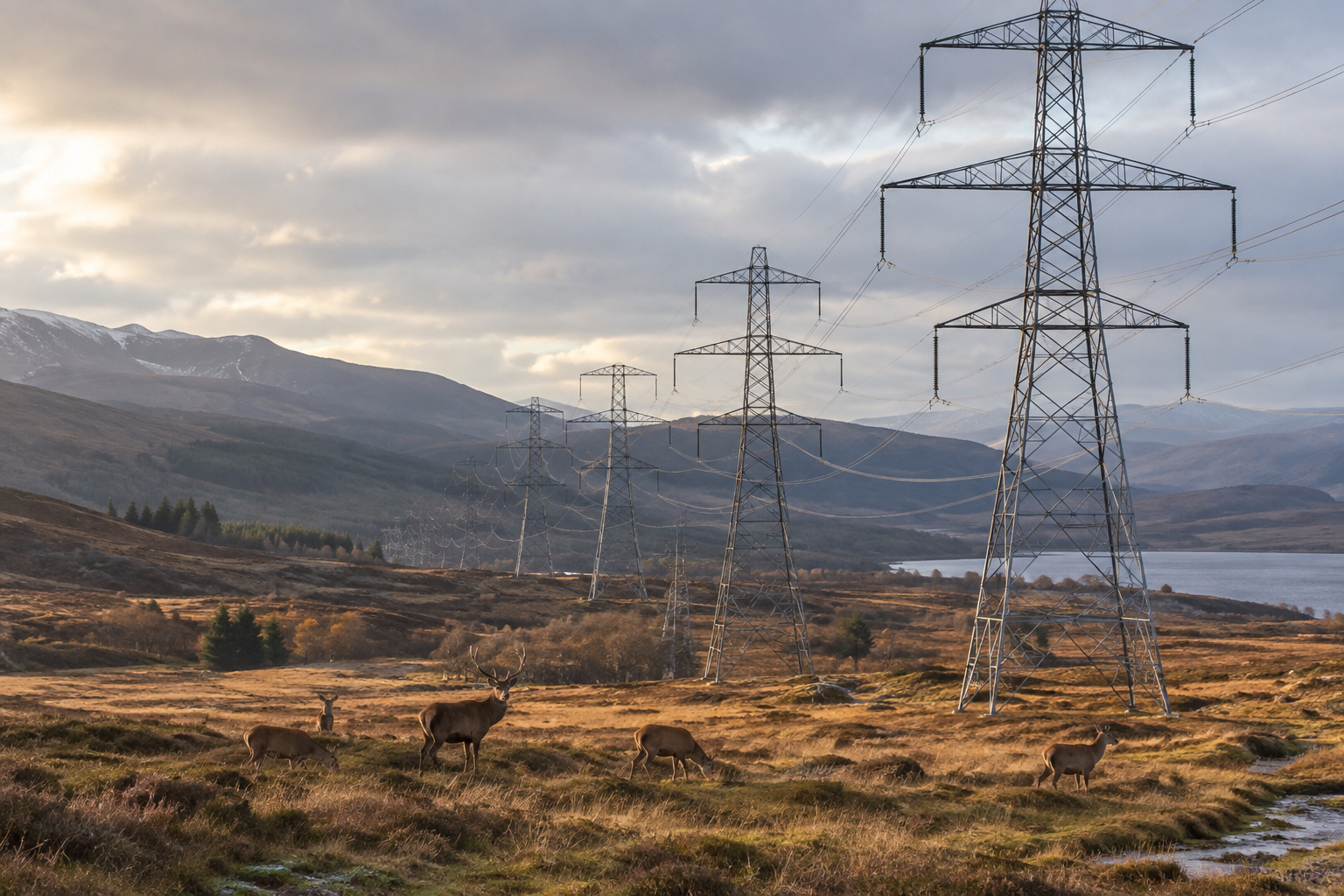
The main line would be supported predominantly on steel lattice towers averaging approximately 57 metres in height, according to the Energy Consents Unit case record. Individual structures would vary according to terrain, engineering requirements and crossings.
The towers are only the most visible component. Each requires foundations. Conductors must maintain clearances from the ground and other infrastructure. Construction requires access to tower positions, compounds and working areas. Existing transmission lines must be diverted where the new infrastructure intersects with them.
The associated substations are substantial pieces of industrial infrastructure in their own right.
A 173-kilometre route also encounters conditions that a compact development does not. Over its length it can cross peat, woodland, watercourses, farmland, archaeological landscapes, settlements, private water supplies and areas subject to environmental or landscape protection.
Route design consequently becomes a process of balancing competing constraints. Moving infrastructure away from one sensitive location can move it towards another.
The Highlands have experienced an energy transformation on this scale before
The closest historical comparison lies in the hydroelectric programme of the twentieth century. The North of Scotland Hydro-Electric Board was established in 1943 and proceeded to construct dams, reservoirs, tunnels, power stations, roads and transmission infrastructure across the Highlands.
Those works altered landscapes permanently. Valleys were flooded, roads moved and electricity infrastructure entered areas that had previously contained little large-scale industrial development.
The hydro programme had two related purposes. It generated electricity from Highland water resources and extended electricity supply to communities that private utilities had often considered uneconomic to connect. The resulting system also allowed electricity generated in the Highlands to serve demand elsewhere.
The institutional arrangements surrounding the present transmission programme are different. The electricity industry has been reorganised repeatedly since the hydro board was created, and transmission now operates within the regulated British electricity market.
The underlying geography remains recognisable. Northern Scotland possesses energy resources capable of producing electricity on a scale far beyond the demand of the population immediately surrounding them. Large infrastructure is required to move that electricity to other places.
Local opposition and national energy policy meet in the same planning case
The Spittal–Beauly application therefore places two forms of public policy against the same physical landscape.
At national level, Scotland and the wider British electricity system are seeking greater transmission capacity to accommodate renewable generation and replace an electricity network designed around an older generation system.
At local level, the infrastructure required to provide that capacity has physical consequences across the council area through which it passes.
Highland Council’s planning assessment deals with the second part of that equation. SSEN’s case for the development is built around the first.
The Public Local Inquiry provides the formal mechanism through which those positions, along with evidence from communities, landowners, statutory bodies and other participants, can be examined before ministers reach a decision.
Underground cables involve a different set of consequences
Calls for major transmission lines to be placed underground frequently arise during disputes over new overhead infrastructure. High-voltage electricity can be transmitted through underground cables, but the engineering is materially different.
Underground circuits require excavation, cable trenches, joint bays and construction access. High-voltage cables generate heat and must be designed and spaced accordingly. Faults can require excavation to locate and repair. Over long distances and difficult terrain, construction costs are generally substantially greater than for overhead lines.
Overhead lines leave a much greater permanent visual presence. Undergrounding replaces much of that visual effect with different construction, engineering, land and financial consequences.
The alternatives being considered in an infrastructure decision of this scale are therefore different forms of development rather than an impact-free version of the same project.
The inquiry is now examining more than a line on a map
The DPEA case file already contains hundreds of documents. The inquiry process can examine evidence concerning landscape and visual effects, cultural heritage, ecology, engineering, alternatives and other matters disputed between the parties.
Its reporters will ultimately provide findings to Scottish ministers. The decision on Section 37 consent will remain with ministers.
That leaves Highland Council in an unusual position. A line extending for 173 kilometres through its territory, accompanied by another 18 kilometres of permanent line diversions, can be opposed by the local planning authority without being capable of refusal by that authority.
The meeting that began on 9 September brought the council’s detailed planning assessment of that infrastructure before elected members. The officers responsible for that assessment recommended objection.
The project now sits inside a national inquiry whose eventual recommendation will reach ministers in Edinburgh. The physical consequences, if consent is granted, will stretch from Caithness to Beauly.
Sources
North Planning Applications Committee — Joint Meeting with South Planning Applications Committee
The Highland Council — 9 September 2026
https://www.highland.gov.uk/meetings/meeting/5400/north-planning-applications-committee
Spittal to Loch Buidhe to Beauly 400kV OHL Connection — ECU00006008
Scottish Government Energy Consents Unit — application received 14 August 2025; accessed September 2026
https://www.energyconsents.scot/ApplicationDetails.aspx?T=6&cr=ECU00006008
Spittal to Beauly 400kV OHL — TRL-270-4
Scottish Government Planning and Environmental Appeals Division — referred 21 May 2026; case updated 20 August 2026
https://www.dpea.scotland.gov.uk/CaseDetails.aspx?id=126873
Spittal–Loch Buidhe–Beauly 400kV Connection
SSEN Transmission — accessed September 2026
https://www.ssen-transmission.co.uk/projects/project-map/spittal–loch-buidhe–beauly-400kv-connection/
Spittal to Beauly Overhead Electricity Line Application
The Highland Council — 24 October 2025
https://www.highland.gov.uk/news/article/17076/spittal-to-beauly-overhead-electricity-line-application