

Scottish councils received more than 258,000 Crisis Grant applications in one year, while emergency spending increased by 26 per cent and fourteen local authorities exceeded their estimated available budgets.
Scotland’s emergency welfare system ended the financial year approximately £1 million beyond its estimated available budget.
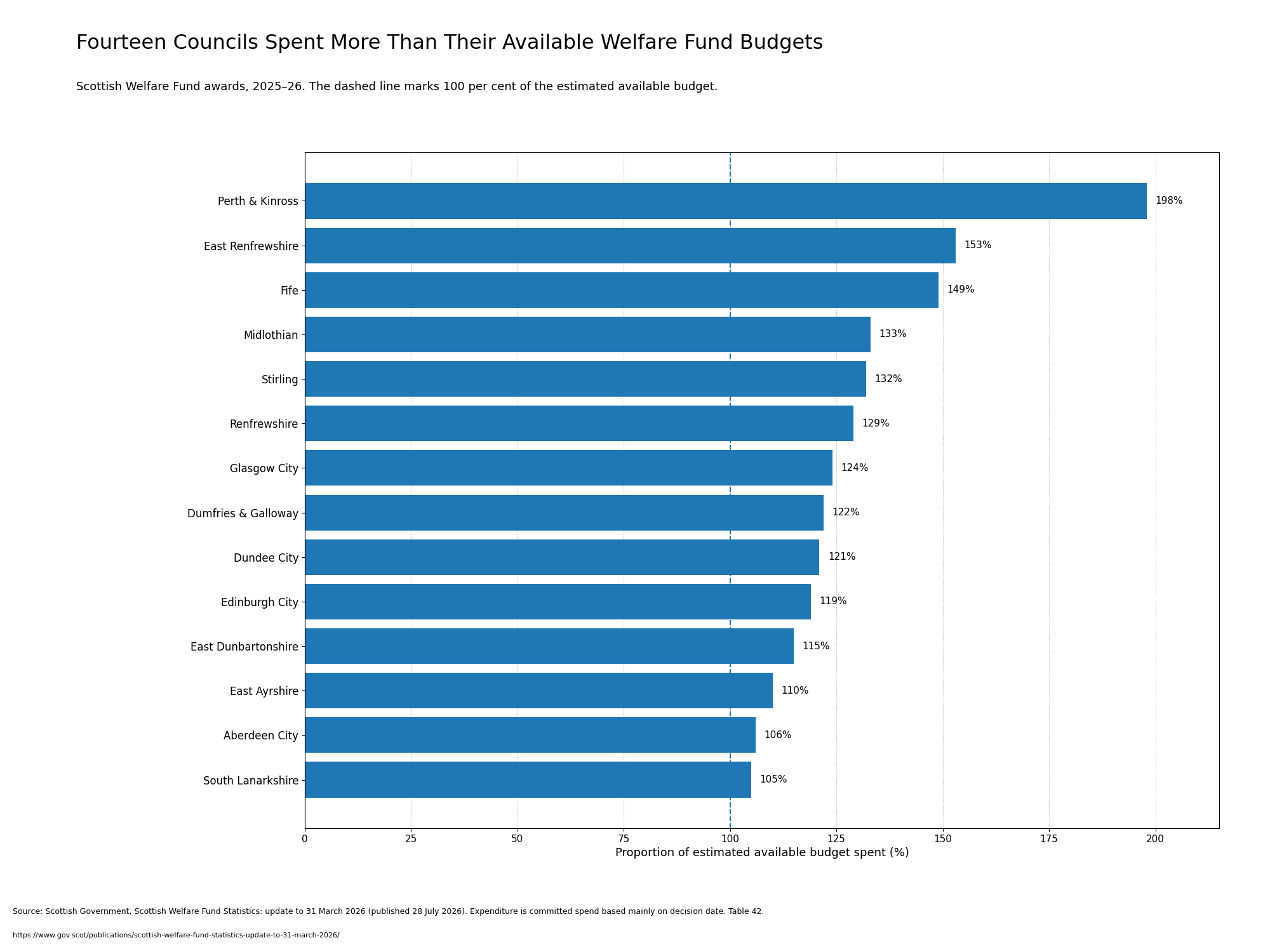
That figure appears modest until the accounts are examined council by council. Fourteen local authorities spent more than the resources estimated to be available to them, recording collective overspending of approximately £6.9 million. Elsewhere, councils retained combined underspends of £5.9 million.
The national excess is therefore the arithmetic result of markedly different local positions, rather than evidence of a uniformly funded safety net.
The Scottish Welfare Fund received 337,980 applications during 2025–26, an increase of four per cent on the previous year. Of those, 258,490 were applications for Crisis Grants, intended to help people facing an immediate threat to their health or safety because they cannot afford food, heating or other essential living costs.
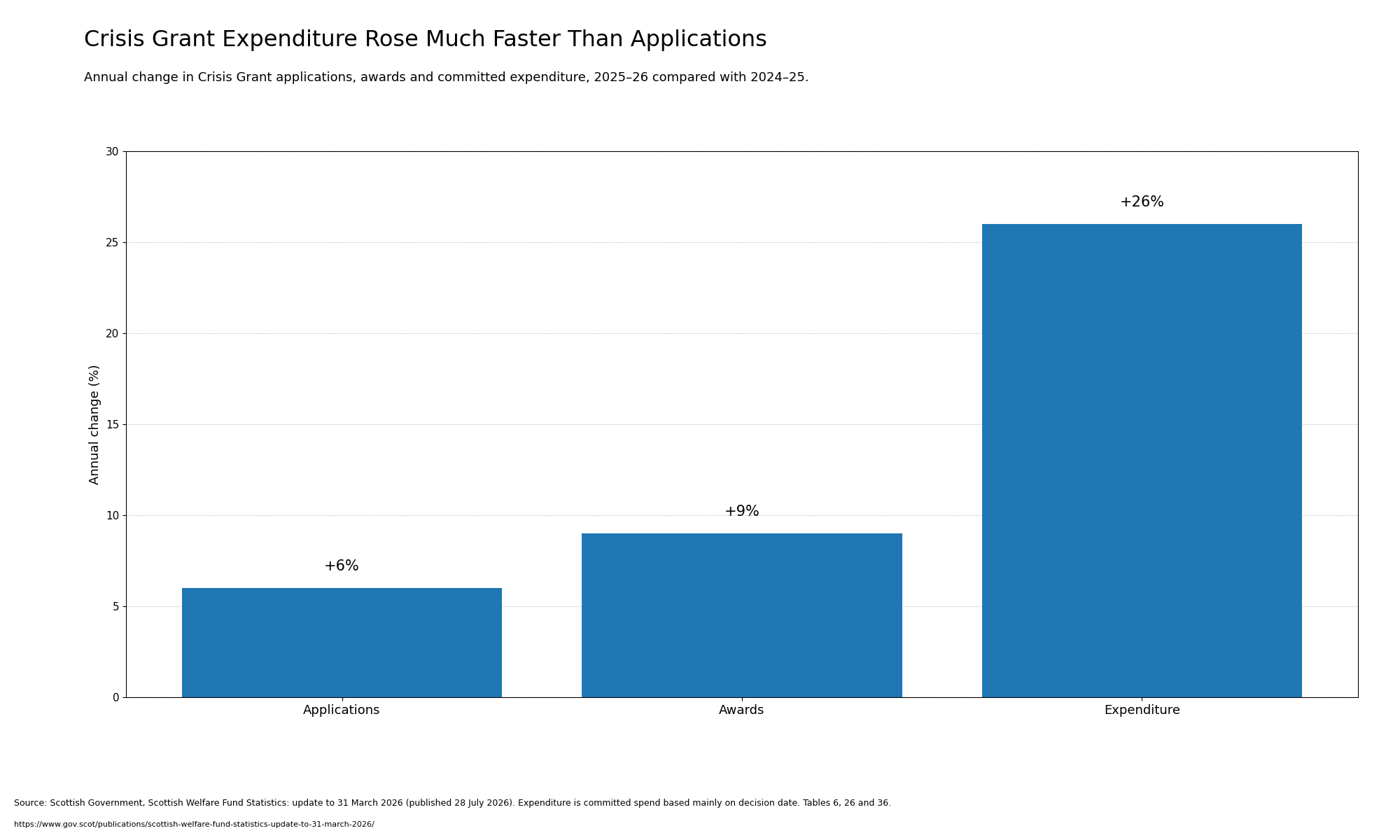
Crisis Grant applications increased by six per cent during the year. Councils made 167,990 awards, nine per cent more than in 2024–25.
Expenditure on Crisis Grants rose considerably faster than the number of applications. Councils committed £21.9 million to Crisis Grant awards, an annual increase of 26 per cent. The average award rose from £114 to £130.
Part of that increase followed the introduction of the Universal Credit Essentials Guarantee into the statutory guidance governing the fund. The guarantee establishes minimum amounts intended to help applicants afford essentials including food, clothing and heating.
The increase in spending should not therefore be presented entirely as evidence of rising poverty. Councils were also paying larger amounts to successful applicants because the previous amounts were judged insufficient to meet basic needs.
However, the number of applications, the repeated use of the fund and the reasons recorded for seeking assistance point towards a system dealing with persistent household shortages rather than occasional misfortune.
More than seven in ten Crisis Grant applications came from people who had applied previously. Repeat applications have remained close to or above 70 per cent for several years.
A fund intended for emergencies is consequently being used repeatedly by many of the same households. That does not establish that applicants are misusing it. It suggests that the emergency has often ended only temporarily, usually when a small payment has carried a household through until its next income arrives.
The most common explanation recorded for seeking a Crisis Grant was that the applicant’s benefit or income had already been spent. This accounted for 118,590 applications, or 46 per cent of all Crisis Grant requests.
Disasters such as fires and floods accounted for fewer than one per cent.
The crisis most frequently encountered by the system was therefore not an exceptional physical event but the ordinary exhaustion of household income before the next payment was due.
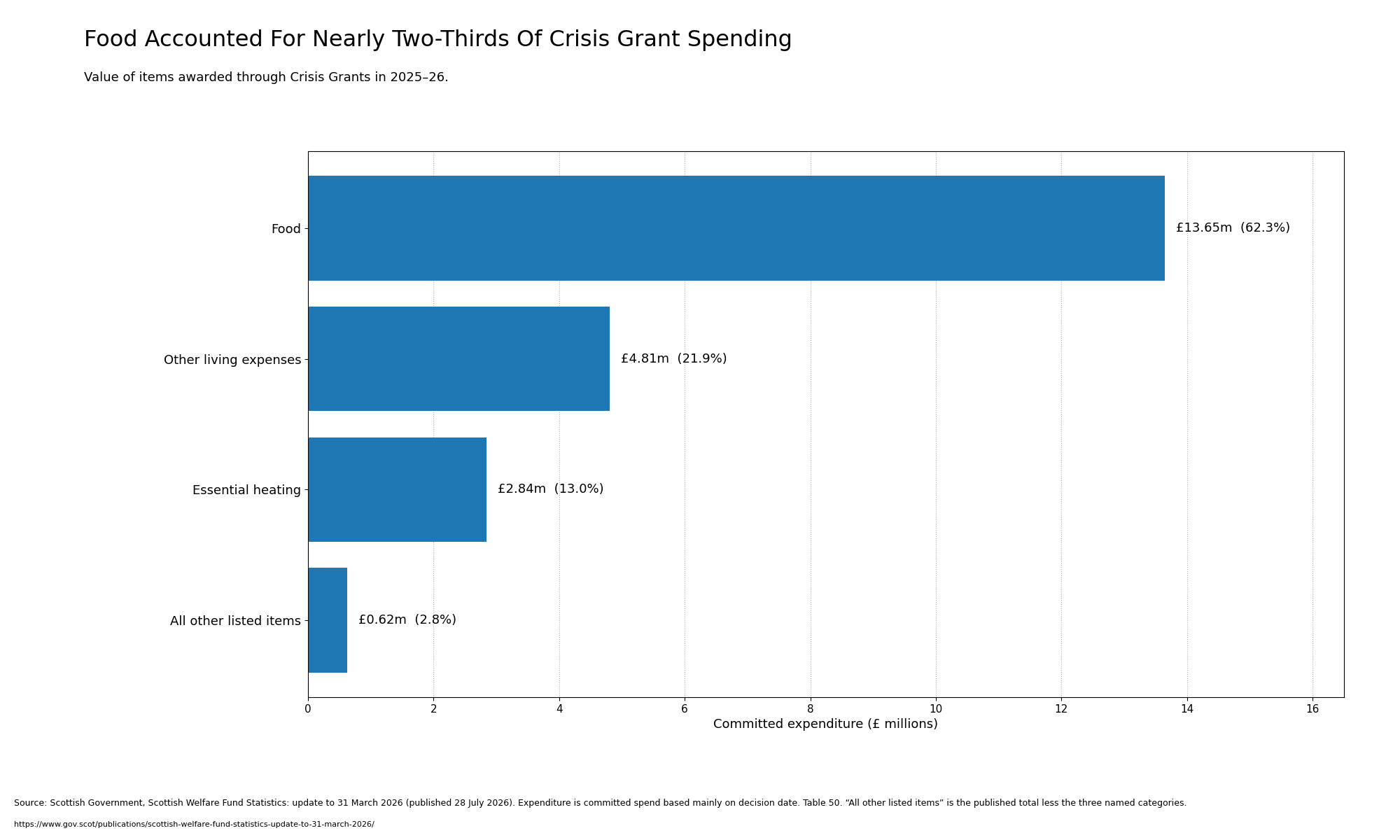
Food accounted for £13.6 million, or 62 per cent, of all Crisis Grant expenditure. Spending on food increased by 30 per cent during the year, while expenditure on essential heating rose by 15 per cent.
Across both Crisis Grants and Community Care Grants, councils committed £52 million in Scottish Welfare Fund awards during 2025–26. The estimated available budget was £51 million.
That available budget comprised £41 million allocated by the Scottish Government and approximately £10 million in unused funding carried forward from the previous year. The central allocation included an additional £5.5 million supplied late in 2025.
The extra money helped some councils remain within their available budgets. Fourteen nevertheless exceeded them.
Perth and Kinross recorded expenditure equivalent to 198 per cent of its estimated available budget. East Renfrewshire spent 153 per cent and Fife spent 149 per cent.
The Scottish Government says councils are permitted to supplement their Welfare Fund budgets from other sources. The national publication does not identify which local budgets supplied that additional money, how much each authority contributed from elsewhere or whether other expenditure was displaced.
At the other end of the table, thirteen councils spent less than 90 per cent of their estimated available budgets. Na h-Eileanan Siar spent 20 per cent, North Ayrshire 44 per cent and Highland 63 per cent.
Low expenditure does not necessarily demonstrate low need. Differences may arise from previous underspends, local application rates, public awareness, administrative practices, eligibility decisions or the manner in which councils record and deliver assistance.
The figures do not establish which explanation applies in each authority. They do show that access to emergency assistance, and the financial pressure associated with providing it, varies considerably according to where an applicant lives.
The differences are also visible in acceptance rates.
Inverclyde approved 89 per cent of decided Crisis Grant applications, while Midlothian approved 52 per cent. Across Scotland, 65 per cent were accepted. Decisions were made on 257,980 Crisis Grant applications and 167,990 resulted in awards, leaving approximately 90,000 decided applications without assistance.
The most common recorded reason for rejecting a Crisis Grant application was exclusion because of the applicant’s previous application history. That reason accounted for 27 per cent of Crisis Grant rejections.
This produces an uncomfortable collision within the scheme. Repeat applications demonstrate that many households remain unable to absorb shortages or unexpected costs, yet an applicant’s previous use of the fund can itself become a reason for refusing further assistance.
The fund is being asked to respond to recurring hardship while retaining rules designed for temporary emergencies.
Awards remain concentrated among households with the least financial resilience. Around half of Community Care Grants and 46 per cent of Crisis Grants went to applicants living in Scotland’s most deprived 20 per cent of neighbourhoods.
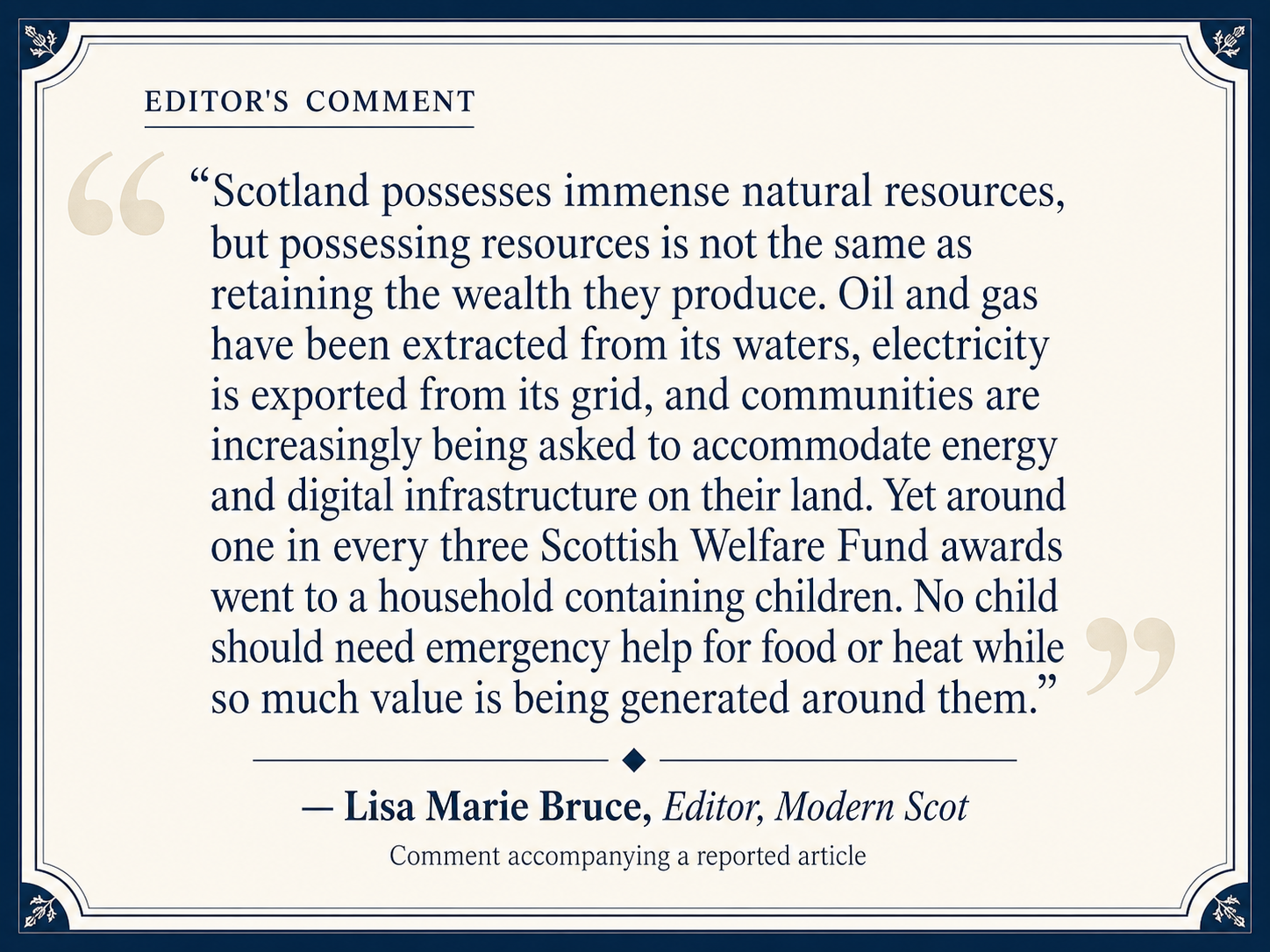
Fifty-nine per cent of Scottish Welfare Fund awards went to single-person households, while 27 per cent went to single-parent households. Around one-third of all awards went to households containing children.
The position for 2026–27 requires closer examination.
The Scottish Budget lists £35.5 million for Scottish Welfare Fund assistance and a further £5.5 million for administration. The Government’s child poverty delivery plan describes the combined figure as £41 million of investment in the fund.
Unless further award funding is supplied during the year, the £35.5 million listed for assistance is below the £41 million allocated for awards in 2025–26 and substantially below the £52 million councils ultimately committed.
Carry-forward balances and additional council contributions may increase the amount available locally, as they did last year. They cannot be treated as a dependable substitute for an award budget that reflects actual demand.
The expenditure figures also require one technical qualification. They are largely based on the date an award decision was made and should therefore be regarded as committed expenditure rather than final confirmed cash expenditure. Individual totals may be revised after reviews or once the cost of supplied goods is known.
That qualification may alter some figures. It is unlikely to remove the broader pattern of councils exceeding their available budgets in some parts of Scotland while substantial balances remain unused elsewhere.
The Scottish Welfare Fund continues to provide a final line of support. It made more awards, paid higher average grants and helped households buy food, heat their homes and establish basic living conditions.
The unresolved question within the figures is how long an emergency fund can continue treating recurring deprivation as a succession of separate crises.
Sources
Scottish Government — Scottish Welfare Fund Statistics: Update To 31 March 2026
https://www.gov.scot/publications/scottish-welfare-fund-statistics-update-to-31-march-2026/
Scottish Government — Scottish Welfare Fund Statistics: Applications
https://www.gov.scot/publications/scottish-welfare-fund-statistics-update-to-31-march-2026/pages/applications/
Scottish Government — Scottish Welfare Fund Statistics: Decisions And Awards
https://www.gov.scot/publications/scottish-welfare-fund-statistics-update-to-31-march-2026/pages/decisions-and-awards/
Scottish Government — Scottish Welfare Fund Statistics: Expenditure And Budgets
https://www.gov.scot/publications/scottish-welfare-fund-statistics-update-to-31-march-2026/pages/expenditure-and-budgets/
Scottish Government — Scottish Welfare Fund Statistics: Items And Payments
https://www.gov.scot/publications/scottish-welfare-fund-statistics-update-to-31-march-2026/pages/items-and-payments/
Scottish Government — Scottish Welfare Fund Statistics: Repeat Applications And Awards
https://www.gov.scot/publications/scottish-welfare-fund-statistics-update-to-31-march-2026/pages/repeat-applications-and-awards/
Scottish Government — Scottish Welfare Fund Statistics: Scottish Index Of Multiple Deprivation
https://www.gov.scot/publications/scottish-welfare-fund-statistics-update-to-31-march-2026/pages/scottish-index-of-multiple-deprivation/
Scottish Government — Scottish Welfare Fund Statistics: Characteristics Of Households In Receipt Of Awards
https://www.gov.scot/publications/scottish-welfare-fund-statistics-update-to-31-march-2026/pages/characteristics-of-households-in-receipt-of-awards/
Scottish Government — Scottish Welfare Fund Statistics: Data And Methodology
https://www.gov.scot/publications/scottish-welfare-fund-statistics-update-to-31-march-2026/pages/data-and-methodology/
Scottish Government — Scottish Budget 2026 To 2027: Chapter 5, Social Justice
https://www.gov.scot/publications/scottish-budget-2026-2027/pages/7/
Scottish Government — Bringing Hope, Building Futures: Tackling Child Poverty Delivery Plan 2026–2031
https://www.gov.scot/publications/bringing-hope-building-futures-tackling-child-poverty-delivery-plan-2026-2031/pages/6/