
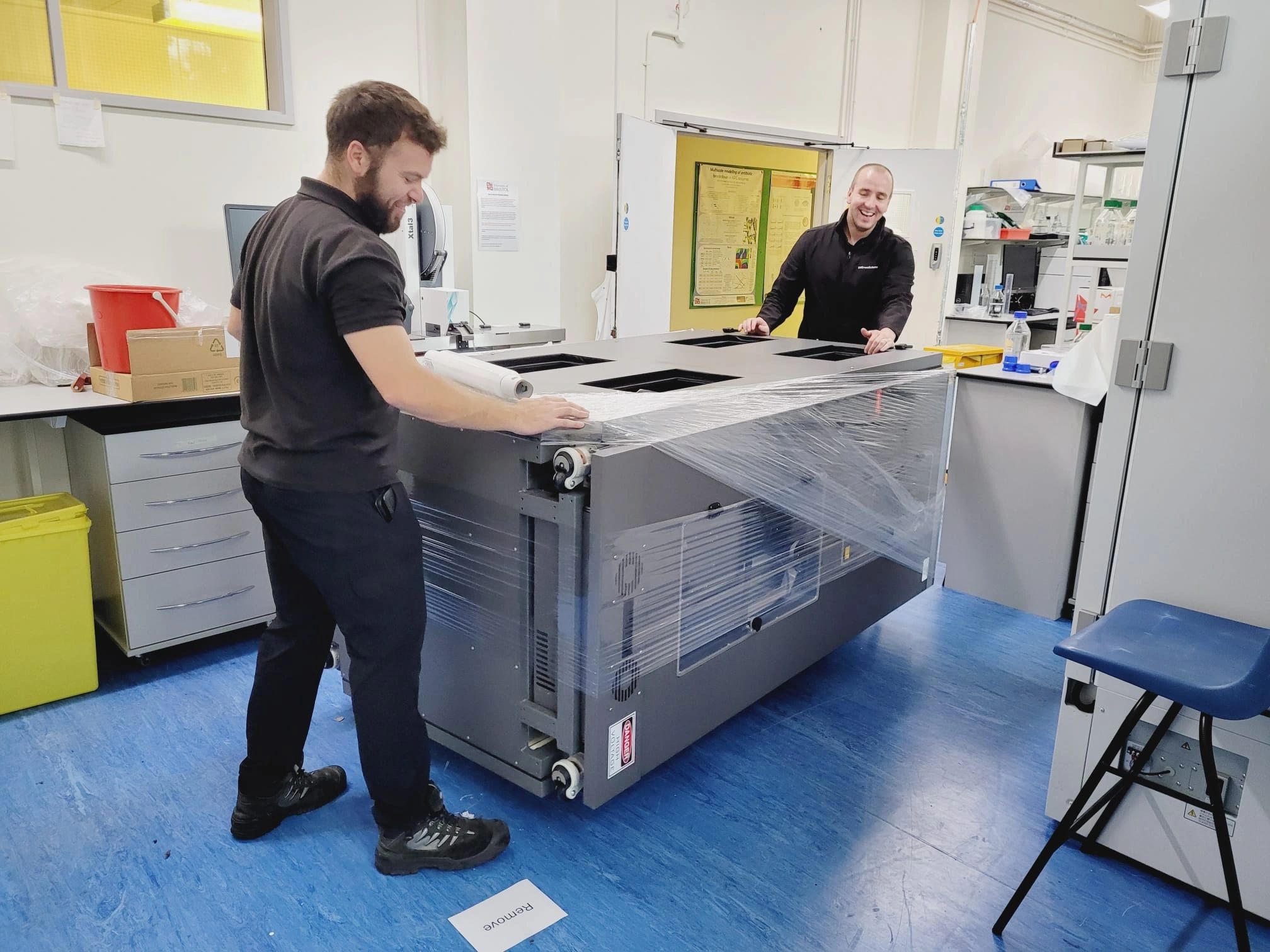
A business operating from the south of Scotland is building an expanding commercial operation around something most research institutions would prefer to get rid of: unwanted laboratory equipment.
UniGreenScheme, which collects, refurbishes and resells surplus scientific instruments, has moved into larger premises in Dumfries with plans to create more than 120 jobs over the next decade. The expansion is supported by a £420,000 grant from South of Scotland Enterprise and is intended to establish a major centre for laboratory equipment reuse and recertification.
The company’s business model is relatively straightforward, but its economic implications are considerable. Universities, hospitals, pharmaceutical businesses and research laboratories routinely replace equipment that may still have substantial commercial value. Some instruments become surplus following laboratory upgrades, research programme changes or departmental reorganisations.
Rather than allowing those assets to remain unused or enter the waste stream, UniGreenScheme collects them and seeks buyers capable of putting them back into service.
The resulting business connects scientific research, specialist engineering, logistics, second-hand equipment markets and environmental savings.
Its expansion illustrates how Scotland’s economy can develop industries not solely through the invention of new products, but through extracting additional value from expensive equipment that already exists.
From a Welsh University Idea to a Scottish Industrial Operation
UniGreenScheme began in Wales in 2015 after its founder became frustrated by the disposal of usable university laboratory equipment.
The company established a Scottish operation at Lochmaben in 2018 and has subsequently developed relationships with universities and other research organisations throughout the country.
It now works with more than 90 universities, including every university in Scotland, according to South of Scotland Enterprise, alongside hundreds of other organisations across the United Kingdom.
Its clients and customers operate in sectors where scientific instruments can represent substantial capital expenditure.
These include biotechnology, pharmaceutical research, higher education, healthcare and industrial testing.
The equipment handled by the business ranges from comparatively small laboratory instruments to industrial-sized autoclaves, microscopes, PCR equipment, analytical instruments, biosafety cabinets and specialist research machinery.
Some surplus equipment remains perfectly serviceable but is no longer required by its original owner. Other assets may need assessment, refurbishment or alternative uses.
The company can find buyers for equipment that would otherwise occupy expensive laboratory space or be disposed of at additional cost.
This creates a market in which the original institution can recover some of its expenditure and another organisation can obtain specialist equipment without necessarily paying the full price of a new instrument.
How the Business Makes Money
UniGreenScheme operates through collection, asset recovery and resale services.
Under its published profit-sharing model, an institution can arrange for surplus equipment to be collected without paying a collection or consultation fee. The company then seeks to sell suitable equipment.
Processing costs are deducted before the remaining profit is divided.
UniGreenScheme provides an example in which an instrument is sold for £1,000 after collection and processing costs of £100. The remaining £900 is shared equally, giving £450 to the original institution.
This illustrates why the model can be attractive to universities facing financial pressure.
Disposing of redundant equipment can itself be expensive, particularly when instruments are large, specialist or difficult to transport.
Recovering cash instead of paying for disposal potentially improves the financial outcome.
Buyers, meanwhile, gain access to scientific instruments that might otherwise be financially beyond their reach.
A small biotechnology company, for example, may have an incentive to purchase suitable used equipment rather than commit substantially more capital to equivalent new machinery.
The financial benefit is not automatic. Equipment condition, maintenance history, calibration requirements, suitability for the intended purpose and the availability of technical support all matter.
For regulated laboratory work, buyers must also establish whether a used instrument meets the standards applicable to its intended use.
Nevertheless, the business has developed an established market for matching surplus scientific assets with organisations seeking equipment.
The Financial Figures Behind the Expansion
South of Scotland Enterprise reports that UniGreenScheme returned more than £750,000 to institutions in the preceding year.
It also states that the company’s activities have generated more than £6 million in savings for organisations compared with disposal.
These figures are not equivalent to UniGreenScheme’s turnover or profit. They describe financial benefits associated with its business model.
The distinction matters because the public announcement does not disclose the company’s annual revenue, operating profit or the total private capital committed to the new Dumfries operation.
What is known is the scale of the new premises and the business’s plans for expansion.
The facility at Irongray Road has capacity to hold and process more than 6,000 pallets of surplus equipment at any one time.
For a business dealing with bulky and technically specialised assets, storage and processing capacity can determine how much work it can accept.
Scottish business manager Nenad Denkov said the operation had been receiving more requests to collect equipment than its previous premises could accommodate.
The new site is intended to remove that constraint.
An Unusual Opportunity for the South of Scotland
The economic significance of the development extends beyond the company’s immediate employment plans.
Dumfries and Galloway faces different industrial circumstances from the larger Scottish cities, where universities, financial services, specialist technology companies and corporate headquarters are more concentrated.
A business handling laboratory assets from across the United Kingdom can operate from Dumfries without depending entirely on local demand.
Its customers and suppliers form a geographically dispersed market, while the physical work of collection, processing, storage, refurbishment and distribution can be concentrated in the south of Scotland.
This creates opportunities for jobs associated with logistics, equipment handling, technical assessment, sales, administration and potentially specialist engineering.
The employment forecast, however, needs to be understood correctly.
The 120 jobs are anticipated over ten years. They have not all been created immediately, and the announcement does not provide a detailed annual recruitment schedule.
Nor does it establish how many of those positions will be permanent, full-time technical roles rather than other forms of employment.
The projected expansion remains significant, but its full economic impact will depend on how much business the company secures and how many positions ultimately materialise.
A Second Market Emerges From Scotland’s Research Economy
Scotland’s universities and life sciences businesses are themselves important purchasers of scientific equipment.
Research laboratories require constant investment in instruments, analytical systems and specialised infrastructure. New projects can require new equipment, while the conclusion of existing programmes can leave institutions with assets they no longer need.
UniGreenScheme’s model introduces a secondary market into that purchasing cycle.
For universities, this can provide a means of recovering value from equipment that has reached the end of its usefulness within one department but remains commercially valuable elsewhere.
For smaller research businesses, access to lower-cost equipment can reduce the investment required to establish or expand operations.
In that respect, the company provides a service to the wider research economy rather than simply collecting unwanted machinery.
Its development also raises questions about how efficiently publicly funded institutions manage their physical assets.
Where expensive equipment has been purchased using public funds, recovering value at the end of a research project can preserve resources that might otherwise be lost.
It does not follow that every redundant scientific instrument should be sold. Some equipment may require specialised disposal, may no longer be safe, or may lack a viable market.
But where reuse is practical, the economic case can be substantial.
The Environmental Figures Also Have an Economic Dimension
The company expects the Dumfries expansion to prevent almost four million kilograms of equipment waste in Scotland over the next decade.
South of Scotland Enterprise also projects savings of approximately 19 million kilograms of carbon dioxide equivalent over that period, with the expanded operation expected to save more than one million kilograms annually.
These are projected benefits rather than independently demonstrated outcomes from ten years of operation.
The underlying economic argument is that reusing an existing scientific instrument can avoid some of the material consumption, manufacturing expenditure and disposal costs associated with replacing it.
Modern scientific equipment can incorporate valuable metals, electronic components, precision-manufactured parts and complex assemblies.
Keeping those products in use potentially preserves more of their existing value than dismantling them solely for materials recovery.
However, resale itself consumes resources. Transport, refurbishment, testing and subsequent energy use must be considered when assessing the full environmental benefit.
The announced carbon savings therefore require an understanding of the assumptions used to calculate them, including the expected lifespan of reused equipment and whether buyers would otherwise have purchased new products.
The Public Investment Question
The £420,000 support from South of Scotland Enterprise represents a public contribution to the company’s expansion.
The agency’s rationale is that increasing the business’s processing capacity will generate additional employment and economic activity in the region.
The announcement identifies the expected employment and environmental benefits, but it does not disclose the full private-sector investment involved or the grant conditions relating to job creation.
Those details matter when assessing the effectiveness of public economic development spending.
The projected 120 jobs should not simply be divided into the grant total and treated as a final cost per job. The positions are expected to develop over a decade, while the grant supports an operation with several different economic objectives.
A fuller assessment would need to consider wages, job duration, direct and indirect local spending, taxes, company investment and any conditions requiring repayment if targets are not met.
The business is already established, rather than being a new venture depending entirely on the grant to begin trading.
Its expansion therefore provides an opportunity to examine how relatively modest public funding can support the growth of companies operating in specialised national markets.
Could Dumfries Become a Centre for Scientific Equipment Refurbishment?
The company’s stated ambition is to develop a major laboratory equipment reuse and recertification centre in southern Scotland.
That would represent a distinctive form of industrial activity.
It does not depend on a nearby oilfield, major power station or unusually large local consumer market. It depends instead on access to technical skills, suitable premises, efficient logistics and a continuing supply of surplus equipment from research institutions.
Scotland’s existing universities, hospitals and biotechnology sector provide part of that supply, while buyers can come from elsewhere in the United Kingdom and overseas.
The central commercial challenge is whether UniGreenScheme can continue expanding its network of suppliers and customers while maintaining sufficient margins to support a larger workforce and facilities.
Its substantial projected employment growth remains to be delivered.
Nevertheless, the development demonstrates that an emerging Scottish industry need not begin with a newly invented technology.
Sometimes the commercial opportunity lies in recognising that equipment already purchased, manufactured and paid for still contains considerable economic value.
In Dumfries, a business has turned that principle into an expanding operation with national customers and a planned workforce considerably larger than its previous premises could support.