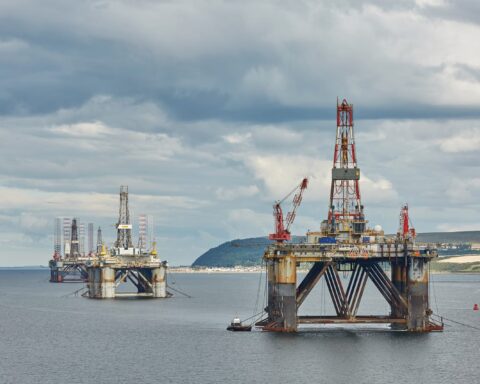


Ministers say private-jet users should pay a fair share because their emissions per passenger are disproportionately high. Yet Scotland’s additional levy will not begin until April 2028, a year after Air Departure Tax starts, while empty private jets remain beyond the reach of the devolved tax.
Scotland will begin collecting its replacement for Air Passenger Duty on 1 April 2027, but the additional charge promised specifically for private jets will not start until the following financial year.
The timetable was confirmed when the Scottish Government published its analysis of responses to the Air Departure Tax consultation on 15 July 2026. Air Departure Tax will initially reproduce the UK Government’s rates and distance bands, while the Scottish Private Jet Supplement will follow in April 2028. Its rate has not yet been announced.
Private-jet passengers will not travel tax-free during the intervening year. From April 2027, the UK Government’s higher Air Passenger Duty rate is due to cover private and business jets weighing at least 5.7 tonnes, rather than applying only to aircraft of at least 20 tonnes carrying fewer than 19 passengers. Scotland says it will reproduce that expanded definition when its devolved tax begins.
The issue is therefore not the complete absence of aviation tax. It is Scotland’s decision to postpone its additional private-jet supplement for a year after Air Departure Tax becomes operational.
A Promise Of A Fair Share
The Scottish Government has already made the political and environmental case for higher private-jet taxation.
Its Climate Change Plan says private jets produce more emissions per passenger than commercial aircraft and that those choosing to use them should pay a fair share for the privilege. Announcing the policy in January, the then Finance Secretary told private-jet users: “In Scotland you will pay, and pay a fair share, for that privilege.”
The Government says matching UK rates during the first year will provide certainty and stability for the aviation industry and taxpayers. Rates for 2028–29, including the Private Jet Supplement, will be set in the 2027–28 Scottish Budget after consideration of their economic, environmental and social effects.
Consultation respondents challenged why that transitional protection should extend to private aviation. Oxfam Scotland said it understood the desire to provide stability during the tax’s first year but did not believe private jets should benefit from the delay. Other respondents argued that private-jet demand was relatively resistant to price because passengers were already accepting very high travel costs.
The Government has consequently reached a curious position. It has declared private aviation sufficiently unequal and carbon-intensive to justify a special charge, but not sufficiently urgent for that charge to begin with the tax designed to carry it.
The Flight With Nobody Aboard
The more serious gap concerns private jets carrying no passengers.
Air Departure Tax is legally a tax on the carriage of people from Scottish airports. When an aircraft flies empty to collect a client, return to its operating base or position itself for another booking, there is no passenger carriage against which the tax can be assessed.
The Scottish Government acknowledges that it does not presently have the devolved power to charge these so-called ghost flights. It has said it will engage with the UK Government about obtaining further powers, but it has not published a timetable for doing so.
One consultation submission from the Aviation Environment Federation said approximately 41 per cent of private-jet flights were empty legs. That is the organisation’s estimate rather than an official measurement of Scottish flights, but it shows why the omission may be substantial rather than theoretical.
An aircraft carrying one wealthy passenger can be taxed. The same aircraft, burning fuel with nobody in the cabin, cannot be charged through Scotland’s present mechanism.
The atmosphere does not distinguish between a paying passenger and an empty leather seat. The fuel is still burned and the carbon still released.
Private jets will not benefit from the proposed Highlands and Islands exemption. The Scottish Government has confirmed that the exemption will cover commercial passenger services but not private-jet travel, although military flights, emergency medical services, search and rescue, firefighting, training and research flights will remain exempt from Air Departure Tax. That is an appropriate distinction between essential connectivity and discretionary private aviation.
It does not, however, resolve the empty-flight problem.
Carbon Restraint Reaches Everyday Life
Sainsbury’s has made a commercial decision to move its own-brand range towards white-shelled eggs by 2028. The supermarket says an independently verified assessment found white eggs had a 12.7 per cent lower carbon footprint per kilogram because the hens converted feed more efficiently and remained productive for longer. The eggs have the same nutrition, taste and quality; the visible change is the shell.
New Great Britain-wide ecodesign regulations come from the UK Government and apply to appliances newly placed on the market. The rules raise minimum efficiency requirements, phase out inefficient vented and condenser models and encourage the sale of heat-pump technology after a transitional period ending on 18 January 2027. Households may keep using functioning dryers already in their homes.
These measures originate in different institutions. They nevertheless reveal a common direction. Carbon calculations increasingly shape what households buy, what retailers stock, how products are manufactured and how apparently minor aspects of everyday life are redesigned.
Carbon Reaches The Highland Farm
Scottish agriculture produced 7.5 million tonnes of greenhouse-gas emissions in 2024. Methane from animal digestion accounted for 4 million tonnes, or 52.6 per cent of the agricultural total. Suckler beef remained the largest agricultural subsector, producing 3.1 million tonnes.
Agricultural emissions have declined partly because livestock numbers have fallen. Between 1990 and 2024, Scotland’s cattle population decreased by 21 per cent and its sheep population by 35 per cent. This does not mean that farmers were ordered to cull animals for climate policy, but fewer livestock have contributed materially to the recorded reduction in emissions.
Methane-reducing feed additives offer another possible route. Bovaer, whose active ingredient is 3-nitrooxypropanol, was authorised for use in Scotland in December 2023. The Scottish Government has said farmers may use it if they choose; there is no universal requirement forcing it into cattle feed.
Government-commissioned evidence has modelled a 20 per cent reduction in enteric methane from beef cattle receiving 3-NOP. Its practical application is more straightforward among housed animals receiving controlled daily rations than among cattle grazing extensively across Highland hills and crofts.
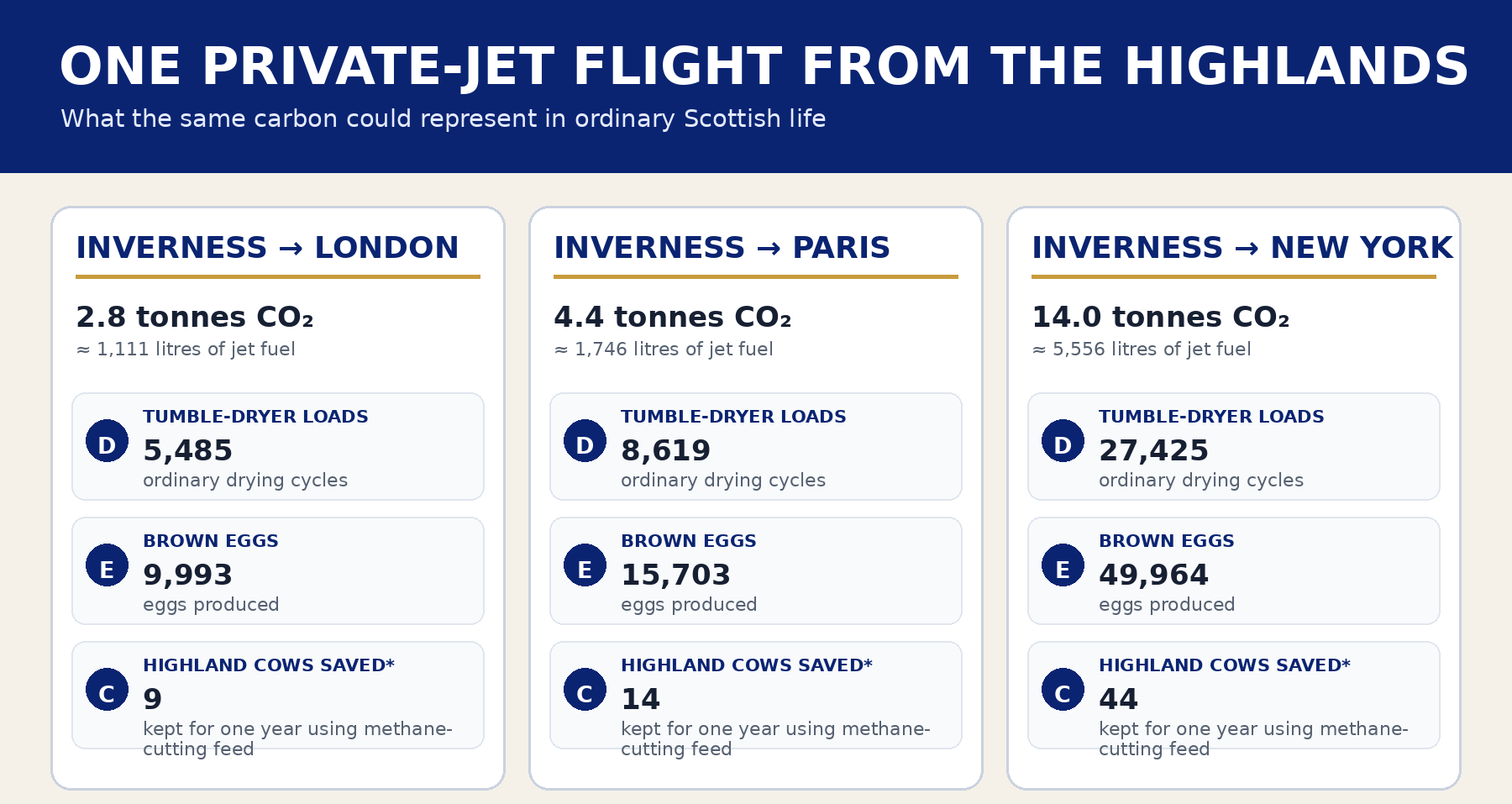
The accompanying Modern Scot graphic uses this model to show how many Highland cattle could, in carbon-equivalence terms, be kept for a year if methane savings from specialised feed offset the estimated emissions from a private flight. “Saved” does not mean that Scottish policy currently presents farmers with a literal choice between the additive and slaughter. It is an illustration of the relative scale of the carbon being discussed.
The comparison still exposes a difference in treatment. Farmers are expected to examine livestock numbers, breeding, feed, manure, fertiliser, machinery, land management and productivity. Private aviation has received an acknowledgement of its disproportionate emissions, followed by another year before Scotland’s additional charge begins.
What One Private Flight Represents
Transport & Environment estimates that a private jet can emit approximately two tonnes of carbon dioxide in one flight hour, although fuel consumption varies substantially according to the aircraft, journey, weather and operating conditions. A peer-reviewed global study covering more than four million private-flight legs calculated average direct emissions of 3.6 tonnes per flight in 2023, with total private-aviation emissions of at least 15.6 million tonnes that year.
The Modern Scot graphic applies the two-tonne hourly benchmark to illustrative flights from Inverness to London, Paris and New York. It compares those flights with tumble-dryer use, egg production and the potential methane reductions attributed to specialised cattle feed.
These are carbon-equivalence illustrations, not flight-specific inventories. They exclude the additional warming effects created by aviation emissions at altitude and should not be read as precise accounts of any individual journey.
Their purpose is to translate tonnes into the ordinary quantities against which the public is increasingly asked to measure its behaviour.
Economic Arguments Remain
Private aviation is not used solely for holidays. Consultation responses identified high-value business travel, investment meetings, sporting and cultural events, golf, country sports, whisky tourism and visits to private estates. Some respondents warned that excessive taxation could move flights and associated spending to airports elsewhere in the UK.
Those concerns should be considered. Aviation is mobile, and a poorly constructed tax could shift departures without reducing the number of flights. Emergency and public-service operations also require protection.
But these arguments do not answer the central point. The Scottish Government has already decided that private jets should carry an additional charge. It has already placed the measure inside its Climate Change Plan. It has already invoked fairness and the disproportionate emissions produced per passenger.
The remaining dispute is about whether the policy matches the urgency of the language used to justify it.
The Test Of A Just Transition
A fair transition does not require every source of carbon to be treated identically. Nor does the existence of private jets excuse avoidable emissions from homes, appliances, food production or agriculture.
Fairness does require proportion.
A household may face a higher initial cost when replacing an appliance. A retailer may redesign its supply chain around relatively small differences in agricultural efficiency. A farmer may be encouraged to alter feed, breeding and herd management while carrying the commercial and practical risks.
Against that background, certainty and stability for private aviation is unlikely to satisfy the public as the sole explanation for postponing Scotland’s additional levy.
The Government should now publish the evidence required to judge the policy. That includes the number of private-jet movements leaving Scottish airports, the proportion that fly empty, their estimated emissions, the revenue expected from the supplement and the level at which the tax might alter behaviour rather than simply become another manageable operating cost.
Ministers should also provide a timetable for seeking the additional powers needed to address ghost flights and explain why the Private Jet Supplement cannot begin alongside Air Departure Tax in April 2027.
These are not arguments against improving appliances, reducing agricultural methane or lowering the environmental cost of food.
They are arguments for applying the same seriousness at the top.
Brown eggs, tumble dryers and Highland cattle have all entered the carbon calculation. Scotland’s private jets have entered it too, but their additional bill will arrive later, and when they fly empty, the present system cannot send one at all.
Sources
Scottish Government — Air Departure Tax: Consultation Analysis Report
https://www.gov.scot/publications/delivering-scotlands-air-departure-tax-consultation-analysis-report/
Scottish Government — Analysis Part A: Proposed Highlands And Islands Exemption
https://www.gov.scot/publications/delivering-scotlands-air-departure-tax-consultation-analysis-report/pages/3/
Scottish Government — Analysis Part B: Private Jet Supplement
https://www.gov.scot/publications/delivering-scotlands-air-departure-tax-consultation-analysis-report/pages/4/
Scottish Government — Delivering Scotland’s Air Departure Tax
https://www.gov.scot/publications/delivering-scotlands-air-departure-tax/
Scottish Government — Scottish Budget 2026–27: Tax Policy
https://www.gov.scot/publications/scottish-budget-2026-2027/pages/4/
Scottish Government — Air Departure Tax Policy
https://www.gov.scot/policies/taxes/air-departure-tax/
Scottish Government — Scotland’s Climate Change Plan 2026–2040: Consultation And Scrutiny
https://www.gov.scot/publications/scotlands-climate-change-plan-2026-2040-annexes/pages/16/
UK Government — Air Passenger Duty And Private Jets
https://www.gov.uk/government/publications/air-passenger-duty-and-private-jets
UK Government — Air Passenger Duty: Extension Of The Higher Rate
https://www.gov.uk/government/publications/air-passenger-duty-and-private-jets/air-passenger-duty-extension-of-the-higher-rate
UK Government — Raising Product Standards For Household Tumble Dryers
https://www.gov.uk/government/consultations/raising-product-standards-for-household-tumble-dryers
UK Government — Tumble-Dryer Regulations: Transitional Period Clarification
https://www.gov.uk/government/publications/regulation-151-of-the-ecodesign-for-energy-related-products-and-energy-information-household-tumble-dryers-regulations-2026-clarification-note/regulation-151-clarification-of-transitional-period
Sainsbury’s — White Eggs: A Lower-Carbon Choice
https://corporate.sainsburys.co.uk/purpose-in-action/everybody-is-talking-about-white-eggs-a-lower-carbon-choice-without-compromising-on-quality/
Sainsbury’s — Sourcing Sustainable Eggs
https://corporate.sainsburys.co.uk/sustainability/explore-by-a-z/agriculture-aquaculture-and-horticulture/sourcing-sustainable-eggs/
Scottish Government — Scottish Agriculture Greenhouse-Gas Emissions And Nitrogen Use 2024–25
https://www.gov.scot/publications/scottish-agriculture-greenhouse-gas-emissions-and-nitrogen-use-2024-25/
Scottish Government — Agriculture Emissions At Second-Lowest Level Since 1990
https://www.gov.scot/news/agriculture-emissions-at-second-lowest-level-since-1990/
Scottish Government — Hill, Upland And Crofting Farmer-Led Group: Climate Evidence
https://www.gov.scot/publications/resas-climate-change-evidence-huc-farmer-led-group/
Scottish Government — 3-NOP Evidence For Cattle
https://www.gov.scot/publications/resas-climate-change-evidence-huc-farmer-led-group/pages/9/
Scottish Parliament — Bovaer: Ministerial Answer, 16 January 2025
https://www.parliament.scot/chamber-and-committees/official-report/search-what-was-said-in-parliament/meeting-of-parliament-16-01-2025?iob=138374&meeting=16198
Communications Earth & Environment — Private Aviation Is Making A Growing Contribution To Climate Change
https://www.nature.com/articles/s43247-024-01775-z
Transport & Environment — Private Jets And Zero-Emission Aviation
https://www.transportenvironment.org/articles/private-jets-can-the-super-rich-supercharge-zero-emission-aviation