
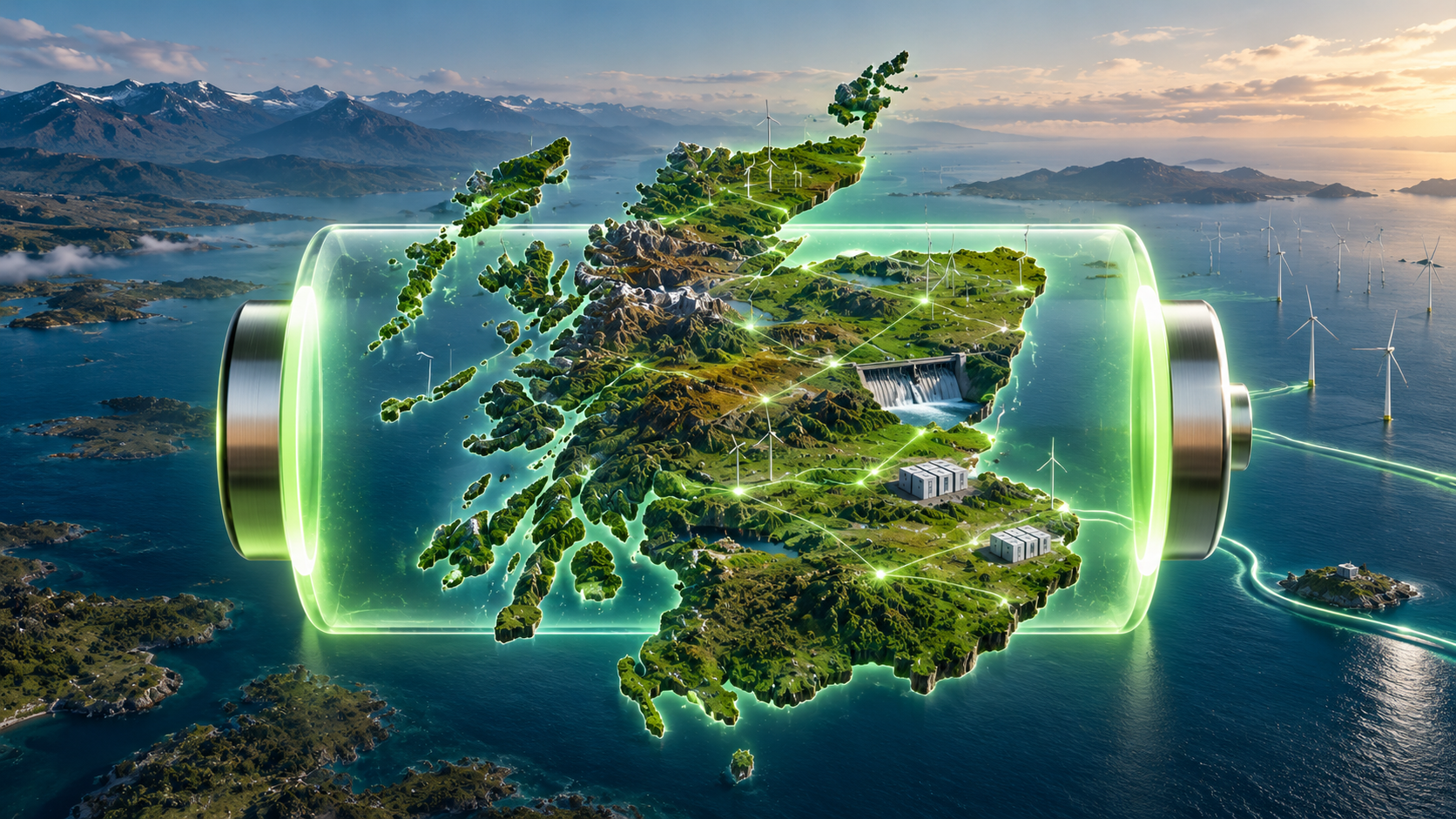
At the end of March, Scotland had 22 operating battery-storage projects with a combined capacity of 843 megawatts. Behind them was something much larger: 426 electricity-storage projects somewhere in the planning pipeline, with an estimated combined capacity of 41.8 gigawatts. Battery storage alone accounted for 32.8 gigawatts, more proposed capacity than either onshore or offshore wind. A new class of electricity infrastructure is spreading across Scotland, much of it beside substations, former power stations and the transmission network. Its owners include international infrastructure funds, investment companies and specialist energy developers, and the electricity stored inside it may have been generated hundreds of miles away.
On 12 August, a battery began commercial operation at Coalburn in South Lanarkshire. Its owner, Copenhagen Infrastructure Partners, describes it as the largest operating battery-energy-storage system in Europe. Coalburn 1 can import or export electricity at a rate of 500 megawatts and can sustain that output for two hours, giving it one gigawatt-hour of storage.
Two more projects belonging to the same investment group are following it. Coalburn 2 is being built beside the first development in South Lanarkshire, while Devilla is being developed near Kincardine in Fife. Each is planned at another 500 megawatts with two hours of storage. Together, the three sites will provide 1.5 gigawatts of power capacity and three gigawatt-hours of storage. The second and third projects represent part of an investment programme previously put at around £800 million.
The three batteries are ultimately investments of Copenhagen Infrastructure Partners, a Danish fund manager that invests institutional capital in energy infrastructure around the world. Their battery equipment is being supplied by Canadian Solar’s energy-storage business. The engineering and construction supply chains extend further.
On the opposite side of the Forth, another large battery is under construction on land at Cockenzie, where one of Scotland’s great coal-fired power stations once stood. The power station closed in 2013 and its twin chimneys were demolished two years later. The site remains closely connected to the transmission system that once carried electricity from coal generation into the Scottish grid.
The new Cockenzie battery is being developed as part of the portfolio of Gresham House Energy Storage Fund. Its latest financial update records Cockenzie among 397 megawatts of new battery projects that reached financial close in May. Construction is under way, with energisation of the Cockenzie project targeted for the first half of 2028. A joint venture involving Sumitomo Corporation and TPK Holdings has taken a 25 per cent interest in Cockenzie and two other projects in the portfolio.
At Coalburn, Cockenzie and dozens of less familiar locations, the physical geography of Scottish electricity is changing. The twentieth-century system was dominated by places that made power: hydro stations, coal stations, nuclear plants and later gas turbines and wind farms. The emerging system increasingly includes places whose principal purpose is to move electricity through time.
Scotland now has more battery storage proposed than wind power
The scale of the change is visible in the Scottish Government’s own energy statistics. At the end of March 2026, Scotland had 24 operational electricity-storage projects with an estimated capacity of 1,583 megawatts. Two were pumped-storage hydro stations accounting for 740 megawatts. The other 22 were batteries, with 843 megawatts between them.
The development pipeline was of an entirely different order. The government recorded 1,236 renewable-energy projects at various stages of planning, construction or development, representing 85.4 gigawatts of estimated capacity. Of those, 426 were electricity-storage projects representing 41.8 gigawatts.
Battery storage accounted for 32.8 gigawatts of the pipeline. The equivalent figures for onshore wind and offshore wind were 18.7 gigawatts and 17.3 gigawatts respectively.
Those numbers do not mean that Scotland is going to build 32.8 gigawatts of batteries. A development pipeline contains projects at very different stages, including proposals that may never obtain consent, financing, grid connections or construction contracts. Some projects can also remain in databases after commercial circumstances have changed.
They nevertheless show where developers are attempting to place capital. By estimated capacity, batteries have become the largest individual technology in Scotland’s renewable-energy planning pipeline.
The Scottish Government’s earlier snapshot at the end of September 2025 recorded approximately half a gigawatt of operating battery capacity and another 2.7 gigawatts that had already received permission and was awaiting construction. The operating total has since risen sharply, in large part because Coalburn 1 alone added 500 megawatts when it entered commercial operation.
The battery does not create the electricity
A grid-scale battery is both simpler and more complicated than a power station. It imports electricity, converts and stores the energy electrochemically, and later exports electricity back to the grid. Most large Scottish projects currently use lithium-ion technology, although other technologies are being developed for longer-duration storage.
Capacity is normally described using two measurements that can easily be confused. Megawatts describe how quickly the battery can import or export power. Megawatt-hours describe how much energy it can hold. A 500-megawatt battery capable of operating at maximum output for two hours therefore stores approximately 1,000 megawatt-hours, or one gigawatt-hour.
This becomes increasingly useful in an electricity system dominated by variable generation. Scotland can produce large quantities of wind electricity when demand is comparatively low or when the transmission network cannot move all available generation to where it is required. At other periods, wind output falls while demand rises.
Storage introduces time between production and consumption. Electricity can be imported when it is abundant and exported later. Batteries can also respond rapidly to instructions from the electricity-system operator, allowing them to participate in balancing and other grid services.
The commercial model is consequently more complicated than simply buying electricity cheaply and selling it at a higher price. Battery owners can earn revenues from wholesale-market trading, the Balancing Mechanism and services required to maintain the electricity system. The precise mixture changes as markets and grid requirements change.
National Energy System Operator has been changing its own systems to accommodate the physical limitations of batteries. In June, new Grid Code arrangements went live allowing limited-duration assets to tell the control room more clearly how much energy they can deliver over time. A conventional generator supplied with fuel and a battery containing a finite charge cannot be scheduled in exactly the same way.
Scotland has a particular reason to attract storage
Scotland’s geography separates a large concentration of renewable generation from major centres of electricity demand farther south. Wind generation has expanded faster than some parts of the transmission system needed to carry its maximum output. Network reinforcements are being constructed, including major new substations, overhead lines, subsea cables and high-voltage direct-current links.
Until enough transmission capacity exists, periods occur when generators in constrained parts of the network are instructed to reduce output because the electricity cannot all be transported through the available system.
Batteries cannot eliminate that problem by themselves. Their usefulness depends upon their location, connection, duration and the conditions at the time. A two-hour battery also cannot absorb an indefinite period of excess wind generation. Once fully charged, it has no further storage capacity until electricity is discharged.
But a battery placed at an appropriate point on the network can absorb electricity during one period and return it during another. That makes substations and existing grid connections commercially valuable locations.
Cockenzie illustrates the pattern. The coal station disappeared, but the electricity infrastructure around the site did not. Similar relationships between former generating sites, substations and new storage projects are appearing elsewhere in Britain.
The next proposal is appearing between Perth and Dundee
This week, residents around Inchture and Errol have been attending public exhibitions for another proposed development. Halfway Energy Park is being promoted by Aukera, a renewable-energy company operating in several European countries with offices in London and Edinburgh.
The developer says the proposed battery project could store an amount of electricity equivalent to as much as 5 per cent of Scotland’s annual non-domestic electricity use, according to the methodology accompanying its project material. Public consultation events were held at Inchture Village Hall on 7 September and Errol Village Hall on 8 September.
Aukera says 60 per cent of its current UK development pipeline is in Scotland. The Halfway project is at an earlier stage than Coalburn or Cockenzie and its eventual scale and configuration will be determined through development, consenting, connection and financing processes.
The location of proposals such as Halfway shows how battery infrastructure can arrive without the visual characteristics historically associated with electricity generation. There is no chimney and no turbine. A large BESS development generally consists of rows of battery enclosures, power-conversion equipment, transformers, access infrastructure, fencing, drainage and a grid connection.
The land requirement can still be substantial, particularly as individual developments move into hundreds of megawatts.
Scotland only published dedicated planning guidance this year
The speed of development has required Scotland’s planning system to establish a more consistent approach to the technology. In March 2026, the Scottish Government published dedicated planning guidance for battery-energy-storage systems for the first time.
The document acknowledges that BESS remains an evolving sector and that relatively few sites were operational when the guidance was prepared. It covers site selection, landscape and visual effects, noise, transport, biodiversity, drainage, decommissioning and fire safety.
Scottish planning law treats a battery installation as an electricity-generating station for consenting purposes. Projects of 50 megawatts or less are normally determined by local planning authorities. Developments above 50 megawatts require consent from Scottish ministers under section 36 of the Electricity Act 1989, with applications administered by the Energy Consents Unit.
The threshold means many of the largest batteries entering Scotland are decided nationally rather than through an ordinary local planning application.
The government commissioned Ironside Farrar to prepare the new guidance at a cost of £29,700 including VAT, with a further £1,071.41 in publishing costs. An environmental-information request subsequently established those figures.
The guidance arrived while the development pipeline was already measured in hundreds of projects.
Fire has created a separate regulatory problem
Most current grid-scale batteries use lithium-ion cells. Under abnormal conditions, damaged or defective cells can enter thermal runaway, in which heat generated inside the cell contributes to further heating and potentially propagates to neighbouring cells.
The Scottish Government’s planning guidance therefore addresses separation between battery units, distances from boundaries and occupied buildings, emergency access, water supplies, containment and the treatment of potentially contaminated firewater. Applicants are encouraged to set out how monitoring, incident detection, drainage and emergency arrangements have been designed into a project.
The Scottish Fire and Rescue Service follows National Fire Chiefs Council guidance for grid-scale battery installations. Its role in the Scottish planning process has an unusual feature: SFRS is not a statutory consultee on BESS applications. Planning authorities and the Energy Consents Unit can seek its advice, and the service says it will identify proposals that appear inconsistent with relevant fire guidance when it is asked to participate.
Responsibility is also distributed across other regimes. Planning authorities determine land-use questions; health-and-safety law applies to construction and operation; environmental regulation can become relevant to pollution and contaminated firewater; and electricity legislation governs larger generating installations.
As the number and scale of sites increase, emergency services will encounter an infrastructure class that scarcely existed in Scotland a decade ago.
The owners are not necessarily electricity companies
The ownership structure developing around batteries differs from the traditional image of a utility owning a power station.
Coalburn 1 belongs to a fund managed by Copenhagen Infrastructure Partners. Cockenzie sits within the portfolio of a London-listed investment fund managed by Gresham House, with a minority interest in the project held through a joint venture involving Japanese and Taiwanese capital. Other Scottish battery developments belong to renewable developers, specialist storage businesses and project companies financed by institutional investors.
This is possible because a battery can be treated simultaneously as electrical infrastructure and as a financial asset. Investors provide capital to build it. The asset earns revenues in electricity and grid-service markets. Those projected revenues can then be valued, financed and, in some cases, sold.
Gresham House Energy Storage Fund’s latest half-year trading update demonstrates the relationship directly. The fund reported that its net asset value per share had risen by 15.8 per cent during the first half of 2026. The largest contributor was the revaluation of 397 megawatts of projects after they entered construction, including Cockenzie, Monets Garden and Elland 2. Moving those developments from an earlier stage into financed construction changed their value within the investment portfolio before they had begun operating.
The electricity system and the investment system are therefore developing together. A grid connection, planning consent, financing package and construction contract can turn a proposed battery into a more valuable financial asset long before it stores its first unit of electricity.
Ownership can change without anything changing on the ground
The company named on a planning application does not necessarily identify the ultimate source of capital behind a project. Large infrastructure developments are commonly held through special-purpose companies. Those companies can be sold, refinanced or brought into joint ventures while the battery remains in exactly the same field.
That makes a national ownership picture difficult to assemble from planning records alone.
A planning database can establish the developer or applicant at a particular date. Companies House can reveal directors, charges and corporate ownership within the UK. Investment-fund disclosures can identify portfolio interests. Overseas corporate records may be required to establish ultimate ownership farther up the chain.
The result can change between consent and operation.
Scotland consequently possesses good public information about how much storage capacity is proposed, but no single public register that presents every grid-scale battery alongside its ultimate beneficial owner, financing structure, grid connection, storage duration, technology, construction status and operational revenue model.
With 426 electricity-storage projects in the development pipeline by March, that missing picture is becoming increasingly substantial.
Thirty-two gigawatts does not mean thirty-two gigawatts will be built
There are powerful reasons for caution around the pipeline figures. Battery development has attracted large amounts of capital because the need for flexibility is increasing, but projects compete for many of the same things: suitable land, planning permission, equipment, financing and — most critically — connections to the electricity network.
A project can obtain planning consent and still wait years for a viable connection. Commercial assumptions can also change before construction. Battery revenues have already experienced periods of compression as more storage entered some markets. Technology costs, financing rates and electricity-market rules continue to change.
Some proposed Scottish projects will therefore disappear, shrink, change ownership or be superseded by other technologies.
The pipeline nevertheless contains another indication of the direction of travel. Scotland’s electricity system is no longer being rebuilt only around generation and transmission. Storage is becoming a third major physical layer.
Two hours solves one problem, not every problem
Most of the largest batteries now being built in Scotland are designed around storage durations measured in hours rather than days. Coalburn 1, Coalburn 2 and Devilla are two-hour systems.
That makes them useful for balancing changes within a day, responding rapidly to the system operator and shifting electricity between periods of lower and higher value. It does not make them a complete answer to prolonged periods of low renewable generation.
Britain is therefore developing a separate long-duration electricity-storage regime. In June, Ofgem provisionally selected 16 projects for support through a cap-and-floor mechanism designed to encourage technologies capable of storing electricity for substantially longer periods. The proposed portfolio includes pumped-storage hydro, compressed-air storage, lithium-ion projects and vanadium-flow batteries.
Scotland already has a long history of storing electricity through pumped hydro. Cruachan began operating in the 1960s, using surplus electricity to pump water uphill before releasing it through turbines when power was required. Battery storage performs a related economic function without requiring two reservoirs and a mountain, but its physical and commercial characteristics are different.
The future Scottish storage system is likely to contain both.
The value of a battery depends partly on the system around it
A battery earns money because electricity has different values at different times and places, and because the system requires rapid services to keep supply and demand balanced. If every hour had the same electricity price, every part of the network had unlimited capacity and generation perfectly followed demand, many of those opportunities would disappear.
Scotland currently has the opposite conditions. Renewable generation varies. Transmission constraints remain significant. Electricity demand changes throughout the day. New loads, including electrified heating, transport, industry and data centres, are expected to alter demand further.
Storage can make that system more flexible. It can also derive commercial value from the volatility and constraints within it.
Those two facts coexist.
The public interest in battery infrastructure therefore extends beyond whether individual planning applications are approved. It includes the design of electricity markets, the cost of balancing the system, transmission investment and the distribution of financial returns from infrastructure being built partly because Scotland has become a major renewable-electricity producer.
The battery map is being drawn now
Coalburn 1 has already moved from proposal to operation. Coalburn 2 and Devilla are following it. Construction is under way at Cockenzie. Halfway Energy Park has entered public consultation. Other projects are moving through the Energy Consents Unit and council planning systems across the country.
At the end of March, the Scottish Government counted 32.8 gigawatts of battery projects in the development pipeline against 843 megawatts operating at that point. Even allowing for projects that will never be built, the difference between those two figures describes the scale of the investment contest now under way.
The twentieth-century map of Scottish electricity could be understood through a relatively small number of enormous generating sites: Longannet, Cockenzie, Hunterston, Torness, Peterhead, Cruachan and the hydro stations of the Highlands. Ownership and function were comparatively visible because electricity was