
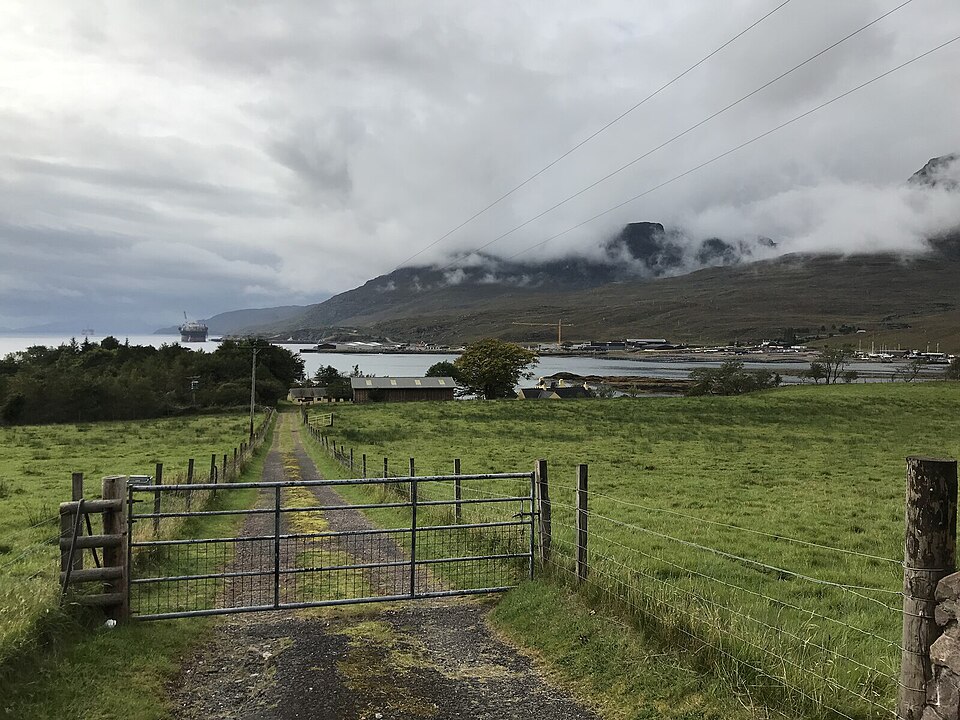
In 1975, workers began removing 1.8 million tonnes of Torridonian sandstone from a Highland mountainside to create a construction yard capable of building one of the largest objects Scotland had ever made. Half a century later, rock is being blasted at Kishorn again. A new £30 million procurement reveals the next stage of an expansion intended to turn infrastructure created for North Sea oil into a manufacturing base for floating offshore wind.
At Kishorn, on the eastern shore of a sea loch between Lochcarron and Applecross, approximately one million tonnes of rock have been blasted and moved during the past year. Part of the material has been used to create 8.5 hectares of new land beside a dry dock whose dimensions belong to an earlier period of Scottish industrial ambition.
The next stage has now entered the procurement system. Kishorn Port Limited is preparing to seek contractors for a new 150-metre quay on the reclaimed land, with water 12 metres deep at chart datum. The estimated construction value is £30 million. The works are expected to include a piled quay wall, mooring dolphins, rock anchors, walkways, lighting, services, surfacing and heavy rock protection.
The procurement notice, published on 28 August, describes the project in conventional engineering terms. Its location gives those works a different historical scale. Kishorn is not a new port being constructed to capture the offshore wind market. It is the remains of one of the most remarkable industrial experiments of the North Sea oil era, now being physically enlarged for a second energy economy.
A dry dock cut out of the Highlands
The Kishorn yard was developed by Howard Doris in the 1970s after the discovery of large North Sea oilfields created demand for offshore structures of unprecedented size. Work began on the north side of Loch Kishorn in 1975. The principal commission was the Ninian Central Platform, ordered for Chevron’s Ninian field east of Shetland.
The geography of Kishorn made possible something that would have been extremely difficult at an ordinary industrial site. The loch provided deep, relatively sheltered water. The surrounding rock supplied construction material. A vast dry dock could be excavated immediately beside the sea and used to form the base of an offshore platform before the structure was floated into deeper water for completion.
The original excavation removed around 1.8 million tonnes of Torridonian sandstone. The dry dock created within it had a working diameter of approximately 160 metres. At the height of the Ninian project, more than 3,000 people were employed at Kishorn. The workforce became known locally as the Kishorn Commandos, and accommodation included two former passenger ships brought to the loch.
The concrete base constructed there was itself an extraordinary piece of engineering. Its base was around 140 metres in diameter and weighed approximately 157,000 tonnes when it was floated out of the dry dock in September 1976. Construction continued in the deeper waters of Loch Kishorn until the completed platform reached about 156 metres in height.
The finished Ninian Central structure weighed more than 600,000 tonnes. In 1978 it was towed from the west Highlands around the north of Scotland and into the North Sea by eight tugs, a journey that took eleven and a half days. The platform was installed in water around 136 metres deep.
Kishorn Port describes it as one of the largest man-made moveable objects ever constructed. The platform remains offshore today.
The boom did not last
Kishorn’s first industrial life was comparatively short. Howard Doris operated the yard from 1975 until 1987. The North Sea construction market changed, oil-industry investment contracted and the enormous workforce assembled around individual platform projects could not be sustained indefinitely.
The yard diversified into other construction work before financial difficulties brought the original operation to an end. Much of the site was subsequently cleared. The infrastructure left behind included something that could not easily be reproduced elsewhere: an enormous dry dock opening directly into a deep Highland sea loch.
It returned to use in 1992 for construction of concrete caissons for the Skye Bridge. Later plans increasingly looked towards renewable energy. In 2013 the site obtained licensing as a renewable-energy construction facility.
Kishorn Port Limited had been established several years earlier as a joint venture between two Scottish businesses, Ferguson Transport and Leiths. The company remains owned equally by them. Ferguson brought port operations, shipping and heavy transport experience; Leiths brought quarrying, concrete and construction-material capability.
The combination has particular relevance to the next proposed use of the site. Kishorn has an operational quarry immediately beside one of Europe’s largest dry docks. Concrete floating wind foundations require very large quantities of material and enormous areas in which structures can be manufactured, stored, assembled and moved into water.
The dry dock has already returned to heavy industry
Kishorn’s revival did not begin with offshore wind. During the past decade the site has increasingly returned to work connected with oil, gas and marine engineering.
The dry dock has been used for vessel recycling and maintenance. The Voyageur Spirit floating production, storage and offloading vessel was brought to Kishorn for preservation work. The Northern Producer semi-submersible drilling rig has used the anchorage. In 2023 the Noble Intrepid, one of the world’s largest jack-up drilling rigs, entered the dry dock for inspection, maintenance and repair.
The existing dock is now described by the port as 260 metres long and 160 metres wide, with a gate opening of 166 metres and water depth of 13.8 metres at mean high water springs. Its scale allows structures that cannot enter most conventional harbours to be brought inside.
The expansion now under way increases both the dimensions of the dock and the amount of usable industrial land surrounding it.
Phase 1a is a £42.2 million project involving dry-dock expansion and reclamation. Highlands and Islands Enterprise agreed £24.259 million of public investment in June 2025. The Scottish Government places the investment within its commitment of up to £500 million over five years for Scottish ports and the offshore-wind supply chain.
The public funding is substantial because the economic proposition is larger than the port itself. Once fully developed, Highlands and Islands Enterprise estimates that projects attracted to the expanded facility could support as many as 1,500 jobs.
The new quay changes what Kishorn can do
The £30 million East Quay now being prepared for tender belongs to the next stage of that development. The 150-metre structure will sit against the land created from the current reclamation works. A depth of 12 metres below chart datum will allow large vessels and floating structures to berth alongside the new industrial area.
The engineering specification indicates the loads for which the site is being prepared. Sheet and combined piles will form the quay structure. Mooring dolphins will be anchored into rock. Heavy rock armour will protect the works. The reclaimed area behind the quay will provide working and laydown space rather than conventional waterfront development.
For offshore wind, land immediately beside deep water is an industrial resource. Turbine components and floating foundations are too large to move easily by road. Some structures are assembled at the waterfront and transferred directly into the sea. Others arrive or depart on specialised vessels. Large areas are required simply to store components while projects wait for installation windows.
Kishorn’s existing dry dock adds another capability. Concrete floating foundations can potentially be constructed inside the dock and floated when sufficiently complete, reproducing in a different form the method used to build the Ninian platform half a century earlier.
Floating wind requires ports of a different scale
Scotland’s offshore wind plans are creating an industrial requirement that did not exist when most Scottish ports were designed. Fixed-bottom turbines can be installed in shallower water using foundations attached directly to the seabed. Much of Scotland’s deeper offshore resource will require floating technology, in which the turbine stands on a buoyant structure moored to the seabed.
The resulting structures are enormous. Their dimensions and weight create requirements for deep water, heavy-load quays, extensive laydown areas, assembly facilities and sheltered locations where floating units can be completed before being towed offshore.
The Scottish Government reset its offshore-wind ambition in January 2026 to as much as 40 gigawatts of new capacity by 2040. The seabed options already awarded through ScotWind and other leasing rounds have produced a development pipeline far larger than the present Scottish port and manufacturing base was built to accommodate.
The economic value of that pipeline depends partly upon where its physical components are made.
The latest Supply Chain Development Statements from 16 ScotWind projects project £25.5 billion of expenditure in Scotland across development, manufacturing, installation and operation. The distribution of that spending is uneven. Scottish Government figures published in August show that Scotland currently accounts for 62 per cent of projected development commitments and 70 per cent of operations commitments, but only 20 per cent of manufacturing and fabrication.
Ports such as Kishorn are being expanded within that gap.
Scotland has offshore wind but does not automatically have an offshore wind industry
Generating electricity in Scottish waters and manufacturing the equipment used to generate it has shaped the economic debate around offshore wind from the beginning. A wind farm can be located off Scotland while its turbines, towers, foundations, cables and specialist vessels are produced elsewhere.
The oil industry followed a related pattern. Scotland captured substantial engineering, fabrication and service activity from the North Sea, but not every stage of the supply chain remained domestic. Kishorn itself demonstrates both the scale that Scottish fabrication once achieved and the vulnerability of industrial sites dependent upon cycles of major projects.
The current port strategy attempts to create facilities before the largest offshore-wind construction programmes begin. Public money is being used to reduce the initial infrastructure cost so Scottish sites are capable of competing when developers place manufacturing and assembly contracts.
Kishorn is one of several ports pursuing that work. Nigg, Ardersier, Cromarty Firth, Aberdeen, Dundee, Leith, Stornoway and other locations are developing different combinations of manufacturing, marshalling, assembly and maintenance capability.
They are not interchangeable. Water depth, quay strength, available land, road access, local industry, grid connections and distance from offshore projects determine what each site can realistically perform.
Kishorn’s particular advantage is scale beside sheltered deep water. Its weakness is the same geography that made the original yard extraordinary: it is a remote west-coast industrial site connected to the rest of Scotland by infrastructure never designed around a large manufacturing centre.
The new industrial geography may not resemble the old one
During the Ninian project, Kishorn overcame remoteness by moving extraordinary quantities of people and material by sea. The construction camp functioned almost as a temporary industrial settlement. The modern development is unlikely to reproduce the 1970s workforce model.
Automation, modular manufacturing, modern employment patterns and improved transport have changed how large engineering projects are delivered. Offshore wind also requires continuity if permanent industrial employment is to replace temporary construction peaks.
The forecast of up to 1,500 jobs depends upon projects being attracted to the expanded facilities once they exist. Public investment creates capability; it does not create an order book.
The timing of the quay procurement therefore sits between two decisions. Scotland has decided to help build the infrastructure. Offshore-wind developers will later decide where to place the contracts that use it.
The latest ScotWind supply-chain figures show why those decisions will determine the economic outcome. Scotland’s projected share of manufacturing and fabrication expenditure remains substantially below its projected share of development and operations expenditure.
The same rock is being moved for a second energy age
Kishorn’s redevelopment has an unusual physical continuity with its past. The first energy boom required a mountainside to be excavated to create the dry dock. The current expansion is again removing rock, but this time the material has also been used to create new industrial land from the loch.
Approximately one million tonnes have been blasted and moved during the latest works. Eight and a half hectares have emerged beside the dock. The next £30 million phase will turn part of that new shoreline into a deep-water working quay.
The original yard was constructed to make a single extraordinary object for an oilfield east of Shetland. What remains of it is now being redesigned around an industry that may require repeated construction of very large floating structures for decades.
Few pieces of Scottish infrastructure have crossed the energy transition so literally. The dry dock that helped put a 600,000-tonne oil platform into the North Sea is being enlarged so that Scotland can compete to manufacture the structures of the industry intended to follow it.
Sources
Kishorn East Reclamation and Dry Dock Enlargement – Phase 1B East Quay
Public Contracts Scotland — 28 August 2026
https://www.publiccontractsscotland.gov.uk/search/show/search_view.aspx?ID=AUG563281
Dry Dock Facilities
Kishorn Port — accessed September 2026
https://kishornport.co.uk/facilities/dry-dock/
History of Kishorn Port & Dry Dock
Kishorn Port — accessed September 2026
https://kishornport.co.uk/about/history/
Ninian Central
Kishorn Port — accessed September 2026
https://kishornport.co.uk/ninian-central/
Multi-million Pound Investment Announced for Kishorn Port
Highlands and Islands Enterprise — 4 June 2025
https://www.hie.co.uk/news-and-blogs/news/2025/june/04/multi-million-pound-investment-announced-for-kishorn-port/
Kickstarting Economic Transformation
Scottish Government — 4 June 2025
https://www.gov.scot/news/kickstarting-economic-transformation/
Infrastructure Delivery Pipeline 2026
Scottish Government — 2026
https://www.gov.scot/publications/infrastructure-delivery-pipeline-2026/
ScotWind Developers Set Out Latest Multi-billion-pound Supply Chain Commitments
Offshore Wind Scotland — 15 July 2026
https://www.offshorewindscotland.org.uk/news/2026/july/15/scotwind-developers-set-out-latest-multi-billion-pound-supply-chain-commitments/
Supply Chain Information
Crown Estate Scotland — updated July 2026
https://www.crownestatescotland.com/supply-chain-information
Offshore Wind
Scottish Government — accessed September 2026
https://www.gov.scot/policies/renewable-and-low-carbon-energy/offshore-wind/